

readwithpride.com
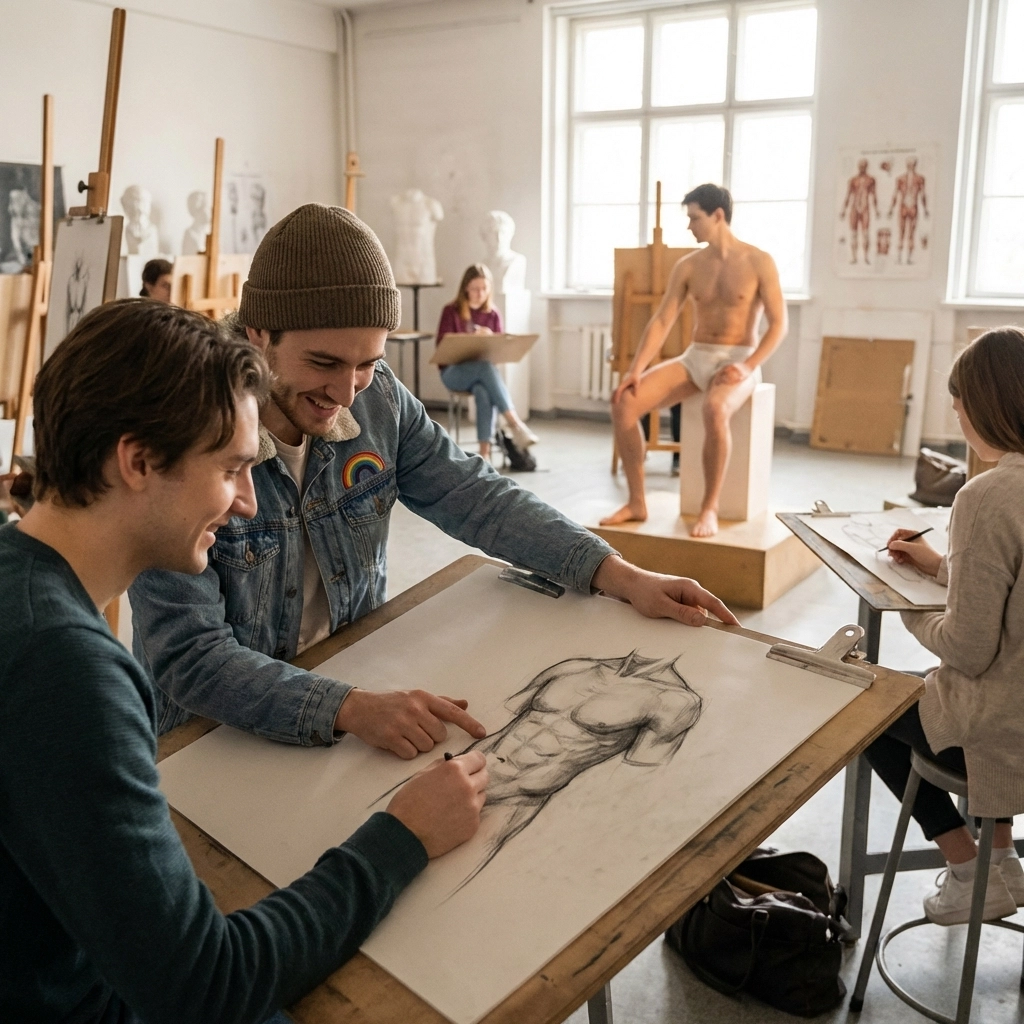
There is a specific kind of silence that exists only in a university art studio. It’s heavy, punctuated only by the rhythmic scritch-scratch of charcoal on paper and the occasional deep breath from a room full of students trying to capture the human soul in graphite. At the center of it all is the model: the male nude.
For many of us in the queer community, the study of the male body isn't just an academic exercise; it’s a reckoning with identity, desire, and history. Whether you're a student squinting at the curve of a latissimus dorsi or a reader diving into a spicy MM romance that features a brooding artist, the male nude remains one of the most powerful symbols in our culture.
Today at Read with Pride, we’re stepping into the studio to explore how university art departments handle the male nude and why queer representation in these hallowed halls is more important than ever in 2026.
A Legacy of "The Ideal"
Let’s get a little bit historical, but keep it cute. Since the 17th century, the male nude has been the MVP of academic art training. Back then, if you wanted to be a serious artist, you had to master the male form first. Why? Because the "founding fathers" of art history: guys like Winckelmann: decided that the male body was the "universal" representation of humanity. They saw it as structurally superior and aesthetically "ideal."
In these early academies, the goal wasn't necessarily to draw the person standing in front of you. It was to draw a version of them that looked like a Greek god. It was all about symmetry, musculature, and a very specific, sanitized version of masculinity. For centuries, the queer gaze was there, but it was hidden behind the mask of "Classicism." Artists were looking at these men with intense passion, but they had to call it "study."

The University Shift: From Statue to Human
Fast forward to the modern university setting. The vibe has shifted from recreating Hercules to understanding the raw, lived-in reality of the male body. In art departments today, the focus is on "Artistic Anatomy." This isn't just about drawing muscles; it's about understanding how a body moves, how skin folds, and how light hits a form that isn't "perfect" by ancient standards.
University programs have become a sanctuary for body positivity and diverse representation. We’re seeing a move away from the "Adonis" archetype toward bodies that reflect the actual LGBTQ+ community. This means seeing trans men, bears, disabled bodies, and older men on the modeling pedestal.
This inclusivity is vital. When a queer art student sees a body that looks like theirs: or like the people they love: being treated as a subject of high art, it changes the game. It validates our existence in a space that used to only value us if we looked like marble statues. If you’re looking for stories that capture this creative tension, check out The Canvas and the Closet for a deep dive into the artist’s perspective.
The Artist/Model Trope: Why We Love It
At Read with Pride, we know a good trope when we see one. The "Artist and the Model" is a staple in MM romance books and gay fiction for a reason. There is an inherent vulnerability in the act of being seen.
In a university setting, the relationship between the student and the nude model is professional, yet strangely intimate. You are staring at a stranger’s naked body for hours, noticing the tiniest details: the way a vein pops in their hand, the scar on their hip, the rhythm of their breathing.
In gay novels, this setup often leads to a "slow burn" or "forced proximity" romance. Think about it:
- The brooding, talented art student who can't stop sketching the model after class.
- The "starving artist" who takes a modeling gig to pay the bills and finds a connection they didn't expect.
- The professor who finds inspiration in a student’s raw, unapologetic queer art.
It’s the ultimate study of the "Queer Gaze." Unlike the traditional "Male Gaze," which often objectifies, the Queer Gaze in art (and in gay love stories) is about recognition. It’s about saying, "I see you, and I understand the weight of your skin."

Museums, Exhibitions, and the "Naked" Truth
What happens to all that university work? Much of it ends up in exhibitions or galleries, and that’s where things get political. Even in 2026, the sight of a naked gay body in a public museum can still ruffle feathers.
But exhibitions focused on the male nude are essential for reclaiming our narrative. When we see "naked art" in a museum that isn't just a headless torso from the 2nd century, it forces the viewer to acknowledge the personhood of the subject.
Contemporary exhibitions are now using photography and mixed media to challenge the "gaze." They aren't just showing us a body; they’re showing us a story. This is why LGBTQ+ fiction and visual art go hand-in-hand. Both mediums are trying to do the same thing: document our lives with authenticity and pride.
The Importance of Queer Representation in Training
Why does it matter if a university art department is "queer-friendly"? Because art school is where many young LGBTQ+ people first find their voice. If the curriculum only teaches the "Classical" (read: straight, white, cis) male nude, it sends a message that queer bodies aren't "fine art."
By incorporating diverse male models and discussing queer art history: like the works of Tom of Finland, Robert Mapplethorpe, or Keith Haring: universities prepare students to enter the world of gay literature and professional art with a full toolkit.

Academic training today also involves a lot of "rigorous scientific study." Students might use chronophotography (decomposing movement) to see how a body actually functions. This technical skill is what allows an artist to create a cover for a MM romance that feels real and evocative, rather than stiff and cartoonish.
Finding Inspiration in Gay Fiction
If you’re inspired by the intersection of art and the male form, there are so many popular gay books that explore these themes. From gay historical romance set in the studios of 19th-century Paris to gay contemporary romance set in the heart of the modern NYC art scene, the "Artistic Anatomy" of our lives is being written every day.
We’re seeing a surge in new gay releases in 2026 that tackle the complexity of the body. Whether it's a gay psychological thriller involving a stolen masterpiece or a heartfelt gay fiction piece about an aging artist finding his muse, the male nude remains the centerpiece of the conversation.
Conclusion: Read with Pride, Draw with Pride
The study of the male nude in universities is more than just a class requirement; it’s a continuation of a centuries-old conversation about what it means to be human. For the LGBTQ+ community, it’s a chance to reclaim the "ideal" and redefine beauty on our own terms.
Next time you’re browsing for top LGBTQ+ books or looking at a piece of art in a gallery, remember the vulnerability and the strength required to stand: or sit: unclothed in the center of the room. It’s an act of bravery, and it’s the foundation of so much of the queer fiction we love.
Want to explore more stories that celebrate the male form and queer identity? Dive into our latest collection of MM romance books and gay eBooks at Read with Pride. Whether you’re into steamy MM romance or award-winning gay fiction, we’ve got something that will capture your imagination.

Stay connected with us for the latest in queer art and literature:
- Follow us on Facebook: Read with Pride Facebook
- Catch us on X: Read_With_Pride
- See the beauty on Instagram: @read.withpride
#LGBTQArt #MaleNude #ArtHistory #MMRomance #ReadWithPride #GayFiction #QueerRepresentation #ArtStudio #GayBooks2026 #MaleForm #ArtisticAnatomy #QueerGaze

Leave a Reply
You must be logged in to post a comment.