readwithpride.com
Growing up queer in a small town is a specific kind of character-building exercise. Not the cute “I learned resilience” version you put on a CV: more like the daily mental maths of Who’s in the shop today?, Will my aunt’s friend be at Mass?, and If I wear this hoodie, will it start a conversation I can’t survive?
Rural Ireland and the UK are full of warmth and community… and also the occasional intense curiosity about your personal life. The joke is everyone knows everyone, but the truth is everyone knows one version of everyone: and if you don’t match the version they’ve already agreed on, things can get weird fast.
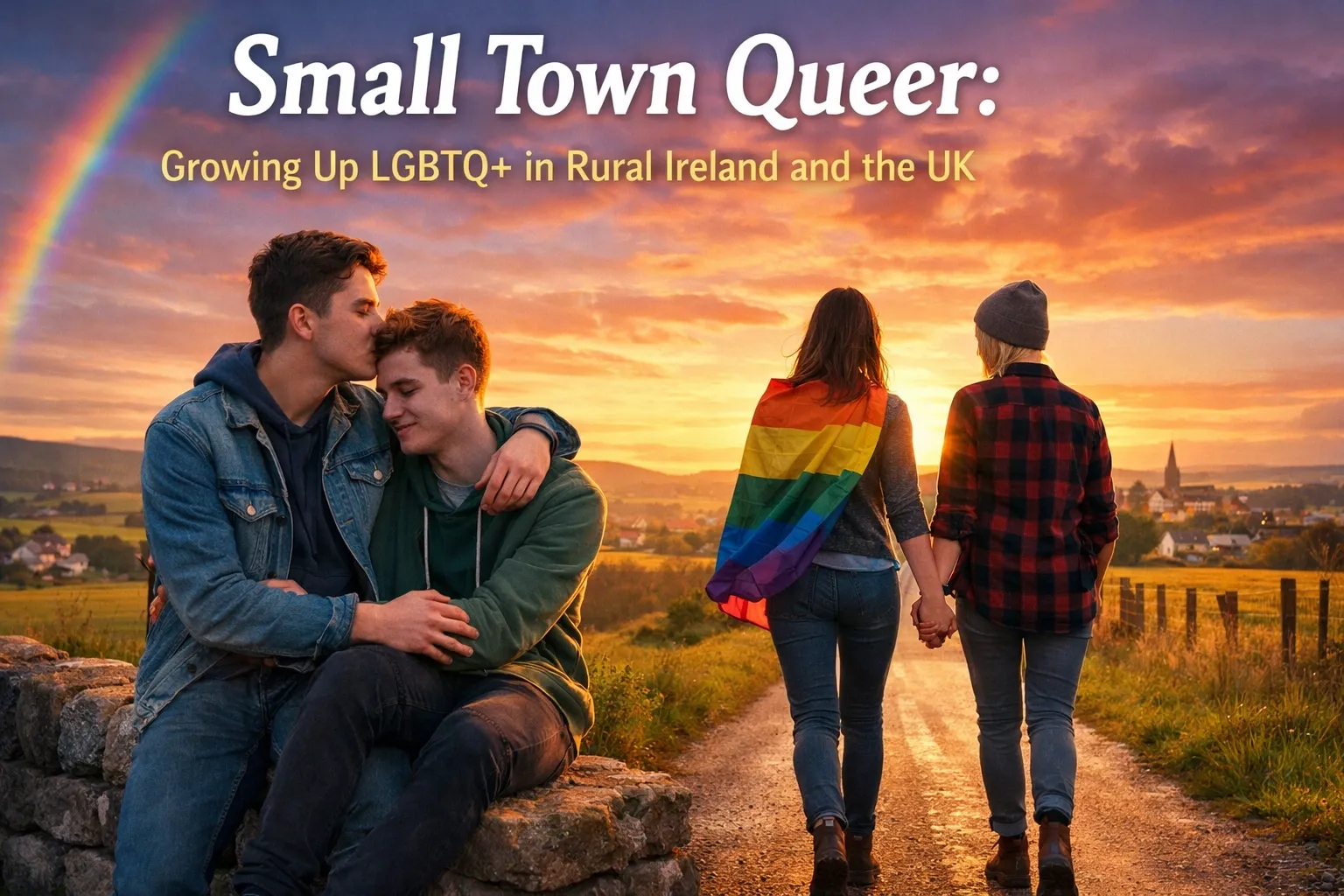
This is a love letter to small-town queer life then and now: the hidden bits of history, the messy middle of growing up, and the quiet joy of finding your people (even if “your people” starts as one friend who doesn’t flinch when you say the word bisexual out loud). And because we’re Read with Pride, we’re also talking about the part books play: especially MM romance books and the kind of quiet intimacy M/M romance novels that felt like oxygen when real life was a little too loud.
The small-town rulebook (written in invisible ink)
In cities, anonymity is default. In villages, privacy is… a rumour.
In rural Ireland and many parts of the UK (think: the Scottish Highlands, Welsh valleys, coastal Cornwall, small-market towns in the Midlands, pockets of the North), queer kids often grow up with the same unspoken rules:
- Don’t stand out (unless it’s for sports, exams, or being “so helpful” your grandmother can brag about it).
- Don’t confirm anything (especially not to someone who “just asked because they care,” while actively reporting back to their sister-in-law).
- Don’t be the first (the first to come out, the first to bring a partner to the pub, the first to say “my boyfriend” without turning into a human tomato).
Even when people aren’t openly hostile, there’s still that cultural silence: where queerness exists as a punchline, a scandal, or something that happens “somewhere else.” Research and first-person accounts from rural Ireland describe that feeling of invisibility: homosexuality referenced mainly as an insult, not as an identity you could grow into with dignity. The result is the classic teenage spiral: If no one says it, maybe it’s not allowed. If it’s not allowed, maybe I’m wrong.
That silence shaped a whole generation. And honestly? It still pops up, just wearing a nicer cardigan.
A quick history of “We were always here” (even if nobody wrote it down)
Queer life in rural Ireland and the UK didn’t begin with Pride flags in shop windows. It existed in side glances, coded language, and friendships that were “very close.” It also existed in the harsh reality of laws, church influence, policing, and social punishment.
Some key context (without turning this into a lecture):
- Ireland: Male homosexuality was criminalised until 1993. That’s not ancient history; that’s “your uncle definitely remembers it” history.
- The UK: Partial decriminalisation in England and Wales was 1967, Scotland 1980, Northern Ireland 1982. “Legal” didn’t mean “safe,” and rural spaces often took longer to socially shift.
- 2015 Ireland marriage referendum: A huge moment of joy nationally: yet rural areas were complicated. Roscommon–South Leitrim being the only constituency to vote “No” hit local LGBTQ+ people hard, and it highlighted how legal change doesn’t always translate to immediate cultural change.
When you grow up in a small place, history doesn’t feel like a timeline. It feels like inherited tension. Like everyone is acting normal, but you can sense where the past is still lodged under the floorboards.
“Am I gay or am I just… bored?”: the bisexual awakening in the countryside
If you’re looking for a neat coming-out arc, rural life laughs politely and changes the subject.
A lot of us had a bisexual awakening that looked less like a cinematic moment and more like:
- suddenly caring a lot about the new lad on the GAA team / rugby squad,
- replaying a random scene from a TV show because “the chemistry was interesting,”
- feeling jealous when your best friend got a girlfriend (and telling yourself it was “protectiveness”),
- learning the word “bisexual” and feeling both relieved and terrified.
In small towns, bisexuality can be especially awkward because people want you to “pick a side.” If you date someone of another gender, you get told it was a phase. If you date someone of the same gender, you get told you were “lying before.” Meanwhile you’re standing there like: No babes, I was just trying to survive maths class and the emotional weight of my own face.
This is where books quietly save people. Because on the page, you don’t have to justify yourself. You can just exist.
And for some readers, the first “oh” moment didn’t come from a school talk or a supportive youth group. It came from reading gay romance novels in secret: especially MM romance for adults with that low-key, quiet intimacy that mirrors real rural longing: hands brushing in the dark, a look that lasts half a second too long, the tension of wanting what you’re not supposed to want.
Rural Ireland: community, church, and the long echo of “what would people say?”
Ireland’s rural queer experience is often shaped by a unique triangle:
- Community closeness (the good kind: neighbours who’ll mind your dog and feed you for no reason)
- Community surveillance (the other kind: “I saw you walking with a fella, is he your cousin?”)
- Church influence (varies massively by place and generation, but it’s part of the cultural weather)
A lot has improved, especially for younger people. Some rural accounts post-2015 describe surprisingly supportive local responses, with minimal backlash after coming out: plus the very real downside of limited dating options (because the queer pool is small and sometimes contains your ex’s cousin).
But access is still a thing. In cities, you can find LGBTQ+ spaces and services more easily: community centres, affirming counsellors, clinics that don’t make you explain your identity like it’s a new app. In rural areas, support can mean a long bus ride, a long wait, or doing the emotional labour of educating the professional who’s supposed to help you.
There are bright spots too: rural queer festivals and gatherings that make space for people who don’t want to choose between “rural” and “queer.” That matters: because a lot of folks genuinely love where they’re from. They just want to be loved back, openly.
Rural UK: different countries, different vibes (same tiny-town pressure)
“Rural UK” isn’t one place: it’s four countries and a thousand micro-cultures.
- Scotland: Some small communities are deeply “live and let live,” but isolation is real. Weather doesn’t help. Neither does being the only queer person you know for 30 miles.
- Wales: Strong community ties can be protective, but also intense. Language and tradition can add another layer: belonging is powerful, but it can also feel conditional.
- England: Rural England ranges from progressive pockets to places where “diversity” means they got a second coffee shop. In small-market towns, gossip is practically a sport.
- Northern Ireland: For many, the tension between tradition, politics, and religion has added extra weight historically: especially outside Belfast.
Across all of it, the theme is familiar: fewer visible role models, fewer dedicated spaces, and more reliance on the internet (which can be lifesaving and also… chaotic).
The secret geography of queer small towns (aka: where we actually felt safe)
If you grew up rural, you probably remember your “safe map”: places that felt neutral, private, or just far enough from judgement.
Common ones:
- the library (quiet, warm, and nobody questions why you’re there)
- the woods / fields / beach (nature: free therapy, occasionally dramatic)
- a mate’s car parked somewhere random (the classic rural living room)
- the one café run by someone who “doesn’t care” (meaning: they do care, but in a nice way)
- online spaces where your name wasn’t attached to your postcode
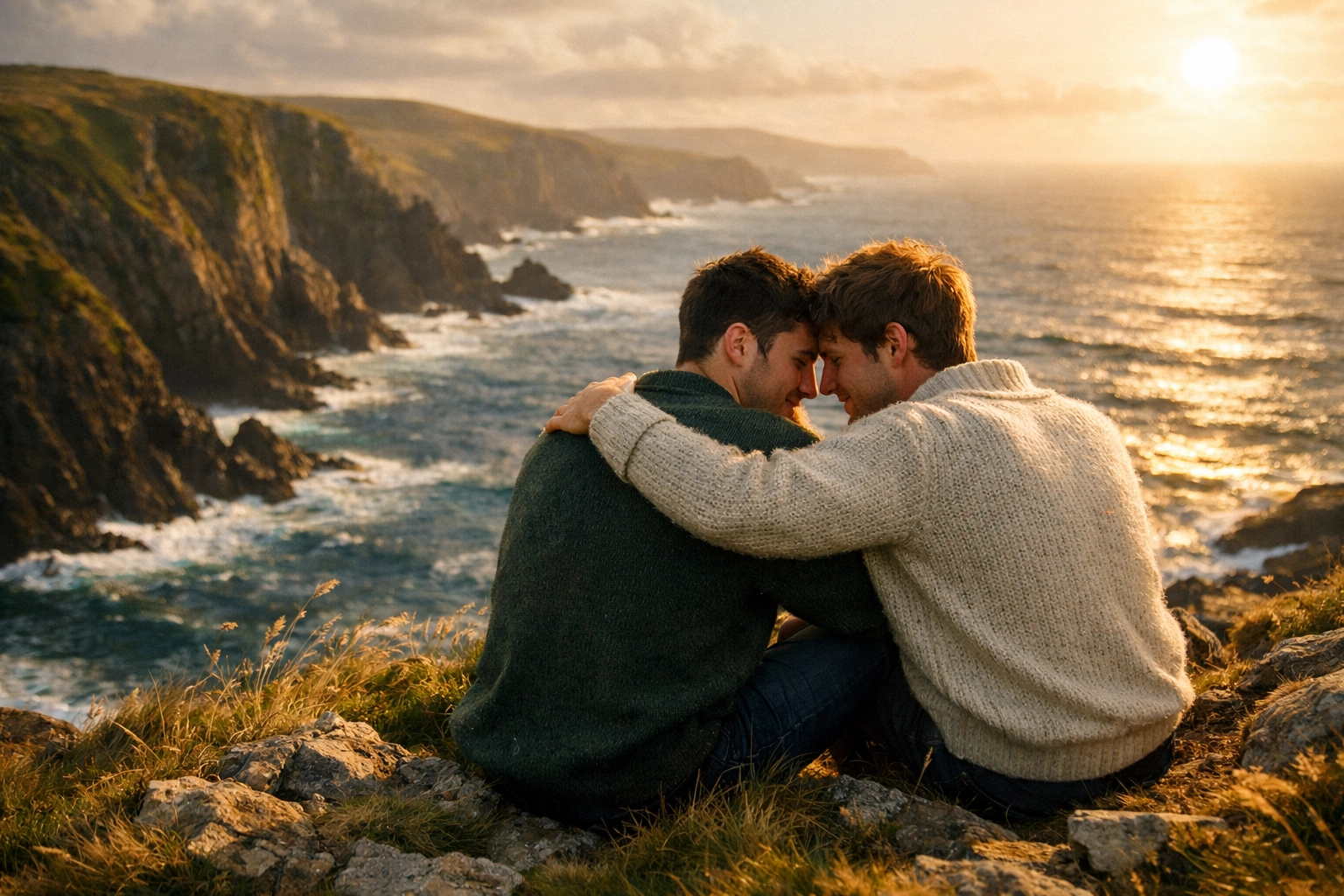
This is also why quiet intimacy MM romance novels hit so hard. They mirror the way rural queer affection often starts: not with fireworks, but with safety. With time. With small gestures that mean everything.
Dating, in a place where everyone knows your history
Small-town dating is basically high-stakes archaeology.
Your options can feel like:
- your best friend’s ex,
- someone who moved back from the city and is “not looking for anything serious,”
- a bloke you matched with who turns out to be your cousin’s coworker (instant delete),
- or long-distance, which is romantic until you’re on the third bus connection wondering why love requires so much scheduling.
And because visibility is lower, the early stages of queer dating often involve reading signals like it’s a full-time job. Is he flirting or just being polite? Is “sure we’ll see” a soft yes or a hard no? Is that a Pride pin or did he just like the rainbow because it matches his jacket?
This is where the fantasy of MM contemporary romance: or the comfort of familiar tropes: can feel genuinely grounding. Tropes give you a map when real life doesn’t.
The tropes that hit different when you’re from a small place
Certain MM romance tropes land harder when you grew up rural, because they feel… accurate. Not in a cheesy way. In a “wow, someone gets it” way.
Forced proximity (MM romance)
In small towns, you can’t avoid people. You’ll see them in the shop, at the match, at the petrol station, and somehow also in the next village. That’s basically forced proximity with a side of awkward eye contact.
Slow burn (MM romance books)
Slow burn isn’t just a trope; it’s a survival tactic when coming out feels risky. Rural queer love often grows in increments: trust first, attraction second, honesty last.
Friends to lovers / best mate’s brother
When your circle is small, friendships are intense. The lines blur. Emotions get messy. It’s basically a trope factory.
Second chance romance
So many people leave. Some come back. And suddenly you’re both older, braver, and slightly traumatised by your hometown: but also weirdly fond of it.
If you’re collecting reads for 2026, keep an eye out for trope-led lists and niche recs on Read with Pride (and yes, we’re always building more): readwithpride.com
What’s changed “now” (and what hasn’t)
Better now:
- More language for identity (kids today have words we didn’t)
- More visible queer people in media and sport
- More online community (which matters massively when you’re isolated)
- More parents willing to learn (even if they start from “I don’t get it, but I love you”)
Still complicated:
- Being out in a place where your family is known
- Lack of local LGBTQ+ services in rural areas
- Limited dating pool
- The “don’t make a fuss” culture (which can be weaponised against queer joy)
A big shift is that more people are claiming rural life as a valid queer life: not just a place to escape from. You can love the land, love your community, and still want to kiss your boyfriend outside the pub without it becoming the main topic of the parish newsletter.
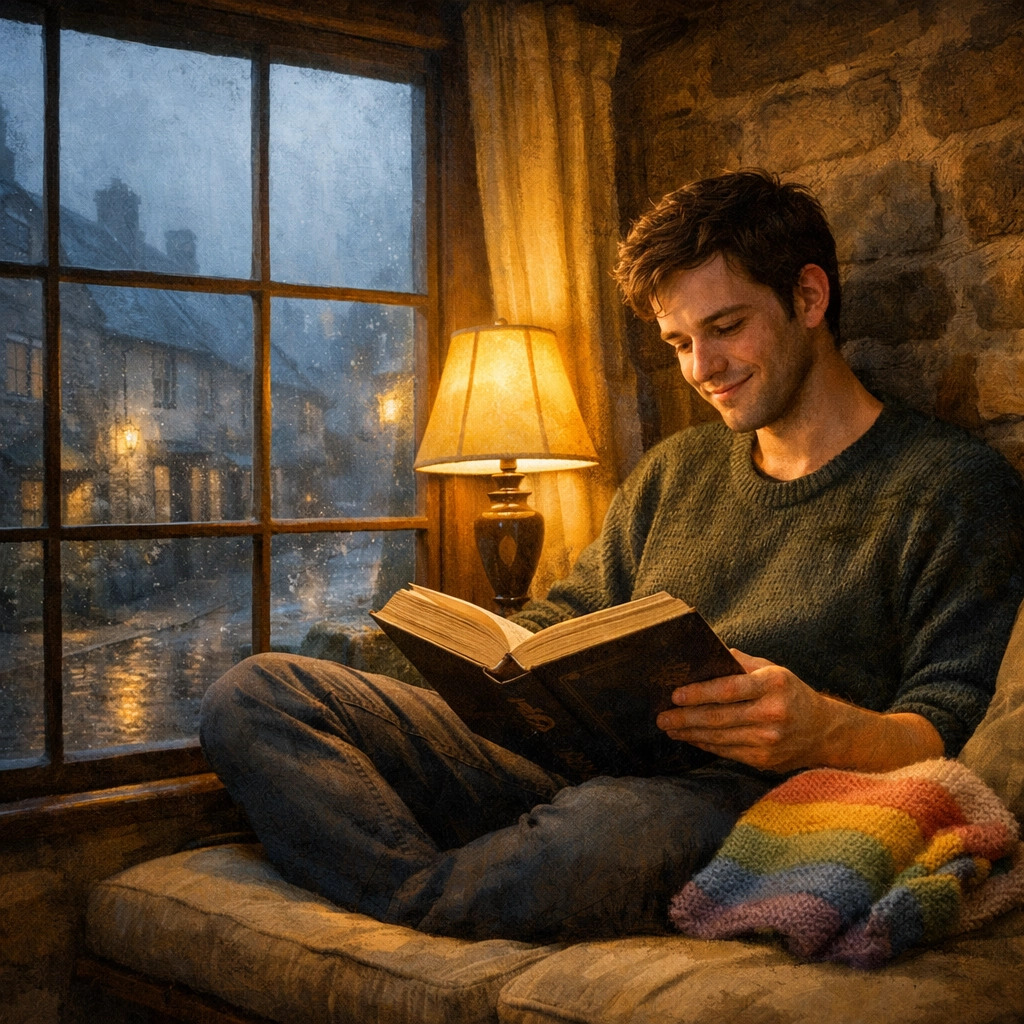
When books become community (and your first Pride flag is a bookmark)
For a lot of rural LGBTQ+ people, reading wasn’t just entertainment. It was proof of concept.
Books gave us:
- a private space to explore attraction safely
- narratives where queer love wasn’t a tragedy every single time
- language for feelings we couldn’t say out loud
- a sense that we weren’t alone, even when it felt like we were
If you’re looking to stack your TBR with gay romance novels, MM romance books, and gay love stories that lean into tenderness, slow-burn chemistry, and that “small town but make it queer” vibe, start browsing here: readwithpride.com
And if you want to go deeper into categories (romance niches, tropes, formats like LGBTQ+ ebooks), our site maps make it easy to wander around without getting lost:
Practical survival tips (that aren’t cheesy, promise)
If you’re currently living the rural queer experience: whether you’re 16 and hiding your phone screen or 36 and still “not sure how to bring it up”: here are some small-town-tested realities:
- Find one safe person. One. That’s enough to start.
- Curate your internet. Follow queer creators who make you feel normal, not broken.
- Build “soft visibility.” A pin, a book, a playlist: whatever signals you without putting you at risk.
- Give yourself permission to want love. Even if your town acts like queer love is an imported product.
- Read stories that match your pace. If you want gentle, try quiet intimacy. If you want catharsis, try big emotions. If you want spice, absolutely go for it: this is your life.
Because sometimes “coming out” isn’t a single speech. Sometimes it’s a slow series of choices: telling one friend, then another, then letting yourself imagine a future that includes holding someone’s hand in daylight.
Follow Read with Pride (and keep your feed queer-friendly)
- Home: readwithpride.com
- X (Twitter): https://x.com/Read_With_Pride
- Instagram: https://www.instagram.com/read.withpride/
- Facebook: https://www.facebook.com/profile.php?id=61586883027069
Hashtags
#ReadWithPride #Readwithpride #MMRomanceBooks #GayRomanceNovels #SmallTownQueer #RuralLGBTQ #QueerIreland #QueerUK #LGBTQEbooks #MMContemporaryRomance #SlowBurnMMRomance #ForcedProximityMMRomance #QuietIntimacy #QueerFiction #GayRomanceBooks #BestMMRomanceBooksOf2026

Leave a Reply
You must be logged in to post a comment.