readwithpride.com
Bristol has always been that mate who shows up to the function wearing something slightly unhinged, somehow pulls it off, and then convinces everyone else to loosen up. It’s a city with an alternative heartbeat, artsy, political, stubbornly itself. So it makes perfect sense that Bristol Pride isn’t just a party in rainbow glitter; it’s part of a long, regional legacy of LGBTQ+ activism in the West of England, built by people who fought for visibility, safety, and joy when none of those things were guaranteed.
This is the story of how Bristol’s Pride evolved, from early community organising (when “out” could cost you your job, your housing, your family) to the modern-day march that fills the city centre with banners, chosen family, and “I can’t believe I’m crying at a drumline” feelings. And because we’re Read with Pride (hi), we’ll also talk about how queer stories, especially MM romance books, keep that legacy alive on the page, from history to happily-ever-after.
Bristol’s alternative spirit: why this city needed Pride
Bristol’s LGBTQ+ culture didn’t spring up overnight. The city’s long been shaped by students, artists, punks, activists, and communities who are good at building their own spaces when the mainstream says “no thanks.”
That “we’ll do it ourselves, then” energy matters. Pride doesn’t just happen because someone books a stage and orders wristbands. Pride happens because people organise: switchboards, support groups, safe meetups, legal funds, community magazines, and the kind of volunteer labour that rarely gets a parade float, but should.
In the West Country, distance from London also shaped queer life. Regional communities had to be resourceful. You couldn’t always rely on big-city infrastructure or national press to show up for you. Which is why Bristol’s early Pride roots are such a big deal: it wasn’t following a trend, it was building one.
1977: The Bristol Gay Festival, regional Pride before it was “Pride”
One of the most important early moments in Bristol’s LGBTQ+ timeline is the Bristol Gay Festival in 1977, widely recognised as one of the earliest queer regional events outside London.
It wasn’t just a social calendar highlight. It was organised as a fundraiser to support Gay News during a legal battle brought by morality campaigner Mary Whitehouse. In other words: the festival was community, culture, and political resistance bundled into one.
Events included social gatherings and film screenings hosted at venues like the Arnolfini and Bristol Arts Centre, spaces that weren’t simply “nice places to go,” but crucial gathering points when safe public visibility was rare.
And yes, it faced backlash. Conservative councillors and local clergy opposed follow-up events. But Labour and Liberal councillors refused to censor them, defending LGBTQ+ people’s right to use public facilities. That matters. Rights don’t expand by magic; they expand because people argue, organise, vote, protest, and refuse to be erased.
From Avon Pride to Pride West: the name changes that tell a bigger story
Bristol Pride’s evolution includes a few rebrands, but not the corporate kind. These shifts reflected changing local government boundaries, and the wider growth of LGBTQ+ organising in the region.
- After 1985: the event became Avon Pride, because Bristol sat within Avon County at the time.
- 1988: Avon Pride held its first march through Bristol city centre, drawing around 500 participants, a serious turnout for the era.
- Mid-1990s: when Avon was abolished, the celebration became Pride West (1994–2001).
Here’s the thing about those numbers and those names: it wasn’t just about geography. It was about reach. A regional Pride is a signal flare. It tells isolated people in smaller towns, villages, or conservative households: “You are not alone. There are more of us. Come find us.”
1995: a civic milestone, when Pride got a key to the city (basically)
In 1995, Pride West hit a major milestone: the Lord Mayor Joan Barbara McLaren opened the festivities, marking the first time a civic leader opened a Pride event in the UK (as documented in the research sources).
It’s hard to overstate how validating that is, especially for older LGBTQ+ folks who remember when the state wasn’t a neutral bystander, but an active threat. Symbolic support doesn’t fix everything, but it does change the social weather. It tells institutions, and the public, that queer people are part of the city’s story, not a footnote.
The Arnolfini and “safe spaces” that weren’t just vibes
We talk about “safe spaces” now like it’s a trendy label, but in the 70s, 80s, and 90s, safe space often meant the difference between community and complete isolation.
The Arnolfini has a documented long-standing relationship with Bristol’s LGBTQ+ community dating back to the 1977 festival. Cultural venues like this didn’t just provide a room and a projector, they provided legitimacy, cover, and continuity. They were places where queer people could gather without the same level of surveillance or hostility found elsewhere.
And yes, legislation mattered too. The UK’s Section 28 (often referenced as Clause 28), which created a chilling effect around LGBTQ+ education and representation, cast a long shadow until its abolition in 2003. Institutions that kept space open, literally and culturally, helped people survive that era with their dignity intact.
2010: Pride Bristol returns, and the city gets its first parade
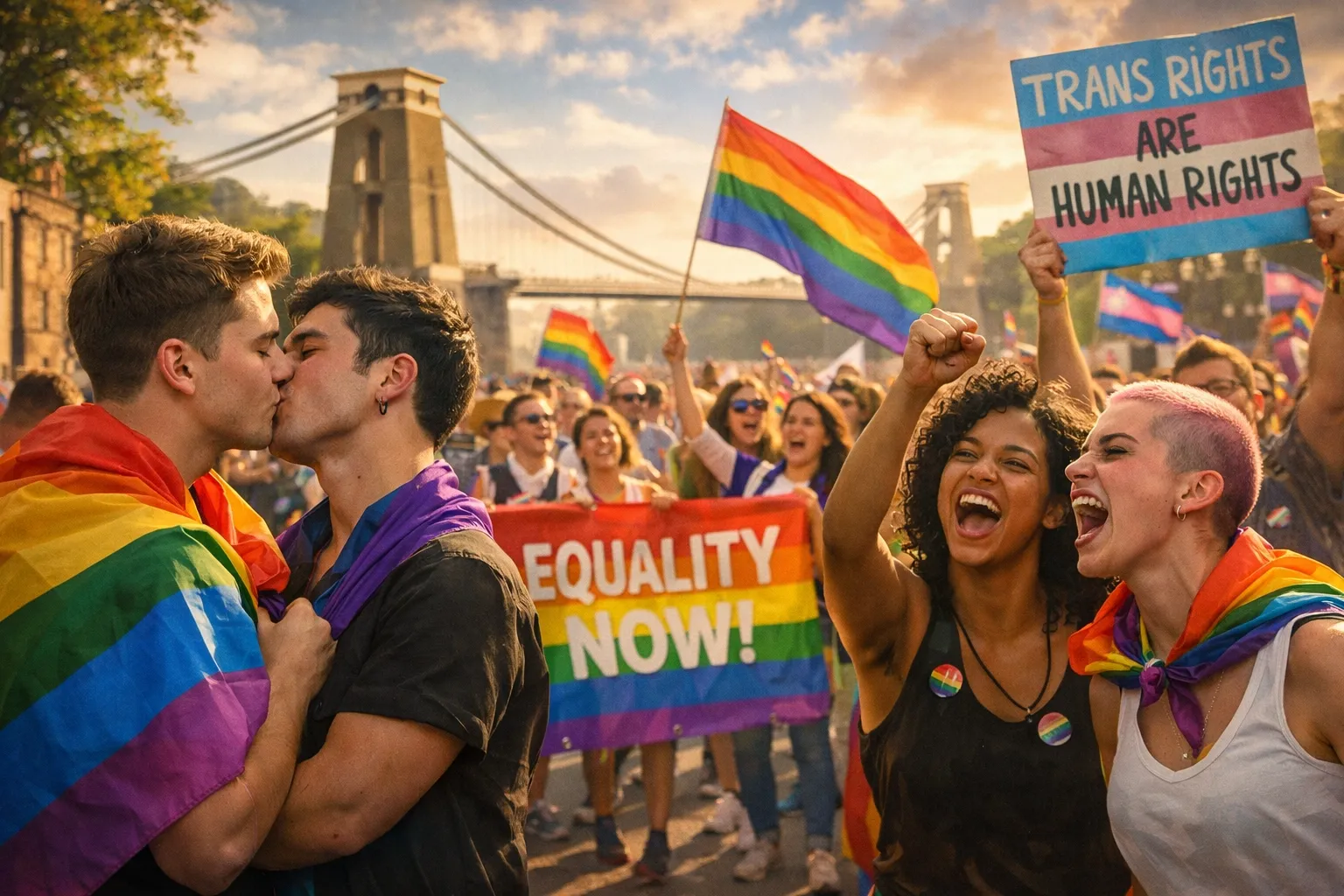
Modern Pride Bristol was resurrected in 2010, and it came back loud. That year included Bristol’s first-ever LGBT pride parade, reportedly drawing over 20,000 attendees.
That jump, from hundreds marching in the late 80s to tens of thousands showing up in 2010, didn’t happen because people suddenly became braver. It happened because activism worked. Because visibility built momentum. Because legal and cultural shifts (hard-won, often messy) made it possible for more people to step outside and say, “This is me.”
Today, Pride Bristol typically runs as a fortnight of events culminating in a march and Pride Day. It’s community workshops and nightlife, politics and pop, families and chosen families. It’s also a reminder: Pride isn’t just a celebration of how far we’ve come, it’s a checkpoint for what still needs doing.
Pride’s global roots (and why Bristol is part of that bigger lineage)
Bristol Pride exists in a global Pride movement rooted in the Stonewall Riots (June 28, 1969), an uprising against police raids, with leadership and visibility from trans women of colour including Marsha P. Johnson and Sylvia Rivera (as commonly cited in Pride histories).
That doesn’t mean every Pride event is identical. It means they’re connected by a shared logic: when institutions criminalise or shame you, you organise. You take up space. You protect each other. You build culture that refuses to be erased.
Bristol’s version of that includes its regional “we’ll handle it” grit, plus an arts-and-activism fusion that feels uniquely West Country.
Expanding Pride: Bristol’s Trans Pride and evolving community needs
Pride keeps changing because communities keep changing. In the 2010s, more specialised Pride events gained visibility, reflecting needs that weren’t always centred within mainstream LGBTQ+ celebrations.
Bristol held its first Trans Pride festival in 2016 (Trans Pride South West), and a Trans Pride march followed in 2019. That’s not “splitting the movement.” That’s the movement growing up and getting more precise about solidarity: listening to what people are saying, and making space accordingly.
Queer activism isn’t just marches: it’s stories, too
There’s a reason books keep showing up in activist spaces. Stories are portable. They travel quietly into bedrooms, backpacks, Kindles, and late-night “one more chapter” spirals.
When you read queer fiction, whether it’s literary, pulpy, historical, fantasy, or full-on “why is this so tender I’m unwell?” romance, you’re participating in cultural memory. You’re normalising queer love. You’re giving yourself (and others) a future.
At Read with Pride, we see it every day: readers looking for gay romance novels and MM romance books not only for escapism, but for recognition. Sometimes the most radical thing is a happy ending that doesn’t feel like a compromise.
If you want to explore more LGBTQ+ ebooks and queer fiction across genres, start here: readwithpride.com.
Trope time: why activism and romance tropes have the same emotional engine
Activism and romance tropes have something in common: both are obsessed with transformation.
Pride stories are “before and after” narratives, before visibility, after visibility; before community, after community. Romance tropes do that too, just with more banter and better kissing.
A few trope connections that hit especially hard in a city like Bristol:
- Found family: the backbone of queer survival, then and now.
- Second chances: for people, for cities, for communities that once turned their backs.
- Slow burn: because trust, like progress, rarely happens overnight.
- Forced proximity: you show up, you’re in it together, and suddenly you can’t pretend it’s not personal.
And yes, if you’re hunting for mm fake dating romance recommendations, you’re not alone. Fake dating is basically a comedic metaphor for “performing acceptable identity” until feelings (and truth) break through. Queer people? Performing identity? Never heard of it.
What to read when you want Bristol Pride energy (but in book form)
Bristol Pride energy is: bold, bright, a little chaotic, deeply caring under the sarcasm, and unapologetically public. If you want reading vibes that match, here are trope-and-tone directions to look for in MM romance books and LGBTQ+ ebooks:
1) Grumpy x sunshine (because joy is a form of protest)
There’s a reason “grumpy x sunshine” hits so well in queer romance. The grump is often carrying history: fear, shame, trauma, or just being tired of fighting. The sunshine character insists on joy anyway, not as denial but as defiance.
If you’re specifically searching for grumpy x sunshine mm romance ebooks, aim for:
- a guarded local who “doesn’t do Pride” (until he does),
- a chaotic optimist who volunteers for everything,
- a community setting where side characters become your new best friends.
2) Fake dating (because sometimes visibility starts as a performance)
Fake dating in MM romance can be pure comedy, but it can also be deeply queer: learning how to be seen, practising being “out” in low-stakes situations, then realising you don’t want to go back.
If you want mm fake dating romance recommendations, look for:
- “we need to look like a couple for the event” setups (hello Pride fundraiser),
- public moments that trigger real vulnerability,
- a shift from “pretend” to “choose.”
3) Activist-adjacent contemporary romance (because love stories don’t happen in a vacuum)
Try romances where characters are:
- organisers, volunteers, or artists,
- navigating community politics,
- rebuilding after setbacks,
- showing up for each other in public and private.
These are the kinds of gay romance novels that feel like the emotional afterglow of a march: tired feet, full heart, and a group chat that won’t stop pinging.
A quick, practical Pride-in-Bristol checklist (for locals, visitors, and the curious)
If you’re heading to Pride events (in Bristol or anywhere), a few community-care reminders never hurt:
- Plan your pace: Pride is a marathon disguised as a glitter sprint.
- Look out for accessibility info: routes, quiet spaces, step-free access, and welfare tents matter.
- Support local orgs year-round: Pride is a moment; community is the work.
- Respect boundaries: not everyone is “out,” not everyone wants photos, and no one owes you personal details.
- Buy queer books: seriously. Stories fund creators and keep culture alive.
For more LGBTQ+ reading and curated queer fiction, browse our catalog and blog hub through readwithpride.com.
Keeping the legacy alive: Bristol Pride as a living archive
Bristol Pride isn’t just a yearly date in the diary. It’s a living archive of the West’s LGBTQ+ history: the 1977 festival fundraiser, the battles over public space, the first marches, the first civic opening, the return in 2010, the growth into a full programme, and the rise of Trans Pride events that reflect a broader, more attentive community.
And honestly? The most Bristol thing about all of this is that the city never waited for permission to be itself.
If you want to keep that spirit going between Pride seasons, do what queer communities have always done: show up, share stories, pass the mic, donate when you can, and read something that makes you feel more you.
Follow Read with Pride for new queer reads, LGBTQ+ ebooks, and trope-led recommendations:
- Home: readwithpride.com
- Instagram: https://www.instagram.com/read.withpride/
- X: https://x.com/Read_With_Pride
- Facebook: https://www.facebook.com/profile.php?id=61586883027069
Hashtags
#BristolPride #PrideInTheWest #LGBTQHistory #QueerActivism #ReadWithPride #MMRomanceBooks #GayRomanceNovels #QueerFiction #LGBTQEbooks #GrumpySunshine #FakeDating #BestMMRomanceBooksOf2026

Leave a Reply
You must be logged in to post a comment.