

readwithpride.com
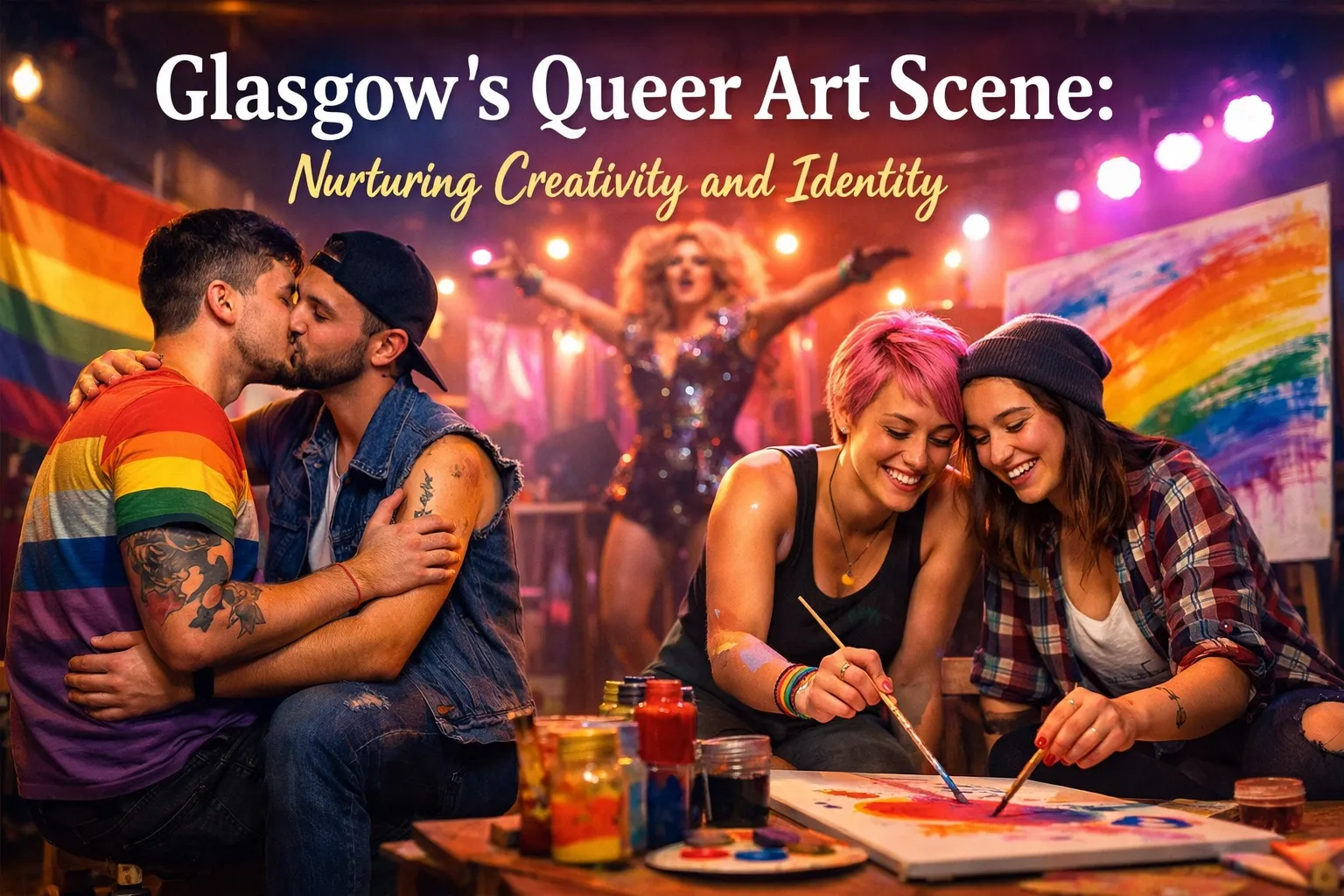
Glasgow has always been good at making something out of nothing: turning old industrial bones into galleries, turning rainy nights into stories, turning “outsider” energy into culture that feels loud, tender, and totally alive. And if you’re looking for where queer identity, art, and music collide in a way that’s both political and playful, Glasgow’s queer art scene is a masterclass.
This isn’t just about nightlife (though yes, the nightlife helps). It’s about the spaces where LGBTQ+ people make work, find each other, test ideas, fall in love, argue about aesthetics, and then go for chips. It’s about community-built platforms that keep creativity possible, especially when funding disappears, venues close, or the algorithm decides your art is “too much.”
Below is a tour of Glasgow’s queer creative ecosystem, past and present, with a side quest into how all this feeds the stories we love in queer fiction, including the tropes we can’t stop reading (and writing) at Read with Pride.
Before “queer arts scene” was a phrase: what Glasgow built (and what it lost)
Glasgow’s LGBTQ+ cultural life didn’t start on Instagram. Like most queer history, it’s been a mix of coded community, DIY survival, and the occasional burst of institutional recognition.
One huge chapter: Glasgay! Arts Festival (1993–2014). For years it was a big, bright annual “yes, we’re here” across arts disciplines, bringing performances, exhibitions, and community events under one banner. Its closure (funding issues, structural challenges, the usual heartbreak playlist) left a gap, but not a void. The ethos didn’t vanish; it scattered into newer initiatives, smaller nights, and more experimental formats.
That’s the thing with queer culture in Glasgow: it rarely disappears. It mutates. It finds a back room. It turns into a zine. It starts again somewhere cheaper.
The anchor platforms: festivals and institutions that keep queer work visible
Glasgow’s scene has a few pillars that do the unglamorous but essential work: programming, paying artists (when possible), offering training, and creating space for people who aren’t always welcomed elsewhere.
SQIFF: film as archive, protest, and love letter
Scotland Queer International Film Festival (SQIFF) has become a genuine anchor since 2015, showing queer films from Scotland and around the world while making the festival accessible with sliding-scale, pay-what-you-decide models. It’s not just screenings either: workshops, talks, networking, professional development. Translation: it helps queer filmmakers stay filmmakers.
And that matters. Because queer film isn’t just entertainment, it’s record-keeping. It captures the textures of our lives: chosen family dynamics, tense conversations with parents, first kisses outside a club at 2am, the grief we don’t always post about, the joy we absolutely should.
Queer Theory nights: where genre rules go to die (in the best way)
Queer Theory (running since 2016) blends music, performance art, spoken word, comedy, and drag, often leaning subversive, experimental, and proudly unpolished. It’s the kind of night that reminds you queer art doesn’t have to be “respectable” to be meaningful.
If you’re someone who loves queer fiction that plays with form (epistolary chapters, mixed media vibes, genre-bending romance arcs), Glasgow’s live performance culture will feel familiar: it’s messy, smart, and emotionally direct.
Venues that act like community centres (even when they’re “just a bar”)
In Glasgow, certain venues do more than host events. They become meeting points. They hold memories. They make creative work easier to access because you can actually show up.
Worker-owned, profit-sharing, and proudly queer: the co-op vibe
Spaces like Bonjour are part of what makes Glasgow feel different: they host drag, book launches, curated club nights, and community-led cabaret in a way that’s not just “a venue renting a room,” but a cultural hub with values.
Nights that spotlight queer Latinx energy, lesbian and trans-inclusive spaces, and POC-centred cabaret create more than entertainment, they create representation with a door policy that isn’t silently hostile.
Big stages with progressive programming
Then you’ve got larger institutions like Tramway that regularly host progressive work and queer-specific events. When larger venues programme queer artists thoughtfully, it signals legitimacy to funders and audiences, but it also gives artists resources: tech support, larger audiences, better production value.
The goal isn’t to “mainstream” queerness into something sanitised. It’s to expand the playing field so queer artists can choose their scale, intimate and DIY or full-stage spectacle.
Sanctuary and the importance of “making without explaining yourself”
Some queer arts spaces are explicit in their mission: to be somewhere you don’t have to justify your identity before you pick up a pen, mic, brush, or camera.
Sanctuary Queer Arts has been described as a space where everyone is welcome and you can make art freely, no performing palatability, no translating yourself for the room. That might sound simple, but it’s actually radical.
Because the most exhausting part of being queer in creative spaces isn’t always the bigotry. Sometimes it’s the constant micro-translation:
- “What do you mean by queer?”
- “Is this autobiographical?”
- “Can you make it more universal?”
- “Do we need the pronouns?”
A sanctuary space says: your default is allowed here.
Southside energy: where neighbourhood culture becomes queer culture
Glasgow’s Southside (think Shawlands, Strathbungo, Govanhill) is often talked about as a hub for queer community life, and it shows up through grassroots initiatives that mix art with daily living.
You’ll find:
- Queer choirs (yes, feelings will happen)
- Gardening groups and eco-oriented meetups
- Reading groups like queer ecologies circles (because of course Glasgow has that, and of course it rules)
- Queer families meetups where community is practical, not theoretical
This matters because queer creativity doesn’t only happen on stages. It happens in kitchens, community halls, rehearsal rooms, bookshops, and borrowed spaces. That kind of “everyday culture” is where future artists get nurtured, because they see themselves reflected before they ever submit an application.
Bookish Glasgow: archives, bookshops, and the quiet power of being documented
Queer art isn’t only forward-looking. It’s also archival, making sure we don’t have to keep reinventing ourselves from scratch every generation.
Independent queer bookspaces and libraries in Glasgow have helped create places where:
- LGBTQ+ history is preserved
- Exhibitions and talks connect past to present
- Readers can find stories that don’t treat queerness as a twist ending
For us at Read with Pride, this is the same energy that fuels our love for MM romance books and queer fiction that takes its characters seriously. When a city preserves queer stories, on shelves, in archives, in community memory, it strengthens the next wave of storytelling.
If you’re in the mood to browse LGBTQ+ ebooks and discover new reads, start at readwithpride.com.
The sound of identity: how Glasgow’s music scene shapes queer selfhood
Glasgow is a music city, full stop. But queer music spaces, club nights, DIY gigs, experimental performance, do something specific: they let people try on versions of themselves.
A queer club night can be:
- a runway for gender expression
- a rehearsal for confidence
- a place to flirt safely
- a place to grieve loudly
- a place to be anonymous for once
And because music culture is collaborative, it builds networks fast. A DJ meets a filmmaker. A poet meets a drag performer. Someone makes a poster. Someone shoots photos. Suddenly, you’ve got a micro-scene, and the art multiplies.
This is also why Glasgow keeps producing stories that feel emotionally vivid. When your community life is built around art and music, the line between “life” and “material” gets thin, in a good way.
From stage to page: why Glasgow feels like an MM romance setting (and we mean that lovingly)
If you read a lot of gay romance novels, you’ll recognise how place can function like a character. Glasgow has all the ingredients romance readers devour:
- tight-knit community, where everyone knows everyone (great for accidental run-ins)
- class and neighbourhood dynamics (instant tension, instant texture)
- creative collaboration (hello, forced proximity)
- late-night conversations after gigs (slow burn fuel)
- rain, neon, and public transport schedules (strangely romantic, don’t argue)
And yes, if you want to talk tropes: Glasgow is basically a generator for enemies to lovers MM romance, because it’s a city where people have opinions. Strong ones. Loud ones. And somehow, that turns into chemistry.
Reading the scene: what Glasgow’s queer arts culture teaches us about romance tropes
Let’s connect the dots between queer arts culture and the stories we love, especially the trope-centric reads that keep dominating gay romance books lists.
Enemies to lovers (aka: “I can’t stand you” at the open mic)
In arts communities, people clash. Taste. Politics. Style. Who got the funding. Who got the slot. Who got the bigger dressing room.
That tension isn’t always toxic; sometimes it’s just passion plus proximity. Which is exactly why the keyword mm enemies to lovers books 2026 is already getting traction: readers want sharp banter, creative rivalry, and that moment when two people realise their “annoyance” is… not annoyance.
If you’re building a 2026 reading list, keep your eye on:
- rivals in the same art collective
- competing DJs booked for the same night
- filmmakers fighting over a shared archive project
- drag artists forced to co-host a chaotic event
Forced proximity (shared studios, shared flats, shared emotional damage)
Affordable space is a myth, so creatives share everything: studios, rehearsal rooms, equipment, ideas. It’s the perfect setup for romance because characters can’t just ghost each other. They have to show up. Again. In the same room. With feelings.
Slow burn (the Glasgow special)
A slow burn feels more believable in a city where the community is interlinked. You don’t go from strangers to soulmates overnight, you go from:
- “we keep seeing each other”
to - “we keep talking”
to - “why do I feel safe with you?”
to - “oh no, it’s love”
That’s Glasgow. That’s queer community. That’s why slow burn remains one of the most satisfying MM romance structures.
“Most anticipated MM romance releases 2026”: how to curate your list like a Glasgow programmer
If you’re hunting most anticipated mm romance releases 2026, steal a trick from festival curators and venue programmers: build a lineup that balances comfort reads with work that pushes you a little.
Try stacking your 2026 TBR like this:
- 1 comfort trope (enemies to lovers, forced proximity, fake dating: your emotional mac and cheese)
- 1 experimental pick (genre-bending queer fiction, literary romance, unusual structure)
- 1 local/regionally grounded story (because place-based romance hits different)
- 1 community-driven read (indie, small press, or a title championed by queer readers)
We do this kind of trope-led discovery all the time at Read with Pride, especially for readers who want MM romance books with strong voice and real emotional payoff. If you want an easy starting point, browse what’s new at readwithpride.com.
Practical ways to support Glasgow’s queer art scene (even if you don’t live there)
You don’t have to be local to show up for a scene. Support can be small, consistent, and actually useful.
- Pay for tickets when you can, especially for sliding-scale festivals and community events. Pay-what-you-decide only works if people who can pay, do.
- Share the work with context: don’t just repost a flyer: say why it matters.
- Buy the zine, the print, the download. Small sales keep grassroots scenes alive.
- Show up sober sometimes. Some community events aren’t built around alcohol, and those spaces matter.
- Read queer stories like you mean it: not only tragedy, not only “issue books,” but romance, joy, chaos, tenderness: the full human range.
And if your support looks like reading (valid), make it intentional: pick up LGBTQ+ fiction, gay romance novels, and LGBTQ+ ebooks that reflect the kind of world you want more of.
Where to find us (and keep your TBR thriving)
- Home: https://readwithpride.com
- Instagram: https://www.instagram.com/read.withpride/
- X: https://x.com/Read_With_Pride
- Facebook: https://www.facebook.com/profile.php?id=61586883027069
Hashtags
#ReadWithPride #Readwithpride #GlasgowQueerScene #QueerArt #LGBTQCulture #ScottishQueerArt #QueerFilm #QueerMusic #MMRomanceBooks #GayRomanceNovels #QueerFiction #LGBTQEbooks #EnemiesToLoversMMRomance #SlowBurnRomance #ForcedProximity #MostAnticipatedMMRomanceReleases2026 #MMEnemiesToLoversBooks2026 #2026GayBooks #GayRomanceBooks #LGBTQReading

Leave a Reply
You must be logged in to post a comment.