readwithpride.com
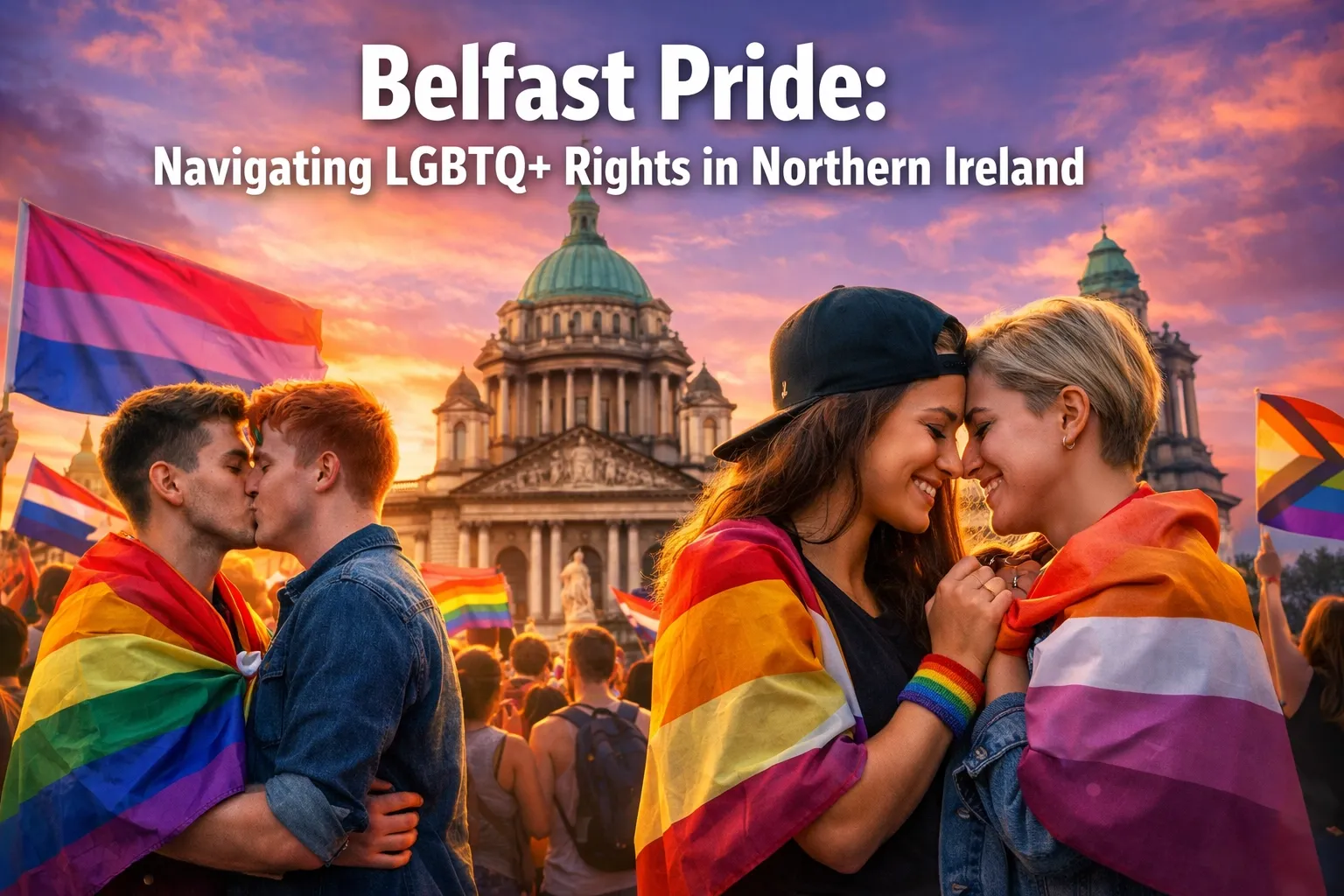
Belfast Pride hits different.
Not because the glitter is extra (though it absolutely can be), or because the parade energy is unmatched (also true), but because Northern Ireland’s political and social landscape has always made visibility feel a little more loaded. In some places, Pride is mostly a party with a side of politics. In Belfast, Pride has always carried the weight of history, sectarian divides, shifting governance, religious influence, and the long shadow of “we’ll deal with that later” whenever LGBTQ+ rights came up.
So if you’ve ever wondered what Belfast Pride means, beyond the flags, the music, and the joyful chaos, this is your guide to the bigger picture: the history, the progress, the frustrations, and why the festival remains both celebration and strategy.
Belfast Pride in 2026: celebration, protest, and a very packed calendar
Belfast Pride has grown into the largest LGBTQIA+ festival on the island of Ireland, pulling in tens of thousands of people and running a jam-packed schedule of events.
From the available festival info: Belfast Pride 2026 runs from Friday 17th to Sunday 26th July 2026, with the main Pride Parade on Saturday 25th July at 1pm (build-up starts at 11am). The festival typically includes 150+ events over 10 days, and draws 60,000+ visitors.
That scale matters, because big visibility is part of the point. But in Northern Ireland, where community identity can still shape where you feel safe holding someone’s hand, Pride isn’t just “a fun weekend.” It’s a public, collective statement: we exist, we belong, and we’re not going back in the closet for anyone’s comfort.

readwithpride.com
A quick (but crucial) history lesson: why LGBTQ+ rights unfolded differently here
To understand Belfast Pride, you’ve got to understand Northern Ireland’s unique context. This isn’t just “the UK, but rainy.” Northern Ireland’s governance and cultural dynamics have shaped LGBTQ+ life in specific, sometimes frustrating ways.
1) Late decriminalisation (and what that signalled)
Male homosexuality was decriminalised in England and Wales in 1967, but Northern Ireland lagged behind, with decriminalisation arriving in 1982 after legal challenges. That delay wasn’t just a legal technicality, it reflected a broader pattern: LGBTQ+ rights often arrived later, and with more pushback.
2) The Troubles and “not now” politics
During the Troubles, life was dominated by security concerns and identity politics. In that kind of environment, LGBTQ+ rights were frequently treated as a “later” issue, something that didn’t fit the dominant narratives of community and conflict.
But queer people were still there. Always. Loving, surviving, finding each other in small spaces, and building networks even when public visibility felt risky.
3) Religion and social conservatism
Northern Ireland has a strong religious influence across communities. Even when laws began to change, social acceptance could lag, and still does in some areas. That doesn’t mean everyone is conservative (far from it), but it does help explain why progress can feel uneven: you can have legal rights on paper and still face real-world barriers in family life, workplaces, schools, and healthcare.
Rights in Northern Ireland: what’s improved, and what still feels like a fight
If you’re “navigating LGBTQ+ rights,” you’re navigating a mix of legal protections, shifting policies, and everyday realities.
Where things have moved forward
- Marriage equality is now legal in Northern Ireland (a major shift that came later than other parts of the UK and Ireland).
- Anti-discrimination protections exist in law, including in employment and service provision.
- LGBTQ+ organisations and community groups have expanded, and younger generations are often more openly affirming.
Where things can still feel complicated
- Political instability and stop-start governance can slow policy development, funding decisions, and long-term planning for equality measures.
- Healthcare access, especially for trans people, can be difficult to navigate, with long waits and limited services.
- Hate crime and harassment remain realities for many people, particularly those who are visibly queer, trans, or gender nonconforming.
- Rural vs urban experience can be stark: Belfast can feel like one world; smaller towns another.
And this is where Pride becomes more than a parade. It’s a pressure valve and a megaphone at the same time, making it harder for institutions to ignore LGBTQ+ voices.
Pride as “cross-community”: what that means in Belfast (and why it matters)
You’ll often hear Belfast Pride described as a cross-community event. In a place where community identity has historically shaped everything from schooling to neighbourhoods, that’s not just nice branding.
It’s powerful because it creates a temporary (sometimes fragile, sometimes thrilling) reality where people show up together anyway. Pride becomes a space where:
- you can meet people outside your usual circles,
- you see allies put themselves on the line publicly,
- you’re reminded that queer identities exist across every background.
It doesn’t erase politics. But it shows a different possibility: connection without demanding sameness.
Safety, visibility, and the “mental map” of queer Belfast
Ask queer people about Belfast and you’ll often hear the same theme: you learn the city through a kind of “mental map.”
Not always because Belfast is dangerous everywhere, often it’s not, but because queer people are trained (by experience) to assess risk:
- Which streets feel fine at 2pm but dicey at 2am?
- Which venues are reliably welcoming?
- When you’re on public transport, who’s watching?
- Is it a night for holding hands… or a night for being subtle?
During Pride, that mental map changes. The city centre can feel like it belongs to you for once. That feeling, being publicly normal, loudly happy, isn’t trivial. It’s part of why Pride matters.
Why “enemies to lovers” and “forced proximity” tropes hit extra hard here
Okay, let’s talk story, because this is Read with Pride, and we know a good trope isn’t “just fiction.” It’s a way to process real tensions safely, with a guaranteed landing (ideally kissing).
Northern Ireland’s history has left people living with inherited divisions: family expectations, community identity, cultural pressure, and sometimes literal neighbourhood lines. That’s fertile ground for two MM romance tropes readers love:
Enemies to lovers MM romance (with Belfast energy)
In an enemies to lovers MM romance, the conflict is baked in: misunderstandings, loyalties, clashing identities, old grudges. In a Belfast setting, that tension can mirror real-life pressures:
- “I’m not supposed to want you.”
- “My family would never accept this.”
- “You represent everything I was taught to distrust.”
The appeal isn’t the conflict itself: it’s the transformation. Watching two men move from suspicion to trust can feel like emotional wish-fulfilment in the best way: proof that people can change.
Forced proximity MM romance trope (aka: “we’re stuck together, deal with it”)
Forced proximity is where two characters are thrown together by circumstance: roommates, road trips, a job, a shared secret, sheltering during a storm, you name it.
In real life, queer people in Northern Ireland have often had to create closeness in tight spaces:
- hidden relationships,
- chosen family,
- community hubs that act like lifelines,
- the classic “we only have each other right now.”
That’s why forced proximity can read as comforting, not just spicy. It’s the fantasy of safety: someone staying, someone choosing you, someone not running when it gets complicated.
If you’re building your 2026 TBR around tropes, those two: enemies to lovers MM romance and forced proximity: pair perfectly with stories that understand Belfast’s layered reality.
For more trope-forward queer fiction and MM romance books, keep an eye on the LGBTQ+ ebooks and reading lists at readwithpride.com:
- Home: https://readwithpride.com
- Explore categories (for when you’re in a scrolling mood): https://readwithpride.com/blog-category-sitemap1.xml
Pride beyond the parade: what “navigation” looks like day-to-day
Pride week is loud and visible. The other 51 weeks of the year? That’s where navigation becomes practical.
Here’s what LGBTQ+ life can involve in Northern Ireland: especially outside Belfast:
1) Being selectively out
Many people are out to friends but not family, or out at work but not in their community group, or out online but cautious in public. It’s not “shame”: it’s strategy.
2) Finding your people (and keeping them)
Queer community can be tight-knit, but that also means when you find your people, you hold onto them. Community isn’t a nice extra; it’s mental health infrastructure.
3) Advocating while exhausted
A lot of LGBTQ+ progress has been pushed by activists who are also just… trying to live. Pride helps share that load by turning advocacy into something communal and visible.
4) Dealing with headlines that feel personal
When LGBTQ+ rights become political talking points, it can feel like your existence is being debated on a panel show. Pride is the counter-message: you don’t get to discuss us without us.
Visiting Belfast Pride: how to show up well (especially as an ally)
If you’re travelling in for Pride, or you’re newly out and testing the waters, here are a few ways to show up in a way that helps: not hurts:
- Respect local context. People’s comfort levels vary. Don’t pressure anyone into visibility they don’t choose.
- Support queer-led spaces. Go to events, tip performers, buy from LGBTQ+ vendors.
- Don’t treat Belfast like a “conflict tourism” backdrop. Pride is about LGBTQ+ joy and rights, not someone else’s edgy Instagram aesthetic.
- Listen more than you lecture. If someone says something feels unsafe or tense, believe them.
Reading Belfast: why queer books still matter (and how Pride connects)
Books have always been a quiet route to survival: especially in places where being openly queer wasn’t safe or simple. Before you could find community in a big public way, you found it in pages: coded love stories, “roommates,” longing looks that meant more than they were allowed to.
That’s why Pride and reading culture are connected. Pride says: we’re here. Books say: you’re not alone.
If you’re building a Pride-season reading list, try choosing based on what you need right now:
- Want catharsis? Go for a slow burn enemies to lovers MM romance.
- Want comfort? Choose a forced proximity MM romance trope with a happy ending you can trust.
- Want history? Pick gay historical romance that doesn’t sanitize the struggle.
- Want escapism? MM fantasy where the only thing at risk is the kingdom (and maybe someone’s heart).
You can browse more gay romance novels and MM romance books via readwithpride.com:
- https://readwithpride.com
And if you like to keep tabs on new content drops, our post sitemaps are here: https://readwithpride.com/sitemaps.xml
Belfast Pride as a barometer: what the festival reveals about change
Every year, Pride shows you what’s shifting: sometimes in encouraging ways, sometimes in complicated ones.
- Bigger crowds can mean broader acceptance… or simply more people willing to be visible.
- More corporate involvement can mean mainstream support… or an ongoing debate about rainbow-washing.
- Increased security can mean better protection… or a reminder that not everyone loves seeing queer joy in the street.
But the core remains: Pride is a living measure of how safe it is to be seen. In Northern Ireland, that measure matters a lot.
Quick Belfast Pride rights checklist: what to pay attention to in 2026
If you’re trying to understand LGBTQ+ rights “on the ground,” these are the themes worth watching during Pride season:
- Are LGBTQ+ organisations being funded and supported consistently?
- Are trans people centred and protected in community planning?
- Are hate incidents being taken seriously (by venues, police, institutions)?
- Is there meaningful cross-community participation: not just symbolism?
- Are LGBTQ+ young people being supported in schools and youth services?
Pride won’t solve everything, but it does what movements have always done best: make it visible, make it collective, make it harder to ignore.
Keep up with Read with Pride (and share your Belfast recs)
If Belfast Pride gets you in the mood for community and stories with teeth (and tenderness), come hang out with Read with Pride across our platforms and at readwithpride.com:
- Website: https://readwithpride.com
- X: https://x.com/Read_With_Pride
- Instagram: https://www.instagram.com/read.withpride/
- Facebook: https://www.facebook.com/profile.php?id=61586883027069
And if you’ve got a favourite enemies to lovers MM romance or a forced proximity queer comfort read that feels like it belongs in a Belfast-shaped world: tell us. Pride is a parade, sure. But it’s also a giant, ongoing conversation about who gets to live freely. Books are part of that conversation too.
Hashtags
#BelfastPride #NorthernIrelandLGBTQ #LGBTQRights #ReadWithPride #MMRomanceBooks #EnemiesToLoversMMRomance #ForcedProximity #QueerFiction #GayRomanceNovels #LGBTQEbooks #GayBooks #Pride2026 #BelfastEvents #QueerReading #GayLoveStories

Leave a Reply
You must be logged in to post a comment.