

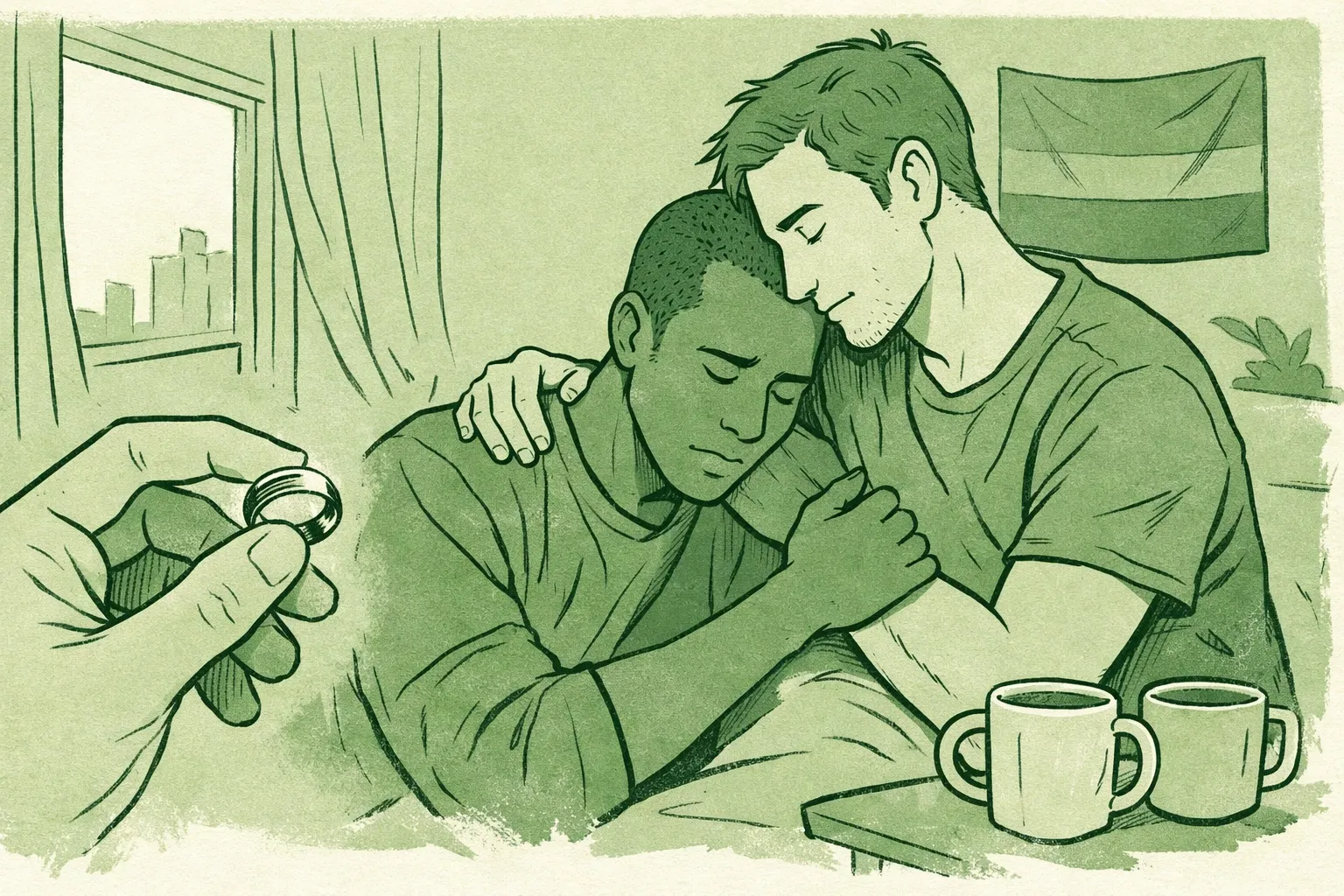
The gold band catches the light as he types another text. Just working late. Delete. Meeting ran over. Delete. Be home soon. Send.
His phone locks, and for a moment, he sees his own reflection in the black screen. Somewhere between the man his wife knows and the man waiting three blocks away at a hotel bar, there's a version of himself he's only beginning to understand.
Dick Ferguson doesn't write fairy tales. He writes the truth: the messy, complicated, heart-stopping truth of men navigating desire that doesn't fit neatly into the life they've built. And for married bisexual men, that truth weighs heavier than any wedding ring.
The Double Burden: When Neither World Feels Safe
Research confirms what many bisexual individuals already know: they face what experts call minority stress: chronic pressure from societal stigma and discrimination that never fully lifts. But married bisexual men carry an additional weight. They navigate double discrimination from both heterosexual and LGBTQ+ communities, experiencing erasure, invalidation, and the constant pressure to "pick a side."
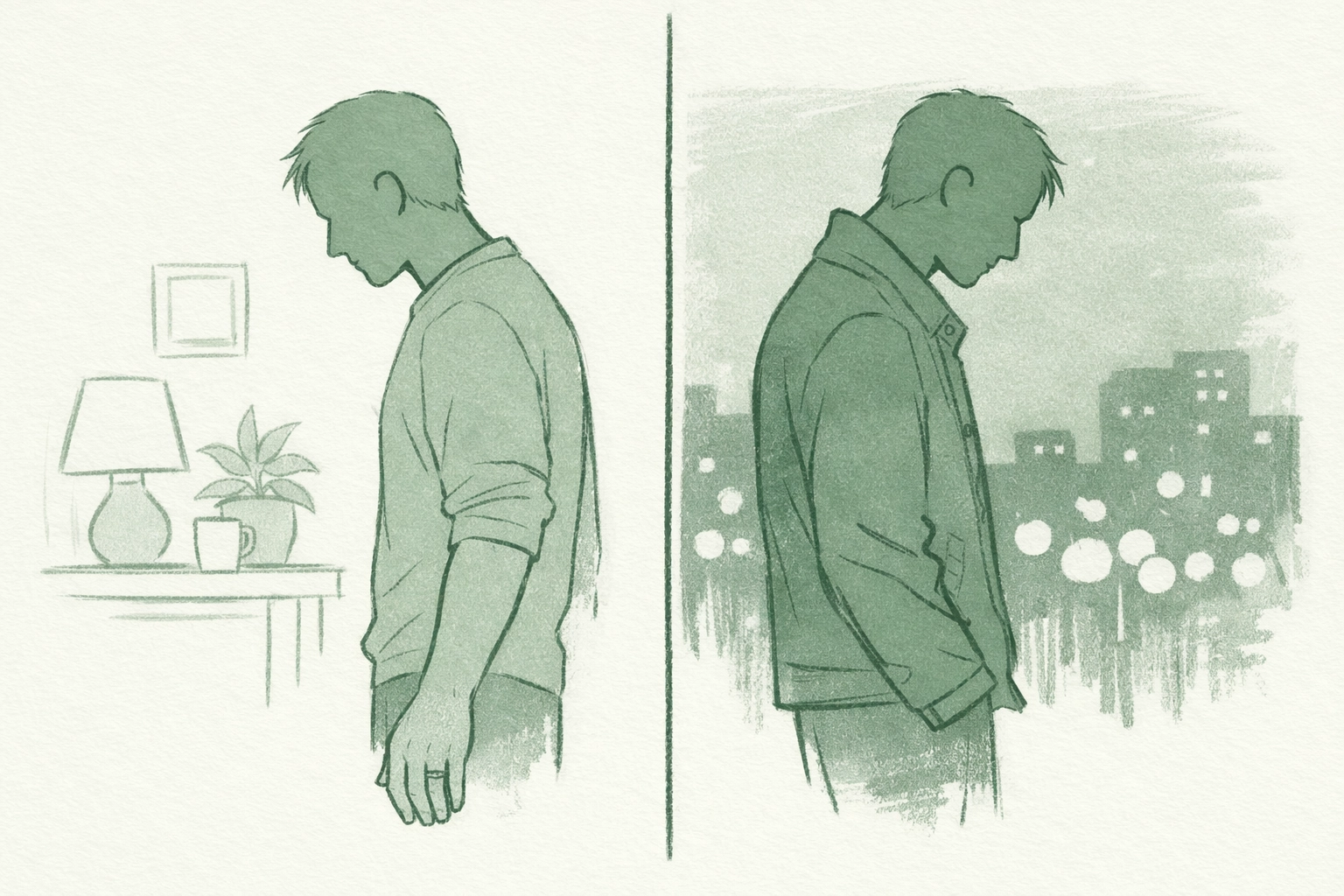
In heterosexual spaces, they're assumed to be straight. The wedding ring is proof enough. No one questions the family photos on the desk or the "my wife" references in conversation. But beneath that surface, desire simmers: raw, undeniable, and utterly unspeakable.
In LGBTQ+ spaces, they're often viewed with suspicion. Too married. Too closeted. Not "really" bisexual: just confused, experimenting, or unwilling to fully commit to their "true" identity. The message is clear: you don't fully belong here either.
Dick Ferguson's characters live in this liminal space. In The Campaign for Us, readers witness the exquisite tension of men whose public personas clash violently with their private truths. These aren't stories about coming out triumphantly to applause: they're about the 3 AM panic attacks, the cognitive dissonance of loving your wife while craving a man's touch, the exhausting work of managing identities in every single social interaction.
The Stress You Can't Name
Identity management isn't just an intellectual exercise: it's a constant cognitive burden. Every conversation becomes a calculation: Can I mention him? Should I correct this assumption? What pronouns should I use? How much truth is safe?
The psychological toll manifests in documented ways. Bisexual individuals report some of the highest rates of depression, anxiety, and suicidal ideation within the LGBTQ+ community. For married men specifically, the stress compounds:
The compartmentalization fractures the self. You become three different people: husband, professional, secret self. The energy required to maintain these separate identities is staggering.
The guilt is relentless. Not gay enough for the gay community. Not straight enough for your marriage vows. Betraying everyone simply by existing as you are.
The isolation is profound. Who can you talk to? Your wife doesn't know. Your LGBTQ+ friends might judge. Your straight friends wouldn't understand. The shame and secrecy become a prison.

Dick Ferguson writes about this isolation with brutal honesty. His characters don't have easy answers. They have hotel rooms and furtive glances. They have the overwhelming relief of being touched by someone who sees their authentic desire: followed immediately by crushing guilt. They have marriages that might be loving but incomplete. They have everything, and nothing at all.
When Desire Becomes Undeniable
There's a moment in every closeted bisexual man's life when the internal pressure becomes unbearable. Sometimes it's triggered by a specific person: a colleague, a friend, someone whose presence makes denial impossible. Sometimes it's just the accumulation of years of suppression reaching critical mass.
The body doesn't lie. You can rationalize, compartmentalize, minimize. You can focus on work, on family obligations, on anything else. But desire has its own language, and eventually, it demands to be heard.
Research shows that when bisexual individuals attempt to make their identity visible, they experience both positive and negative concurrent outcomes. On days when visibility happens: even in small ways: there's more positive affect, higher identity affirmation, less depression and anxiety. But there's also more potential for rejection, negative reactions, and emotional risk.
For married men, this becomes particularly complex. Visibility might mean:
- A conversation with a trusted friend
- Meeting someone who awakens something long dormant
- Seeking out LGBTQ+ spaces or online communities
- Finally admitting to yourself what you've always known

Each act of visibility is both liberation and risk. Ferguson's work, particularly in The Price of Desire, explores how authentic connection with another man can feel like finally breathing after years underwater: and simultaneously like betraying everything you've built.
The Context of Connection
Not all intimate encounters carry the same weight. Research confirms what lived experience teaches: the context matters enormously.
An affair born of adrenaline and opportunity: a business trip, a conference, a moment of weakness: brings its own particular flavor of stress. The secrecy is total. The compartmentalization is rigid. The guilt is sharp and immediate.
A developing emotional connection with another man: where conversation leads to understanding, understanding to friendship, friendship to something more intense: creates different tensions. This isn't just physical release. This is the terrifying possibility of being truly known.
A relationship that evolves into something sustained: where hotel rooms become regular patterns, where "I'll text you" becomes a promise kept: transforms stress into different questions: How long can this continue? What am I willing to risk? What kind of man does this make me?
Ferguson never romanticizes these situations. His characters don't conveniently discover that their wives are secretly okay with everything. They don't magically resolve complex ethical dilemmas. They struggle, they fail, they hurt people, they get hurt. They're gloriously, achingly human.
Explore more complex relationship dynamics in Beyond Boundaries: A Journey of Love and Fetish, where identity and desire refuse to follow convenient scripts.
Finding Support in an Unsafe World
Therapeutic research emphasizes bisexual-affirming approaches that explicitly validate bisexuality as a real, stable sexual orientation: not a phase, not confusion, not a stepping stone to being "fully gay."
Effective support includes:
Cognitive-Behavioral approaches that challenge internalized biphobia and build confidence in bisexual identity without pressure to choose a monosexual label.
Shame Resilience practices that help identify triggers related to biphobia and cultivate self-compassion rather than judgment.
Strategic visibility decisions that recognize coming out is a process, not a single event, and that you can be out in some contexts while maintaining privacy in others.
For married bisexual men specifically, resources like The Private Self: A Guide to Honoring Your Truth in Your Own Time and Beyond the Closet Door: A Gay Man's Coming Out Plan offer frameworks for navigating these impossibly complex situations with greater clarity and self-compassion.
The Weight We Carry
The wedding ring isn't just metal: it's a promise, a social contract, a public identity. For bisexual men in heterosexual marriages, it's also a constant reminder of the parts of themselves they've agreed to keep hidden.
Dick Ferguson's work matters because it refuses to simplify this experience. His stories acknowledge the genuine love that can exist in a heterosexual marriage while also honoring the equally genuine desire for male intimacy. They don't offer easy resolutions because there aren't any. They offer recognition: the profound relief of seeing your own struggle reflected on the page.
At Read with Pride, we believe every bisexual story deserves to be told with nuance and authenticity. Explore the complete collection of MM romance, gay fiction, and LGBTQ+ ebooks at dickfergusonwriter.com.
Your identity is valid. Your desire is real. Your struggle is seen.
Follow us on social media:
Instagram: @dickfergusonwriter
X/Twitter: @DickFergus94902
Facebook: Dick Ferguson Writer
Discover more LGBTQ+ fiction at www.readwithpride.com
#MMromance #BisexualIdentity #LGBTQfiction #GayRomance #QueerFiction #ReadWithPride #BisexualMen #GayBooks #LGBTQbooks #MMbooks #GayFiction #DickFerguson #AuthenticQueerStories #GayLiterature #ComingOut #LGBTQcommunity #QueerAuthors

Leave a Reply
You must be logged in to post a comment.