

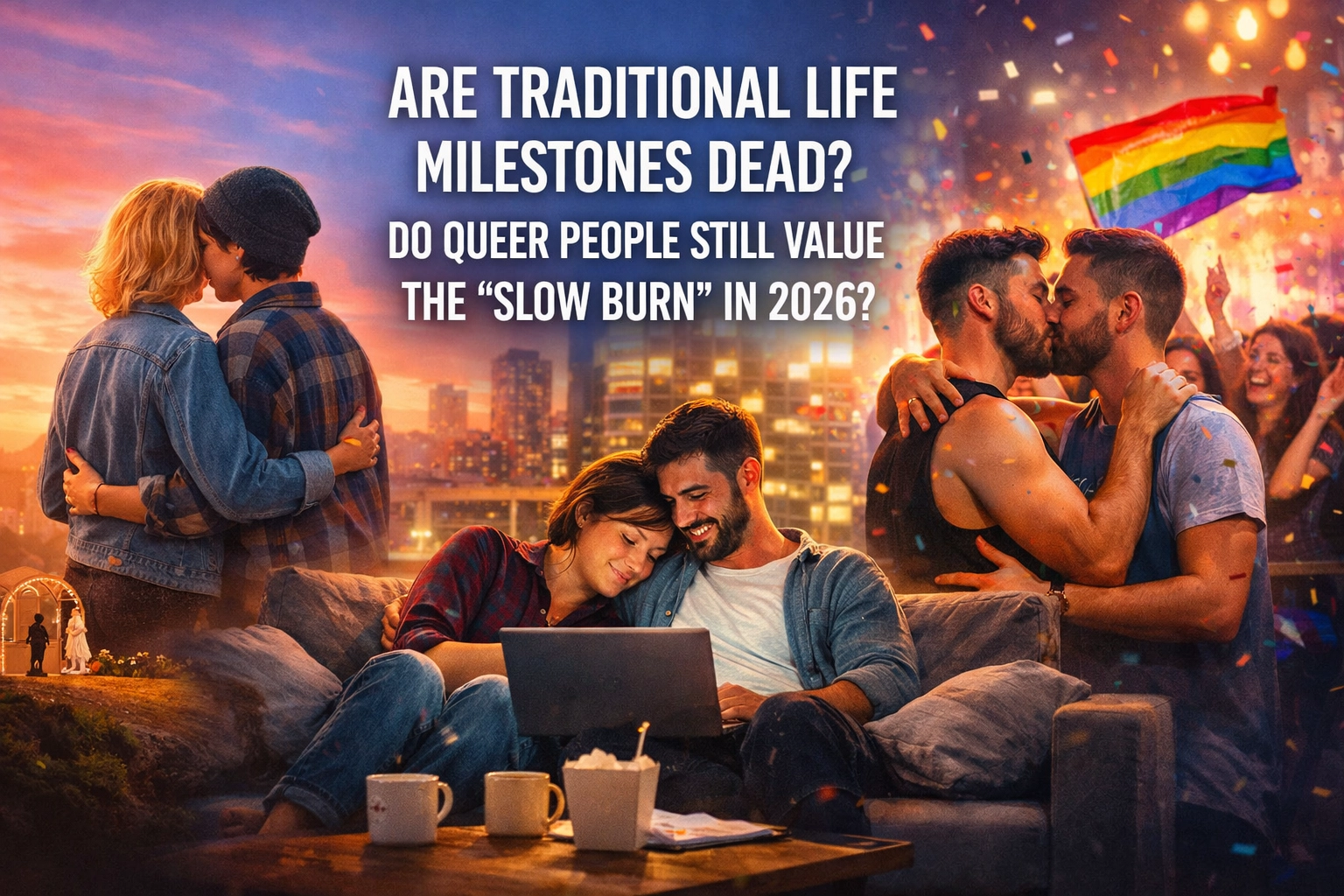
readwithpride.com
The “standard timeline” is wobbling… but it’s not gone
For a long time, adulthood came with a checklist that felt less like “life” and more like a customer journey: move out → job → marriage → kids → retirement → suspiciously early interest in air fryers. In 2026, that checklist hasn’t vanished, but it’s definitely not the default setting anymore.
A big reason is practical. Recent data on young adults (25–34) shows fewer people hitting all the traditional milestones than in previous decades. In 2024, only about 21% had reached the classic four (moving out, job, marriage, children), compared to 45% back in 1975. The most common pathway now is economic-first, moving out and working, but not marrying or having kids. Translation: “I can afford groceries, but not a wedding venue.”
Now add queer reality on top of that: we’ve never had universal access to the “standard timeline,” and even when we did, many of us didn’t want it. Queer life has always included detours, restarts, and plot twists (sometimes fun, sometimes brutal). So when people ask, “Are traditional life milestones dead?” a lot of LGBTQ+ folks respond: “They were never the whole story for us.”
But here’s the more interesting question for 2026: if the old milestones are loosening, what replaces them, and do queer people still crave the ‘slow burn’ anyway?
Queer milestones: less “one right way,” more “earned chapters”
Queer people still have milestones. We just tend to build them out of meaning rather than tradition.
Some common queer life milestones that don’t always show up in “official” adulthood narratives:
- The first time you say your identity out loud and feel more relief than fear (or a messy mix of both)
- Found family becoming real, the group chat becomes emergency contact-level
- Moving to a place where you can breathe (even if it’s just a different neighborhood, not a whole new city)
- The first relationship that feels safe (not perfect, safe)
- Rewriting “family”: chosen family, co-parenting with friends, queer communal living, or “we’re not married but we share a Costco membership and a dog”
- Learning your relationship style: monogamy, polyamory, open, queerplatonic, “we’re partners but we don’t do labels,” etc.
These are life transitions. They’re real. They shape you. They just aren’t always legible to straight culture, or to algorithms that assume “engaged by 27” is a universal goal.
And honestly? That’s why queer fiction hits so hard, because it gives shape to the milestones that mainstream storytelling sometimes ignores.
Are we still into the slow burn, or is everyone speedrunning intimacy?
Let’s talk about the “slow burn” both as a relationship vibe and as a romance trope, especially in MM romance books, where slow burn has basically become a love language.
In real life, 2026 dating culture can feel like two extremes battling it out:
- Fast intimacy: “We’ve been talking for 48 hours; should we move in or just emotionally merge?”
- Slow everything: “I’m healed, boundary-forward, and booked until June.”
Queer people can be in either camp. But slow burn is still deeply valued, just for slightly different reasons than “waiting for marriage.”
Why slow burn still matters in queer relationships
Slow burn isn’t about delaying love for the sake of tradition. It’s about building trust, safety, and truth in a world that hasn’t always offered us those things easily.
Slow burn can mean:
- Coming out at your own pace, and letting someone witness it without pressure
- Taking time to unpack shame, fear, or old survival strategies
- Building compatibility beyond chemistry (yes, even when the chemistry is feral)
- Navigating community overlap: exes, friends, former situationships, the whole “we all know each other” queer ecosystem
- Letting the relationship become real without forcing it into a milestone mold
In other words: for many queer folks, slow burn is less “will they, won’t they” and more “can we build something that doesn’t break us?”
And why some of us don’t want slow burn
Also valid: not everyone wants to simmer.
Some queer people prefer fast connection because:
- They’ve already done years of internal processing and are ready
- They’re older, divorced, out late, or rebuilding after a long closet era
- They’re tired of “almost” relationships and want clarity
- Their community norms are more direct (especially in certain queer spaces)
Slow burn is lovely. But “slow” shouldn’t mean “unclear,” “avoidant,” or “stringing someone along.”
The new queer milestones in 2026 (and what they reveal about love)
Traditional milestones used to signal stability. In 2026, stability often looks different, especially for LGBTQ+ folks. Here are a few “new” milestones we’re seeing more openly, plus what they say about what we value.
1) “We defined the relationship… in our own language”
Queer relationships often require a little DIY. Not because we’re chaotic (although we can be), but because the old scripts don’t always fit.
Defining the relationship might include:
- monogamous, open, polyamorous
- “partners” vs “boyfriends” vs “husbands” vs “something else”
- agreements around sex, privacy, social media, family contact, and community events
This is a milestone because it’s intentional. It’s also a quiet antidote to heteronormative default settings.
2) Chosen family becoming the center of gravity
In 2026, chosen family isn’t a cute phrase, it’s logistics:
- shared rent
- group holidays
- recovery support
- childcare swaps
- “Who gets my keys if I lock myself out?”
- “Who do I call when I’m spiraling?”
That’s not less serious than marriage. It’s serious in a different direction.
If you want stories that honor this, queer fiction and gay romance novels do it beautifully, especially when the friend group isn’t just background noise but a real emotional scaffold.
3) Co-building a life without “the usual” markers
A lot of queer couples (and polycules, and queerplatonic partners) build lives that don’t include marriage or kids, but include:
- buying property with legal agreements
- long-term caregiving plans
- shared businesses
- relocating together
- navigating visas and residency (still a huge one)
- building community roots
These are milestones with real stakes. They just don’t come with a universal greeting card aisle.
What romance readers already know: the slow burn is a milestone machine
Slow burn stories work because they mirror the way many queer people actually come to love: through micro-milestones.
In a great slow burn MM romance book, the milestones aren’t “engagement ring” and “baby announcement.” They’re:
- the first time he uses the right name without thinking
- the first honest apology
- the first time someone stays after seeing the messy parts
- the first time they choose each other publicly
- the first time touch stops being a question and becomes a home
That’s why slow burn is so sticky. It’s not just suspense. It’s emotional proof.
If you’re hunting tropes, slow burn pairs perfectly with long-tail favorites like:
- enemies to lovers MM romance (slow burn + tension = science)
- forced proximity (the classic “one bed” emotional pressure cooker)
- friends to lovers (aka “the softest knife”)
- workplace romance (power dynamics + consent conversations matter)
- second chance (slow burn with history and receipts)
And yes, some of the best slow burn reads in 2026 are the ones that let queer characters have full lives: friends, work, identity, grief, joy: while the romance builds like a heartbeat, not a jump scare.
For more LGBTQ+ romance and trope-led browsing, start at readwithpride.com and follow the rabbit holes from there.
Monogamy, polyamory, and the “milestone” question
One reason “traditional milestones” feel shakier in 2026 is that relationship structures are more openly discussed, including in queer spaces. That changes the milestone map.
In monogamous queer relationships, milestones often look like:
- meeting chosen family (sometimes more intense than meeting parents)
- building long-term routines
- legal planning (wills, medical power of attorney: unsexy but vital)
- “we’ve done a hard season and didn’t lose each other”
In polyamorous/open relationships, milestones can look like:
- agreements that get revised without drama
- metamour relationships moving from awkward to supportive
- calendar peace (the rarest treasure)
- care work being shared and appreciated
- conflict handled with skill, not punishment
Either way, queer people are still asking the same core questions:
- Are you safe with me?
- Do you see me clearly?
- Can we build something that lasts: even if it doesn’t look traditional?
Slow burn, at its best, is basically the narrative version of those questions.
So… are traditional milestones dead?
Not dead. Just dethroned.
In 2026, traditional milestones are options, not a moral scoreboard. And queer people: who have always had to be creative with belonging: are often ahead of the curve.
Queer relationships still value commitment. Still value building. Still value “we chose this.” We just don’t always package it as marriage-kids-house in that order, at that age, with that aesthetic.
And the “slow burn”? Still alive, still beloved: especially when it means:
- clarity without rushing
- intimacy with consent and depth
- love that arrives because it’s built, not because the plot demanded it
Which is exactly why slow burn remains one of the most satisfying MM romance books experiences: it feels like a relationship earning itself, step by step, like queer life so often does.
Keep the conversation going (and keep your TBR fed)
- Explore LGBTQ+ romance and queer fiction at readwithpride.com
- Follow along for daily bookish chaos, trope talk, and new releases:
Hashtags: #ReadWithPride #MMRomanceBooks #GayRomanceNovels #QueerRelationships #QueerFiction #SlowBurnRomance #ChosenFamily #LGBTQBooks #GayBooks #MMRomance #2026GayBooks

Leave a Reply
You must be logged in to post a comment.