

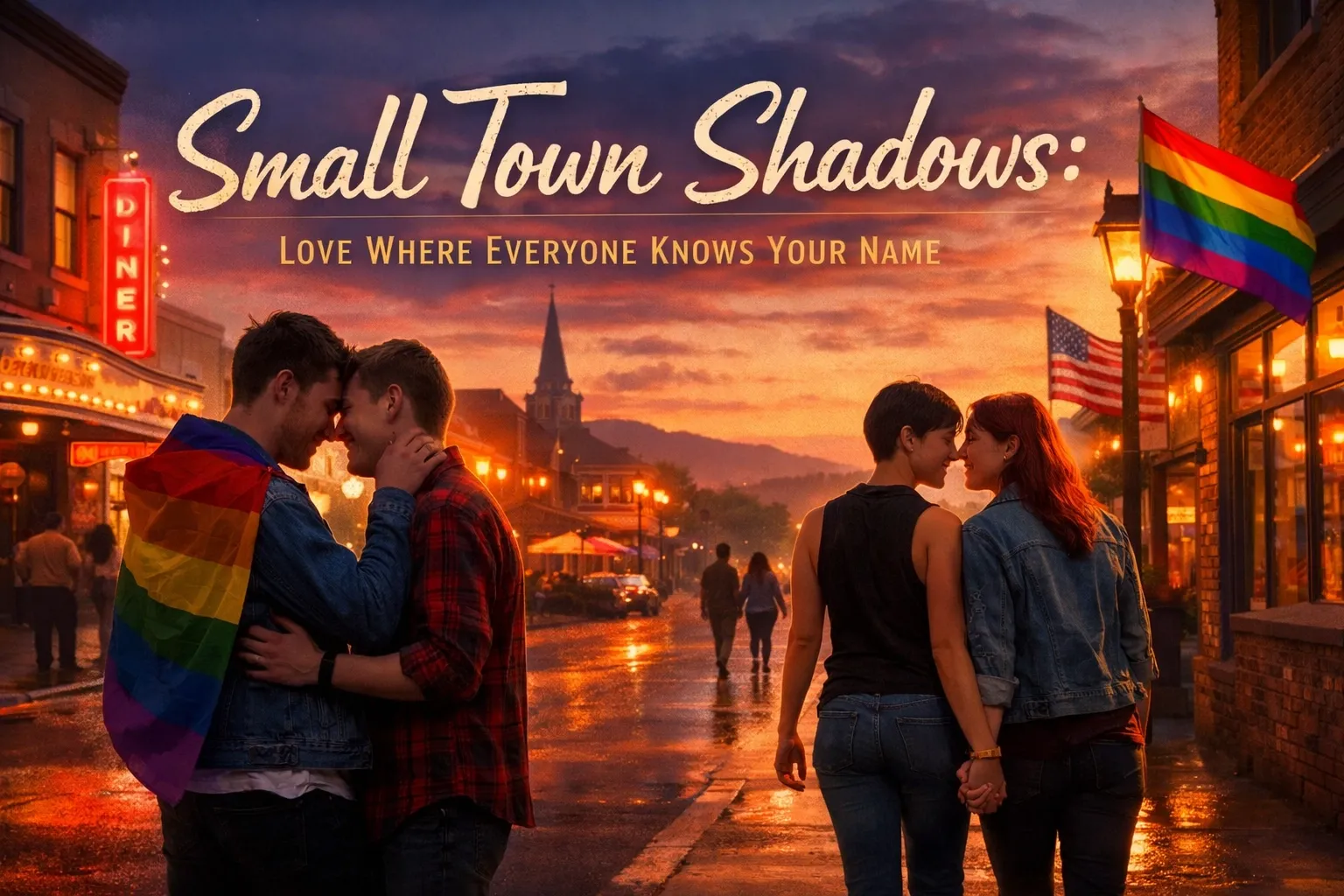
There's something about small towns that romance novels get perfectly right and terrifyingly wrong at the same time. Yes, there's charm, the kind where the diner knows your order before you sit down and the hardware store owner asks about your mom by name. But that same intimacy? It's a double-edged sword when you're living a life the town doesn't expect from you.
Welcome to Small Town Shadows, the third installment in our "Living Behind Closed Doors" series here at Read with Pride. We're exploring what it means to love someone when every grocery run feels like a surveillance operation and your front porch is the only place you can breathe.
The Currency of Gossip
In a small town, information travels faster than the speed of light. Mrs. Henderson saw you at the post office with a man she didn't recognize. By Tuesday, three people have asked your mother if you've "finally met someone nice." By Friday, the speculation has morphed into a full narrative that may or may not involve a secret fiancée from the city.
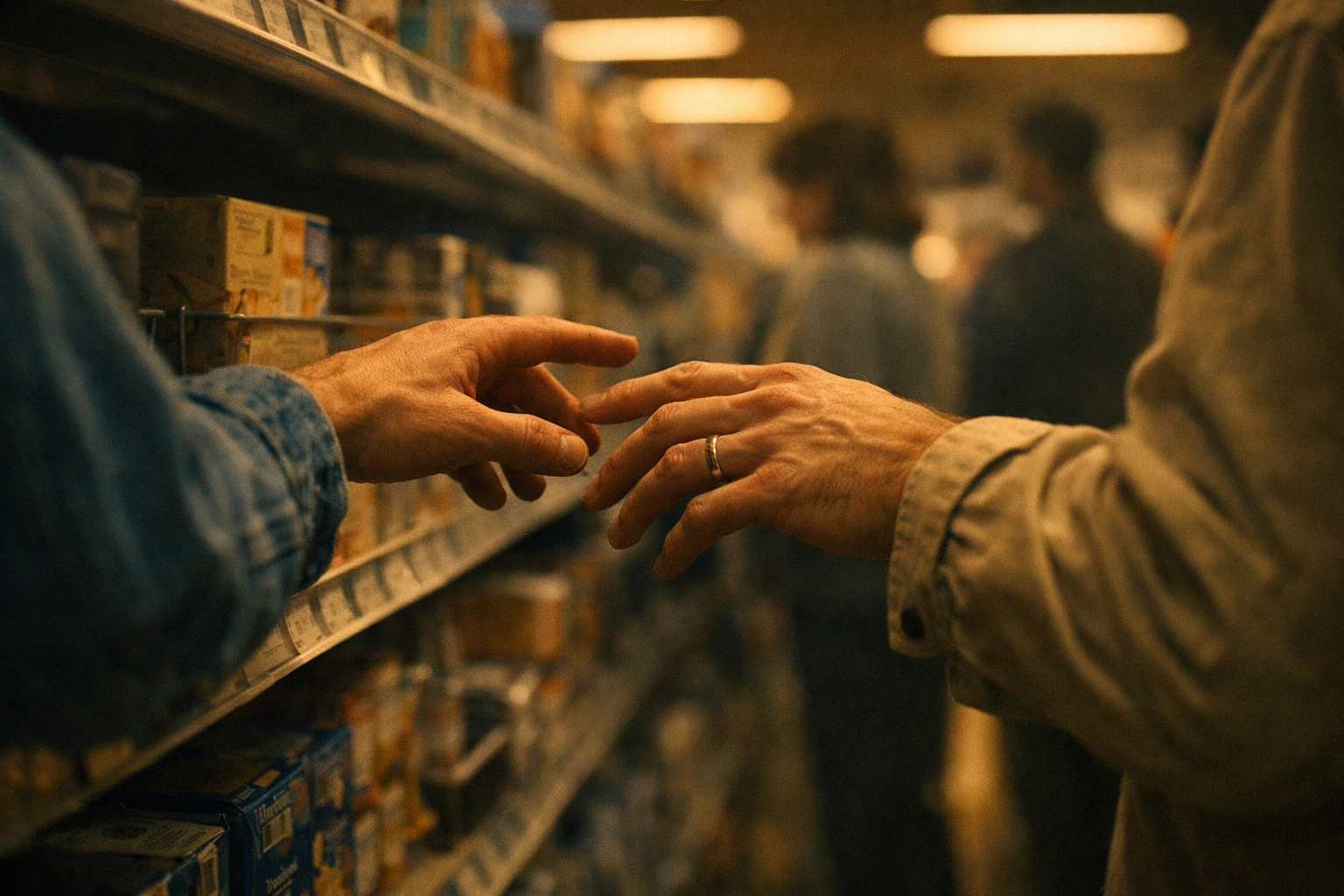
The truth? That man was your partner of five years. But in a place where "lifelong bachelor" is code for something nobody wants to say out loud, you've learned to play the game. You talk about work. You mention "a friend" visiting for the weekend. You become a master of pronouns so vague they could apply to literally anyone.
This is the reality for countless gay men living in tight-knit communities where closeted life in a small town isn't just about personal choice, it's about survival, job security, family peace, and sometimes physical safety. The secret gay lovers dynamic isn't a spicy romance trope when it's your Tuesday afternoon at the feed store.
The Lifelong Bachelor Label
There's a particular kind of exhaustion that comes with being perpetually single in everyone else's narrative. Your aunt stops asking about girlfriends around age thirty. Your coworkers give you that sympathetic head tilt when someone mentions weddings. You become "set in your ways," "married to your work," or, the classic, "just hasn't found the right girl yet."
The label sticks like a name tag at a high school reunion. And the worst part? It's often easier to wear it than to correct it. Because correction means explanation. Explanation means exposure. And exposure in a small town means consequences that ripple through every aspect of your life.
So you let them think you're alone. You let them set you up with their cousin who just moved back from the city. You smile politely and say, "I'll think about it," knowing full well you're going home to the person who actually knows you, the one who exists only behind your closed door.
The Grocery Store Ballet
If you've lived this life, you know the dance. You're in the cereal aisle when you spot him, your partner, three rows over. In another world, you'd walk up, maybe grab something off his list, make a joke about his terrible taste in coffee. In this world? You exchange the briefest of glances, a micro-expression that says "I see you, I love you, we're okay," and you keep moving.
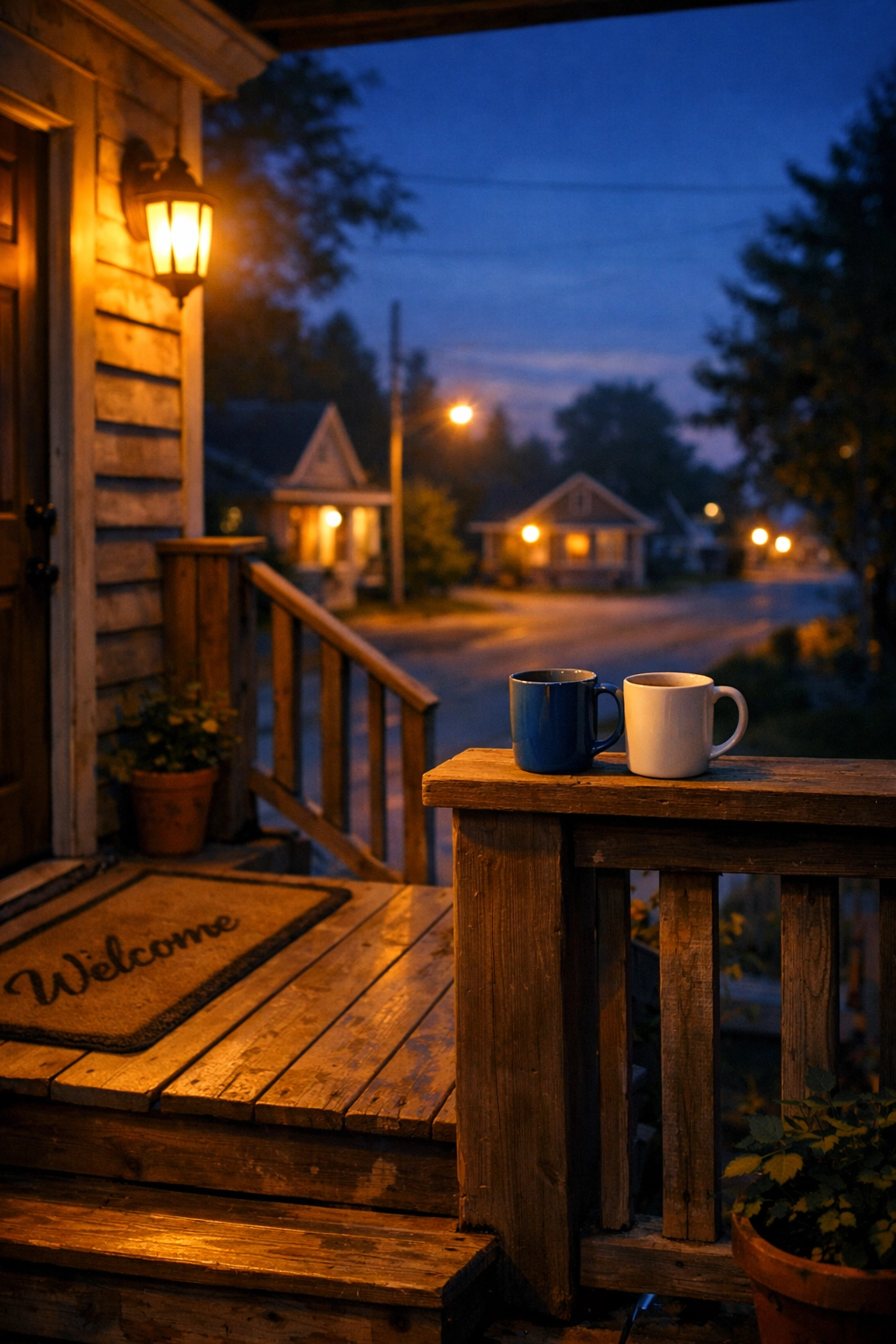
This is small town MM romance stripped of its glossy cover art. It's careful. It's calculated. It's a constant risk assessment that happens in split seconds: Who's watching? Who knows who? Is this safe?
The fiction version gets the longing right, that ache of being so close to someone you love but unable to reach for them. What it sometimes misses is the sheer mental exhaustion of it all. The way your brain becomes a chess board, always three moves ahead, always anticipating who might see what and what it might mean.
The Sanctuary of Home
But then there's the front porch light. That single bulb that means "safe" in a way nowhere else does. When you pull into that driveway, when you close that door behind you, the performance ends. The armor comes off. The pronouns become specific and beautiful.
This is where MM romance books capture something true and vital: the intensity of a love that exists in stolen moments and sacred spaces. When the rest of the world demands you play small, home becomes enormous. Every shared meal, every lazy Sunday morning, every argument about who's doing the dishes, they all matter more because they're yours alone.
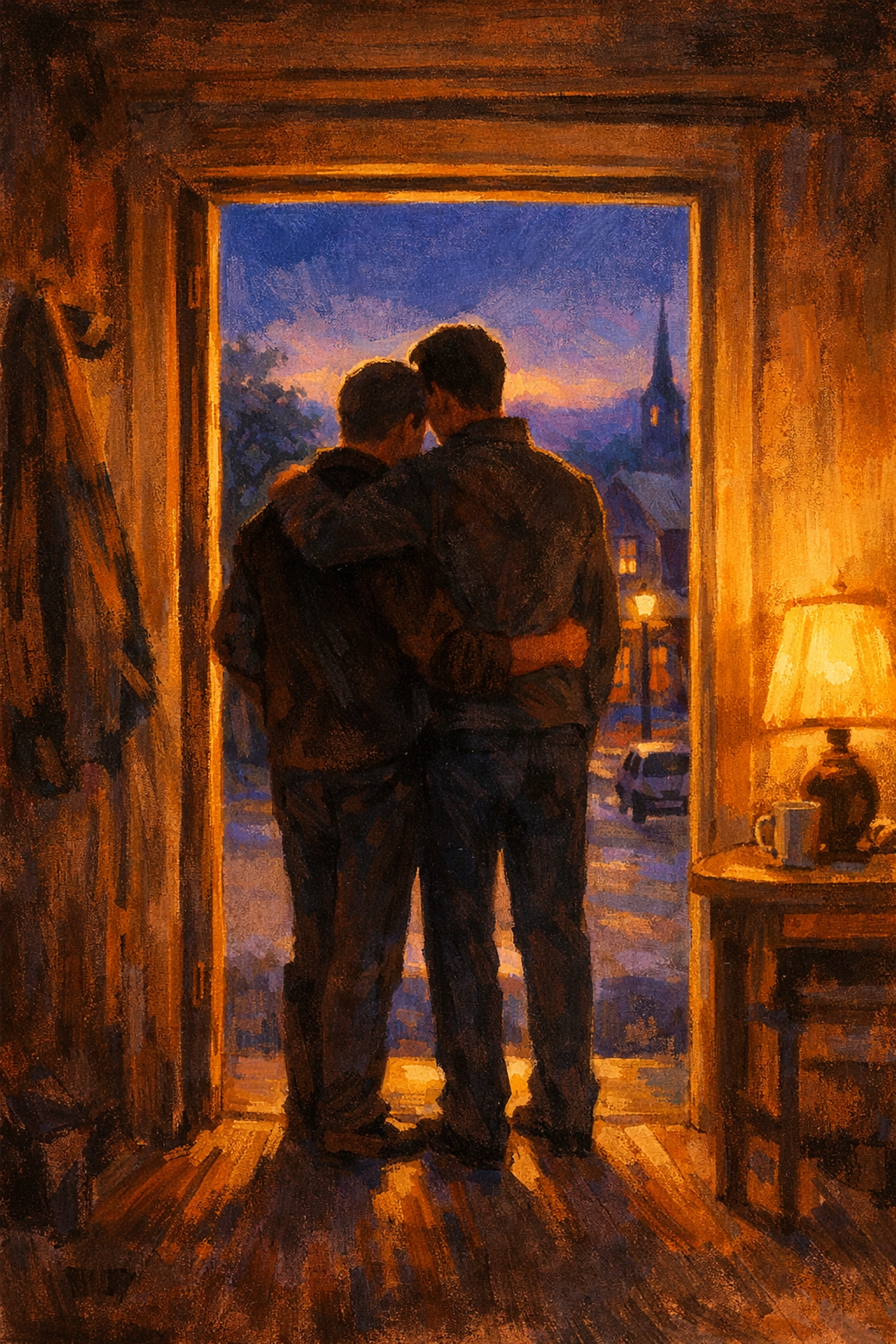
The porch light becomes a symbol. It's the marker between two worlds, the one where you're the bachelor from the office and the one where you're someone's whole heart. Some couples develop elaborate rituals: a specific number of times to knock, a particular way the curtains are drawn, signals that mean "coast is clear" or "give it an hour."
It sounds like something from a spy novel, and in a way, it is. You're protecting something precious in hostile territory. The difference is that the "enemy" isn't a foreign government, it's your neighbors, your employer, sometimes your own family.
The Fear vs. The Familiar
Here's the paradox that keeps people in small towns even when cities beckon with their anonymity and rainbow flags: small towns are home. This is where you learned to ride a bike. Where your best friend from third grade still lives two streets over. Where you know every back road and seasonal tradition. Leaving means losing all of that, the good and the complicated.
So you stay. You stay and you love in the margins. You stay and you build a life in the shadows. You stay because leaving feels like letting the fear win, and staying feels like claiming something that's rightfully yours: the right to love where you're from.
The closeted in a small town experience isn't always tragic. Sometimes it's defiant. Sometimes it's a conscious choice to refuse invisibility while also refusing to perform for an audience that wouldn't understand anyway. It's saying "this is my home too" while keeping the most important parts of yourself locked away from prying eyes.
The Stories We Tell Ourselves
Every small town has them, the rumors, the whispers, the "confirmed bachelors" who everyone knows about but nobody talks about. There's often a generation gap in perception: the older folks who genuinely believe you've just been unlucky in love, and the younger ones who've figured it out but respect the unspoken agreement to stay quiet.
Sometimes there's solidarity in the shadows. A knowing nod from the librarian who's "never married" either. An unexpected defender when someone makes a joke that cuts too close. A network of people living parallel lives, all behind different closed doors, all protecting the same secret.
This is the part that gay romance novels are starting to explore more honestly, the complexity of it. The fact that small town life isn't universally hostile but isn't exactly welcoming either. It's a thousand shades of gray, where acceptance exists in gestures but never in words, where love is permitted as long as it stays invisible.
When Shadows Become Home
After a while, the shadows stop feeling like hiding and start feeling like shelter. You learn that intimacy doesn't need an audience. You discover that love doesn't shrink in small spaces, it concentrates, it intensifies, it becomes something pure and undiluted by external validation.
This isn't to romanticize the closet or suggest that hiding is healthy. It's not. The psychological cost is real and documented. But for those who choose to stay, who build lives in these in-between spaces, there's a resilience that develops. A strength in knowing who you are even when the world doesn't get to see it.
Finding Your Story
If you're looking for MM romance that captures this specific experience, the small town dynamic with all its complications and quiet rebellions, Read with Pride has curated stories that understand the nuance. Not every love story needs to end with a grand coming-out moment. Sometimes the victory is in the ordinary: ten years together, a mortgage, a dog, and a front porch light that's always on.
The beauty of gay fiction is that it can hold space for all of it, the fear, the longing, the frustration, and the unexpected joy of building something real in the margins. Because love behind closed doors is still love. A secret doesn't make it less true.
The Light Still Burns
As we move deeper into this "Living Behind Closed Doors" series, we're not here to judge anyone's choices about visibility or safety. We're here to witness, to acknowledge, and to celebrate the lives lived quietly and the love that persists despite everything.
Because in a small town where everyone knows your name, sometimes the bravest thing you can do is come home to the person they don't know exists, and love them anyway.
Stay tuned for Story #4: Digital Safe Havens, where we explore how the internet became the first room where many gay men felt truly safe. Subscribe to Read with Pride and follow us on Facebook, Instagram, and Twitter for more stories from the margins.
#MMRomance #SmallTownRomance #GayRomanceBooks #ReadWithPride #LGBTQFiction #ClosetedLove #SecretLovers #QueerFiction #GayLoveStories #MMBooks #2026GayRomance #LivingBehindClosedDoors
Digital Safe Havens: The First Room Where We Could Breathe
![[HERO] Digital Safe Havens: The First Room Where We Could Breathe](https://cdn.marblism.com/8kLPmn3Qx02.webp)
Before pride flags hung in living room windows, before marriage equality, before most of the visible progress we celebrate today, there was a glowing screen in a dark room. There was a dial-up connection that screeched like a banshee. There was a chat room where, for the first time, you could type the words you'd never said out loud.
Welcome to Digital Safe Havens, the fourth story in our "Living Behind Closed Doors" series. This is about the internet as sanctuary, as lifeline, as the place where thousands of gay men took their first tentative steps toward being seen.
The Sound of Connection
If you're old enough to remember the dial-up tone, you remember something sacred. That mechanical screech meant more than just internet access, it meant escape. It meant possibility. It meant that for the next hour (or until someone needed the phone line), you could exist outside the constraints of your physical location.
For closeted men, especially those in small towns or conservative families, the internet wasn't just entertainment. It was survival infrastructure. It was the difference between total isolation and knowing, really knowing, that you weren't alone.
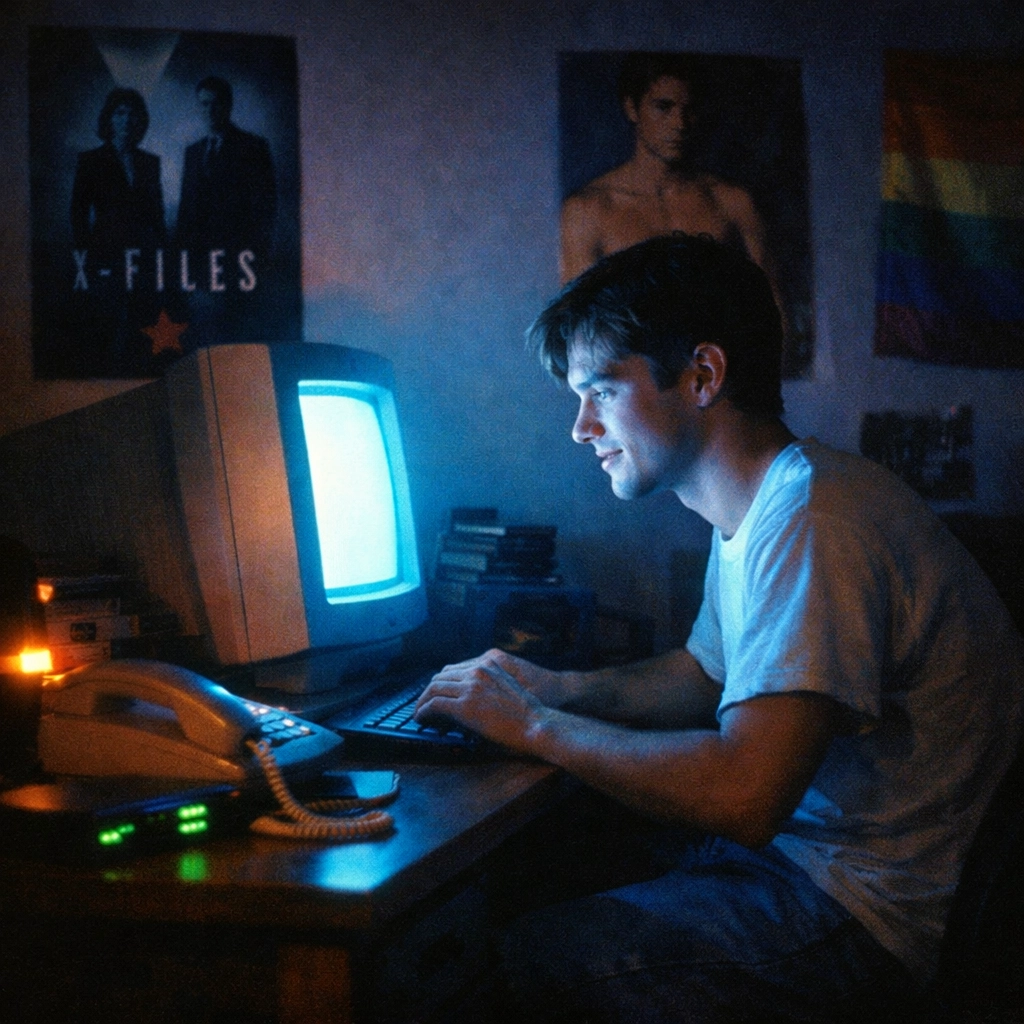
Forums with names you had to Google in incognito mode. AOL chat rooms with innocent-sounding titles that were anything but. Message boards where people used handles instead of names and shared stories that would have been dangerous to tell anywhere else. This was the underground railroad of the closeted, and the currency was truth.
The First "I Am"
There's something you need to understand about the pre-social media internet: it was anonymous in a way nothing is anymore. You could be anyone. You could be yourself. Those two things weren't mutually exclusive, they were finally, miraculously, the same.
The first time you typed "I'm gay" in a chat room, even if it was to strangers, even if it was at 2 AM with your heart pounding so hard you thought you'd wake the house, that was a coming out. Maybe the most important one. Because you came out to yourself.
The responses came fast: "Me too." "Welcome." "You're not alone." Simple words that rewired your entire understanding of your place in the world. You weren't broken. You weren't the only one. You weren't going to die having never been honest about who you were.
This is the foundation of gay romance that often goes unspoken in the stories we read today, the fact that for so many men, their first taste of community, of possibility, of a future that included love, came through a screen.
Building Worlds in Text
Early internet MM romance fans will remember the fan fiction archives, the LiveJournal communities, the Yahoo groups that felt like secret societies. These weren't just places to read stories, they were places to imagine different lives. Lives where two men could fall in love publicly. Lives where happy endings weren't just possible but expected.

The quality ranged from "someone just learned what semicolons are" to "why isn't this published?" but that wasn't the point. The point was authorship. Control. The power to write the narratives that mainstream media refused to tell.
You could be seventeen in rural Texas and read about two men in love in New York City. You could be thirty-five and married to a woman and discover that the feelings you'd been suppressing had names, had stories, had entire communities built around them. You could be anywhere and access everywhere.
This digital landscape gave birth to tropes that now dominate gay fiction: the slow burn that happens entirely via email, the online friendship that turns into something more, the person behind the screen who understands you better than anyone in your physical life. These weren't just plot devices, they were lived experiences translated into fiction.
The Safety of Distance
Here's what made the internet different from every other closeted space: physical distance. In a chat room, you weren't worried about someone from work seeing you. In a forum, your neighbor couldn't spot you and report back to your parents. Online, you could be honest without immediate physical consequences.
That distance allowed for honesty that would have been impossible face-to-face. Men discussed their fears, their desires, their confusion about attraction and identity. They asked questions they couldn't ask their doctors or therapists. They admitted to feelings they'd been taught to bury.
The internet became the world's largest support group, running 24/7, accessible from anywhere with a connection. It was imperfect, trolls existed even then, and misinformation spread like wildfire, but it was something. For men with nothing else, it was everything.
From Screens to Hearts
And then the magic happened: people started meeting in person. The online friend became a coffee date. The chat room buddy became a road trip companion. The forum regular became the person you couldn't stop thinking about.

MM romance books love this trope for good reason, it's inherently dramatic. Will they look like their photos? Will the chemistry translate offline? Will this be the moment everything falls apart or the moment everything finally makes sense?
For closeted men, these meetings carried extra weight. You were taking something safe and contained and exposing it to the harsh light of reality. But you were also, maybe for the first time, allowing yourself to want something out loud. To pursue it. To believe it might actually happen.
The internet-to-real-life pipeline created countless relationships, many of which are still thriving today. It proved that connection forged in text and pixels could be just as real, sometimes more real, than anything that started at a bar or through friends.
The Archive of Our Lives
One of the most powerful things the internet did was create a record. Before, being closeted meant your history disappeared. Your relationships existed only in memory. Your milestones had no witnesses.
Online, even in anonymous spaces, there was documentation. There were posts that showed your journey from "I think I might be gay" to "I'm in love with someone." There were timestamps on the evolution of your understanding. There was proof, even if only for you, that this happened, that you lived it, that it mattered.
For historians of LGBTQ+ fiction and culture, these early internet archives are gold mines. They show the real-time development of language, the negotiation of identity, the creation of community norms. They capture a moment in time when everything was changing but nothing had changed yet, when men were finding each other in digital spaces even as the physical world remained hostile.
The Shadows Go Digital
Of course, the internet wasn't all liberation. For every man who found community, there was another whose browsing history became evidence against him. For every successful romance, there was a catfishing disaster. For every support forum, there was a space that weaponized shame.
The digital closet came with its own surveillance concerns. Shared computers meant cleared histories. Email accounts meant passwords and privacy concerns. Online presence meant digital footprints that could be traced, discovered, used against you.
This tension, between the freedom of online spaces and the danger of being discovered there, is the dark side of digital safe havens. The internet gave with one hand and threatened with the other. It was sanctuary and trap simultaneously, depending on who had access to your devices and your accounts.
The Evolution Continues
Fast forward to today, and the internet looks completely different. Social media replaced anonymous forums. Dating apps replaced chat rooms. Instagram replaced LiveJournal. But the fundamental need remains the same: safe spaces to be honest about who we are.
Modern gay romance novels reflect this evolution. The characters slide into DMs instead of AOL message boards. They match on apps designed explicitly for queer people. They navigate the complex terrain of online visibility, out on some platforms, careful on others, always weighing the risks and rewards of digital authenticity.
Read with Pride curates stories that understand both the history and the present of digital queer life. From the early internet era to contemporary social media, from anonymous forums to verified profiles, the evolution of online identity is woven into MM romance in ways that honor where we've been and where we're going.
Still Breathing Digital Air
For men still living behind closed doors, the internet remains vital. It's the married man in the suburbs who finds community in Reddit threads. It's the teenager in a conservative household who discovers YouTube channels that validate his experience. It's the older man who thought he'd die without ever meeting someone like him, until he found a forum specifically for people in his situation.
Digital safe havens aren't just history, they're ongoing. As long as there are men who can't be out in their physical lives, there will be online spaces where they can breathe. The platforms change, the technology evolves, but the fundamental human need for connection and honesty remains constant.
The Gift of Pixels
Looking back, it's clear that the internet did something unprecedented: it connected closeted people across geographic, economic, and social boundaries. It created a global community out of individual isolation. It turned "the only gay person I know" into "part of a network spanning continents."
That's not small. That's revolutionary. That's the kind of thing that changes lives and, eventually, changes societies. Because men who found community online eventually came out offline. They found partners, built families, demanded recognition. The digital safe haven became a launching pad for physical-world activism and visibility.
Stay with us for Story #5: The "Roommate" Dynamic, where we explore the delicate dance of family gatherings and the painful art of introducing your partner as your friend. Follow Read with Pride on Facebook, Instagram, and Twitter for more from this series.
#MMRomance #DigitalSafeHavens #GayRomanceBooks #ReadWithPride #LGBTQFiction #OnlineCommunity #QueerHistory #GayLoveStories #MMBooks #2026GayRomance #LivingBehindClosedDoors #InternetHistory
The "Roommate" Dynamic: Dancing Around the Truth at Family Dinner
![[HERO] The Roommate Dynamic: Dancing Around the Truth at Family Dinner](https://cdn.marblism.com/9nKRmP4Yx03.webp)
"So this is your… roommate?"
Four words that carry the weight of everything unsaid. The pause before "roommate" says more than the noun itself ever could. It's a question mark shaped like a statement, an acknowledgment shaped like ignorance, a knowing shaped like plausible deniability.
Welcome to The "Roommate" Dynamic, the fifth installment in our "Living Behind Closed Doors" series. This is about the peculiar choreography of family visits, the elaborate performance of platonic cohabitation, and the toll it takes on everyone involved, especially the person you're supposedly just sharing rent with.
The Language of Avoidance
Every closeted relationship develops its own vocabulary. "My friend is visiting for the holidays." "My buddy from college and I got a place together." "Oh, you know, just helping each other save money on rent."
The pronouns get careful. "They" becomes a shield against specification. Stories get edited mid-sentence when you realize you're about to mention something too intimate, too couple-y, too obviously not roommate behavior. You learn to talk around the truth so expertly that sometimes you forget you're even doing it.
This linguistic gymnastics is exhausting. It's the opposite of how language is supposed to work: instead of clarifying and connecting, you're using words to obscure and distance. You're wielding communication as a weapon against communication itself.
For the partner being introduced as the roommate, it's a particular kind of hurt. Every "friend" is a mini-rejection. Every "roommate" is a closet door closing in real time. Every careful pronoun is a reminder that in some contexts, they don't get to be your person: they have to be your person-adjacent placeholder.
The Geography of Separate Bedrooms
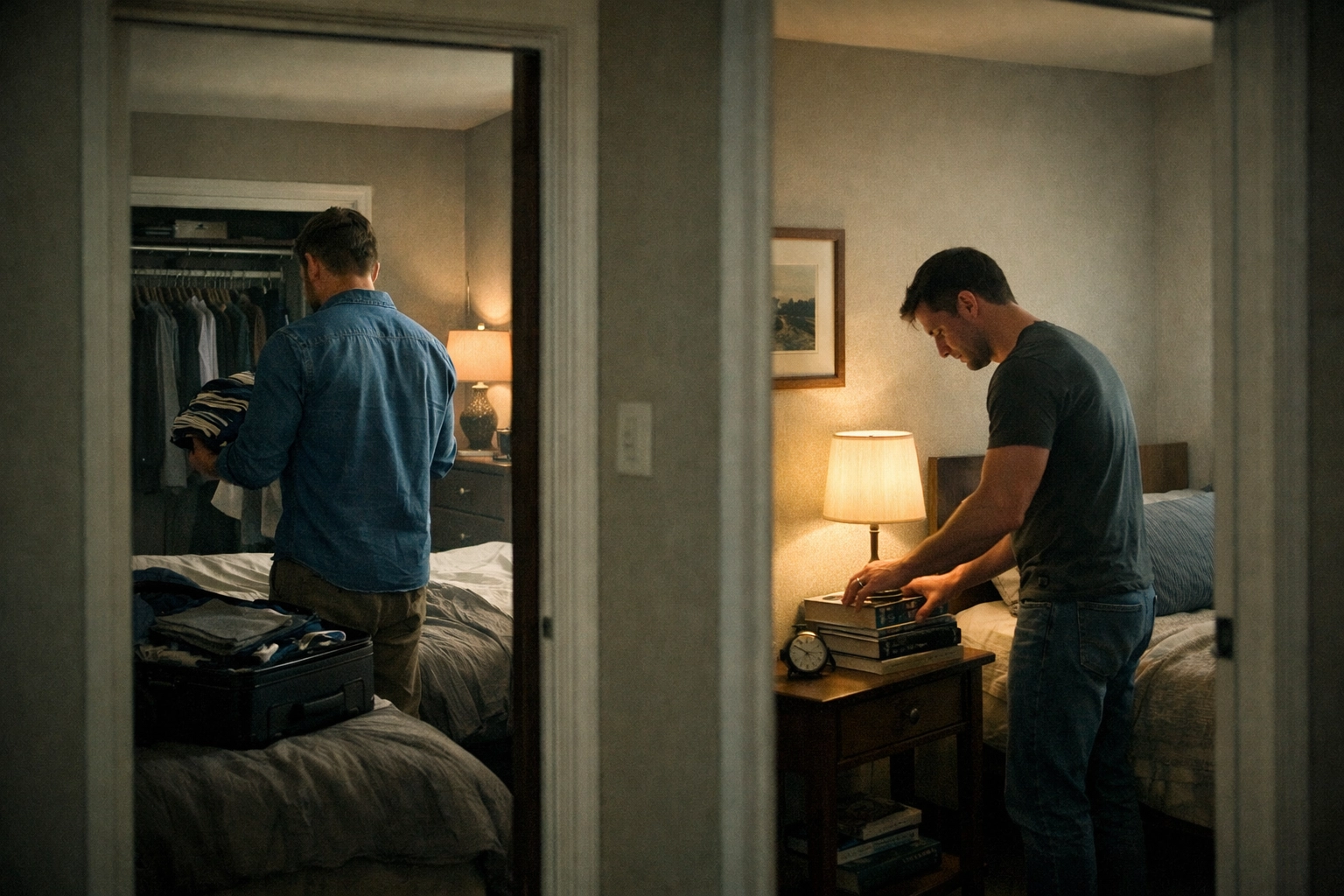
"We should probably set up the guest room," you say three days before your parents arrive. What you mean is: we need to create evidence of two separate lives under one roof. We need to build a set that sells the story.
So you move things around. A few of your shirts go into the spare room closet. Some of his books get strategically placed on the nightstand. You make one bed look slightly more lived-in than the other. You hide the photos that are too tender, too obviously couple-y. The bathroom gets a careful edit: his products move to "his" bathroom, yours stay in "yours."
It's like running a witness protection program in your own home. You're erasing evidence of your actual life and replacing it with a carefully constructed fiction that might hold up under parental scrutiny.
The worst part? You both become pretty good at it. The routine gets smooth. The transitions happen faster. You develop systems. And every time you do it, it gets a tiny bit easier to live divided, even after the guests leave.
The Performance of Friendship
Your mom asks if he's seeing anyone. You watch him carefully construct an answer that's vague enough to sound true and specific enough to sound real. "You know, dating here and there, nothing serious." Meanwhile, you're sitting three feet away, your relationship of five years reduced to "nothing serious" for the sake of family peace.
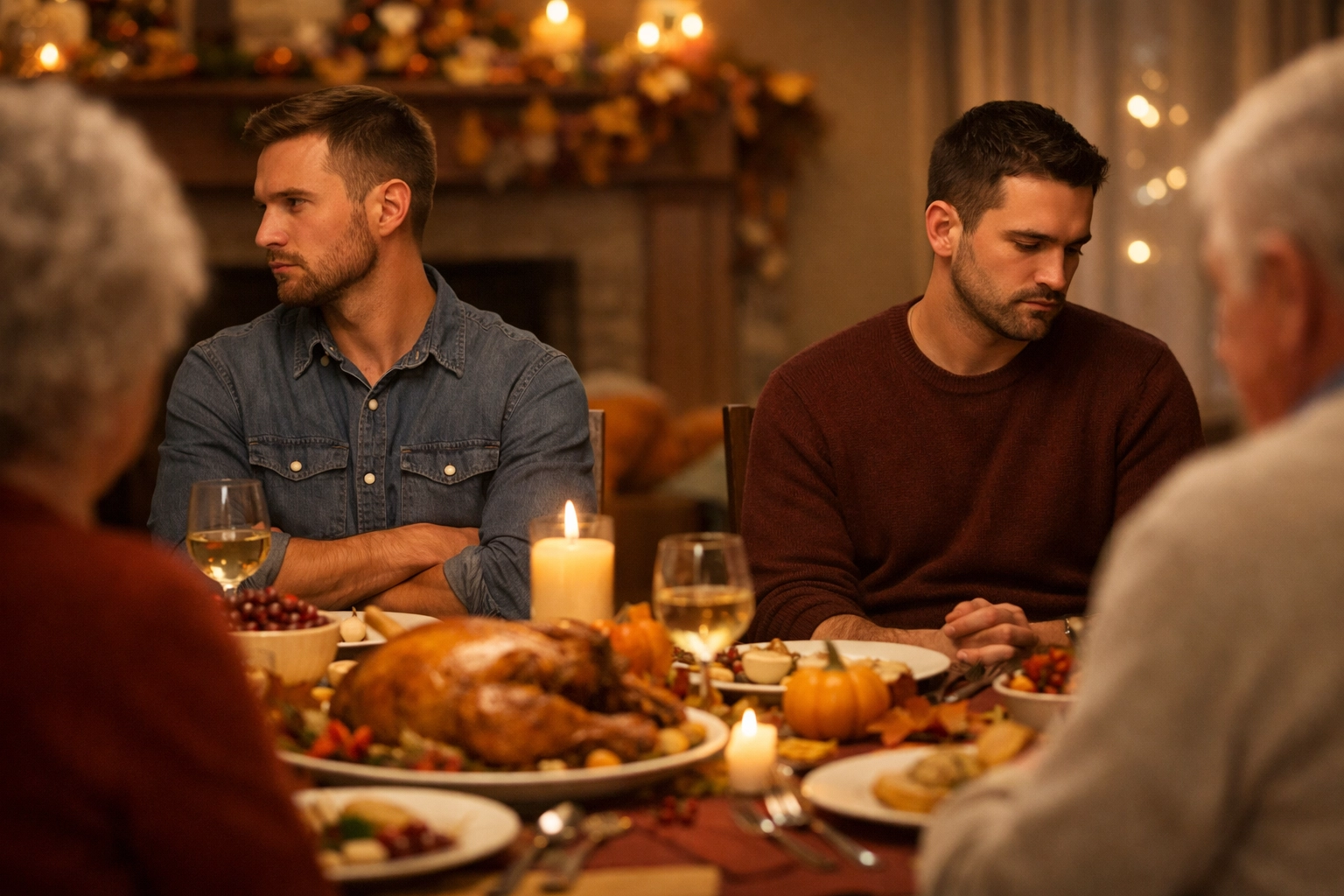
You all play along. Everyone knows the dance steps because everyone, in some way, has participated in this kind of performance before: maybe not about sexuality, but about something. The polite fiction that keeps Thanksgiving dinner from exploding. The agreed-upon story that keeps family dynamics intact.
This is MM romance stripped of its literary gloss. There's no grand gesture here, no dramatic coming out, no family acceptance montage. There's just two people who love each other learning to act like casual acquaintances when certain people are watching. There's compartmentalization as survival strategy.
The gay romance books that handle this well understand that it's not always about rejecting your family or choosing your partner over blood relations. Sometimes it's about navigating impossible situations with the tools you have available. Sometimes it's about protecting yourself and the person you love while also maintaining relationships that matter, even when they're complicated.
Holiday Heartbreak
The holidays are when this dynamic intensifies to painful levels. Thanksgiving, Christmas, Easter, whatever your family celebrates: these are the times when the performance is longest and the stakes feel highest.
You watch couples at the table being openly affectionate while you're careful not to even pass the salt in a way that might seem intimate. You hear questions about when you're going to settle down, find someone nice, stop being so picky: all while the person you've settled down with is being offered seconds on pie.
Your partner endures well-meaning but cutting questions: "Don't you miss having your own place?" "You ever think about finding someone and starting a family?" "How long are you going to do this roommate thing?"
The unspoken answer to all of it: This is my place. This is my someone. This is my family. You're just not allowed to know that.
The Strain on the Partnership
Let's be real: the roommate dynamic doesn't just affect your relationship with your family: it affects your relationship with your partner. Resentment builds. Hurt accumulates. Every time they're introduced as "just a friend," it's a small wound. Over time, small wounds become scars.
Arguments happen. "Why can't you just tell them?" "You don't understand what my family is like." "I'm tired of pretending we barely know each other." "You think I like this?"
These aren't new arguments: they're ancient ones, playing out in countless relationships where one or both partners are navigating the closet. The closeted gay romance trope exists in fiction because it reflects a reality that's still remarkably common. It's 2026, and people are still introducing their partners as their roommates.

The fiction versions usually resolve this with either a dramatic coming out or an ultimatum. Reality is messier. Sometimes couples live in this liminal space for years, even decades. Sometimes they find ways to make it work. Sometimes the strain eventually breaks them. There's no universal happy ending, just individual circumstances and choices.
When Family Knows But Won't Know
Here's the thing about the roommate dynamic: sometimes it's not even about actual secrecy. Sometimes it's about maintaining a shared fiction that allows everyone to avoid difficult conversations.
Your sister probably knows. She's made comments that make it clear she's not buying the roommate story. But she also never pushes for confirmation because then it would be real and it would require her to take a stance with your parents. So she plays along, asking after your "friend" with just enough quotation marks in her tone that you know she knows, but never saying it directly.
This is the exhausting middle ground where truth exists in subtext but never in text. Where everyone is performing for everyone else, and nobody knows who's actually fooled anymore. It's plausible deniability as a multigenerational project.
The Cost of Peace
You tell yourself it's worth it. That keeping the peace is important. That your parents are old, set in their ways, products of their time. That your relationship is strong enough to weather being invisible a few times a year. That it's a small price to pay for maintaining family ties.
But prices compound. Small costs become large debts. Your partner learns to expect to be erased, and that expectation becomes a part of your relationship dynamic. You learn to be two people: one in front of family, one behind closed doors: and that split becomes part of your identity.
The gay fiction that handles this honestly doesn't provide easy answers. It acknowledges that sometimes choosing visibility means choosing isolation. That sometimes staying closeted means staying connected to people and places that matter, even if they don't fully know you. That sometimes there is no right choice, just different kinds of losses.
Finding Your Truth
For those reading this and seeing their own lives reflected back: you're not alone. The roommate dynamic is one of the most common experiences in MM romance communities, both in fiction and reality. It's painful. It's common. And it's okay to feel whatever you feel about it.
Some people eventually come out to their families. Some don't. Some reach a middle ground where the truth is known but never discussed. Some cut ties. Some maintain distance. There's no one right way to navigate this, despite what any advice column or romance novel might suggest.
Read with Pride features MM romance books that explore all of these outcomes: the ones where families eventually come around, the ones where they don't, and the ones where the ambiguity persists. Because representation means showing the full spectrum of experiences, not just the ones that resolve neatly.
The Door Remains Closed
As we continue this "Living Behind Closed Doors" series, the roommate dynamic represents one of the most painful aspects of closeted life: being diminished in front of the people who should celebrate you most. It's a uniquely intimate wound: not physical danger or legal discrimination, but erasure in the name of love.
But it's also where many people live, and where many people find ways to build meaningful lives despite the constraints. The door may be closed to some, but what happens behind it is still real. The love is still love, even when it has to masquerade as coincidental cohabitation.
Next up is Story #6: The Pressure Cooker, where we explore the psychological toll and unexpected intensities of hidden romance. Subscribe to Read with Pride and follow us on Facebook, Instagram, and Twitter.
#MMRomance #TheRoommateDynamic #GayRomanceBooks #ReadWithPride #LGBTQFiction #ClosetedLife #SecretRelationships #QueerFiction #GayLoveStories #MMBooks #2026GayRomance #LivingBehindClosedDoors #FamilyDynamics
The Pressure Cooker: When Secrets Become Their Own Kind of Intimacy
![[HERO] The Pressure Cooker: When Secrets Become Their Own Kind of Intimacy](https://cdn.marblism.com/7kNMlo5Wx04.webp)
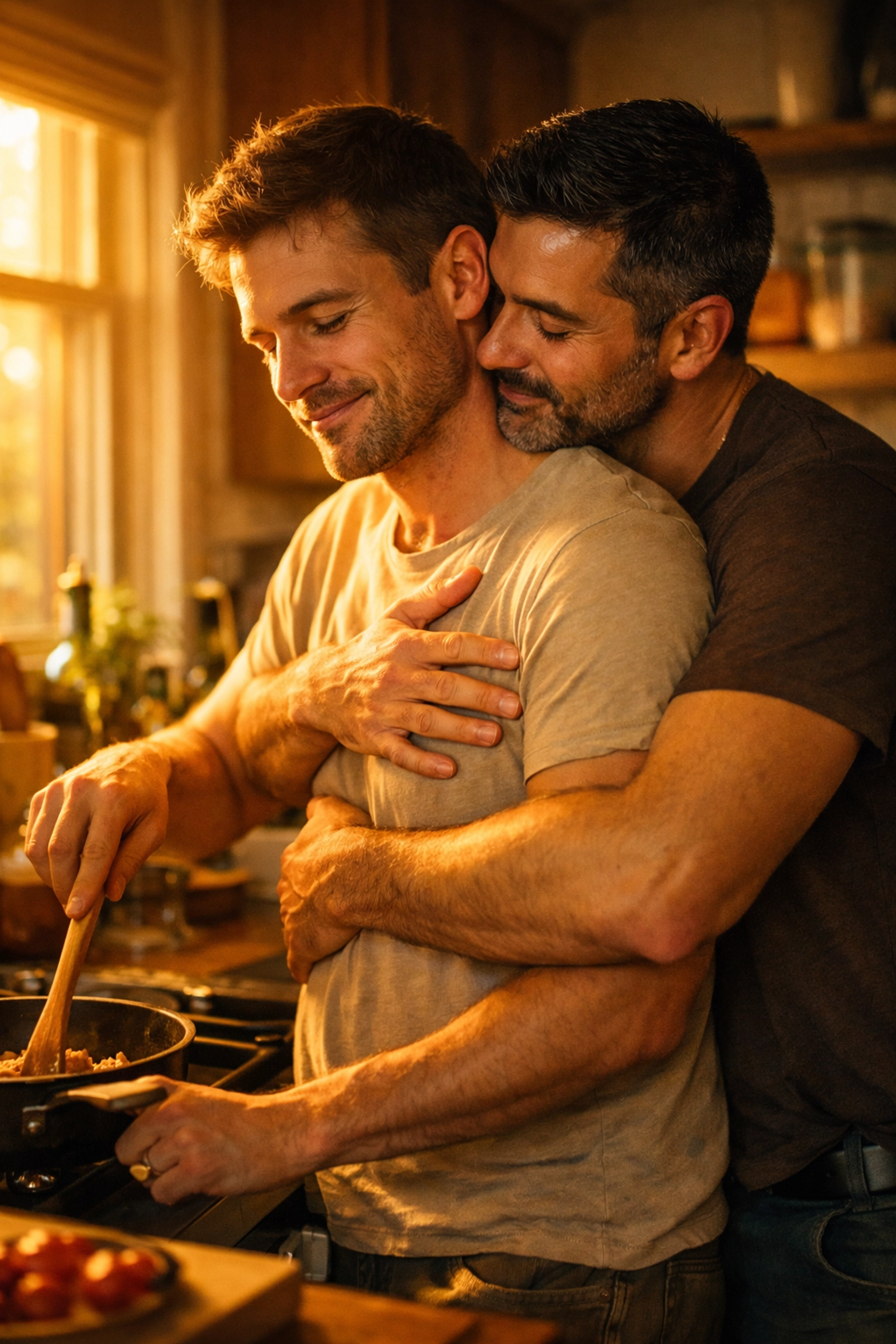
There's a particular intensity that develops when you're living a double life. Everything heightens. Every touch means more because you can't touch freely. Every stolen moment becomes precious because moments are stolen, not given. The pressure builds not despite the secrecy but because of it: and somewhere along the way, the pressure itself becomes addictive.
Welcome to The Pressure Cooker, the sixth installment in our "Living Behind Closed Doors" series. This is about the psychological complexity of hidden romance: the toll it takes and the unexpected ways it intensifies everything you feel.
The Weight of Performance
Living closeted means you're always performing. At work, you're the straight-passing guy who talks sports and doesn't react when colleagues make casually homophobic comments. At family gatherings, you're the perpetual bachelor who deflects questions about dating with practiced ease. In public with your partner, you're just two friends grabbing dinner, no eye contact that lasts too long, no body language that suggests intimacy.
The performance requires constant vigilance. You're monitoring yourself, monitoring your surroundings, calculating risk levels, adjusting behavior in real time. It's cognitively exhausting. Studies on minority stress and cognitive load confirm what closeted people already know: hiding who you are burns tremendous mental energy.

But here's where it gets complicated: that performance creates a pressure differential between your public and private selves. And when you finally close the door behind you, when you're alone with the person who knows the real you, the release of that pressure is intense. It's relief and vulnerability and raw honesty all at once.
That intensity? It's powerful. Sometimes dangerously so. Because it can make the closeted relationship feel more profound, more meaningful than it might be without the external pressure. The secrecy itself becomes part of the bond. You're not just lovers: you're co-conspirators, the only two people who know the truth. That's heady stuff.
The Rush of Risk
There's a physiological component to secret relationships that MM romance books sometimes capture and sometimes miss. When you're doing something risky: when you're holding hands in a dark parking lot, or kissing in a restaurant one town over, or existing together in semi-public spaces while maintaining the fiction that you're not actually together: your body releases adrenaline.
Adrenaline heightens arousal. It makes everything feel more intense. It creates a feedback loop where the risk itself becomes part of the attraction, part of what makes the relationship feel electric in ways that safe, public relationships might not.
This isn't healthy, exactly. But it's real. It's the reason some closeted relationships struggle when they move toward openness: remove the external pressure, and suddenly you have to figure out if what you have works without the added intensity of secrecy. Sometimes it does. Sometimes it doesn't.
The gay romance novels that handle this honestly explore what happens when the pressure drops. When you can finally just be a regular couple doing regular things without fear or performance. Sometimes that's a happy ending. Sometimes it reveals that the relationship was more about rebellion and escape than actual compatibility.
The Toll on Mental Health
Let's not romanticize this too much: living in a pressure cooker is damaging. The constant hypervigilance takes a toll. Anxiety becomes baseline. Depression is common. Substance abuse is higher among closeted queer people than their out counterparts. The stress is literally measurable in cortisol levels and health outcomes.

You're living in a constant state of partial dissociation: you're there but not fully there, engaged but always monitoring, present but performing. Over time, this creates what psychologists call identity fragmentation. You become multiple versions of yourself across different contexts, and maintaining coherence across those versions is exhausting.
Your relationship bears the weight of this too. Your partner becomes your only outlet for authenticity, which is both beautiful and burdensome. They're your therapist, your confessor, your only witness to your full self. That's a lot of responsibility for one person to carry. The pressure cooker doesn't just contain you: it contains both of you, together.
When Fighting Becomes Connection
Here's something true about pressure cooker relationships: the fights are different. When you can't be openly together in most contexts, when your time together is limited and precious, even your conflicts carry extra weight.
Arguments become high-stakes because you can't just walk away and cool off in separate spaces the way other couples might. You can't call a friend and vent, not honestly, because your friend doesn't know the truth about your relationship. You can't even have certain fights in certain places because you never know who might overhear.
So conflicts intensify. Small disagreements become relationship-defining. Everything feels like it might be the thing that breaks you because the stakes are already so high, the stress already so constant, that your tolerance for additional friction is minimal.
But here's the paradox: when you fight through something while maintaining secrecy, when you resolve a conflict under those conditions, it creates a sense of "us against the world" that's deeply bonding. Every obstacle overcome together becomes proof that your relationship can survive anything. The pressure cooker, again, becomes its own kind of intimacy.
The Forbidden Fruit Effect
Psychologically, there's something called the forbidden fruit effect: the tendency for people to want something more when it's prohibited. This applies to relationships too. When your love is taboo, when it has to be hidden, when it requires deliberate effort and risk to maintain: it can feel more valuable precisely because it's forbidden.
This is tricky territory. Because while that intensity is real, it's also based partly on external circumstances rather than the inherent quality of the relationship. Remove the "forbidden" element, and what's left? Sometimes a deeply connected partnership that was strengthened by adversity. Sometimes a relationship that relied on external drama to feel significant.
Gay fiction exploring this theme often presents characters who confuse secrecy for depth, who mistake the thrill of hiding for genuine compatibility. The honest versions show characters who have to reckon with what their relationship actually is once the external pressures change.
Compartmentalization as Survival
One of the psychological adaptations to pressure cooker relationships is compartmentalization: the ability to separate different aspects of your life into distinct mental containers. Work you, family you, public you, private you with your partner. Each gets its own compartment, and you learn to keep them from bleeding into each other.
This is a survival skill. It's how you make it through Thanksgiving without having a panic attack. It's how you maintain professionalism at work while internally processing a fight you had with your partner that morning. It's how you exist across multiple contexts without completely losing your sense of self.
But compartmentalization, while useful, also creates distance: not just from others, but from yourself. When you're constantly dividing yourself into parts, you lose touch with the whole. You become efficient at managing contexts but sometimes forget what it feels like to be integrated, to be one complete person in all places.
Your relationship lives in one of these compartments, possibly the most important one. But it's still just a compartment, sealed off from the rest of your life. And that containment, while necessary, is also limiting. It means your love exists in a bubble, apart from the full fabric of your life. That's both protective and isolating.
The Unexpected Upside
Here's where I'm going to say something potentially controversial: sometimes the pressure cooker creates relationships that are more honest, more intentional, and more examined than their public counterparts.
When you're living in secret, you can't take the relationship for granted. You can't autopilot through it. Every moment together is chosen, not defaulted into. You're constantly negotiating boundaries, checking in, making sure this is still worth the risk and stress. That requires communication that some public relationships never develop.
The intensity forces you to know each other deeply and quickly. You skip some of the superficial stages other couples go through because you're immediately dealing with high-stakes questions: What are we to each other? What are we willing to risk for this? How do we maintain our bond under these conditions?
This isn't an argument for staying closeted: it's not. The costs are too high. But it is an acknowledgment that adversity sometimes forges connections that ease doesn't. Some relationships that begin in pressure cookers become incredibly resilient once they're able to exist openly. They've already survived the hardest test.
When the Pressure Needs Release
Not all pressure cooker relationships are sustainable long-term. Sometimes the intensity that made them feel profound becomes the thing that burns them out. The constant stress wears through even strong foundations. The compartmentalization creates distance that becomes impossible to bridge. The forbidden fruit loses its appeal when the fruit is no longer forbidden.
MM romance books from Read with Pride explore all these outcomes: relationships that thrive after coming out, relationships that don't survive the transition to openness, relationships that find middle grounds where some secrecy remains but the worst pressure lifts. Because there's no one story of closeted love: there are thousands, each unique to the people living it.
Finding Your Release
If you're living in a pressure cooker relationship right now, here's what matters: your mental health is valuable. Your relationship's intensity shouldn't come primarily from external threat. The thrill of secrecy shouldn't be what's holding you together. And if you're staying closeted purely for the high it provides, that's worth examining honestly.
But if you're closeted for safety, for family, for work, for any of the very real reasons people stay hidden: you're not wrong. The pressure cooker isn't your fault. You're doing what you need to do to survive and protect what you love. Just remember that survival mode isn't meant to be permanent. Eventually, pressure needs release, or the container cracks.
Stay tuned for Story #7: The Leak in the Armor, where we explore what happens when the private world and public world accidentally collide. Follow Read with Pride on Facebook, Instagram, and Twitter for the next chapter.
#MMRomance #ThePressureCooker #GayRomanceBooks #ReadWithPride #LGBTQFiction #ClosetedLove #SecretRelationships #QueerFiction #GayLoveStories #MMBooks #2026GayRomance #LivingBehindClosedDoors #MentalHealth

Leave a Reply
You must be logged in to post a comment.