

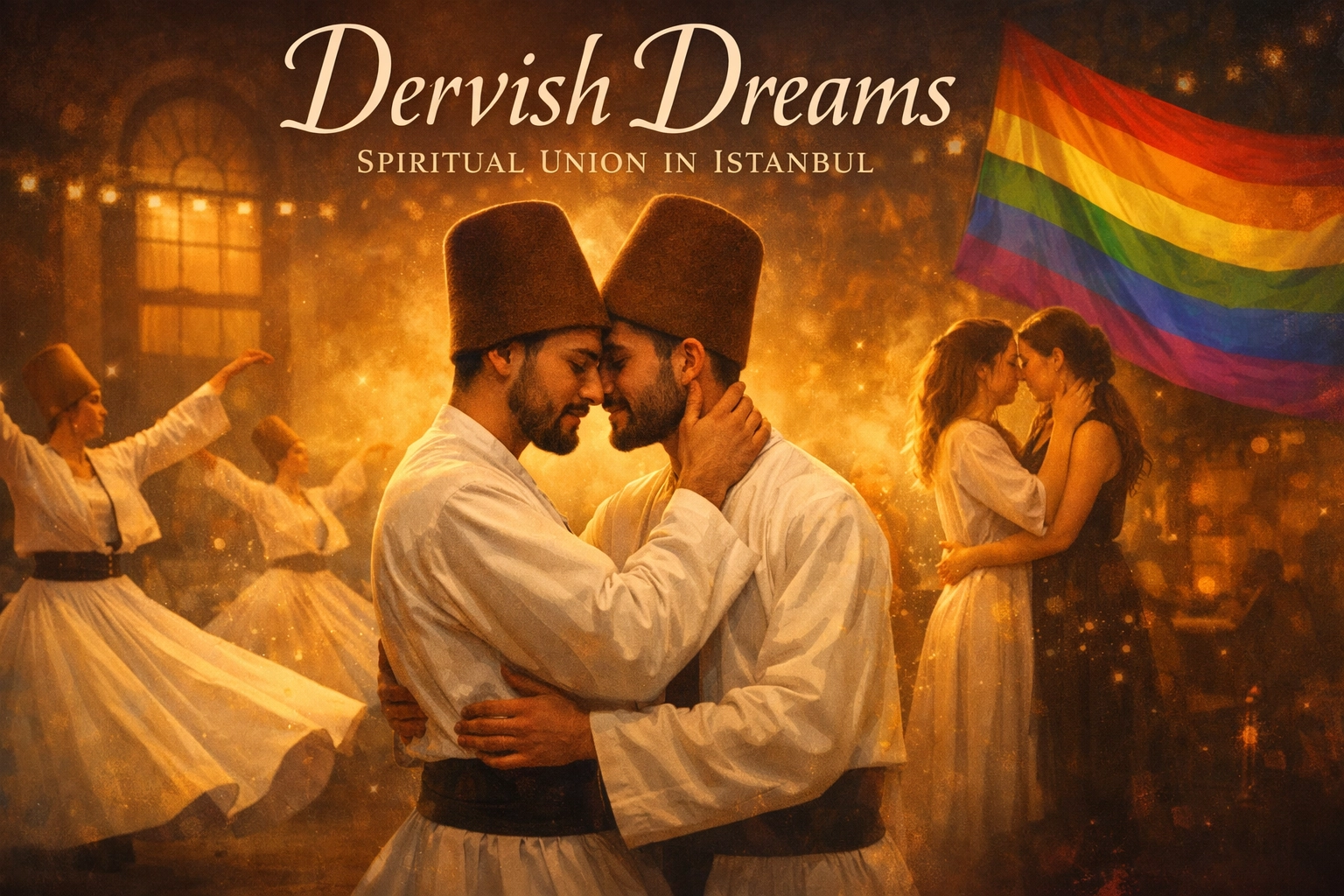
"The minute I heard my first love story, I started looking for you, not knowing how blind that was. Lovers don't finally meet somewhere. They're in each other all along." , Rumi
When the Soul Recognizes Itself
Mehmet first saw Kerem at the Hodjapasha Dance Theater on a February evening, when the ancient stones still held the chill of winter and the air smelled of incense and possibility. The converted 15th-century hamam had been transformed into a sacred space, and as the Whirling Dervishes began their Sema ceremony, Mehmet felt something shift inside his chest, a recognition that had nothing to do with the performance before him.
Kerem stood three rows back, his profile illuminated by the soft theatrical lighting. But it wasn't his beauty that caught Mehmet's attention. It was the way tears streamed silently down his face as the dervishes spun, their white skirts blooming like flowers seeking the sun, their arms raised, one hand pointing to heaven, one to earth, becoming conduits for divine love.
This is a story about that moment. About two men who found each other in Istanbul's oldest spiritual tradition, and discovered that the love Rumi wrote about eight centuries ago doesn't discriminate.
The Language of Turning
In Sufi tradition, the Sema ceremony represents the soul's journey toward God, a spiritual ascent through love, a shedding of ego, a return to truth. The dervishes don't whirl for show. They enter a hyperconscious state of meditation, their physical bodies maintaining an axis while their spirits soar toward divine unity.
Mehmet had come to the ceremony seeking answers. Thirty-two years old, a literature professor at Istanbul University, he'd spent years reconciling his faith with his identity. Growing up queer in a religious family meant learning to hold contradictions, to love Allah while believing Allah couldn't possibly love him back. Not as he truly was.
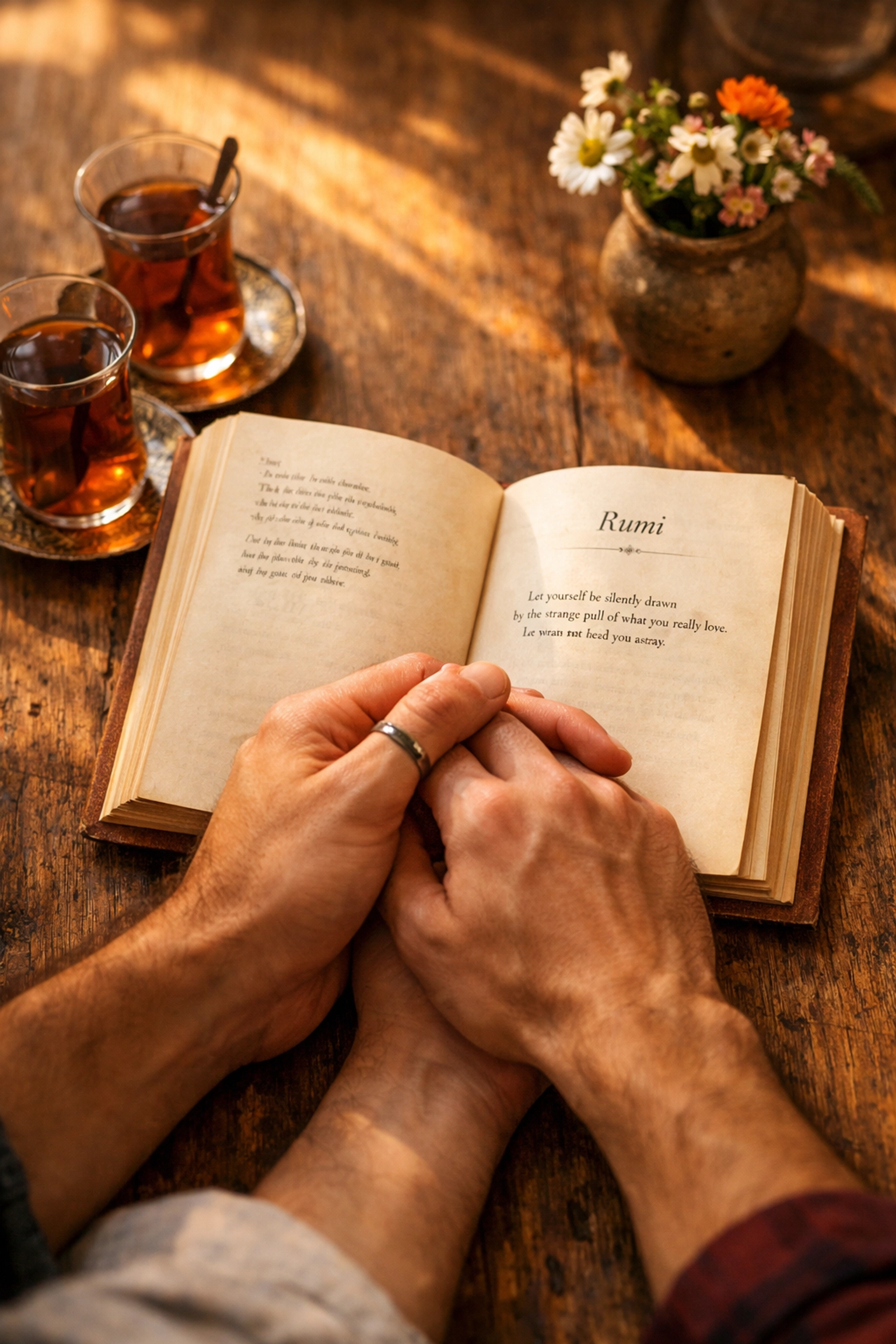
But Rumi's poetry had always suggested otherwise. "Let yourself be silently drawn by the strange pull of what you really love. It will not lead you astray."
After the performance ended, Mehmet found himself standing outside the theater, unable to leave. The February wind cut through his coat, but he stayed, watching tourists and locals filter out into the night. When Kerem emerged, their eyes met with the inevitability of planets following their orbits.
"First time?" Kerem asked in Turkish, his voice still thick with emotion.
"No," Mehmet replied. "But the first time it made me cry."
Coffee and Confession
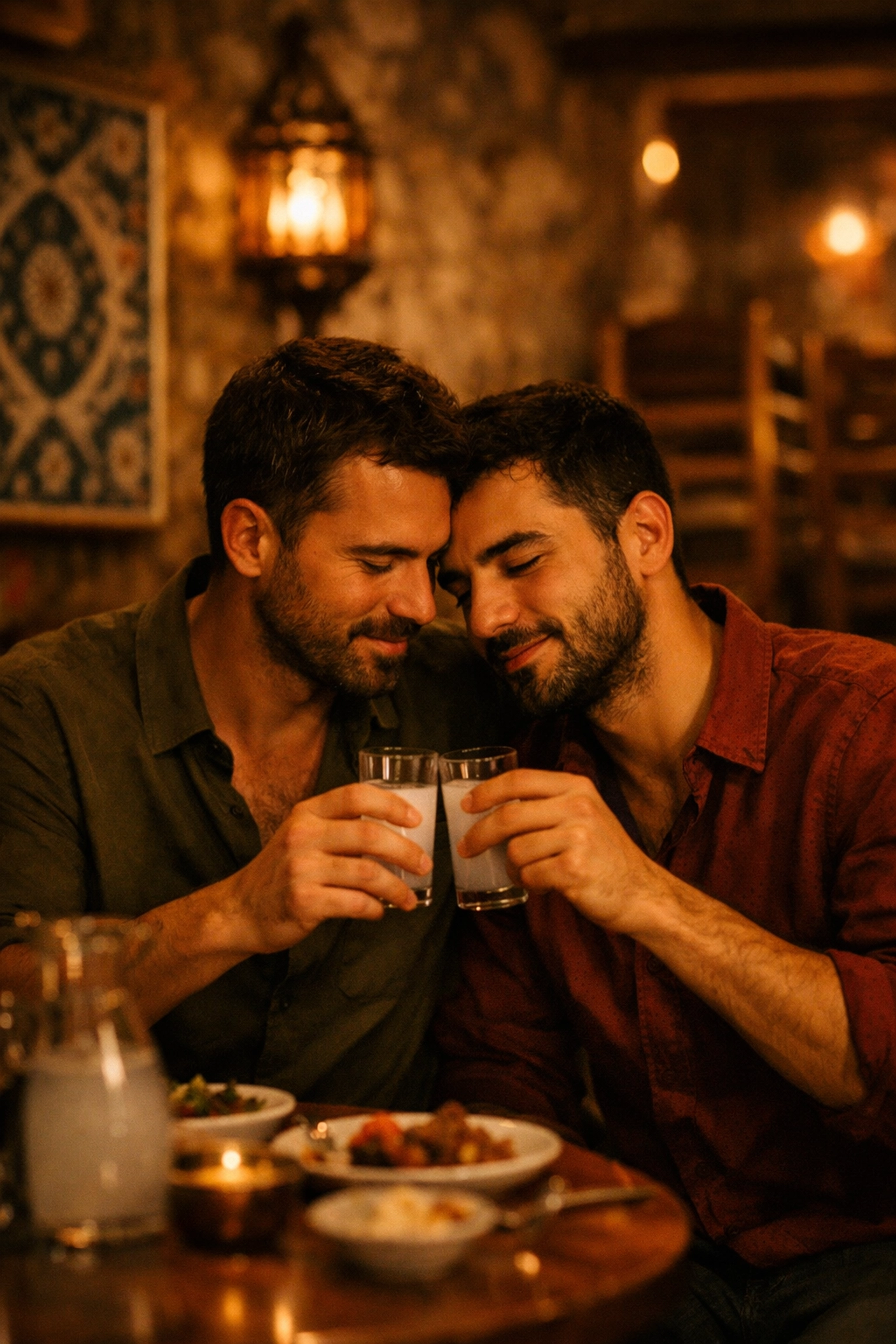
They ended up at a meyhane in Beyoğlu, tucked away from the main streets where the tourists congregated. Over glasses of rakı that turned cloudy white when water touched them: aslan sütü, lion's milk: they talked until the owner started stacking chairs around them.
Kerem was a graphic designer, originally from Izmir, who'd moved to Istanbul five years ago for work and stayed for the city's peculiar magic. "There's something about Istanbul," he said, "the way it holds so many contradictions without breaking. East and West. Ancient and modern. Sacred and profane."
"Conservative and queer," Mehmet added quietly.
Kerem smiled. "Especially that."
They discovered they'd both grown up in religious households, both loved Rumi's poetry, both had complicated relationships with the faith that shaped them. Kerem's grandmother had been a follower of the Mevlevi order: the Sufi tradition founded by Rumi himself. She'd taught him that aşk, divine love, was the force that spun the planets and the dervishes alike.
"She told me once that love is love," Kerem said, his fingers tracing the rim of his glass. "That Allah sees the heart, not the body. Not the gender."
Mehmet felt something crack open inside him: a door he'd kept locked for so long he'd forgotten it was there.

The Museum of Souls
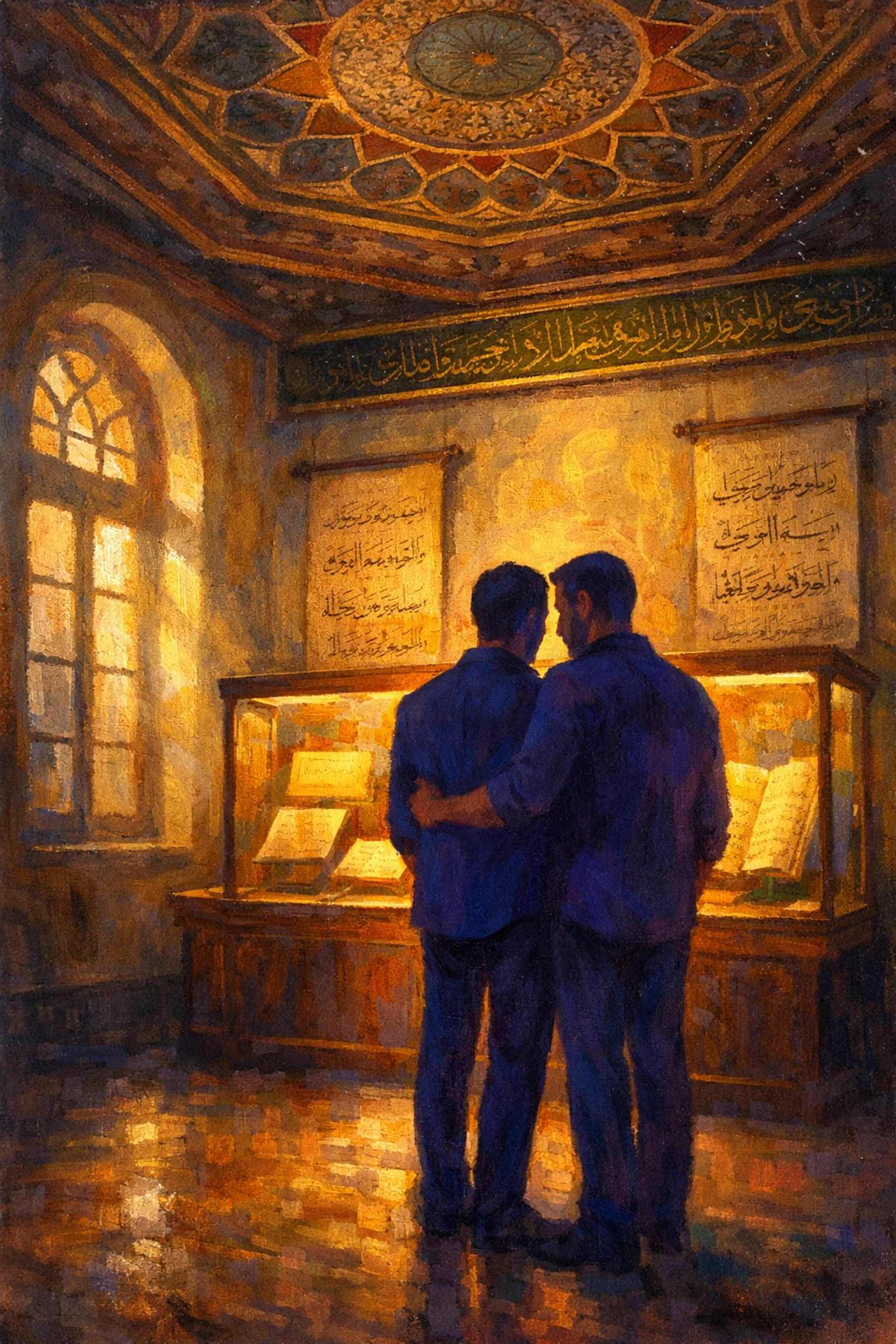
Their second meeting was at the Galata Mevlevi Museum, the tekke where the Mevlevi dervishes once lived and studied. They arrived early on Sunday, before the 17:00 ceremony, and wandered through the museum's quiet halls. Here were Rumi's teachings made tangible: calligraphy scrolls, ancient musical instruments, the tennure (the white skirts) that symbolized the ego's shroud.
In a small side room, they found a display of Rumi's poetry in Turkish, Persian, and English. Mehmet read aloud: "Goodbyes are only for those who love with their eyes. Because for those who love with heart and soul, there is no such thing as separation."
"Do you believe that?" Kerem asked.
"I'm starting to."
When the ceremony began in the octagonal hall, they sat side by side on the wooden benches, shoulders touching. The dervishes entered in their black cloaks: representing the tomb, the ignorance that must be shed. When they removed their cloaks, revealing the white tennure beneath, it was a symbolic rebirth.
As the ney flute began to play: that haunting, hollow sound like the soul crying out for the divine: Kerem reached for Mehmet's hand.
It wasn't a romantic gesture. Or rather, it was something deeper than romance. It was recognition. Two souls who'd been wandering separately, suddenly understanding they'd been circling the same truth all along.
What Rumi Knew
Over the weeks that followed, they fell into each other like continents drifting together across an ancient sea. They walked along the Bosphorus at sunset, the water turning copper and gold. They explored bookshops in Kadıköy, pulling volumes of Yunus Emre and Hafiz from dusty shelves. They cooked together in Kerem's tiny Cihangir apartment, windows open to the sound of the city: calls to prayer mixing with street music, ferry horns, and laughter.
They talked about faith and fear, about what it meant to be queer in a Muslim country, in a city that was both welcoming and hostile, ancient and evolving. They talked about families who loved them but didn't understand them, about the exhaustion of living in partial truths.
But mostly, they just existed together. And in that existence, Mehmet began to understand what Rumi had been writing about all along.
Divine love wasn't separate from human love. The aşk that spun the dervishes was the same force that made his heart race when Kerem smiled. The unity the Sufis sought: the dissolution of self into the beloved: that's what it felt like when Kerem held him at night, two bodies breathing in sync, two souls recognizing themselves in each other.
The Ceremony of Two
Three months after they met, on a warm May evening, they returned to Hodjapasha. This time, they knew what they were watching. They understood that the dervishes' whirling wasn't about escaping the body but transcending it: about becoming so present in the physical that the spiritual could shine through.
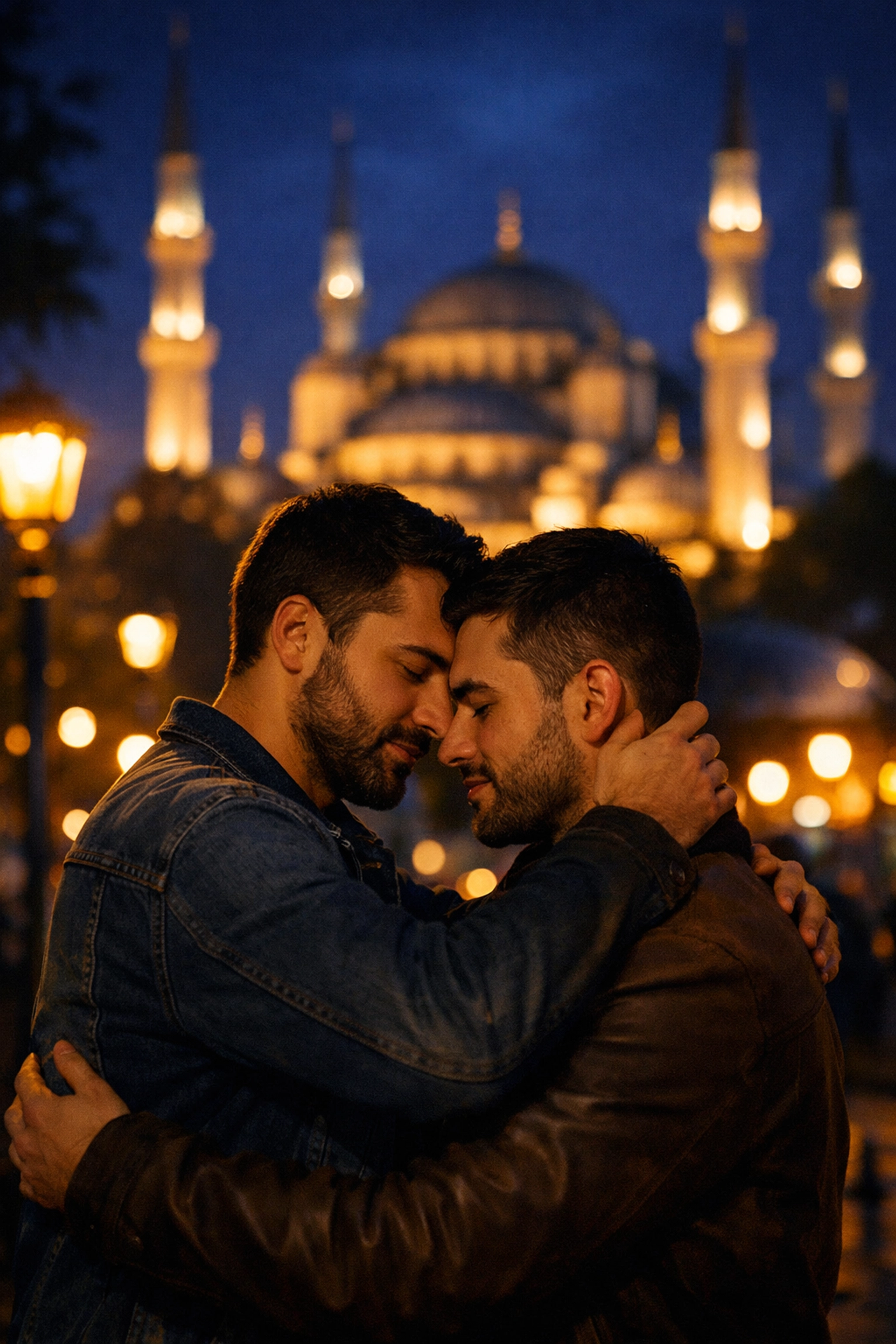
After the ceremony, walking back through the cobblestone streets of Sultanahmet, past the illuminated domes of mosques and the dark water of the Golden Horn, Kerem stopped.
"I love you," he said simply. "Not in spite of this city, or our faith, or anything we've been taught. But because of it. All of it."
Mehmet pulled him close, kissed him there under the Istanbul sky, where minarets pointed toward heaven and ferry lights danced on water, where Rumi's words still echoed across eight centuries: "I belong to no religion. My religion is love."
Love Without Labels
This is what the Sacred Hearts series is all about: showing that queer love and faith aren't contradictions. They're conversations. In Istanbul, where East meets West and ancient wisdom lives alongside modern complexity, two men found that the most sacred thing isn't dogma or tradition. It's connection. It's the courage to love authentically.
The Mevlevi dervishes understood something profound: that spinning toward the divine meant opening yourself to love in its purest form. No conditions. No restrictions. Just the endless turning toward truth.
Mehmet and Kerem's story continues, like the Sema itself: turning, seeking, finding, returning. Two men in Istanbul, writing their own verses in the poetry of divine love.
"Let the beauty we love be what we do. There are hundreds of ways to kneel and kiss the ground." : Rumi
Discover more beautiful MM romance stories that celebrate love in all its forms at Read with Pride. Because every love story deserves to be told.
Follow our journey:
- Facebook: Read with Pride
- Instagram: @read.withpride
- Twitter/X: @Read_With_Pride
#ReadWithPride #MMRomance #GayRomance #LGBTQFiction #QueerLove #SacredHearts #SufiLove #IstanbulRomance #MuslimLGBTQ #GayRomanceBooks #MMRomanceBooks #QueerFiction #DivineLove #LGBTQBooks #GayLoveStories #AuthenticLove #MMNovels #GayFiction #ContemporaryRomance #SpiritualRomance

Leave a Reply
You must be logged in to post a comment.