

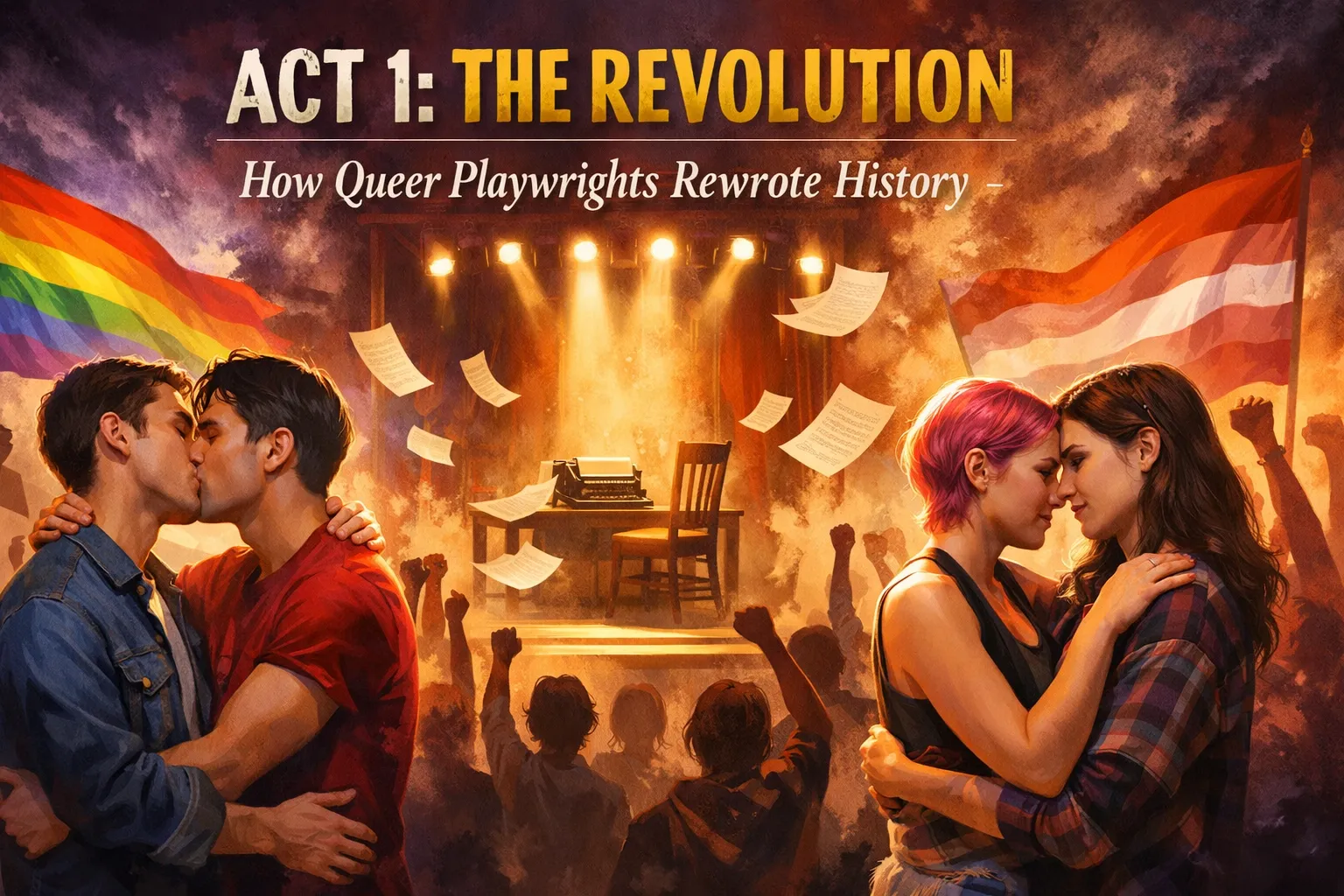
There's something profoundly powerful about live theatre. The lights dim, the curtain rises, and suddenly we're transported into someone else's story, their pain, their joy, their truth. For decades, queer stories were either invisible on stage or reduced to stereotypes and tragedy. But then came the revolutionaries, the playwrights who decided enough was enough. They picked up their pens and rewrote history, one script at a time.
The Stage Before the Revolution
Picture American theatre before 1964. If you were lucky, or unlucky, depending on how you look at it, you might catch a glimpse of a gay character. But they weren't really characters at all. They were cautionary tales, tragic figures skulking in closets, their queerness presented as a fatal flaw or a shameful secret. These weren't people; they were props in someone else's moral lesson.
The message was clear: queer lives weren't worthy of celebration, complexity, or even basic humanity. If we appeared at all, we were there to suffer, repent, or disappear by the final act. This wasn't just bad representation, it was erasure dressed up as art.
Enter Leslie Bright: The Queen Who Changed Everything
Then came 1964, and everything shifted. Lanford Wilson's The Madness of Lady Bright premiered at Caffe Cino in Manhattan, and contemporary queer theatre was born. The play centered on Leslie Bright, a lonely drag queen who was fierce, outspoken, and unapologetically herself. No closets, no apologies, no tragic suicide in Act III.
The Village Voice called it "repulsive." And honestly? That reaction tells you everything you need to know about how revolutionary this moment was. Wilson wasn't asking permission to tell Leslie's story. He wasn't softening the edges or making queerness palatable for straight audiences. He was simply showing a queer character as a person, complex, sympathetic, and gloriously, defiantly real.
The Madness of Lady Bright ran for 205 performances, becoming one of Caffe Cino's most popular productions. But more importantly, it kicked down a door that had been locked for far too long. Suddenly, queer stories had a home.
The Safe Haven: Caffe Cino's Underground Revolution
Behind every revolution is infrastructure, and for queer theatre, that infrastructure was Caffe Cino. Established in 1958 by Joe Cino, a retired Sicilian-American dancer, this tiny Greenwich Village coffee shop became so much more than a venue. It became a sanctuary.
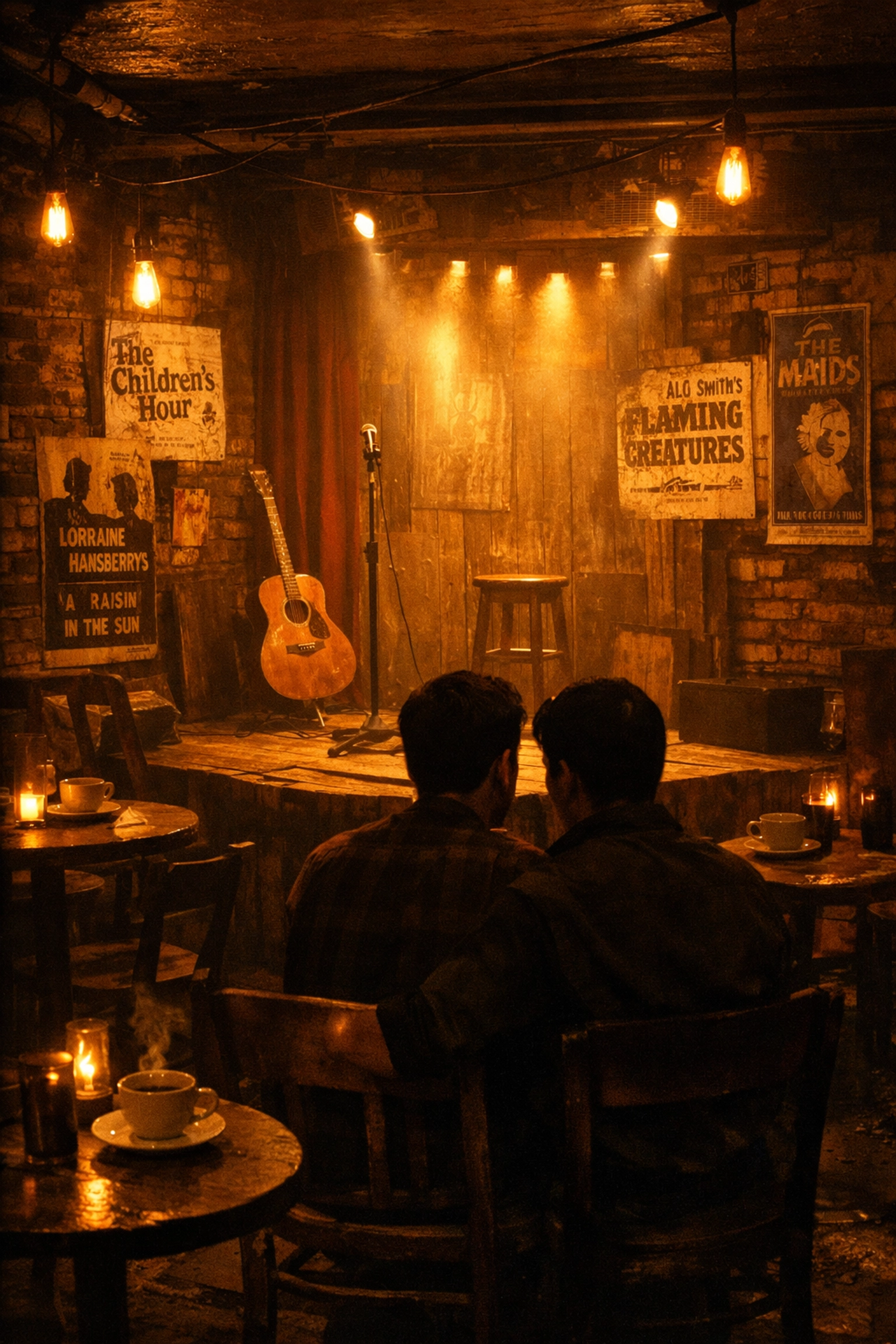
Built on a shoestring budget with recycled materials, the Cino's stage was small, scrappy, and perfect. Joe Cino curated a program of homoerotic plays by writers like Jean Genet, Oscar Wilde, and Tennessee Williams, works that other venues wouldn't touch. And because this was the pre-Stonewall era, when police raids on queer spaces were routine, Cino did something that might sound shocking today: he paid local police to leave them alone.
That payment wasn't corruption, it was survival. It transformed the Cino into more than just a theatre. It became a fashionable alternative to bars and bathhouses, a place where queer New Yorkers could gather, create, and exist without fear. For once, we controlled the narrative. For once, we got to tell our own stories.
The Ripple Effect: A Generation of Queer Voices
Wilson's success opened the floodgates. The Cino became New York's first theatre dedicated to contemporary queer writing, and it launched the careers of an entire generation of playwrights: Tom Eyen, William M. Hoffman, Robert Patrick, Doric Wilson, and countless others who might never have found a platform otherwise.
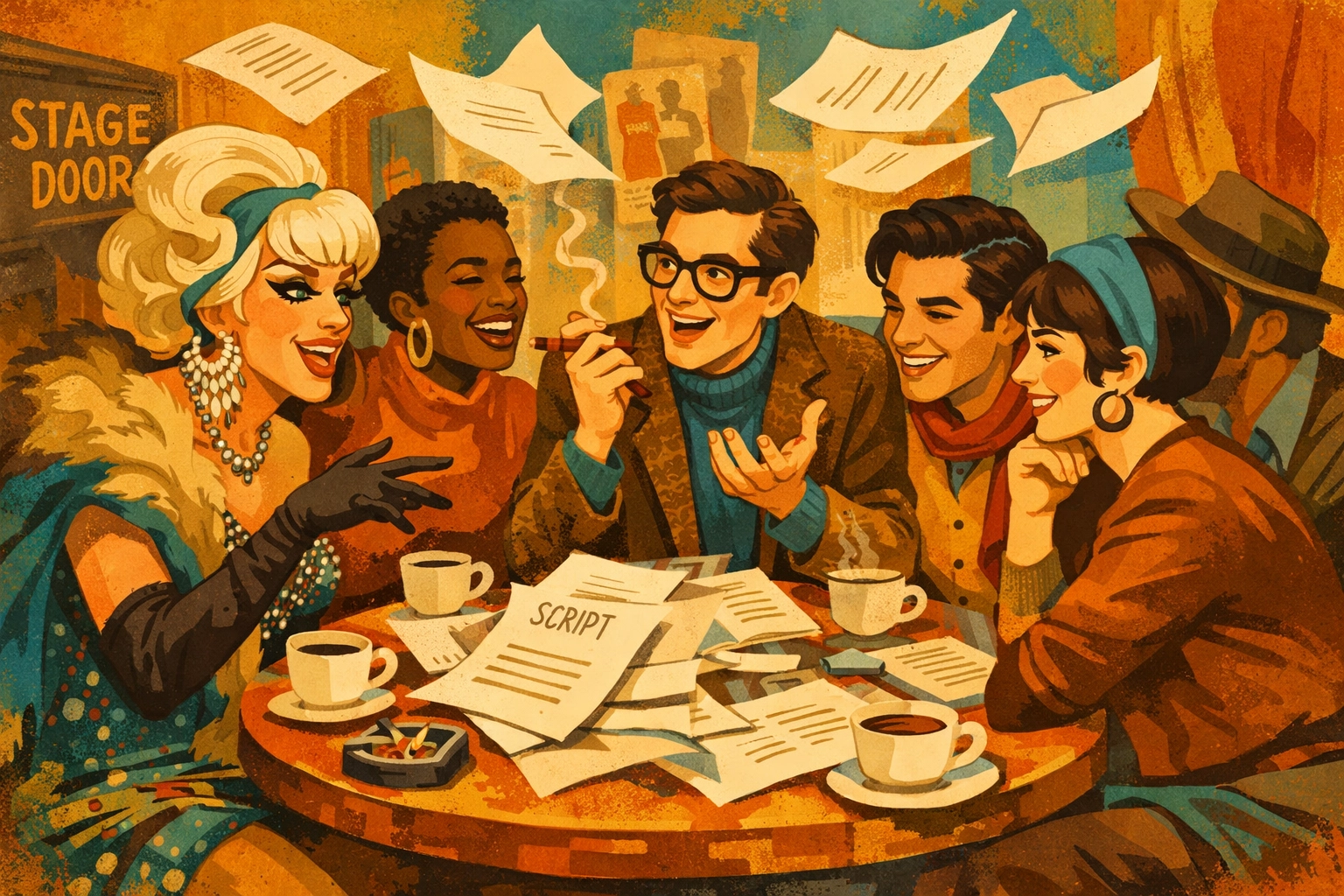
These writers didn't just create entertainment, they created community. They explored themes that mainstream theatre refused to touch: the complexity of queer desire, the violence of homophobia, the beauty of queer love and friendship. They showed audiences that our lives contained multitudes, that we could be funny, tragic, romantic, political, messy, and magnificent all at once.
Throughout the latter 20th century, queer theatre continued to thrive "on the margins, in financially precarious off-off-Broadway venues, performance spaces, basement bars and community groups." These weren't glamorous spaces with velvet seats and corporate sponsorship. They were DIY, scrappy, and absolutely vital, places where queer stories could be performed by and for queer audiences without censorship or compromise.
What Was Lost, What Remains
Here's the heartbreaking part: much of this history has been lost. When Caffe Cino closed in 1968 after Joe Cino's tragic death, many scripts and records disappeared. Countless queer plays from this era exist now only in fading memories, if at all. The mainstream theatre establishment didn't think our stories were worth preserving.
But what remains is the legacy, the proof that queer playwrights fundamentally rewrote the rules of American theatre. They insisted that our stories mattered. They created spaces where we could see ourselves reflected with dignity, complexity, and truth. They showed us that the stage could be a site of revolution, not just entertainment.
Why This History Matters for Readers Today
You might be wondering what 1960s queer theatre has to do with MM romance books or contemporary LGBTQ+ fiction in 2026. Everything, actually.

These playwrights were doing then what gay romance novels and queer fiction do now: they were claiming space for authentic queer stories. When you pick up an MM romance from Readwithpride.com, you're participating in that same tradition. You're saying that gay love stories deserve to exist, to be celebrated, to take up space without apology.
Just as Wilson and his contemporaries refused to limit queer characters to tragedy, today's gay authors and MM authors refuse to limit queer stories to coming-out narratives or Issue Books™. They write gay romance series where the queerness is simply part of the character's identity, not their entire personality. They write gay fantasy romance, gay thriller, gay historical romance, and every other genre under the sun, because we contain multitudes.
The Revolution Continues
The stage revolution that started at Caffe Cino never really ended. It just changed venues. Today, queer stories appear on Broadway, on streaming platforms, in bestselling gay fiction, and yes, in the pages of LGBTQ+ ebooks that you can download right now.
Every gay novel, every MM contemporary romance, every steamy MM romance that ends with a happily-ever-after is part of this legacy. We're still rewriting history, still insisting that our stories deserve space, still creating community around the radical act of telling queer truths.
So the next time you settle in with one of the best MM romance novels of 2026, remember: you're part of a revolution that started in a tiny Greenwich Village coffee shop over sixty years ago. You're continuing the work that those early playwrights began: the work of saying that queer joy, queer love, and queer lives are worth celebrating.
And that, friends, is how the curtain rose on our revolution.
Ready to be part of the story? Explore our collection of award-winning gay fiction and new gay releases at Readwithpride.com. Whether you love slow burn MM romance, enemies to lovers, or forced proximity tropes, there's a queer story waiting for you.
Follow us for more LGBTQ+ content:
- Facebook: Read With Pride
- Instagram: @read.withpride
- Twitter/X: @Read_With_Pride
#ReadWithPride #QueerTheatre #LGBTQHistory #MMRomance #GayRomanceBooks #QueerFiction #GayFiction #LGBTQBooks #MMRomanceBooks #GayAuthors #QueerStories #TheatreHistory #LGBTQPride #GayLoveStories #MMBooks #QueerRevolution #LGBTQReading #GayBookClub #2026Books

Leave a Reply
You must be logged in to post a comment.