


Some books don't just tell a story, they rewrite what we thought stories could do. Middlesex is one of those rare literary earthquakes that shook the ground beneath our feet and left us standing in a completely different landscape. Published in 2002 and winning the Pulitzer Prize for Fiction in 2003, this sweeping epic doesn't just give us an intersex protagonist; it gives us three generations of Greek-American family history, a meditation on identity itself, and one of the most important pieces of LGBTQ+ literature ever written.
If you haven't read it yet, buckle up. We're about to dive into why Middlesex remains an essential read for anyone passionate about queer fiction and the stories that expand our understanding of gender, identity, and what it means to be human.
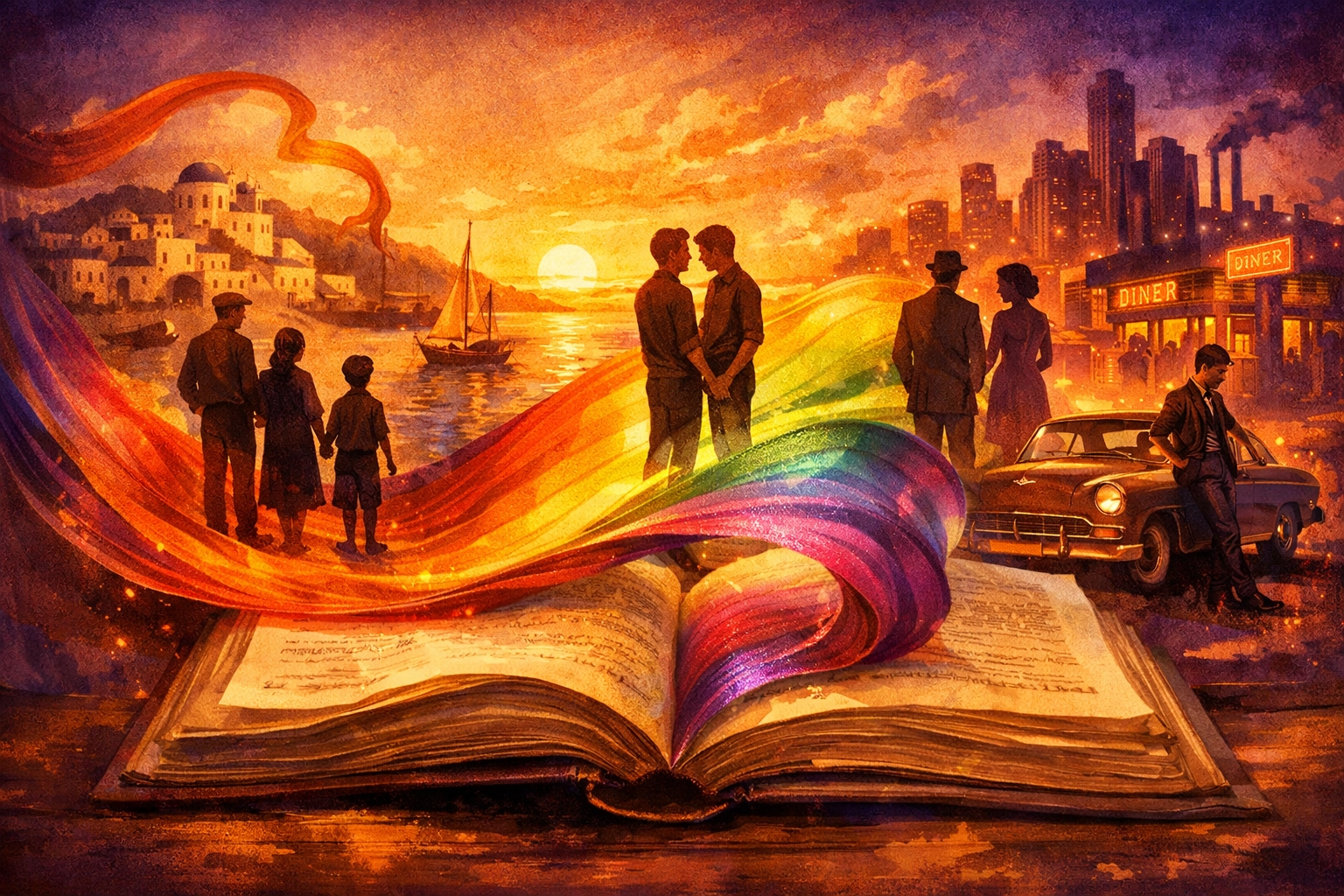
An Epic That Spans Continents and Generations
Middlesex isn't your typical coming-of-age story, though it certainly contains one. The novel opens with narrator Cal Stephanides, born Calliope, reflecting on his intersex condition and the genetic quirk that travelled through his family tree like a secret message waiting to be decoded. But before we get to Cal's story, we go way back. Like, 1922 Greece back.
The narrative sweeps us from a burning Smyrna during the Greco-Turkish War to the streets of Detroit, where Cal's grandparents arrive as refugees and build a new life in America. We follow the family through Prohibition, the rise and fall of Detroit's automotive golden age, the 1967 riots, and eventually into the suburbs where Cal grows up as Callie: a girl who doesn't quite fit the mold.
This multigenerational structure isn't just showing off (though the literary craftsmanship is genuinely stunning). It's fundamental to understanding how identity forms, how secrets compound across decades, and how one recessive gene can carry the weight of an entire family's unspoken truths. It's gay literature at its most ambitious, refusing to be confined to a single timeline or perspective.

The Intersex Experience: Groundbreaking Representation
Here's what makes Middlesex genuinely revolutionary: in 2002, intersex characters were virtually invisible in mainstream literature. Cal's journey: from being raised as Callie, through the discovery of his intersex condition at fourteen, to his eventual life as a man: brought intersex experiences into the cultural conversation in a way few works had done before.
The novel doesn't shy away from the medical realities, the confusion, the shame that society tries to impose on bodies that don't fit neatly into binary categories. Cal's adolescence is marked by a growing awareness that something is different, culminating in a diagnosis that forces both him and his family to confront questions they've never had to ask before.
But Middlesex never reduces Cal to just his biology. He's a fully realized character with desires, fears, humor, and agency. When he discovers the truth about his body and makes the choice to live as male rather than undergo surgery as doctors recommend, it's a powerful assertion of self-determination. In an era when intersex infants were routinely subjected to "corrective" surgeries, Cal's story offered a counter-narrative: what if we let people decide for themselves?
More Than Identity: A Literary Masterpiece
Let's talk craft for a minute, because Middlesex isn't just important: it's beautifully written. The prose has this confident swagger, jumping between time periods and perspectives with the kind of narrative control that makes it look easy (spoiler: it's not). Cal's voice as narrator is wry, self-aware, and often hilarious, even when dealing with painful material.
The mythological allusions throughout the novel (Hermaphroditus, Tiresias, the Oracle at Delphi) add layers of meaning without feeling pretentious. They remind us that questions of gender and transformation are ancient, not modern inventions. People have always existed outside the binary; literature just hasn't always acknowledged it.

And can we talk about that opening line? "I was born twice: first, as a baby girl, on a remarkably smogless Detroit day in January of 1960; and then again, as a teenage boy, in an emergency room near Petoskey, Michigan, in August of 1974." It's one of the great opening sentences in contemporary literature: immediately intriguing, perfectly setting up the dual narrative, and announcing that this book is going to do something different.
Cultural Impact and Lasting Legacy
When Middlesex won the Pulitzer, it wasn't just a win for one book: it was a watershed moment for LGBTQ+ fiction in mainstream literary culture. Here was a major literary prize going to a novel that centered an intersex experience, that treated gender as something complex and multifaceted rather than simple and fixed.
The book helped educate countless readers about intersex conditions (the novel deals specifically with 5-alpha-reductase deficiency) at a time when most people had never heard the term "intersex." It sparked conversations in book clubs, classrooms, and living rooms about gender, biology, and identity. It showed publishers that queer fiction could be both commercially successful and critically acclaimed.
More than two decades later, Middlesex remains relevant. As conversations about gender identity have evolved and expanded, as non-binary and trans voices have become more visible, the novel's exploration of what it means to exist outside conventional gender categories feels even more prescient. It's required reading in gender studies courses, frequently appears on "best of" lists, and continues to find new readers every year.
Why You Should Read It (Or Reread It) Now
If you're looking for gay books that challenge you intellectually while keeping you emotionally engaged, Middlesex delivers on all fronts. It's a family saga, a coming-of-age story, an immigrant narrative, a meditation on identity, and a damn good yarn all rolled into one.
For readers at Read with Pride, this novel represents exactly the kind of LGBTQ+ literature we celebrate: stories that expand our understanding of queerness, that refuse easy categorization, that insist on the complexity and dignity of lives lived outside the mainstream. While we may focus primarily on MM romance books and gay romance novels, works like Middlesex remind us of the broader landscape of queer storytelling.
The novel also offers something rare: a story that looks at how families handle difference, how secrets shape relationships across generations, and how the choice to be authentic can ripple through an entire family system. It's ultimately hopeful without being naive, honest without being cruel.

Finding Your Next Great Read
Middlesex is part of our ongoing "Pages of Pride" series, where we're exploring 50 of the best LGBTQ+ books in history and contemporary literature. From classics to contemporary hits, from MM fiction to broader queer narratives, we're building a reading list that celebrates the full spectrum of queer storytelling.
Whether you're a longtime fan of gay literature or just discovering the wealth of queer fiction out there, Middlesex deserves a spot on your shelf. It's proof that LGBTQ+ fiction can be epic in scope, literary in ambition, and deeply, profoundly human in its concerns.
Ready to explore more essential queer reads? Check out our full collection at readwithpride.com where we're constantly adding new recommendations, from steamy MM romance to thought-provoking literary fiction.
Follow us for more LGBTQ+ book recommendations:
- Facebook: Read With Pride
- Instagram: @read.withpride
- Twitter/X: @Read_With_Pride
#MiddlesexNovel #IntersexLiterature #LGBTQBooks #QueerFiction #ReadWithPride #GayLiterature #LiteraryFiction #PulitzerPrize #PagesOfPride #QueerReads #LGBTQReading #DiverseBooks #GenderIdentity #ContemporaryFiction #BookRecommendations #LGBTQHistory #QueerClassics #MustRead #BookLovers #PrideReading

Leave a Reply
You must be logged in to post a comment.