

readwithpride.com
Sometimes the most faithful act is the one that gets you kicked out of church.
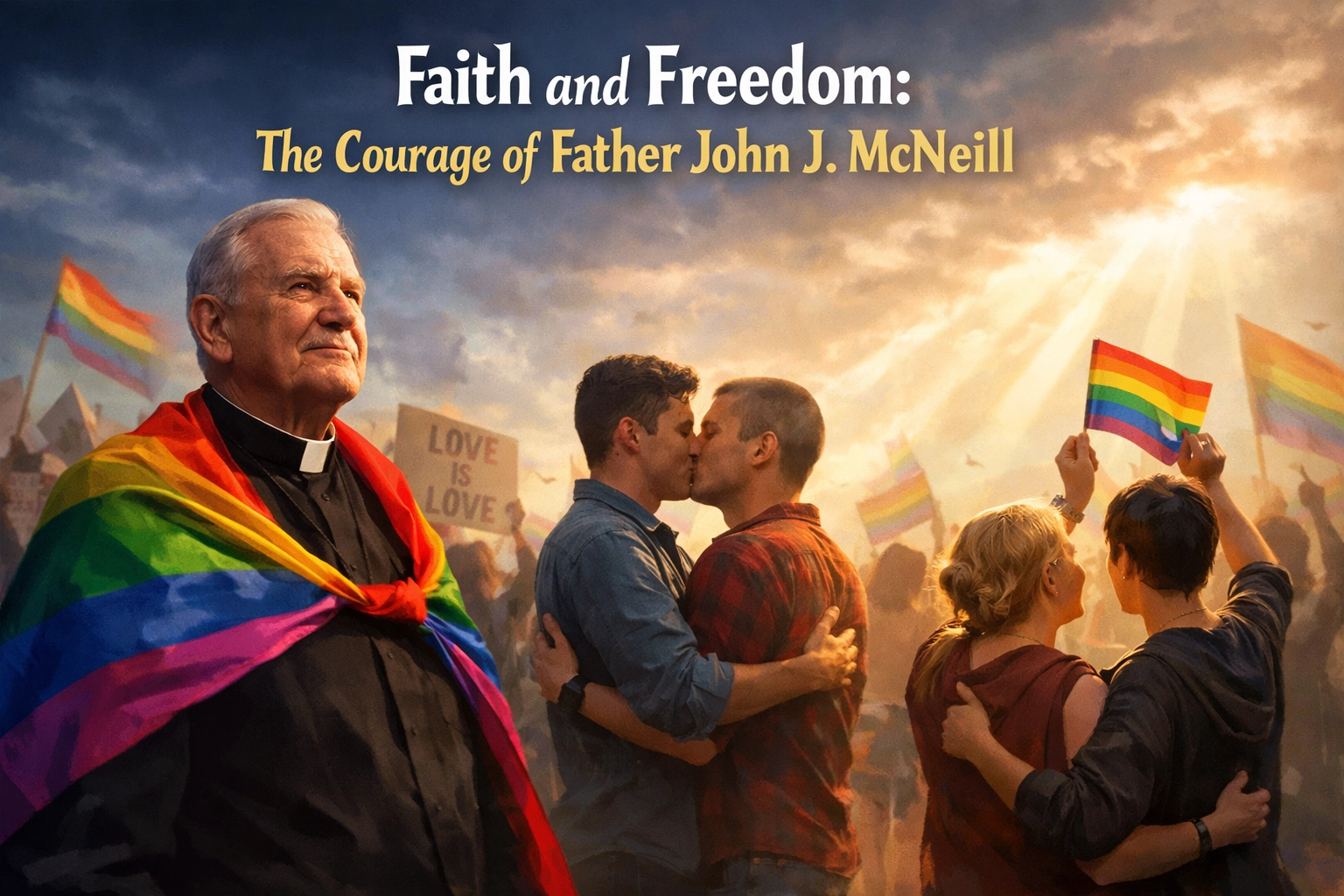
Father John J. McNeill knew this truth better than most. A Jesuit priest who spent nearly four decades in service to his religious community, he made a choice that would define his legacy: speak truth to power, even when that power wore a mitre and held the keys to heaven. His story isn't just about scandal or secrets: it's about the extraordinary courage it takes to choose love over obedience when the two come into conflict.
A Faith Forged in Fire
John McNeill didn't stumble into priesthood. His calling was born in the darkest of places: a Nazi POW camp during World War II. Captured at just 17 years old while serving in the Army, he found himself facing the very real possibility of death. But instead of breaking him, the experience deepened something profound within him. He later described those harrowing days as deeply spiritual, a time when he felt God's presence more clearly than ever before.

When he returned home to Buffalo, New York, that Irish Catholic kid who'd survived the war knew exactly what he wanted to do with his life. In 1948, he entered the Society of Jesus: the Jesuits: and was ordained in 1959. For the next two decades, he taught theology and philosophy at prestigious institutions like Fordham University, Union Theological Seminary, and Le Moyne College. He became known not just as a brilliant scholar, but as a peace advocate during the Vietnam War, someone who understood firsthand the cost of violence and the value of human dignity.
Everything seemed to be going according to plan. But McNeill was about to drop a theological bomb that would shake the very foundations of Catholic teaching.
The Book That Changed Everything
In 1976, Father McNeill published The Church and the Homosexual, and the Catholic world would never be the same. The New York Times later called it "the first extended nonjudgmental work about gay Catholics, a subject that had long been taboo in official church discourse." That might sound dry, but what it really means is this: for the first time, a Catholic priest was saying out loud what countless LGBTQ+ Catholics had been whispering in confession booths and crying about in prayer: that maybe, just maybe, being gay wasn't a sin.

Using arguments drawn from human sciences and Catholic scholarship itself, McNeill challenged the Church's prohibition on same-gender relationships. He didn't just say "be nice to gay people" (though that would have been radical enough). He argued that the Church's stance was fundamentally wrong: "pastorally harmful and theologically incorrect," as he put it. He dared to suggest that the institution he'd devoted his life to was causing real, measurable harm to God's children.
The book was groundbreaking in the truest sense: it broke ground that had been considered sacred and untouchable. For gay Catholics who'd been told their entire lives that they were disordered, broken, or condemned, McNeill's words were like water in a desert.
But Rome was watching. And Rome was not pleased.
When Cardinals Come Calling
The pushback was swift and severe. The Vatican, then led by Cardinal Joseph Ratzinger (who would later become Pope Benedict XVI), wasn't about to let a parish priest rewrite two thousand years of doctrine. In 1986, Ratzinger issued a directive that would become infamous in LGBTQ+ Catholic circles: he called homosexuality an "objective disorder."
McNeill didn't blink. He publicly criticized the directive as "cruel": and that word choice matters. Not "misguided." Not "unfortunate." Cruel. He was calling out the institutional Church for inflicting suffering on vulnerable people in the name of God.

Rome's response was predictable: shut up or get out. They ordered him to cease all ministry to gay persons, to essentially abandon the very people he'd spent years serving and advocating for. The choice was clear: maintain his status within the Jesuit order by staying silent, or lose everything by speaking truth.
He chose truth.
The Price of Prophecy
In 1987, after nearly 40 years as a Jesuit, Father John J. McNeill was expelled from his religious community. Let that sink in: four decades of service, of teaching, of ministry, all ending because he refused to tell LGBTQ+ Catholics that their love was disordered. He later referred to himself as "a Jesuit in exile," a poignant phrase that captures both his ongoing spiritual identity and his forced separation from the community that had defined his adult life.
But here's the thing about prophets: they don't stop being prophetic just because you remove their official title. If anything, McNeill's work accelerated after his expulsion. Free from the constraints of institutional approval, he could finally say everything he believed needed to be said.
He co-founded DignityUSA, an organization that became a lifeline for LGBTQ+ Catholics across the country: a place where they could be both fully gay and fully Catholic, without apology or shame. This wasn't just about creating a social club; it was about providing spiritual community for people the Church had rejected.
Love in the Time of AIDS
Then came the AIDS crisis, and McNeill showed what active compassion actually looks like. In 1988, at the height of the epidemic when fear and stigma were at their peak, he co-founded the Upper Room AIDS Ministry (now Harlem United). While many in the religious community were either silent or openly hostile toward people with AIDS, McNeill was providing housing, pastoral counseling, and healing.

He believed deeply that "every human being has a God-given right to sexual fulfillment" and that "individual conscience needs to be the final arbiter when deciding on sexual matters." These weren't just abstract theological positions: they were guiding principles that led him to show up for dying men when much of society had turned its back.
This is what made McNeill different from other liberal theologians who might have written sympathetic papers from the safety of their offices. He didn't just theorize about compassion; he embodied it. He held hands with the sick, blessed the dying, and celebrated the love that mainstream religion condemned.
A Legacy Written in Rainbow Ink
The accolades came, even if the Vatican's blessing never did. In 1984, he received the National Human Rights Award. In 1987, he was chosen as Grand Marshal of the New York City Gay Rights Parade: imagine a Catholic priest leading that march down Fifth Avenue, cassock and all. The Dignity/USA Prophetic Service Award recognized over 25 years of extraordinary work on behalf of Catholic LGBTQ+ communities.
But perhaps his greatest legacy isn't the awards or the books or even the organizations he founded. It's the countless individuals who read his work or heard him speak and finally, for the first time, believed that they could be both gay and beloved by God. For people raised in religious traditions that told them to choose between their faith and their authentic selves, McNeill offered a third option: wholeness.
Father John J. McNeill died in 2015 at the age of 90, still officially a priest, still believing that the Church would eventually catch up to what his conscience had always known. His story reminds us that sometimes the most faithful thing you can do is refuse to be silent when silence means complicity in someone else's suffering.
In a world where we often hear about religious hypocrisy and hidden scandals, McNeill's life stands as something different entirely: a story of radical integrity, of choosing the harder path because it was the right path. He proved that you can challenge an institution while still loving it, that you can be expelled from a community while remaining faithful to its deepest values.
For LGBTQ+ readers looking for stories of courage and authenticity, McNeill's journey is essential reading. It's a reminder that our history includes not just the people who persecuted us, but also those who risked everything to stand with us: sometimes from the most unexpected places.
Looking for more stories of LGBTQ+ courage and truth? Explore our collection of gay romance books and MM fiction at Read with Pride, where every story celebrates authentic love and brave lives.
#ReadWithPride #LGBTQHistory #FatherMcNeill #GayRights #CatholicLGBTQ #QueerFaith #LGBTQBooks #MMRomance #GayFiction #PrideReading #QueerHistory #LGBTQCommunity #AuthenticLove #CourageousStories #GayRomanceBooks
Connect with us:
📘 Facebook
🐦 X/Twitter
📸 Instagram
🌐 readwithpride.com

Leave a Reply
You must be logged in to post a comment.