

readwithpride.com
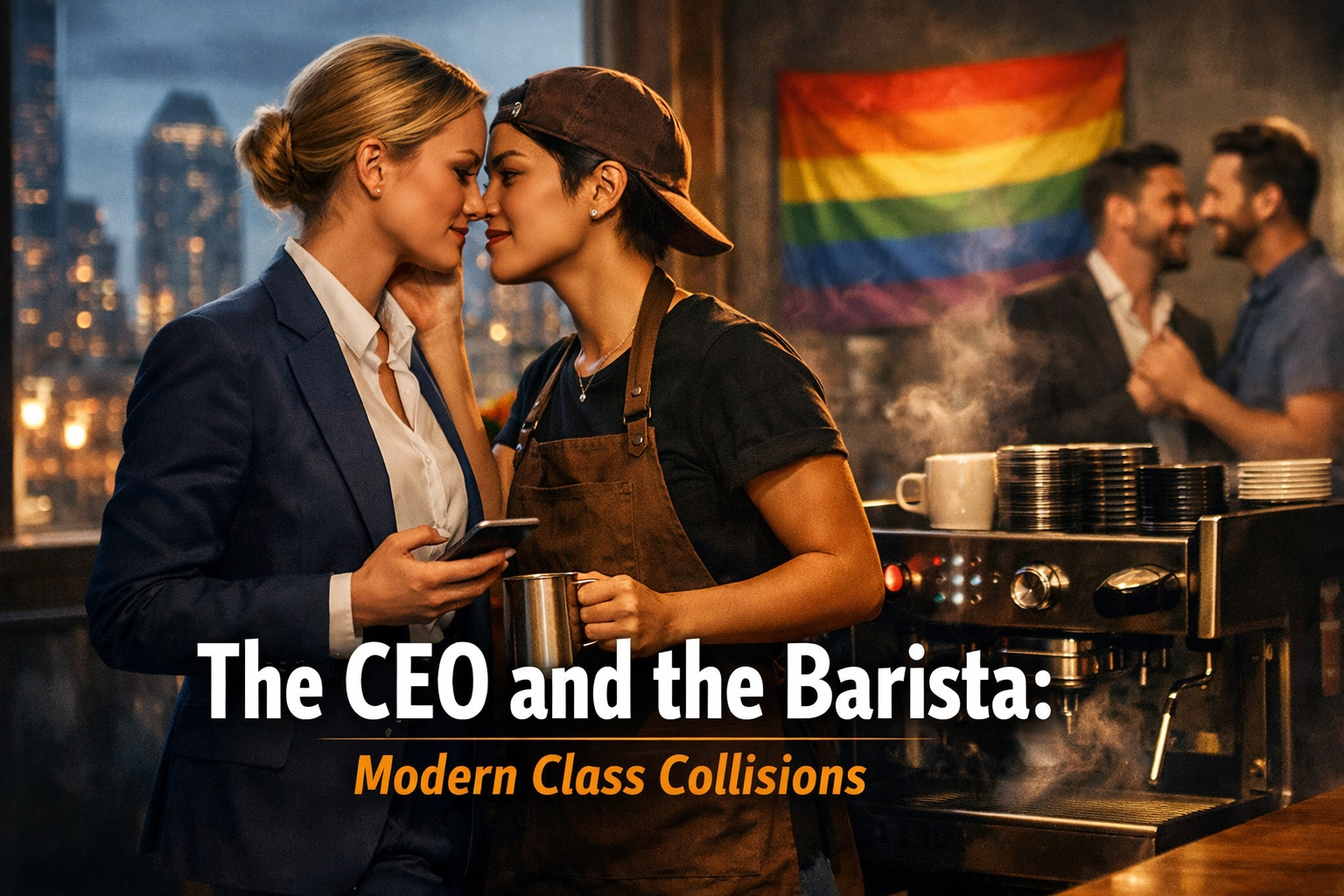
The coffee shop on Fifth Avenue opens at 6:47 AM sharp. Marcus knows because he's been watching the door for three weeks now, his Tesla idling across the street like some lovesick teenager's Honda Civic. Inside, through the steamed-up windows, he can see Jamie wiping down the espresso machine, getting ready for the morning rush that starts with Marcus himself.
It's ridiculous, really. Marcus runs a tech company valued at $2.3 billion. He has assistants who could pick up his coffee. Hell, he has an entire kitchen staff at his penthouse. But every morning, he walks through that door at 7:02 AM to order the same oat milk latte and spend exactly four minutes and thirty seconds talking to a barista who lives in a studio apartment in Queens with two roommates.
When Cappuccinos Cost More Than Conversations
The wealth gap in gay relationships isn't new, it's been creating drama since Roman senators were sneaking around with their enslaved cup-bearers. But in 2026, it hits different. We're not talking about sugar daddy arrangements or transactional relationships. We're talking about genuine connections that happen to cross economic borders that might as well be armed checkpoints.

Jamie makes $17 an hour plus tips. Marcus made that much in the time it took to read this sentence. When Marcus mentions "grabbing dinner," he's thinking of a restaurant where the tasting menu costs $450 per person. When Jamie suggests dinner, he means the Thai place on his block where you can eat for under twenty bucks.
The thing about class divides in gay relationships is that they magnify all the usual complications. You're already navigating coming out, family acceptance, and finding community. Now add "my boyfriend's credit card got declined at Whole Foods" or "my partner doesn't understand why I can't just take a week off work to go to Mykonos."
The Historical Receipts
Let's time-travel for a second, because this tension is old as dirt, or at least as old as property ownership. In ancient Rome, elite men often pursued relationships with freedmen or enslaved individuals. The power dynamics were, let's be honest, horrifying by modern standards. But even in those deeply unequal relationships, Roman writers documented the complications: jealousy, social stigma, and the constant question of whether affection was genuine or strategic.
Medieval Europe? Same story, different costumes. Court records from Renaissance Florence, a city that was simultaneously hostile to sodomy and completely saturated with same-sex desire, show cases of wealthy merchants prosecuted for relationships with apprentices or servants. The class difference wasn't just financial; it was baked into every social interaction.
Fast forward to Victorian England, and you've got Oscar Wilde's downfall triggered partly by his affair with Lord Alfred Douglas, less about class and more about family disapproval, but the dynamics are instructive. Wilde also pursued relationships with younger, working-class men, and those encounters contributed to his legal troubles. The upper classes could love across boundaries, but society made damn sure there was a price.

In the early 20th century, gay spaces in cities like Berlin and New York became rare places where class mixing could happen. The speakeasies, the underground clubs, these were democratic zones where a factory worker might dance with a banker. But when the lights came on and everyone went home, the economic realities remained stark.
The Modern Minefield
Back to Marcus and Jamie. After two months of increasingly charged conversations over coffee, Marcus finally asks Jamie out. Jamie says yes. The first date is… awkward. Marcus picks a restaurant he considers "casual": a wine bar where glasses start at $18. Jamie orders the cheapest item on the menu and barely touches it because he's doing mental math about his rent.
Marcus notices but doesn't know how to address it without sounding condescending. Jamie notices that Marcus notices and feels simultaneously embarrassed and resentful. By dessert (which Jamie declines), they're both convinced this won't work.
But then Jamie walks Marcus to his car: that stupid Tesla: and makes a joke about how the car probably has better healthcare than he does. Marcus laughs, really laughs, and suddenly they're talking about the absurdity of American capitalism at 10:47 PM on a Tuesday, and Jamie's leaning against the car door, and Marcus is thinking about how much he wants to kiss someone who actually sees him as a person, not a portfolio.
So they try again. And again. And the challenges keep coming:
The Social Circle Problem: Marcus's friends are venture capitalists and tech entrepreneurs who vacation in the Maldives. Jamie's friends are actors, artists, and service industry workers who consider a weekend in the Catskills a splurge. Mixing these groups feels like a sociology experiment that nobody signed up for.
The Time Poverty Issue: Jamie works two jobs to make rent. Marcus works eighty-hour weeks because he chooses to. But when they both say "I'm exhausted," they mean different things. One is survival fatigue; the other is ambition fatigue. Both are valid. Both create resentment when not acknowledged.

The Gifting Catastrophe: For their three-month anniversary, Marcus books a weekend at a resort in the Berkshires. Jamie makes him a playlist. Marcus loves the playlist: genuinely loves it. But Jamie sees the resort confirmation email and feels like he can't possibly reciprocate at that level. Marcus insists it doesn't matter. Jamie knows that's true and also knows it's not quite that simple.
Family Dynamics: Jamie's mom is thrilled he's dating someone "successful" and makes uncomfortable comments about Marcus being "a good provider." Marcus's mother asks pointed questions about Jamie's "career trajectory" and suggests he might want to "consider going back to school." Both families mean well. Both families make everything worse.
The Starbucks CEO Reality Check
Recent news gives us a fascinating mirror to Marcus and Jamie's dynamic. Former Starbucks CEO Laxman Narasimhan famously worked monthly shifts as a barista, making drinks alongside entry-level employees. He wanted to bridge the gap between corporate leadership and store workers: a gap that usually keeps CEOs spending only about six percent of their time with rank-and-file employees.
Meanwhile, his successor Brian Niccol allegedly avoided interaction with a barista who tried to greet him on the street in 2025. The contrast is stark: one leader deliberately crossed class boundaries to build understanding; another reportedly couldn't even acknowledge someone from across that divide.
Here's the kicker: Niccol earned 6,666 times the average Starbucks worker's pay in 2024. Not 666 times: 6,666 times. That's not a wage gap; it's a wage canyon. And that's the world Marcus and Jamie are navigating, except they're trying to build an intimate relationship across it.
What Actually Works
Six months in, Marcus and Jamie have figured out some things. Not everything, but enough to keep going:
They established "separate checks" as default for casual meals, with Marcus covering special occasions. Jamie pushed for this, and Marcus hated it at first (because he wanted to treat Jamie), but he came to understand that constantly being treated feels like being patronized.
They talk about money explicitly. Not in a spreadsheet way, but in a "here's what I'm comfortable with" way. When Marcus wants to take a trip, he asks Jamie what's feasible. Sometimes Marcus covers more costs; sometimes they pick less expensive options. The key is the conversation happening.

Jamie got a new job managing a coffee roastery. Better pay, better hours. Marcus helped with interview prep but didn't make calls or pull strings. The distinction mattered to both of them.
Marcus started hanging out in Jamie's world more: dive bars instead of cocktail lounges, house parties instead of gallery openings. He learned to appreciate experiences that don't cost $200 per person. Jamie occasionally ventures into Marcus's world and finds some of it less intimidating than expected.
They're honest about the weirdness. When Marcus casually mentions his stock options vesting or Jamie talks about overdraft fees, they acknowledge the different universes they inhabit. Pretending those universes don't exist only builds walls.
The Uncomfortable Truth
Not every CEO-and-barista story ends well. Most don't, actually. The friction points are real: different life experiences, different stressors, different relationships to money and security. Add in societal judgment: from both sides: and you've got a relationship playing on hard mode.
But here's the thing about MM romance and queer love stories: we've always been good at navigating complicated terrain. Gay relationships have historically crossed boundaries of class, race, age, and background because we've built our communities outside traditional structures. We've had to.
The question isn't whether a CEO and a barista should date: that's nobody's business but theirs. The question is whether they can build something real when their material realities are so different. The answer is maybe, sometimes, if they're both willing to do the uncomfortable work of bridging a gap that society keeps widening.
Marcus still shows up at the coffee shop most mornings, even though Jamie doesn't work there anymore. It's become their spot, their ritual. They order coffee, share a pastry, and talk before their days pull them in different directions: Marcus to his corner office, Jamie to the roastery warehouse.
The wealth gap hasn't disappeared. It never will. But they're learning to build a bridge across it, one honest conversation at a time.
Explore more authentic queer love stories and MM romance books that tackle real-world challenges at readwithpride.com: because every love story deserves to be told.
Follow us for more LGBTQ+ stories and gay romance content:
📘 Facebook
📷 Instagram
🐦 X/Twitter
#ReadWithPride #MMRomance #GayRomanceBooks #LGBTQFiction #QueerLoveStories #MMRomanceBooks #GayFiction #ContemporaryRomance #ClassDivide #GayLiterature #LGBTQBooks #MMContemporary #QueerFiction #GayNovels #RomanticFiction #LGBTQRomance #GayBookClub #2026Books #AuthenticLove #GayRomance

Leave a Reply
You must be logged in to post a comment.