

readwithpride.com
The mud on his boots told the whole story. Sir Edmund had crossed oceans, deserts, and battlefields to return to his family's estate in the English countryside. Three years of crusading had left him with scars, a chest full of medals he didn't want, and a bone-deep exhaustion that no amount of sleep could cure. What he hadn't expected was the boy in the wheat fields who would make him question everything he thought he knew about duty, honor, and love.
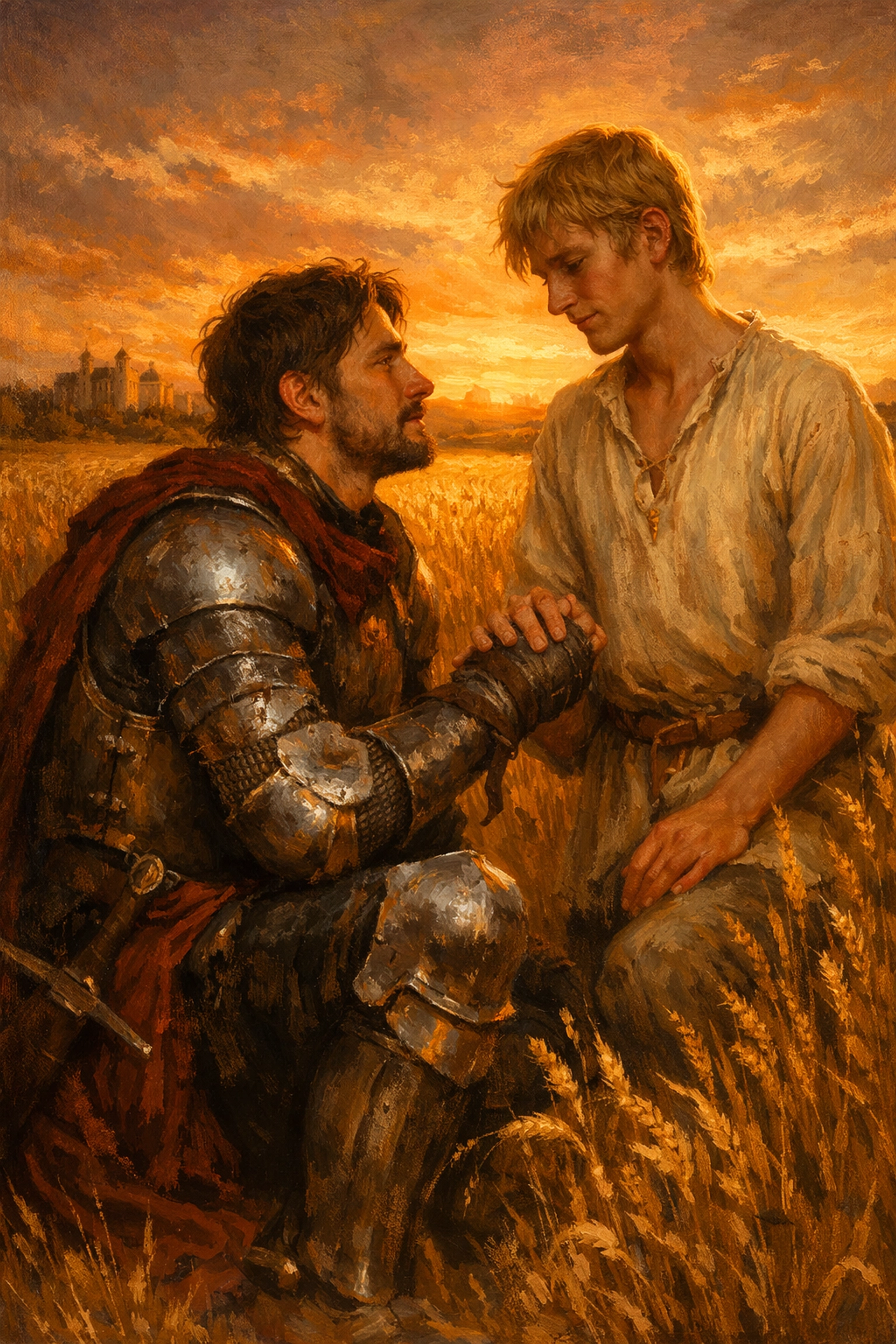
Thomas was seventeen, all lean muscle and sun-browned skin from working the land. He'd been born in a cottage on the estate's edge, the son of farmers who'd worked the same soil for generations. His hands were calloused from the plow, his hair bleached lighter by summer suns, and his eyes held a kind of quiet intelligence that noble breeding could never manufacture. When Sir Edmund first saw him hefting bundles of wheat onto a cart, something shifted in his chest like a key turning in a lock he didn't know existed.
When Worlds Collide
Medieval society wasn't just divided, it was carved in stone. Knights occupied a space so far above peasants that they might as well have been different species. The feudal system dictated every interaction, every glance, every possibility. A knight could command a peasant to work, to serve, to die in his wars. But to love one? That wasn't just forbidden by class, it defied the entire architecture of how their world was supposed to function.
Edmund had responsibilities that weighed heavier than his chain mail. His family expected him to marry a suitable lady, produce heirs, and manage the estate with the cold efficiency required of his station. He was supposed to see Thomas and the other peasants as resources, as barely-human tools for working the land. The fact that he couldn't stop watching Thomas move through the fields, couldn't stop finding excuses to ride past the wheat rows at sunset, couldn't stop thinking about the curve of his smile, well, that made him dangerous to himself and everyone around him.
The Risk of a Glance
Their first real conversation happened by accident. Edmund's horse threw a shoe near the southern fields, and Thomas was the one who approached, offering to help walk the animal back to the stables. For twenty minutes, they talked. Actually talked. Not lord to servant, but human to human. Thomas spoke about the land with a passion Edmund had never heard in any noble's voice, describing the soil like a lover, understanding the rhythms of growth and harvest with an intimacy that came from actual labor rather than ownership.
Edmund found himself confessing things he'd never told anyone, the horror of the crusades, the way violence had hollowed him out, the growing certainty that everything he'd been taught about honor and glory was a beautiful lie. Thomas listened without judgment, without the performance of sympathy that Edmund got from his peers. Just listened. And in that listening, something bloomed between them that had no name in their language, no place in their world.
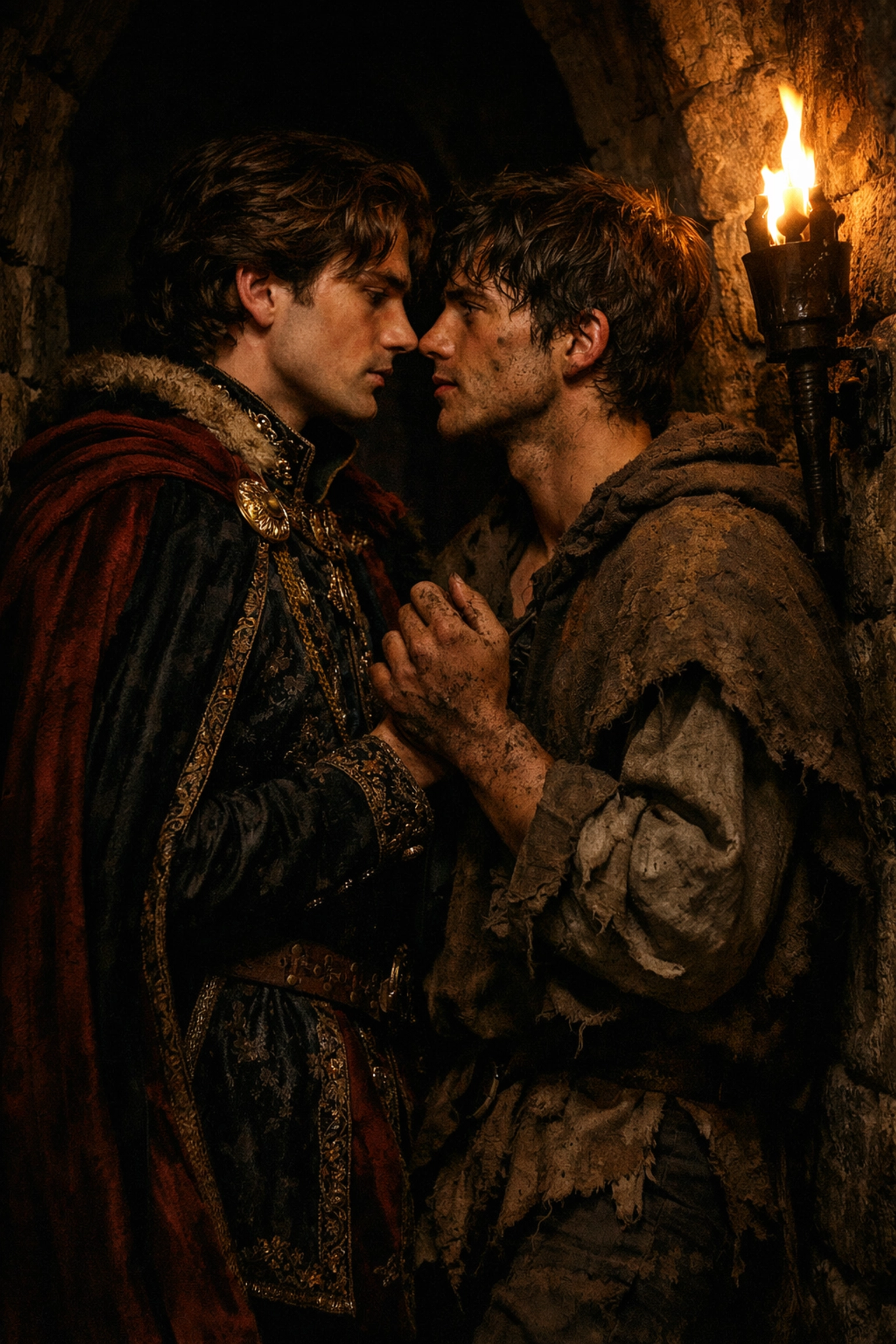
But every conversation was a risk. The estate workers noticed when their lord lingered too long at the fields. Edmund's mother commented on his "unusual interest in agricultural matters." The parish priest, always watching for sin like a hawk watches for mice, began to pay closer attention during confession. And Thomas's father warned his son with the grim wisdom of someone who understood exactly how the world worked: "They can take everything from us, boy. Don't give them a reason to notice you exist."
Stolen Moments in a Surveilled World
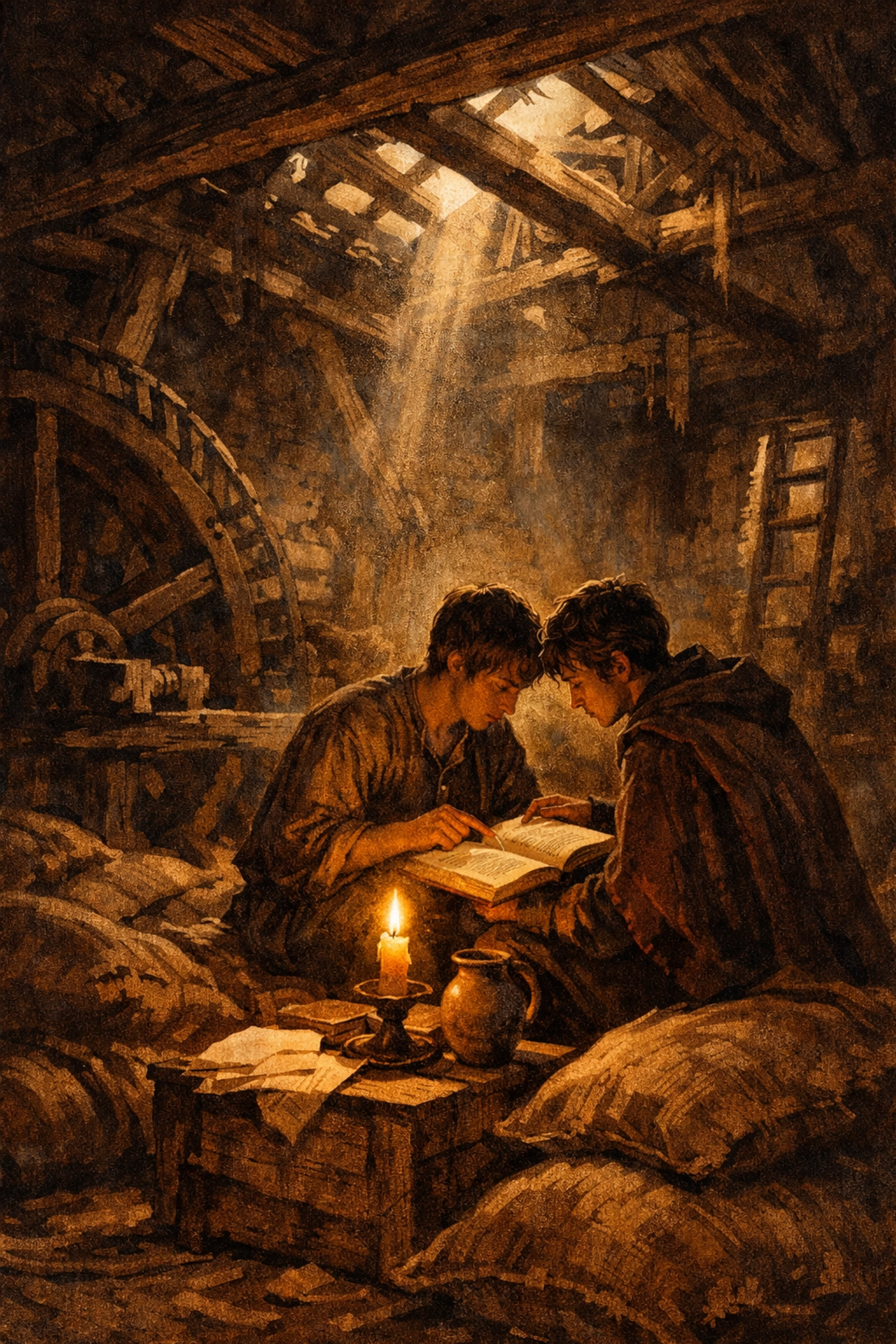
They learned to be careful. Messages passed through trusted hands: a stable boy who owed Thomas a favor, a kitchen maid who understood more than she let on. They met in the abandoned mill at the edge of the estate, in the hour between vespers and dinner when Edmund could claim to be inspecting properties and Thomas could claim to be checking animal traps. The mill smelled of old grain and rotting wood, but it was theirs. The only place where they could drop the masks they wore for survival.
In that crumbling space, Edmund wasn't a knight and Thomas wasn't a peasant. They were just two people trying to figure out how to love each other in a world designed to keep them apart. Edmund taught Thomas to read using borrowed books, a crime in itself: literacy was meant to be the exclusive domain of clergy and nobility. Thomas taught Edmund what it meant to work with his hands, to create rather than destroy, to tend rather than command.
The physical distance between them in public was excruciating. Edmund would ride past Thomas in the fields, and they couldn't even acknowledge each other with more than a formal nod. At night, Edmund would lie awake in his silk-sheeted bed while Thomas slept on a straw pallet in a one-room cottage, and the injustice of it burned like acid. Every comfort Edmund enjoyed: the food, the warmth, the safety: was built on the labor of people like Thomas, people who would never taste those comforts themselves.
The Price of Discovery
It couldn't last. It never could. Someone always talks, someone always notices, someone always sees what they're not supposed to see. In this case, it was Edmund's cousin, a minor noble with ambitions and a talent for ferreting out secrets that could be weaponized. He found one of Thomas's letters, written in the crude hand of someone newly taught, full of yearning and poetry that no peasant was supposed to possess.
The accusation was sodomy, which was a crime punishable by death. But more than that, it was the crime of crossing class boundaries, of undermining the divine order that kept the powerful powerful and the powerless in their place. Edmund's family offered him a choice: renounce Thomas publicly, call him a seducer and a liar, and marry the daughter of a neighboring lord within the month. Or face ruin: stripped of title, lands, and protection. Either way, Thomas would be dealt with permanently.
Love Against an Empire
Here's what the historical romance novels don't always tell you about class-crossed love in medieval times: it almost never worked out. The system was too entrenched, too ruthless, too willing to destroy individuals to maintain its own logic. Real historical accounts are full of aristocrats who quietly kept lower-class lovers as open secrets, but formalized nothing, legitimized nothing, protected nothing when the pressure came.
But occasionally: very occasionally: people chose love anyway, knowing the cost. Some knights gave up their titles to live as commoners. Some peasants fled to cities where they could disappear into anonymity. Some lovers ran to the edges of the known world, to places where the old rules hadn't yet taken root. Were they happy? Maybe. Were they free? More than they'd been. Did they regret it? You'd have to ask them, and most of their stories were never written down.
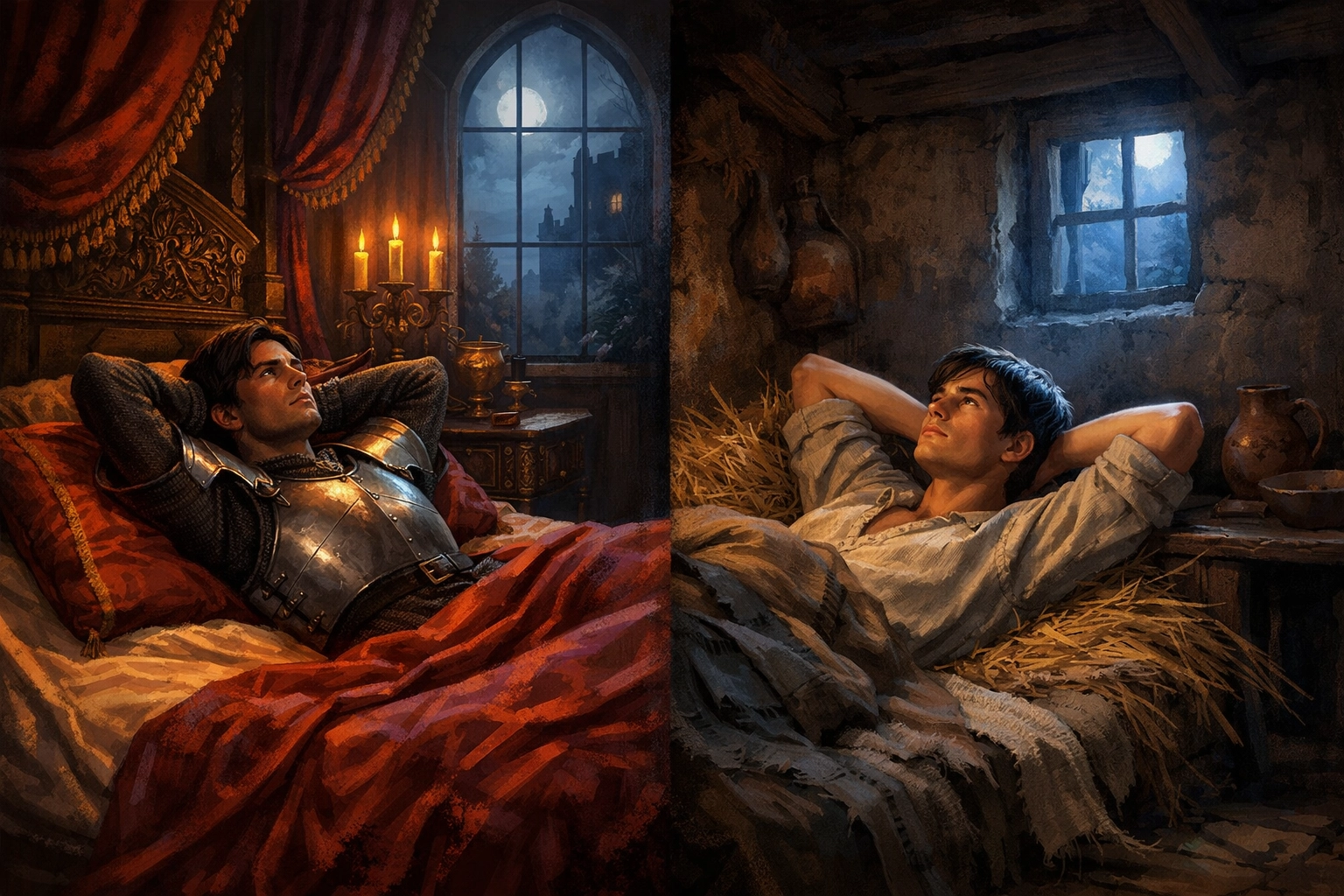
Edmund faced an impossible calculus. Every privilege he'd ever known, every comfort, every certainty about who he was: all of it depended on abandoning Thomas. And Thomas, for his part, told Edmund to do exactly that. "Save yourself," he said in their final meeting at the mill. "One of us should survive this." But Edmund had spent three years watching men die for causes they didn't understand, for lords who saw them as disposable. He was done with honor that required sacrificing love.
Historical Echoes in Modern Lives
This story: this specific story of Edmund and Thomas: is fiction. But it represents thousands of real stories that played out across medieval Europe, across every society that divided people into rigid hierarchies of worth. Class has always been a weapon used against queer love, because queer love already threatened the social order. Add economic disparity, and you've got a double crime: loving wrong and loving across boundaries that were meant to be uncrossable.
The echoes of these medieval dynamics still reverberate today. We like to think we've moved past rigid class structures, but wealth inequality creates similar barriers. The tech CEO and the barista. The doctor and the janitor. The trust fund kid and the student working three jobs. Cross-class queer relationships still navigate complications around money, access, education, and the thousand subtle ways that economic difference creates power imbalances even in love.
What draws us to these historical stories of class-crossed romance isn't just the drama: it's the recognition. We see ourselves in the impossible choices, in the courage it takes to love someone when everything in your world tells you it's wrong. These medieval lovers teach us that queerness has always existed, and it's always had to fight against systems designed to keep people in their assigned places.
Finding Your Own Story
Looking for more MM romance books that explore these themes of love across social divides? Read with pride features LGBTQ+ fiction that honors both the romance and the real struggles of loving against the odds. From gay historical romance set in different eras to contemporary stories that echo these same class dynamics, our collection celebrates love that refuses to stay in its lane.
The story of the knight and the peasant reminds us that love has always been revolutionary. Every time someone chooses connection over convention, passion over propriety, they're part of a tradition that stretches back centuries. Edmund and Thomas may be fictional, but their struggle is eternal: and so is the hope that love, somehow, finds a way.
#MMRomance #GayHistoricalRomance #LGBTQFiction #ReadWithPride #GayRomanceBooks #QueerFiction #HistoricalMMRomance #GayLoveStories #ClassDivide #MedievalRomance #LGBTQBooks #GayNovels
Follow us for more LGBTQ+ stories and romance:
📘 Facebook
📷 Instagram
🐦 Twitter/X
🌐 ReadWithPride.com

Leave a Reply
You must be logged in to post a comment.