

There are places in the world that seem to be waiting for a human presence before they reveal themselves.
The singing sand dunes of the Gobi are one of them.
At Khongoryn Els, sometimes called the Singing Dunes or Duut Mankhan, dry grains can produce a deep hum or booming note when they slide together down a steep slope. Under the right conditions, the movement of millions of grains becomes almost synchronised. The dune resonates. The sound travels through the air and into the body, a low vibration beneath the feet.
But before anyone walks across it, the dune is quiet.
It is not empty. It is not lifeless. It is simply holding its voice.
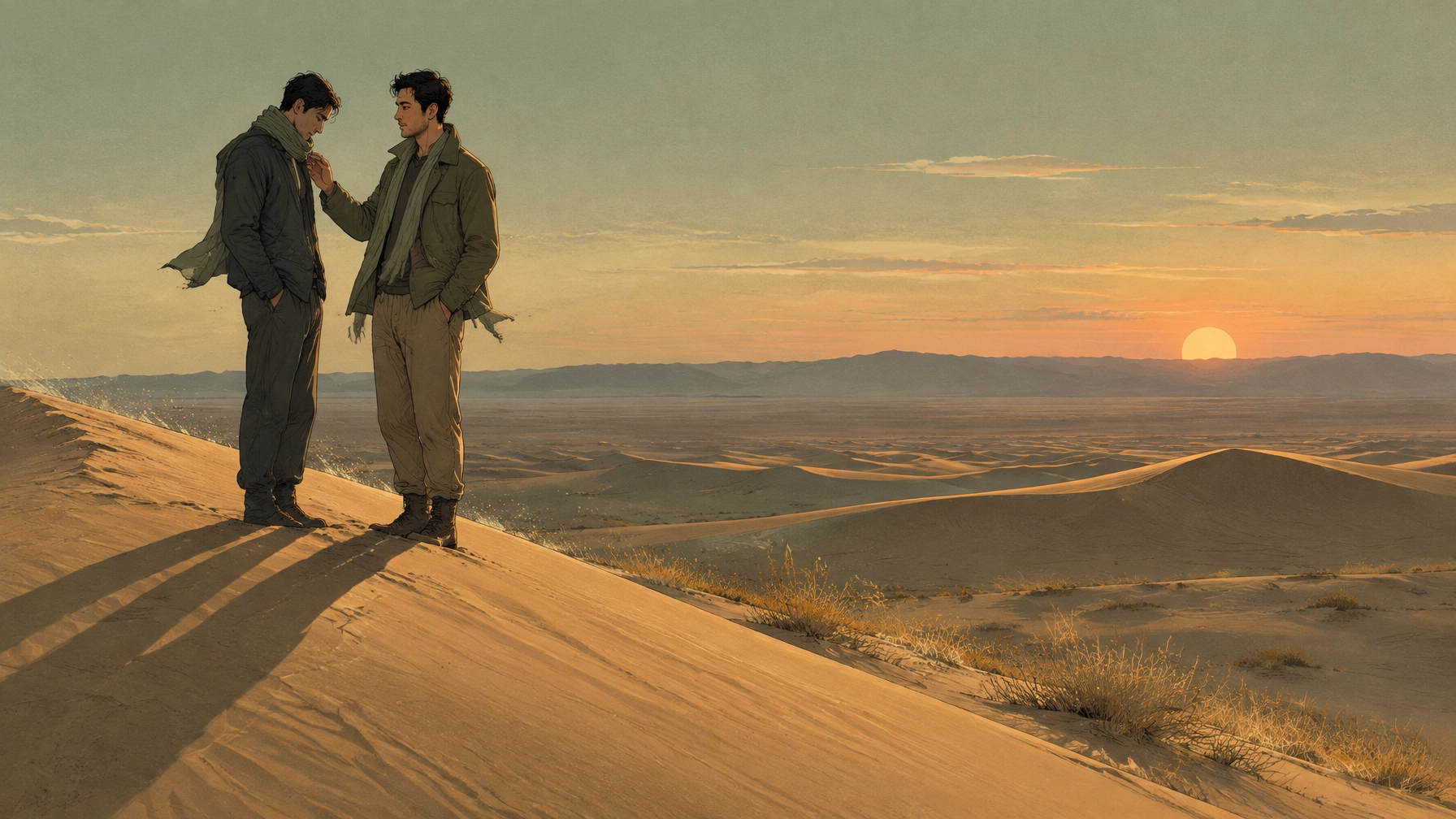
That was what Elias thought about as he stood beside Marek on the ridge, watching the last light stretch across the desert.
The evening had turned cold. The sand, warm beneath the afternoon sun, was losing its heat quickly. Wind moved over the crest in thin, restless breaths, carrying the dry smell of grass from the plain below. Their shadows reached across the slope, long and narrow, touching at the edges before separating again.
Marek looked down the face of the dune.
“Ready?”
Elias kept his hands in his coat pockets. “For what?”
“To hear it.”
“You’ve heard it before.”
“I have.”
“Then you know what it sounds like.”
Marek smiled, but he did not tease him. That was one of the things Elias had come to understand about him. Marek could be persistent without being forceful. He could ask a question and leave room for the answer. He could stand beside silence without rushing to fill it.
“It doesn’t sound the same every time,” Marek said.
Elias looked at him then.
The wind passed between them. Somewhere below, a strand of dry grass scratched against another in the darkening air.
“Neither do people,” Marek added.
The silence Elias had mistaken for safety
Elias had spent most of his life believing that silence was a form of protection.
If he did not name what he wanted, no one could reject it. If he did not describe what had happened, no one could decide that his grief was excessive, inconvenient or embarrassing. If he kept his past folded tightly inside himself, he could pass through the world without giving anyone the opportunity to handle it carelessly.
He had learned to be composed.
He had learned to say, “It was a long time ago.”
He had learned to smile when people asked whether he was happy, as though happiness were a document he could produce on request.
What he had not learned was how to be known.
Not vaguely known. Not admired from a safe distance. Known in the difficult, unflattering detail of a real life: the fears that arrived without warning, the old loyalties, the anger he carried like a stone, the desire he had once considered too dangerous to admit.
Elias was bisexual, but even that truth had never felt simple in his mouth. It had been treated as a phase by some, a provocation by others, and a convenient mystery by people who preferred not to listen. He had grown tired of explaining that attraction did not become less real because it was complicated. He had grown tired of feeling that every confession required evidence.
With Marek, he did not want to perform certainty.
He wanted, for once, to speak without preparing an argument first.
That frightened him more than the desert.
A love story written in small movements
Marek stepped onto the slope.
A thin sheet of sand moved beneath his boot. It slipped several inches, whispering down the face of the dune.
Elias watched him descend.
“You don’t have to follow me,” Marek called.
“I know.”
Marek waited.
That was his quiet persistence: not a demand, but an open space.
Elias took one step.
The sand shifted under him. Cold grains worked their way around the edge of his boot. He took another step, then another. The slope was steeper than it appeared from the ridge. His body leaned instinctively towards Marek, who reached back without looking and offered his hand.
Elias stared at it.
The gesture was ordinary. That was what made it so difficult.
There were no declarations in it. No promise that the past could be repaired. No demand for an explanation. Just Marek’s hand, held out against the falling light.
Elias took it.
They began to walk.
At first, there was only the sound of their breathing and the soft drag of sand beneath their feet. Then the slope gave way in a larger movement. A ribbon of grains ran beside them, gathering speed.
The hum began so quietly that Elias thought he had imagined it.
It seemed to rise from inside the dune rather than from the surface. A deep note, almost too low to hear, travelled through the soles of his feet. It moved into his legs and chest. The sound was not beautiful in any polished or delicate sense. It was rough, immense and physical.
Marek looked across at him.
“Do you feel it?”
Elias nodded.
They continued down.
The more they moved, the stronger the resonance became. Their footsteps disturbed the sand, and the sand answered. Not because the dune had suddenly become something else, but because movement had revealed what had been waiting inside it all along.
What the dunes understand about being heard
There is a difference between being silent and being silenced.
The first can be chosen. It can be rest, reflection, privacy or peace.
The second is imposed. It is the result of fear, shame, dismissal or the repeated lesson that your truth will cost more than your silence.
Elias had confused the two for years.
He had called himself private when he was afraid. He had called himself careful when he was lonely. He had told himself that the things he could not say aloud were not important enough to say.
Marek never tried to pull the words out of him.
That was why the words eventually came.
They stopped halfway down the dune, where the last sunlight rested across the sand in a muted gold band. The air had sharpened. The cold had begun to gather in Elias’s fingers.
“I thought if I said it,” he began, “it would become real.”
Marek did not move.
Elias looked towards the plain. “Everything I lost. Everything I wanted. The person I was before I learned to be afraid of being seen.”
Marek waited.
“I thought if I told you, you’d look at me differently.”
“I do look at you differently.”
Elias’s breath caught.
Marek turned towards him. “I see more of you now.”
It was not the reassurance Elias had expected. It was better. It did not deny the fear or pretend that disclosure had no consequences. It acknowledged the risk and met him there.
“I don’t know how to do this,” Elias said.
“Do what?”
“Be loved without hiding.”
Marek’s expression softened. “Then we’ll learn slowly.”
The dune hummed beneath them.
The courage of moving together
A slow-burn love story is not built from grand gestures alone. It grows through repeated choices: answering the difficult question, staying through the silence, allowing an imperfect truth to remain in the room.
For readers drawn to emotionally invested MM romance, those choices often matter more than the first kiss or the final declaration. The deepest romantic tension is not simply whether two men will fall in love. It is whether they will believe they are allowed to be fully present when love arrives.
That question sits at the heart of literary queer fiction.
It belongs to the man who is coming out later than he expected. To the bisexual man who has spent years being told that his identity is temporary or contradictory. To the guarded character whose jealousy is really fear, whose anger protects an old wound, whose apparent distance conceals an almost unbearable need for connection.
These are the stories that make room for contradiction.
They understand that a man can want intimacy and fear it. He can be brave in public and terrified in private. He can love another man deeply while still carrying the voices of people who taught him that such love had to be hidden.
The point is not that the fear disappears.
The point is that someone stays while he speaks.
The song that rises when we dare to walk
By the time Elias and Marek reached the foot of the dune, the sun had gone.
The sky held a fading green-grey light. Behind them, their footprints marked the slope in a crooked line, already softening under the wind. The hum had faded too, leaving only the ordinary sounds of evening: fabric shifting, breath, the distant movement of the desert.
Elias looked back at the dune.
“It’s quiet now,” he said.
“For the moment.”
“Do you think it remembers the sound?”
Marek considered this. “Maybe.”
Elias wanted to tell him that he remembered everything. The first time he had realised his feelings for a man were not a mistake. The years he had spent making himself smaller. The grief he had packed away so carefully that he had almost forgotten it belonged to him. The relief of standing beside someone who did not need him to simplify his past before offering him a future.
Instead, he said, “I’m glad I came down.”
Marek took his hand again.
This time, Elias reached first.
The dunes did not sing because they were forced to. They sang because movement passed through them. Because the grains shifted together. Because what had been held still was finally allowed to travel.
Perhaps that is true of us, too.
Some voices need patience before they can be heard. Some grief needs a safe witness. Some desire needs to be spoken more than once before it stops sounding like an apology.
And sometimes love is not the person who tells you to be fearless.
Sometimes it is the person who walks beside you while you are still afraid, offering a hand, leaving room for silence, and trusting that your song has been there all along.
For readers seeking heartfelt gay fiction, high-angst emotional reads and character-driven MM novels, the journey towards that first honest sentence can be as powerful as any destination. Explore more emotionally immersive LGBTQ+ fiction and gay romance books through Read with Pride, or discover Dick Ferguson’s work in the Dick Ferguson e-book store.
#LGBTQBooks #MMRomance #GayRomance #MMFiction #QueerFiction #GayFiction #GayNovels #GayLoveStories #LGBTQFiction #GayLiterature #EmotionalMMBooks #SlowBurnRomance #AngstRomance #CharacterDrivenRomance #ComingOutStories #BisexualRepresentation #QueerAuthors #MMAuthors #ReadingWithPride #ReadWithPride


Follow us on social media
Follow Dick Ferguson for more emotionally charged gay novels, MM romance books, queer fiction and LGBTQ+ reading recommendations:

Leave a Reply
You must be logged in to post a comment.