

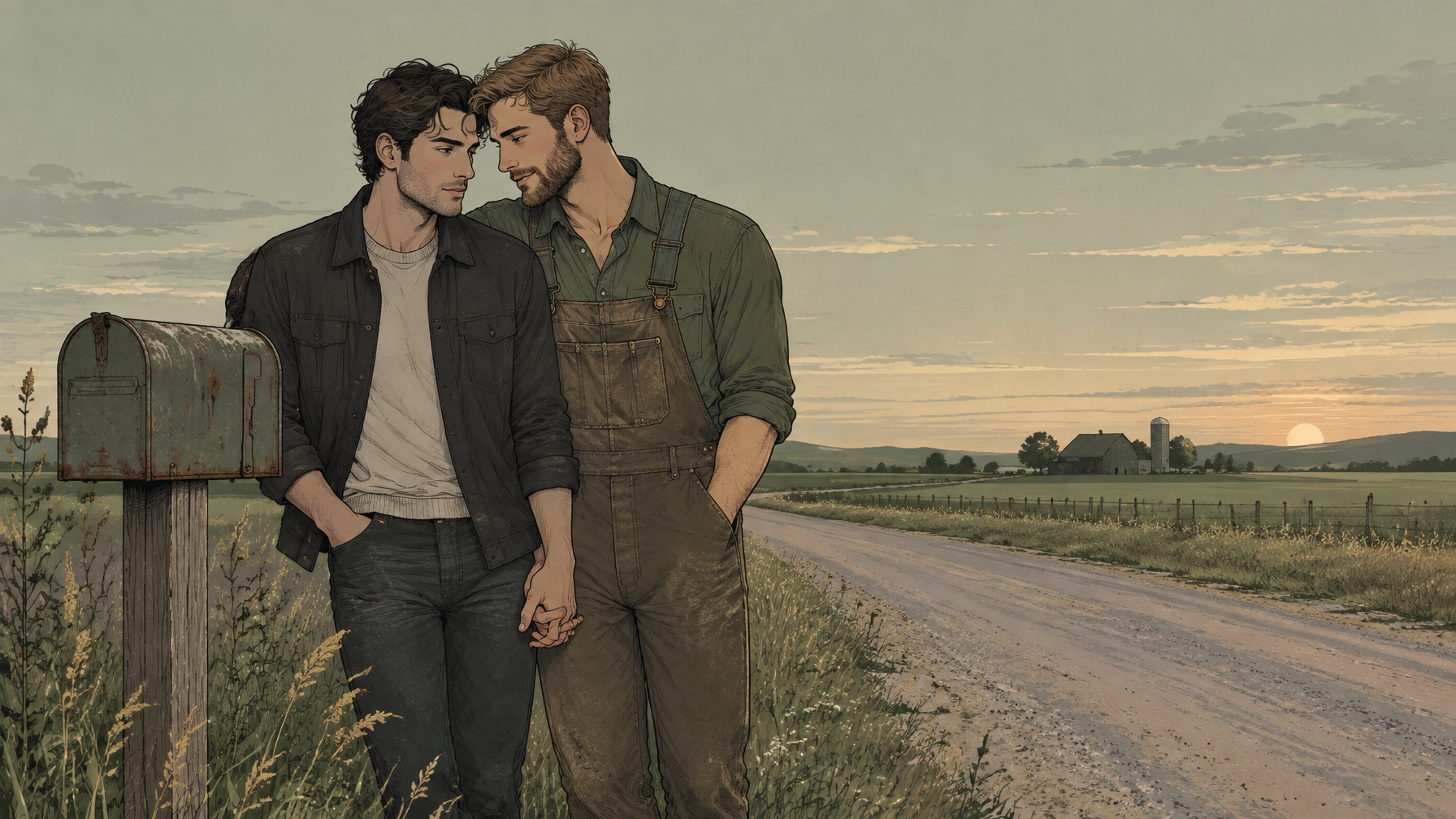
There were easier ways for Daniel to discover that Kai had made room for him.
There was the spare key, though Kai had never presented it as a ceremony. He had simply left it in the blue bowl by the kitchen door one morning, beneath a handful of loose screws and the receipt for a sack of feed.
There was the second mug beside the coffee tin. The second pair of boots by the back step. The space Kai cleared in the wardrobe without asking whether Daniel planned to stay long enough to need it.
Daniel had accepted all of these things with the careful gratitude of a man handling glass.
But the mailbox was different.
The mailbox stood at the end of the gravel drive, where the farm road bent towards the fields and the old cottonwoods broke the wind. It was a plain rural box, dark green once, though years of rain and sun had lifted the paint in thin curls. Its wooden post leaned slightly to one side. Road dust gathered along its lower edge. In wet weather, the metal smelled cold and mineral-rich. In summer, it held the warmth of the afternoon.
Daniel had passed it hundreds of times.
For months, it had carried only Kai’s name.
That morning, it carried two.
The fear of being written down
Daniel saw the change before he understood it.
He had come back from town with a paper bag of groceries pressed against his hip and a smear of flour across his sleeve. The road was dry, the sky pale with the promise of heat. Somewhere beyond the hedgerow, a tractor gave a low mechanical cough. Tires whispered over the packed dirt. A crow lifted from the fence line and vanished into the glare.
Then Daniel noticed the white paint.
Not bright white. A softened, weathered white, carefully brushed onto the metal beside Kai’s name.
His own name.
DANIEL.
The letters were not perfect. The D was slightly broader than the others. The paint had gathered in a small ridge at the bottom of the L. Whoever had written it had done so by hand, with patience rather than confidence.
Daniel stopped walking.
The grocery bag pulled at his fingers. A jar shifted inside it and tapped against a tin of tomatoes. The sound seemed absurdly loud.
He had spent years believing that love was safest when it left no mark.
If nothing was written down, nothing could be taken away. If no one knew where he belonged, no one could use belonging against him. He had moved through cities and rented rooms and borrowed lives with the quiet efficiency of a person who did not want to be missed. He had learned how to leave before leaving became a conversation.
A name on a mailbox was not a promise, exactly.
That was what frightened him.
It was evidence.
It said: this person receives things here. This person is expected. This person can be found.
Daniel had moved too many times to trust being expected.
Kai does not hurry him
Kai was by the barn, repairing a section of fencing. He wore an old green shirt with the sleeves rolled to his elbows. His hands were dark with soil and grease. When he saw Daniel standing by the mailbox, he set the pliers down on the fence rail.
He did not call out.
That was one of the things Daniel loved most about him: Kai never rushed to fill a silence that might be doing important work.
He crossed the yard slowly. The grass brushed against his boots. He looked at the mailbox, then at Daniel.
“Morning,” Kai said.
Daniel nodded.
His gaze remained fixed on the painted letters.
“When did you do that?”
“Yesterday evening.”
“Why?”
Kai glanced towards the road. A pickup passed in the distance, its tires making a soft, continuous hiss over the dust.
“Thought you might want your letters to know where to find you.”
The answer was so simple that Daniel almost laughed. Instead, something tightened behind his ribs.
He had expected an explanation. A practical reason. Perhaps the old box had needed repainting, or the post office had asked for both names, or Kai had been tired of sorting Daniel’s envelopes into a separate pile.
He had not expected the tenderness of it.
Daniel put the grocery bag down. The bottom folded in slightly against the gravel.
“You didn’t ask me.”
“No.”
The word landed gently.
Kai did not defend himself. He did not say, I assumed you were staying. He did not say, You’ve been here nearly a year. He did not turn the moment into a test Daniel could fail.
He simply stood beside him, giving him the dignity of his fear.
That was Kai’s quiet steadiness. Not the absence of difficulty, but the refusal to make difficulty perform.
A small gesture, carrying the whole weight of home
Daniel reached towards the mailbox.
The metal was cool where the sun had not touched it. Near the name panel, the paint felt uneven beneath his fingertips. He could feel the raised edge of the lettering, the minute brush marks, the places where Kai’s hand had paused.
A name was such a small thing.
Seven letters.
A few strokes of paint.
Yet Daniel felt the old instinct rise in him: step back, make a joke, tell Kai it was too much. He could still leave. He could still turn this into an afternoon errand and drive away before the road dust settled around his shoes.
He could say that names were dangerous.
He could say that permanence was only another word for the place where disappointment waited.
Instead, Kai lifted his hand.
He did not touch Daniel’s face. He did not pull him close. He only placed two paint-stained fingers over Daniel’s wrist, right where his pulse was beating too fast.
The gesture was almost nothing.
It changed everything.
Kai’s hand did not hold him in place. It did not claim him. It told him, without ceremony, You can stay frightened. I am still here.
Daniel looked down at their hands.
Kai’s thumb moved once across the inside of his wrist.
The road carried on around them. A gate creaked somewhere in the fields. The wind moved through the dry grass with a sound like distant rain. From the farmhouse came the faint clatter of something settling in the kitchen.
Life did not pause to witness Daniel’s decision.
That made it easier to make one.
“I don’t know how to do this,” Daniel said.
Kai looked at him. “Do what?”
“Be somewhere.”
The words came out rougher than he intended. He stared at the mailbox because looking at Kai felt too exposing.
“I know how to visit. I know how to leave. I know how to make a place feel temporary enough that it can’t hurt me when it changes.” He swallowed. “But this”
Kai waited.
“This makes me visible.”
The quiet stretched between them.
Then Kai said, “You were visible before I painted your name.”
Daniel closed his eyes.
It was not a grand statement. Kai did not say that love conquered fear or that home healed everything. He only offered the truth, plain and unadorned.
Daniel had been visible in the way he took his coffee. In the way he slept with one hand curled beneath his chin. In the way he checked the weather twice before driving anywhere. In the way he stood at the kitchen window when he missed the city, even though he never admitted that he did.
Kai had seen him long before the mailbox.
Perhaps that was what made the name bearable.
It did not create a new version of Daniel. It acknowledged the one already there.
The word he had been avoiding
Daniel turned his wrist beneath Kai’s hand until their palms met.
His fingers were cold. Kai’s were warm and rough.
“I thought you’d get tired of waiting for me to believe this,” Daniel said.
“I’m not waiting.”
“For what?”
“For you to become someone else.”
The answer entered him slowly, like warmth returning to a hand that had gone numb.
Kai’s thumb rested against his knuckles.
“You don’t have to make a speech,” Kai said. “You don’t have to promise me forever beside a mailbox.”
A laugh escaped Daniel then. It broke in the middle, becoming something dangerously close to a sob.
“I wasn’t going to.”
“I know.”
“You don’t know that.”
“I know you.”
There it was. The frightening thing beneath the frightening thing.
Not the painted name. Not the address. Not the possibility of being found.
Being known.
Daniel leaned forward until his forehead rested against Kai’s shoulder. The fabric of Kai’s shirt smelled of sun, cedar, and the clean metallic trace of the fence wire. Kai’s arm came around him, unhurried and firm. He held Daniel as though holding him required no special permission.
For a while, they stood that way at the end of the drive.
The mailbox leaned beside them. The fields moved under the wind. Dust settled in the shallow grooves left by passing tires.
Daniel thought of all the places where he had once imagined himself safe: anonymous hotel rooms, rented apartments with empty walls, cities large enough to swallow a person whole. He had mistaken disappearance for protection.
Here, safety was not the absence of a mark.
It was Kai’s hand on his back.
It was the farm road carrying his name into the world.
It was the knowledge that if he left, someone would notice, and if he stayed, someone would make room.
Home is not always a place you choose alone
That evening, Daniel brought a small tin of paint from the shed.
The lettering did not need repairing. Kai told him so. Daniel ignored him.
Together, they stood by the mailbox beneath a sky turning lavender at the edges. Daniel touched up the bottom of the N. Kai steadied the small tin while Daniel worked. Their shoulders brushed whenever the wind shifted.
The new paint was slightly darker than the old.
It did not matter.
The name was still imperfect. It was still there.
Later, inside the farmhouse, Daniel found a letter waiting on the kitchen table. It was addressed to him at Kai’s farm. His name looked strange on the envelope, too formal and too intimate at once.
He ran his thumb over the ink.
Then he opened it.
For readers drawn to emotionally immersive MM romance, character-driven queer fiction, and heartfelt gay fiction, this is the kind of milestone that stays with us: not a wedding, not a declaration shouted beneath a perfect sky, but a name quietly added to the place where someone already loves you.
That is the particular ache of the best gay novels and MM novels. The world may be wide and uncertain, but a single ordinary object can become a record of belonging. A mailbox. A key. A hand finding yours in the dark.
Explore more LGBTQ+ ebooks, gay books, queer fiction, gay literature, and emotional MM books through Read with Pride. For readers looking for gay romance, MM romance books, gay love stories, and LGBTQ+ reading with emotional depth, Read with Pride offers a place to continue following stories about men who are learning how to be seen, and loved, without surrendering the complicated truth of who they are.
Three possible next Evening Edition chapters
-
The Empty Chair at the Harvest Table: Daniel faces the first family gathering where everyone assumes he will stay, and Kai quietly makes space beside him.
-
Rain on the Tin Roof: A storm traps Daniel and Kai in the farmhouse while an old fear about leaving resurfaces between them.
-
The Key Beneath the Flowerpot: Daniel discovers that Kai has given him a key to the farm office, forcing him to decide what kind of future he is willing to enter.
Follow us on social media
Follow us for more character-driven MM romance, gay romance, queer fiction, and LGBTQ+ reading:
#MMRomance #GayRomance #QueerFiction #GayFiction #LGBTQFiction #GayLoveStories #EmotionalMMBooks #HeartfeltGayFiction #CharacterDrivenQueerFiction #MMNovels #LGBTQReading #ReadWithPride


Leave a Reply
You must be logged in to post a comment.