

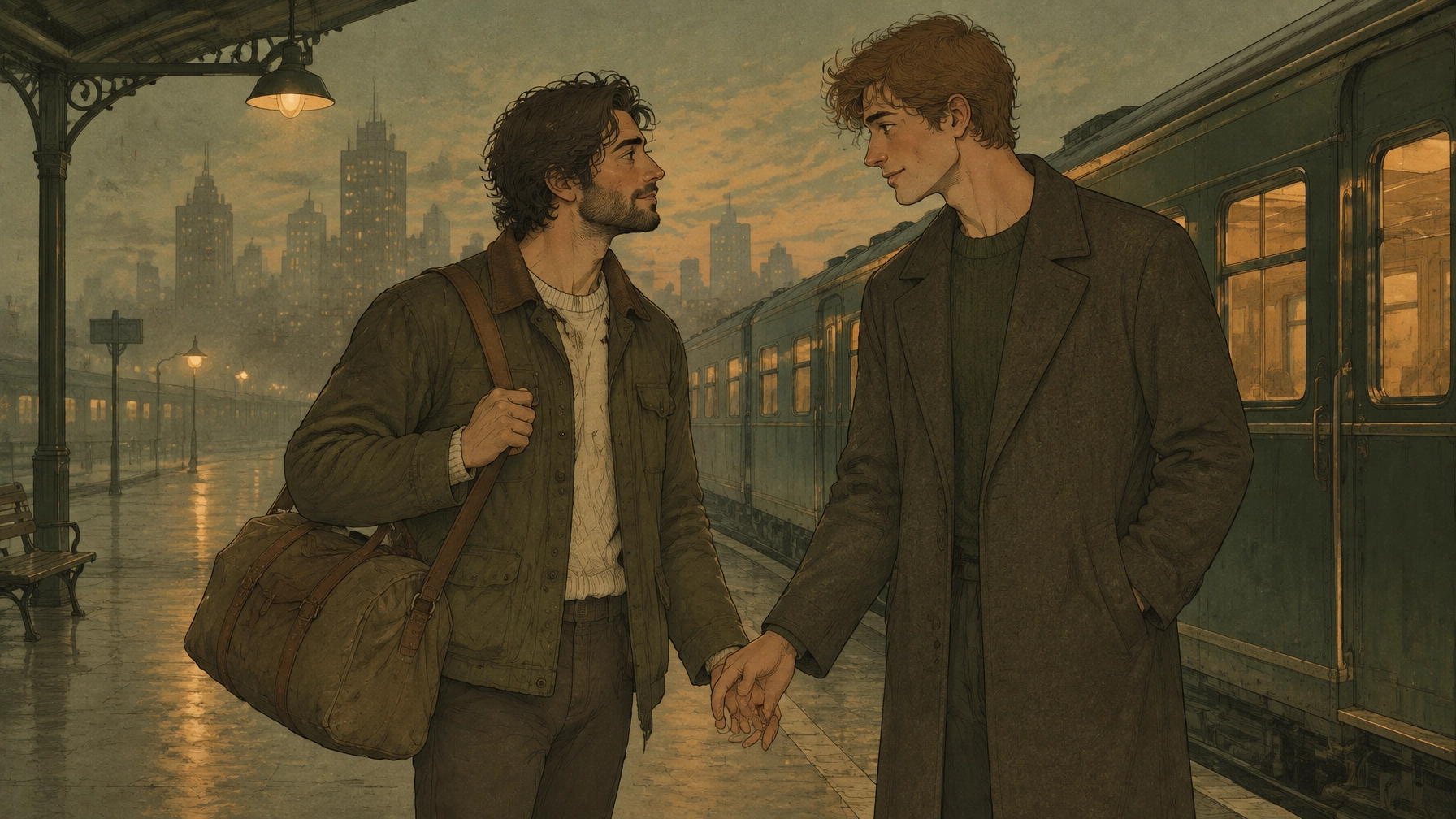
There is a particular silence at the end of a railway platform.
It is not the silence of the countryside, where wind moves through hedges and the dark gathers slowly around the fields. It is not the silence of a sleeping house, either. The city’s silence is made from interruption: the last announcement fading into static, the distant brakes of a train, the fluorescent hum above a vending machine, a thousand people carrying private lives through public spaces.
That was where Daniel stood, with one small suitcase at his feet and Marcus’s unanswered message glowing on his phone.
Are you really going?
Daniel had read the question so many times that the words had begun to lose their shape. He could have answered easily. Yes. No. I don’t know. Come with me.
Instead, he put the phone away.
For three years, the city had taught him how to live alone without appearing lonely. It had taught him the efficiency of small apartments, the discipline of eating dinner over a sink, the careful performance of being fine. It had given him work, anonymity and a view of the river between two towers of glass.
It had also given him Marcus.
That was the trouble with leaving. You could pack the books, the winter coat and the chipped blue mug. You could cancel the electricity, return the keys and tell your colleagues that you were taking time away. But you could not fold a person into a suitcase. You could not carry a man’s laugh through a ticket barrier without being changed by its absence.
The city is good at making love wait
Urban life often appears full of connection. Crowded streets, late-night cafés, trains arriving every few minutes, lights burning in hundreds of windows. Yet a city can make intimacy strangely difficult.
There is always another shift. Another deadline. Another room to cross before you can say what you came to say. Two men may share a bed and still spend weeks failing to have the conversation that matters.
For Daniel and Marcus, love lived in the margins.
It was Marcus arriving after midnight with rain on his shoulders. It was Daniel keeping the hallway light on, pretending he had not been waiting. It was coffee left beside the wrong side of the bed. It was the quiet understanding that neither of them was ready to name what they were becoming.
They loved each other in the way many people first learn to love: cautiously, imperfectly and with one eye on the exit.
That kind of love can feel safe for a while. There is comfort in leaving the important sentence unfinished. If nobody says stay, nobody has to hear I can’t. If nobody asks for a future, nobody has to admit that the present is not enough.
But waiting is not neutral. It changes the people who do it.
Sometimes patience deepens love. Sometimes it turns longing into resentment. Sometimes it allows two men to grow towards one another. Sometimes it simply gives fear more time to build a house.
This is one of the emotional tensions at the heart of a powerful MM romance: not merely whether two men will fall in love, but whether they will risk being known after love has already become impossible to deny.
Leaving the city does not mean leaving the past
Daniel had imagined the rural house as an answer.
It stood at the end of a narrow lane, beyond a village shop and a stone bridge where the river moved brown and fast after rain. The cottage had belonged to his uncle, then remained empty for almost a decade. Its windows were clouded with dust. The garden had gone wild. Ivy pressed its dark fingers into the brickwork.
There would be work to do. That appealed to him.
He wanted difficult, practical things: clearing the shed, repairing the fence, learning which birds arrived before dawn. He wanted his days to have edges again. He wanted to know what time meant when it was not measured by traffic, meetings and the blue light of a phone.
Independence had once meant being answerable to no one. Now, standing on the train with the city falling behind him, Daniel began to understand that independence could also mean choosing what, and whom, he was willing to be answerable to.
The rural landscape did not offer instant healing. The fields were not sentimental. Rain still found the gap beneath his collar. The cottage still held cold in its walls. At night, the darkness outside the windows was so complete that it seemed to have weight.
But the countryside removed his distractions.
There were no crowds to disappear into. No familiar bar where he could sit alone and feel almost social. No convenient excuse for being unreachable. Out there, a missed call became a decision. A locked door became a statement.
Daniel discovered that he had not left the city because he wanted to stop loving Marcus.
He had left because he could no longer keep loving him in the same unfinished way.
Home is not always where we return
The phrase home can carry too much weight. It can suggest safety, family, childhood, permanence: the reassuring idea that somewhere, beneath all our changes, there is a place waiting to receive us.
For many queer men, home may be more complicated than that.
It may be the room where we first told the truth. It may be the flat we built with friends after leaving a family that could not accept us. It may be a city that gave us language, community and the freedom to become visible. It may be a rural place that once felt impossible, then became the landscape where we finally learned how to rest.
Home can also be a person.
That does not mean another man should be responsible for repairing every wound or becoming the entire shape of a life. Healthy love does not erase independence. It makes room for two complete people to choose one another without disappearing inside the choice.
When Marcus finally arrived at the cottage, he did not bring a grand apology. He brought the blue mug from Daniel’s old flat.
It was wrapped in a tea towel and already cracked along the handle.
“You left this,” Marcus said.
Daniel looked at him across the kitchen. Outside, rain tapped steadily against the glass. The kettle clicked off. Somewhere in the fields, a bird called once and then went quiet.
“I thought you were keeping it,” Daniel said.
“I thought you wanted me to.”
There it was: the small, devastating truth beneath so many relationships. They had both been waiting for permission. Both had mistaken silence for kindness. Both had believed that love could survive indefinitely on implication.
Daniel reached for the mug.
Their fingers touched.
Neither of them spoke for a moment. The silence was different here. It did not belong to the city or to the space between trains. It belonged to the room they might make together, if they could learn to speak before the next departure.
The last train is not always the end
Stories about leaving often suggest that departure is a clean act. A man boards a train, watches the skyline recede and becomes someone new before the first rural station appears.
Real emotional change is less generous.
Daniel carried the city with him: its speed, its suspicion, its habits of concealment. He carried Marcus’s unanswered question, the ache of what they had failed to say and the fear that wanting a shared life might cost him the independence he had fought to build.
Marcus carried his own history. He had learned to offer affection in fragments, as if a full confession might make him vulnerable to abandonment. He had loved Daniel carefully and hurt him accidentally. He had mistaken hesitation for honesty.
The journey home could not solve those things.
But it could place them in a room where they were no longer easy to avoid.
That is why urban-rural contrast can be so powerful in queer fiction and emotionally immersive MM romance. The city and the countryside become more than settings. They reveal different versions of the self.
The city asks: Who are you when nobody has time to stop and look?
The rural place asks: Who are you when there is nowhere left to hide?
Between those questions, love has to make its choice.
Not a perfect choice. Not a dramatic promise that erases every fear. Sometimes it is simply a man putting the kettle on while another man takes off his wet coat. Sometimes it is a key left on a table. Sometimes it is the courage to say, “I want you here,” and to remain present long enough to hear the answer.
For readers drawn to heartfelt gay fiction, character-driven queer fiction, high-angst gay romance and lyrical MM novels, these are the moments that matter most. The embrace after the argument. The message finally answered. The train that leaves, and the person who stays.
If you are looking for emotionally charged gay novels and MM romance books that explore longing, identity, difficult choices and the fragile work of building a life with another man, you can explore Dick Ferguson’s LGBTQ+ ebooks on Read with Pride.
And for more LGBTQ+ reading, gay love stories and thoughtful queer fiction, visit Read with Pride.
Follow us on social media
Follow Dick Ferguson and Read with Pride for new gay book recommendations, emotional MM fiction and updates for readers who believe love stories can be tender, difficult and deeply true:
#MMRomance #GayRomance #QueerFiction #GayFiction #LGBTQFiction #MMNovels #GayLoveStories #EmotionalMMBooks #HeartfeltGayFiction #GayRomanceBooks #LGBTQReading #ReadWithPride #ReadingWithPride


Leave a Reply
You must be logged in to post a comment.