

readwithpride.com
Let’s be honest: if you’ve ever spent more than five minutes scrolling through a gallery of classical sculpture: or, let’s be real, through the "highly recommended" section of your favorite gay romance novels: you’ve noticed it. That sharp, deliberate, and undeniably magnetic pair of lines that point the way down from the hips.
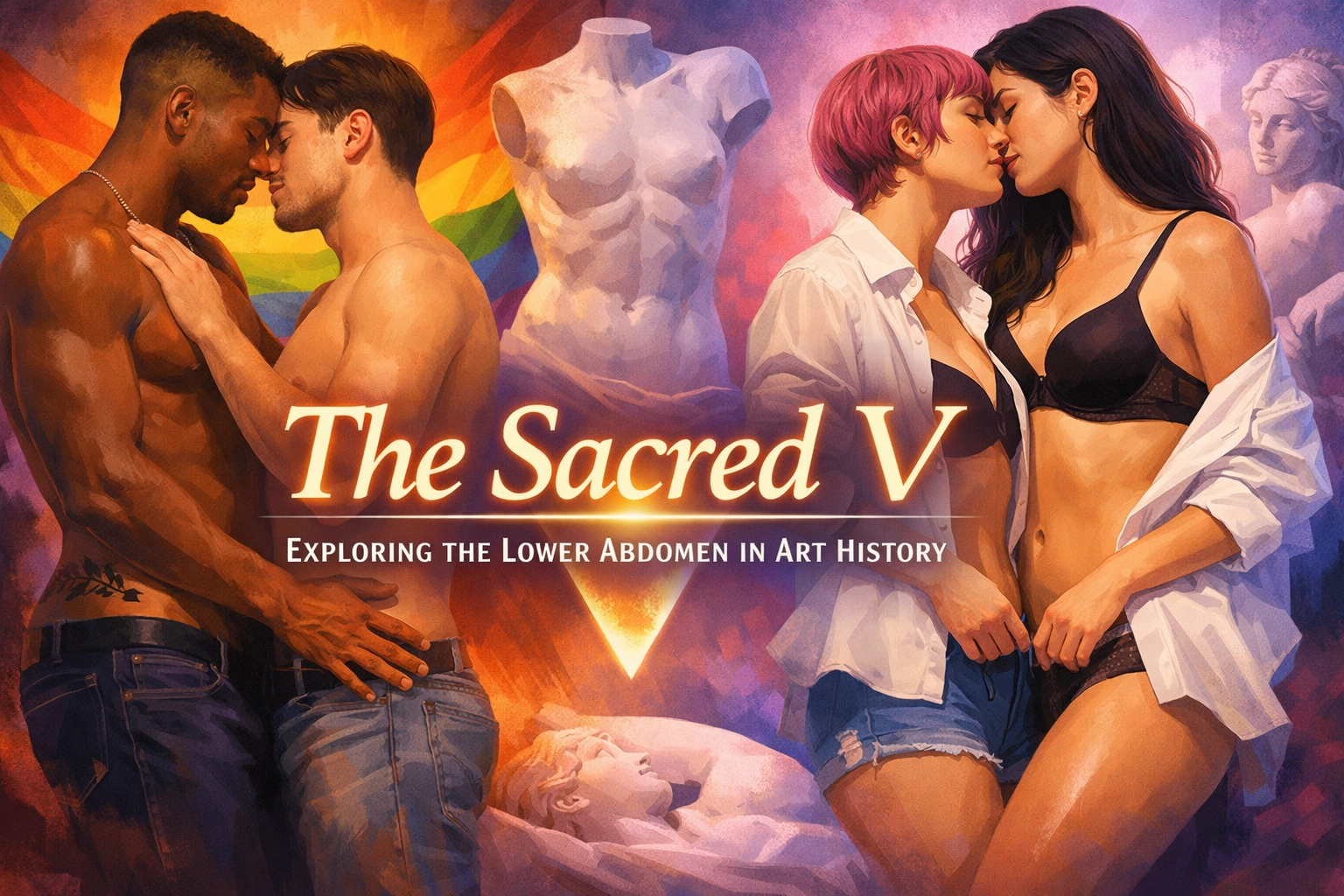
In the fitness world, it’s called the "Adonis Belt." In anatomy, it’s the iliac furrow. But in the world of art and queer desire, it is often referred to as "The Sacred V." It is arguably one of the most celebrated features of the male physique, a topographical map of muscle and bone that has fascinated artists for millennia. At Read with Pride, where we celebrate the beauty of the male form in both prose and ink, we thought it was time to take a deep dive into why this specific bit of anatomy holds such a grip on our collective imagination.
The Greek Invention of the Ideal
Before it was a staple of MM romance books covers, the V-line was a statement of political and spiritual perfection. The ancient Greeks didn’t just stumble upon the lower abdomen; they obsessed over it. To the Greeks, a beautiful body was a reflection of a beautiful soul (kalokagathia).
If you look at statues like the Doryphoros (The Spear Bearer), you’ll see the iliac crest defined with a precision that seems almost superhuman. These weren't just random dudes; they were the "ideal." The V-line wasn't just about being "shredded"; it was about the "contrapposto" stance: that shift in weight that makes one hip dip and the other rise, creating those delicious, asymmetrical lines that define the lower torso.
For the ancients, this wasn't just "naked gay bodies art"; it was a celebration of the athlete and the warrior. It represented the pinnacle of discipline. Today, we see that same discipline reflected in the heroes of our favorite gay fiction and gay novels, where physical prowess often meets emotional vulnerability.
The Renaissance: Anatomy Meets the Divine
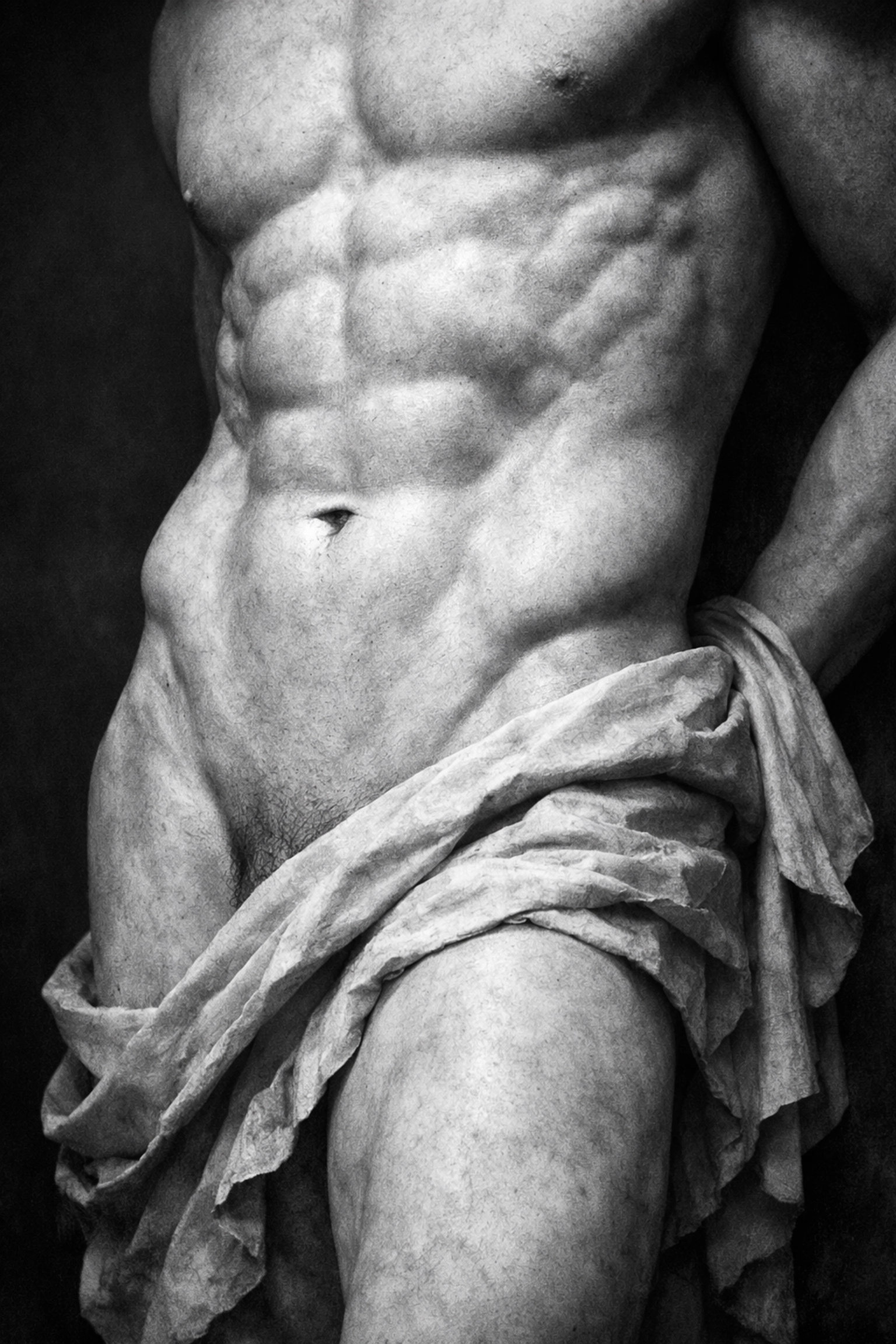
Fast forward to the Renaissance, where artists like Michelangelo and Leonardo da Vinci decided that "good enough" wasn't enough. They wanted to know what was happening under the skin. This era turned the V-line from a stylistic choice into a masterclass in anatomical accuracy.
Michelangelo’s David is perhaps the most famous example of the Sacred V in history. When you stand in the Accademia in Florence (or look at a very high-res photo), the way the light catches the lower abdomen is intentional. It’s a transition point: the bridge between the strength of the torso and the power of the legs. Michelangelo was a man who clearly appreciated the male form (his private life and poems suggest he was very much one of us), and his attention to the "V" feels like a love letter to the male body.
In M/M books and queer fiction, we often see this same level of detail in descriptive writing. Just as Michelangelo used a chisel to define a muscle, a talented author uses words to trace the same lines, building tension and desire through the "Sacred V."
The Shift to Photography: The Flesh Becomes Real
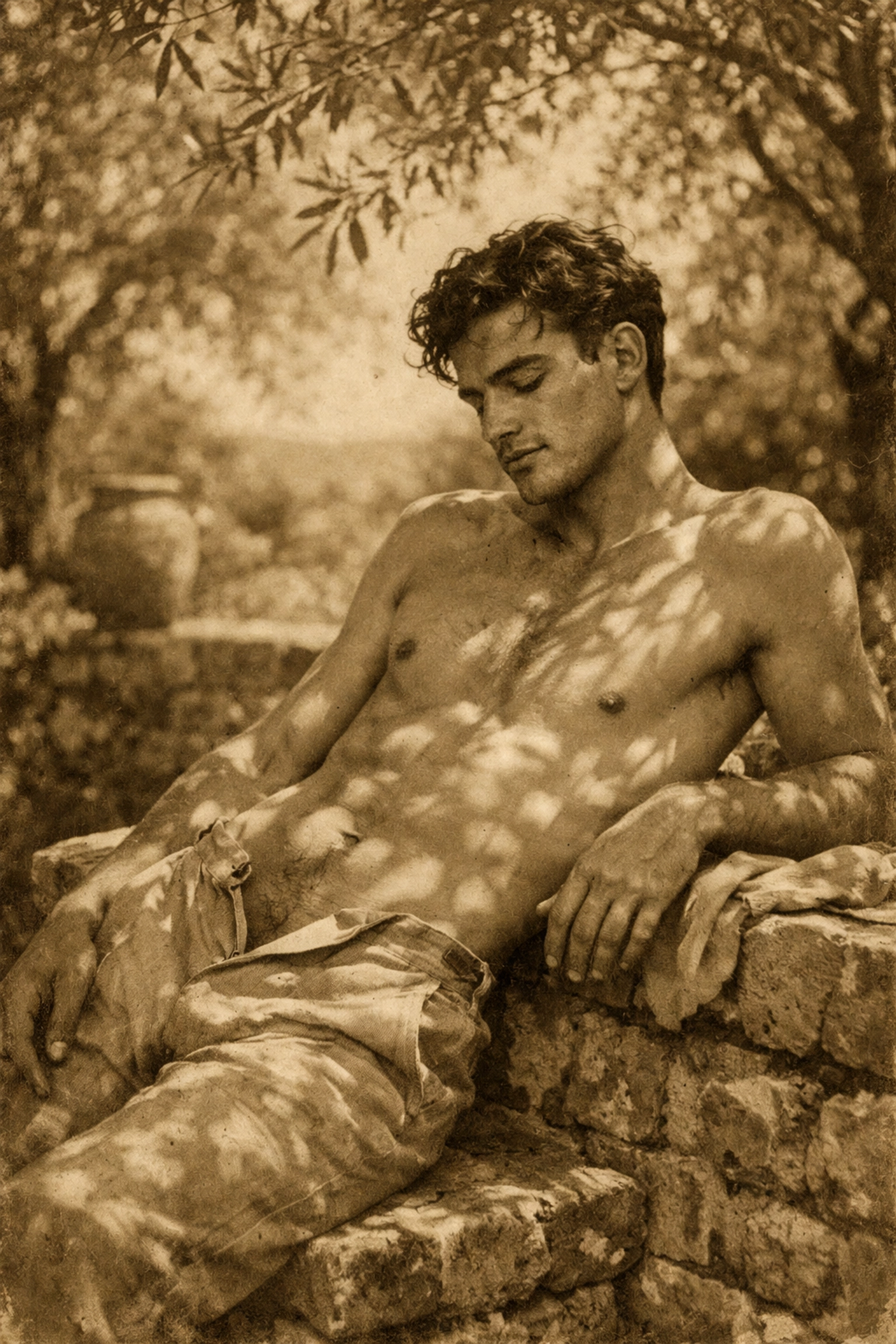
By the 19th and early 20th centuries, art moved from marble to film. Early physique photographers like Baron Wilhelm von Gloeden began capturing "naked art in university and museum" contexts, often blurring the lines between classical study and homoerotic appreciation.
Von Gloeden’s work, featuring young men in Sicily posed like Greek gods, brought the V-line into the modern era. These weren't distant statues; they were real men with real skin. This transition was crucial for the development of gay literature and visual culture. It allowed us to see ourselves in the art. The V-line became a symbol of hidden worlds, of "physique" magazines that were the only way queer men could see bodies like their own during times of heavy censorship.
The V-Line in Modern MM Romance
Today, the "Sacred V" has a new home: the digital and physical covers of popular gay books. Whether it’s a steamy MM romance or a gay contemporary romance, that lower abdominal definition serves as a visual shorthand. It tells the reader: "This story is about heat, it’s about physical connection, and it’s about the beauty of the male form."
In 2026 gay books, we’re seeing a move toward even more inclusive representations of the body, but the appreciation for the "V" remains a constant. It’s a trope in itself: the "shirtless hero" shot. But beyond the thirst-trap aesthetic, it represents a continuation of that classical tradition. When we look at a book cover featuring a well-defined lower abdomen, we are participating in a visual tradition that stretches back to the Parthenon.
Why We’re Still Obsessed
So, what is it about those two lines? Why does the V-line continue to be a focal point in "naked gay bodies art" and "nudism in art"?
- Directionality: Visually, the V acts as a literal arrow. It directs the eye, creating a sense of movement and anticipation.
- Vulnerability: The lower abdomen is a soft, vulnerable part of the body. Highlighting the muscular "armor" around it (the V-line) creates a fascinating contrast between strength and openness.
- Proportion: It defines the waist and hips, creating the "X" or "V" shape that has been the standard of male beauty in the West for centuries.
At Readwithpride.com, we believe that appreciating these lines is about more than just aesthetics. it’s about reclaiming the male gaze. For so long, art history was framed through a heteronormative lens, even when the artists themselves were queer. By celebrating "The Sacred V," we are acknowledging our own history and our own desires.

Finding the Art in the Everyday
You don't have to go to a "museum and exhibition" to find this kind of art. You can find it in the way a character is described in a gay romance series, or in the curated photography shared within our community. The "Sacred V" is a bridge between the classical past and our queer present.
Whether you're looking for best MM romance recommendations or deep dives into gay historical romance, understanding the visual language of the body helps us appreciate the stories even more. The next time you see that familiar V-line on a book cover or in a gallery, remember: you’re looking at a masterpiece of human evolution and artistic obsession.
Join the Conversation
What’s your favorite depiction of the male form in art or literature? Is there a particular MM romance book that describes the "Sacred V" just right? Let us know!
For more explorations of queer culture, LGBTQ+ fiction, and the best gay love stories, stay tuned to our blog at readwithpride.com.
Follow us for more queer art and books:
- Facebook: Read with Pride
- Twitter/X: @Read_With_Pride
- Instagram: @read.withpride
Explore our collections:
#ReadWithPride #MMRomance #GayArt #MaleNudeArt #QueerLiterature #GayBooks2026 #ArtHistory #AdonisBelt #LGBTQPublishing #GayRomanceNovels

Leave a Reply
You must be logged in to post a comment.