

readwithpride.com
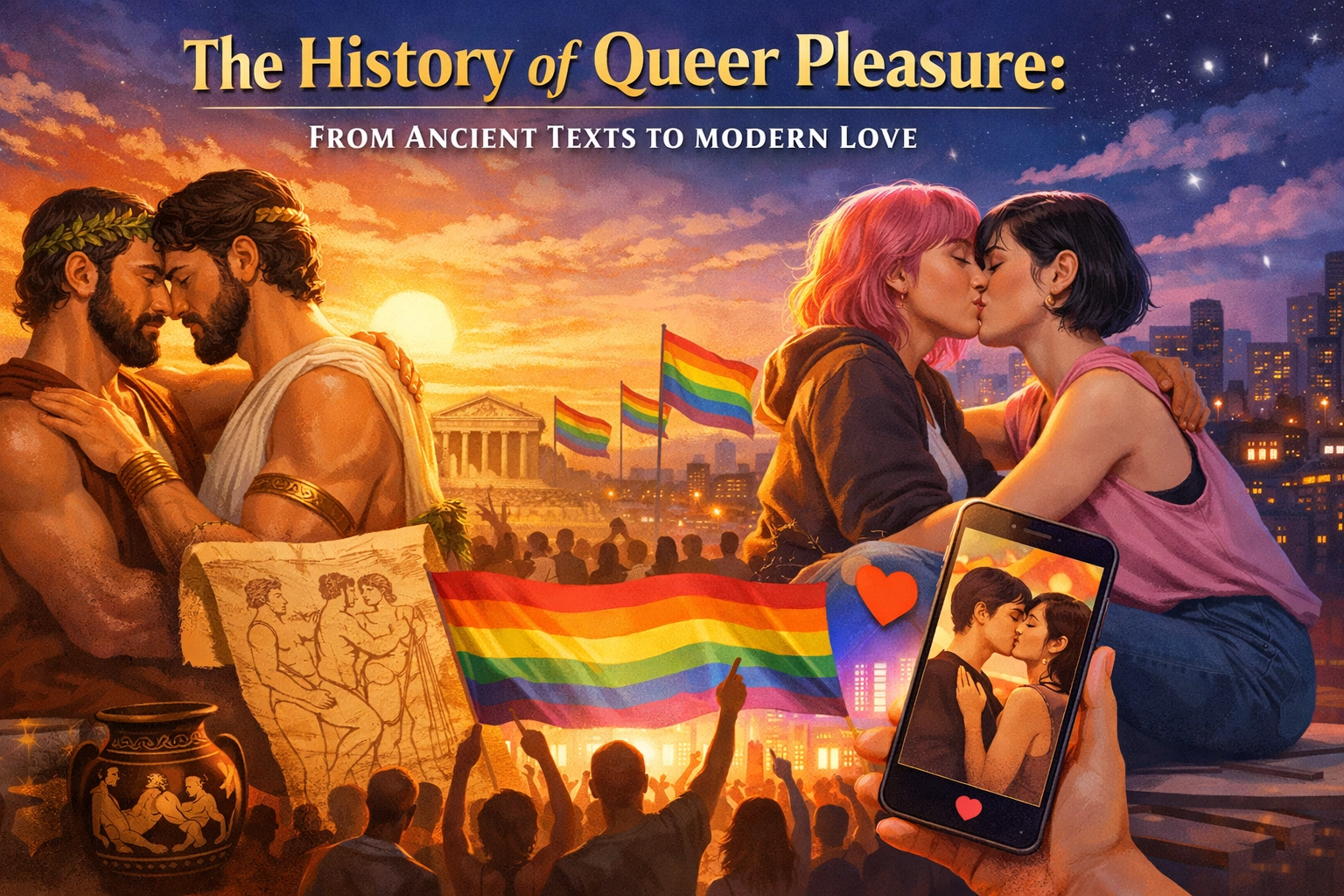
Let’s be real for a second: queer pleasure didn’t just pop into existence when the first Pride flag was stitched together. While history books often try to paint a picture of a very straight, very buttoned-up past, the truth is way more colorful: and a lot more fun. From the steamier side of ancient philosophy to the "Gay Kamasutra" vibes of Eastern texts, queer joy, desire, and intimacy have been part of the human experience since humans started having experiences.
At Read with Pride, we’re obsessed with stories. Whether it’s the latest MM romance books or a deep dive into gay historical romance, we know that seeing our pleasure reflected in literature isn't just a modern trend: it’s a reclamation of a long-lost heritage. So, grab a coffee (or something stronger), and let’s take a trip through the history of queer pleasure.
Beyond the Binary: Ancient Wisdom and the "Gay Kamasutra"
When people think of the Kama Sutra, they often imagine a dusty manual for heterosexual acrobatics. But if you look closer at ancient Indian texts like the Kama Sutra and the Ananga Ranga, you’ll find mentions of the "Tritiya-prakriti" or the "third nature." These texts didn't just acknowledge queer people; they recognized a spectrum of gender and desire that feels remarkably modern.
Ancient cultures often viewed pleasure as a craft, an art form that transcended the simple mechanics of reproduction. In these "Gay Kamasutra" contexts, intimacy between men was documented as a natural expression of desire. There were descriptions of techniques, relationships, and the spiritual importance of finding joy in another person's body. It wasn’t about "sin"; it was about connection.

Similarly, in Ancient Greece, the poet Sappho was busy writing the blueprint for queer fiction on the island of Lesbos. Her work centered on the raw, unadulterated desire between women. Around 600 BCE, she was already capturing the "slow burn" and "soulmate" tropes we still devour in MM romance and LGBTQ+ fiction today.
The Persian Poets and the "Beautiful Youth"
Fast forward to the Abbasid Caliphate around 750 CE, and you’ll find Abu Nuwas. If you think modern gay novels are spicy, you haven't read Nuwas. He was the bad boy of Persian-Arab poetry, famous for his "khamriyyat" (wine poems) and his "muzakkarat" (poems about beautiful young men).
Nuwas didn't hide his desires; he celebrated them in the royal courts. His work is a reminder that even in deeply religious or structured societies, queer pleasure found a way to be articulated and celebrated. This period of history provides a rich backdrop for many gay historical romance writers who want to explore a world where the lines of desire were often more fluid than we’re led to believe.
Secret Rooms and Molly Houses: The Underground Era
As we moved into the 17th and 18th centuries, the "Great Erasure" began. Laws like King Henry VIII’s Buggery Act of 1533 turned queer pleasure into a capital crime in many parts of the West. But you can’t keep a good community down.
Enter the "Molly Houses." These were the 18th-century equivalent of a gay bar, tucked away in the backrooms of London taverns. Mother Clap’s Molly House is one of the most famous. These weren’t just places to meet; they were spaces for performance, "marriages," and the unashamed pursuit of pleasure. They were the original safe spaces where the "found family" trope: so popular in gay contemporary romance: was lived out in real-time, under the constant threat of a police raid.

Even during this time, art was the ultimate loophole. Michelangelo was writing hundreds of love poems to Tommaso dei Cavalieri in the 1530s, using the language of high art to mask a very real, very queer passion. It’s the kind of high-stakes tension that makes for the best MM romance books today.
The 20th Century: From Cabarets to Stonewall
The 1920s in Berlin were a literal golden age for queer culture. Before the darkness of the 1930s, Berlin was the queer capital of the world. You had "Das Lila Lied" (The Lavender Song) playing in cabarets, and the first trans-rights research being conducted. Pleasure was political, visible, and vibrant.
Then came the 1960s. We all know the story of Stonewall in 1969, but it’s important to remember what they were fighting for. They weren't just fighting for the right to exist; they were fighting for the right to love and experience pleasure without being arrested. When the patrons of the Stonewall Inn fought back, they were reclaiming their bodies.
This era paved the way for the explosion of gay literature and queer authors who could finally write without using metaphors or tragic endings. The "Bury Your Gays" trope began to die out, replaced by the "happily ever after" (HEA) that defines the MM romance books we love today.
The Digital Revolution and the Rise of MM Romance
Today, we are living in a new golden age. The internet has done for queer pleasure what the printing press did for the Bible: it made it accessible to everyone. We’ve seen the rise of LGBTQ+ ebooks and the democratization of publishing. Platforms like Read with Pride allow authors to bypass traditional gatekeepers who used to say, "There isn't a market for this."
Spoiler alert: there is a massive market for this.
Whether it’s steamy MM romance, gay fantasy romance, or gay psychological thrillers, 2026 is shaping up to be a record year for new gay releases. We’re seeing tropes like "enemies to lovers," "forced proximity," and "slow burn" being explored through a uniquely queer lens, where the stakes are higher and the emotional payoffs are deeper.

Why We Read with Pride in 2026
History shows us that queer pleasure has always been a form of resistance. To find joy in a world that tells you it’s "wrong" is a radical act. When you pick up a gay love story or one of the popular gay books of 2026, you’re participating in a tradition that spans thousands of years.
We’re no longer relegated to the footnotes of history or the backrooms of Molly houses. We are center stage. From the "Gay Kamasutra" of the past to the top LGBTQ+ books of the present, our pleasure is a story worth telling.
If you’re looking to dive into these worlds, check out some of our favorites like The Swordsman's Compass for that classic gay historical romance feel, or explore our full library for the latest in MM contemporary and gay thriller fiction.
The history of queer pleasure isn't just a record of what happened; it’s a map for where we’re going. And as long as there are stories to tell, we’ll be here to read them with pride.
Stay Connected with the Community:
- Follow us on Facebook: Read with Pride
- Catch us on X: @Read_With_Pride
- Instagram vibes: @read.withpride
- Browse the latest releases: Readwithpride.com
#ReadWithPride #MMRomance #GayHistory #QueerFiction #GayRomanceNovels #LGBTQBooks #GayKamasutra #2026GayBooks #GayLoveStories #HistoricalRomance

Leave a Reply
You must be logged in to post a comment.