

Category: Unexpected Places | Morning Edition
A number with no one waiting
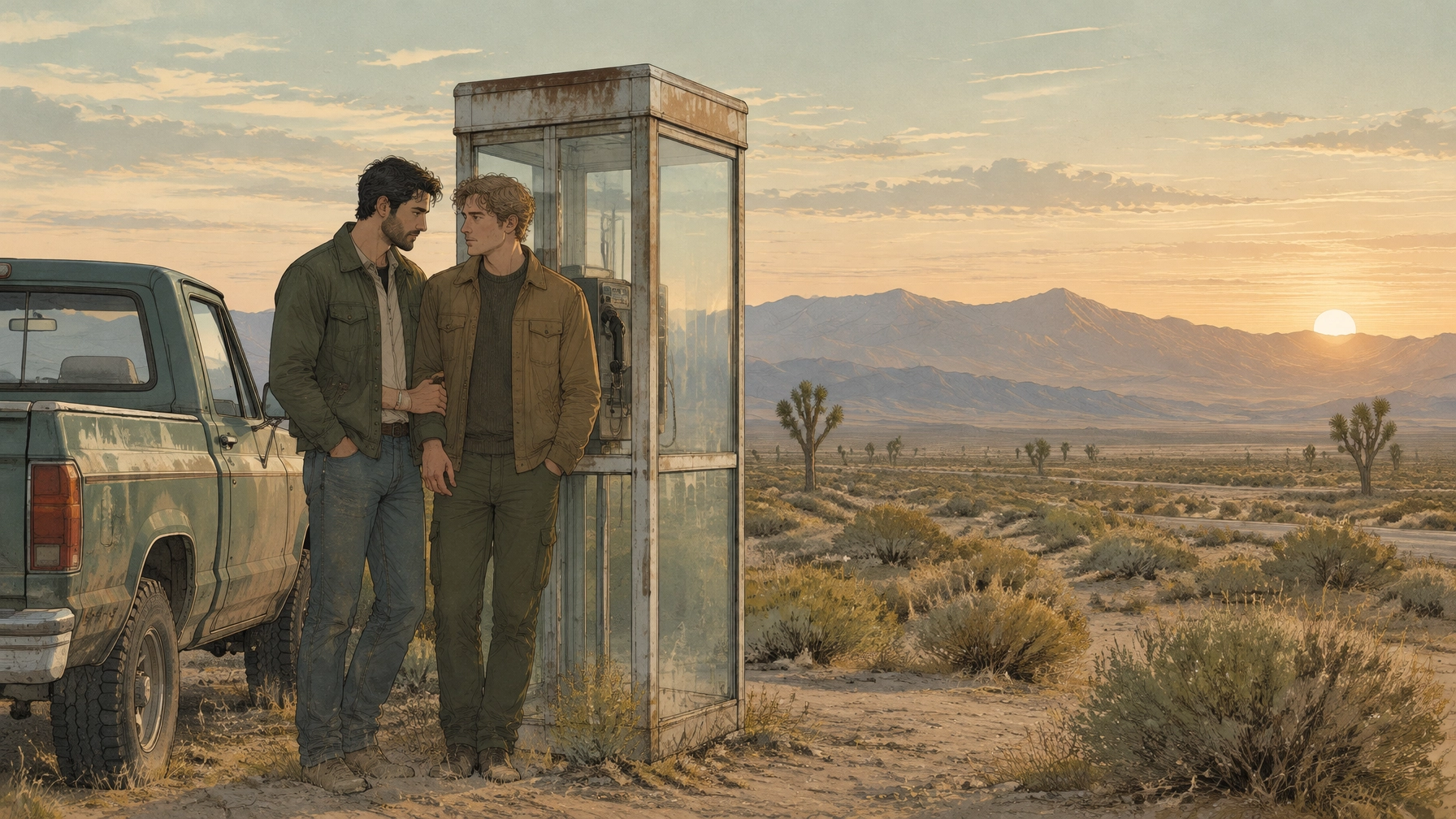
By the time Nathan saw the old phone booth, the sun had thinned to a pale coin above the Mojave. The booth stood alone beside the road, its glass cloudy with dust, its metal frame dulled by years of heat. There was no town in sight. No traffic. No useful reason to stop.
Nathan pulled over anyway.
He had been driving long enough for the silence in the car to feel like another passenger. His phone had bars, technically. It had a brother’s number he hadn’t called in years. It had work messages, appointment reminders, and the occasional notification from someone who needed something. What it didn’t have was a voice he trusted enough to miss.
When the brothers last spoke, Nathan had tried to explain that he was gay. His brother had gone quiet, then said a few things that lodged in Nathan’s memory like grit. Neither of them had found a way back from that conversation. Nathan told himself the distance was a choice. It was easier than admitting he still listened for a call that might never come.
The booth was no longer connected. It had been removed from the desert years ago, after its unlikely fame brought visitors and pressure to a fragile landscape. But Nathan had read about it on the road and followed the idea of it here: a lonely telephone, a random number, strangers calling across the distance in the hope that somebody might answer.
He hadn’t expected to find anyone.
Milo was standing a few yards away, looking toward the empty stretch of road as if he had been keeping watch.
The man who used to answer
“I thought it was still here,” Nathan said.
“The booth?” Milo asked. “Not anymore.”
Milo had once driven out to the phone when the stories about it began to travel. He’d answered for people who called the desert number, and sometimes for people who came looking in person. They wanted to hear a stranger’s voice, or leave one behind. Milo understood the appeal. After his own family had grown distant, answering a call had felt like a small, stubborn way to believe connection was still possible.
He didn’t say that right away. At first, he only asked Nathan if he was all right.
Nathan disliked how gently he asked. Gentleness could feel like a hand on a bruise.
“You drove out here to answer strangers?” Nathan said. “Or to collect their stories?”
Milo’s expression tightened. “You think I did it because I was afraid to ask someone to stay.”
“I think it’s easier to be useful to people who don’t know you.”
The words came out sharper than Nathan intended. He knew that kind of sharpness: a blade held between two people to see who would flinch first.
Milo looked away toward the road. “Maybe. And you drove four hundred miles to a phone that doesn’t work.”
Nathan had no answer ready. The truth of it sat between them, plain and uncomfortable. He had driven a long way to stand beside a dead line. Maybe that was its own kind of dialing.
This is the territory of MM romance in unexpected places: not a magical place that repairs a man, but a remote one that makes it harder to keep pretending he has nothing to ask for. The landscape gives Nathan no easy distraction. There is only heat, distance, and another man who doesn’t rush to fill the quiet.
What jealousy is protecting
They walked around the old concrete pad where the booth had stood. A few stones had shifted in the wind. There was no marker, no receiver, no number to dial.
Nathan asked whether Milo missed it.
“Sometimes,” Milo said. “But I don’t miss being a voice people could hang up on without knowing my name.”
Nathan heard the hurt beneath the plainness. He also heard the part of himself that wanted to be the only person Milo had ever waited for.
The feeling embarrassed him. He barely knew Milo. Still, jealousy rose quickly: jealousy of all the strangers who had called, all the private confessions Milo might have heard, all the people who had been able to reach him without risking anything in return.
“That was a lot of people getting a piece of you,” Nathan said.
Milo looked at him. “And you think I wanted to give it away?”
“I think maybe you preferred being needed to being known.”
For a moment, neither man moved. Nathan felt the old fear opening underneath his accusation: that if Milo knew him properly, he would decide Nathan was too much trouble. Better to point out another person’s defenses first. Better to make rejection feel like something he had predicted.
Milo didn’t retaliate. “Maybe I did,” he said. “But answering them didn’t make me less lonely.”
That answer unsettled Nathan more than anger would have. It left room for both of them to be right. Milo could have found comfort in strangers’ calls and still longed for someone to ask about his own silences. Nathan could resent that openness while wanting, more than anything, to be met with it.
A gay love story is not automatically an easy story. Its emotional journey can begin in the distance between wanting to be chosen and believing oneself worth choosing. The most tender thing Milo offered Nathan was not a promise. It was the patience not to pretend the hurt could be solved in one afternoon.
Letting the phone ring
The old booth was gone, but Nathan still had the number he’d saved from an article. He opened his contacts, found his brother, and stood with the phone in his hand.
“You don’t have to,” Milo said.
“I know.”
Nathan dialed.
The call could not reach the booth. It went nowhere useful; there was no person waiting on the other end, no desert voice rising through the receiver. But Nathan listened as the ring sounded from his phone. He let it continue for a few seconds before ending the call.
Milo stayed beside him.
He didn’t say Nathan should try his brother instead. He didn’t suggest the right words, or tell him everything would be fine. He didn’t turn the moment into proof that Nathan was healing. He simply remained there while Nathan held the silence he had made.
That, Nathan thought, was the difference between waiting and staying. Waiting watches the horizon for something to arrive. Staying is choosing not to leave the person already beside you.
“I don’t know how to call him,” Nathan said.
“You don’t have to know all of it yet.”
The answer was small enough to believe.
A message at the edge of reception
They drove toward a motel before dark. The desert gave way slowly, in changing shades of brown and green. When Nathan’s phone finally found a signal, he opened his brother’s conversation and typed a message.
I’m sorry I disappeared after we last talked. I’m not asking you to make everything okay. I just wanted to say I still miss you.
He read it twice, then pressed send before he could polish it into something safer.
For a while, nothing happened. Milo sat beside him in the parked car, quiet and present. Nathan’s first instinct was to joke about the service, to take the risk back before it could hurt him. He let the joke pass.
The reply arrived several minutes later.
I read this. I’m not ready to talk about everything. But I can talk tomorrow.
Nathan’s chest tightened. Tomorrow was not forgiveness. It was not an erasure of what had gone wrong. It was only an opening, and openings could still close.
He showed Milo the message.
Milo read it, then looked at Nathan. “That’s something.”
“Yeah,” Nathan said. “It is.”
They stayed the night. Not because the silence had vanished, or because one brave text could mend a history. They stayed because the road would still be there in the morning, and neither man needed to pretend that leaving was the only way to keep control.
This is what character-driven queer fiction can make room for: longing that doesn’t become a cure, and tenderness that doesn’t demand a neat ending. For emotionally invested MM readers, the quiet choice to remain can carry as much weight as a confession. Sometimes an emotional MM romance, literary in spirit, asks less whether love can fix the past than whether two men can face it without turning away.
The Mojave Phone Booth is gone. What remains is the question it left behind: when a call comes through, or when it doesn’t, who is willing to stay?
For readers drawn to emotionally layered MM novels and queer fiction, explore Dick Ferguson’s work through Read with Pride.
Follow us on social media
Join us for more reflections on love, longing, and LGBTQ+ stories:
#MMRomance #QueerFiction #LGBTQBooks #LiteraryRomance #CharacterDrivenFiction #GayLoveStories
Three future Morning Edition ideas
Morning Edition: The Door to the Sea at St. Michael’s Mount, Where Two Men Learned the Tide Does Not Keep Promises
A crossing that appears and disappears with the water draws two men into a conversation about timing, trust, and what it means to meet someone halfway.
Morning Edition: Beelitz-Heilstätten, Where Two Men Learned That Ruins Keep the Shape of What We Leave
In the quiet corridors of an abandoned sanatorium, two men confront the difference between being alone and choosing solitude. (Rare Experiences)
Morning Edition: The Underwater Post Office of Vanuatu, Where Two Men Learned to Send a Message Without Knowing Who Would Find It
Beneath the surface, a pair of divers discover how vulnerability changes when every word must be carried by hand. (Rare Experiences)
Images
Hero image: fictional, literary illustration of the Mojave encounter.
Supporting image: Nathan listens to the dead line while Milo stays beside him.

Supporting image: a quiet night after the difficult conversation.

Supporting image: a small message and a cautious beginning.


Leave a Reply
You must be logged in to post a comment.