

The Timetable
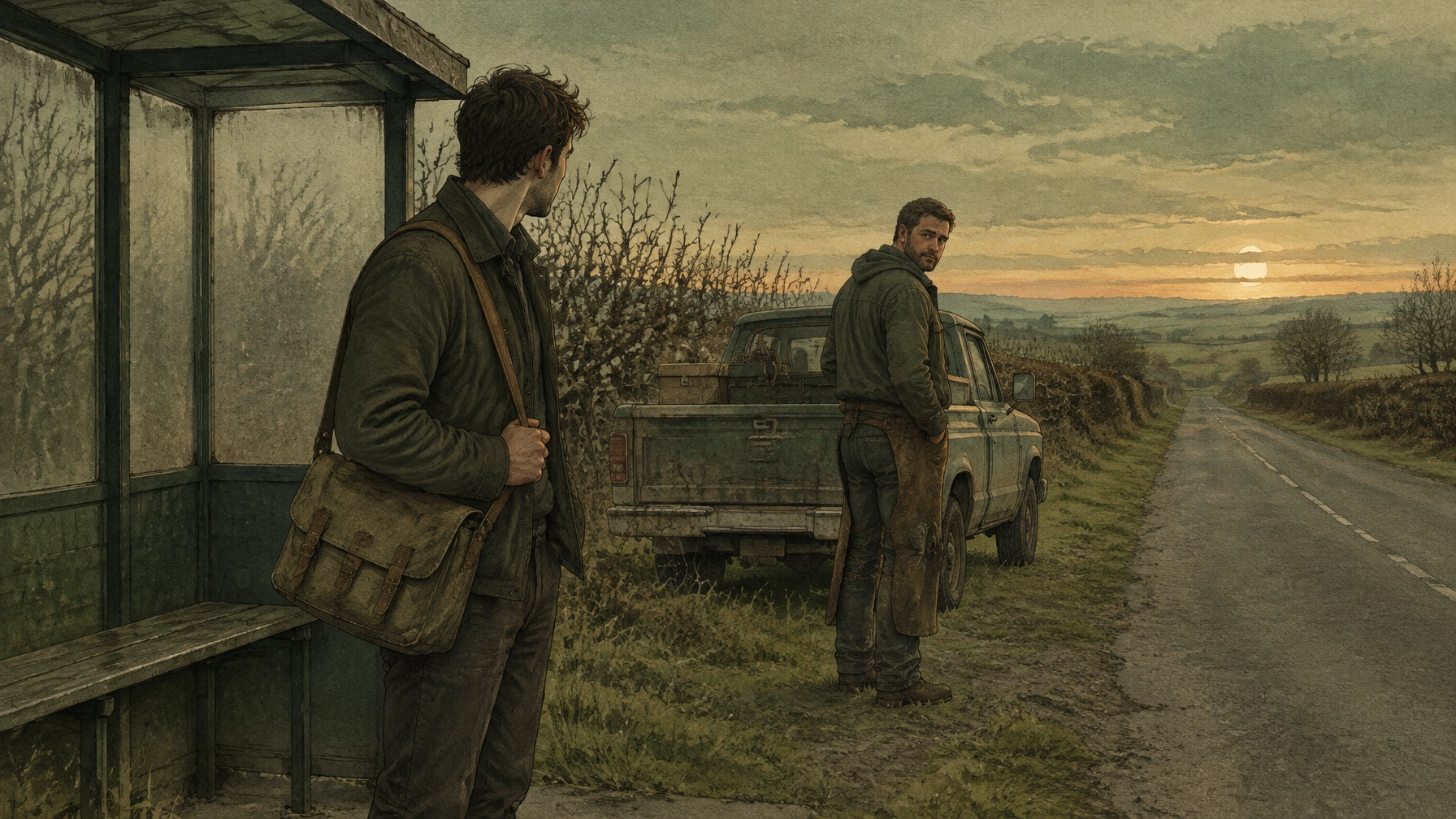
The county had printed the notice in blue ink and taped it inside the bus shelter, where the paper lifted at one corner whenever the wind came down from the hills.
SERVICE ENDS AT MONTH’S END.
I read it every morning for a week, though the words never changed. By the final evening, the timetable beneath it had already become a record of something that would not happen again.
I was thirty-two and six months out of the city. In the country, distance had a way of becoming personal. Wrenfield was the nearest town with a library and a job, and the once-a-day county bus was the narrow thread between them and the cottage where I’d begun, cautiously, to imagine staying.
The bus smelled of diesel and cold vinyl. Its heater worked only on the left side, so I spent the commute with one knee warm and the other keeping its own counsel. I knew which window rattled on the bend and which seat let you watch the fields without seeing your reflection.
I knew Jonah, too, by then, or knew the outline of him. He was a farrier, broad-handed and quiet, with the faint smell of woodsmoke and horses about his coat. For weeks, we had been circling each other in the small ways people do when neither has decided what to call the thing between them. A nod outside the post office. A question about the weather that neither of us needed answered. Once, his hand steadying the library door as I passed through.
On the last evening, he was waiting near the shelter beside his truck.
“You’re the last one,” he said.
“I know.”
His gaze went to the notice. “I could take you home.”
I looked at the truck, then at the road beyond it, darkening between the hedges.
“No, thanks,” I said.
The words came out clean. That was the trouble with them.
A Small No
Jonah nodded as if I had told him something ordinary. He didn’t press. He only opened the driver’s door, climbed in, and waited long enough for the engine to catch before pulling away.
The bus arrived with a shudder, headlights washing over the shelter. I climbed aboard and chose the warm side. The driver had the radio low. I held my hands beneath the heater and watched Jonah’s taillights disappear down the road.
The route took longer than it should have. It seemed to know it was ending. Each familiar stop slipped past in the dusk: the bend by the old chapel, the lay-by with the leaning sign, the crossroads where no one ever seemed to be waiting. When the bus finally rolled into my village, the sky had settled into a deep, bruised blue.
The shelter was empty. The county notice flapped softly against its glass.
I stepped down. The bus pulled away, leaving diesel in the cold air, and the sound of its engine thinned until there was only the wind in the hedge.
I could have walked. It was not impossible. I knew the road, knew the dark, knew how to keep my face still when the cold got into it.
For years, I had made a private virtue of needing nothing. In the city, asking could turn into a debt you never agreed to, or a weakness someone learned where to press. You asked, and they kept score. You asked, and they left before you could decide whether to regret it.
My fingers found the edge of the timetable. The paper was damp and soft beneath my thumb.
Jonah had offered. I had refused. He had let the no stand.
I watched the road where his truck had gone, then pulled my phone from my coat. My hand hovered above his name. The screen dimmed. I tapped it awake again.
Then I called.
He answered before the second ring. “All right?”
I swallowed. “Could you come back?”
A brief silence, not the kind that closes a door, but the kind that makes room.
“Of course,” he said. “Stay there.”
The Road Without Lamps
His headlights appeared at the far end of the road, moving steadily through the dark. When the truck stopped, Jonah leaned across and pushed open the passenger door from inside.
I climbed in. The cab held the warmth of the engine and the smell of leather, damp wool, and the woodsmoke that clung to him. A thermos sat between us. When he loosened the lid, the coffee smelled faintly of mint.
“You all right?” he asked.
“Yes.”
He waited.
“I think so,” I said.
He nodded and eased the truck back onto the road.
For a while, we didn’t speak. The headlights combed the black road ahead, picking out wet leaves, white fence posts, the pale flash of a road sign. Beyond their reach, the fields were only a suggestion of dark against darker sky.
The quiet in the cab was not like the quiet I knew from being alone. It had another person inside it. Jonah’s hands rested easy on the wheel. Mine lay folded in my lap, then unfolded, then settled on my thigh.
At a bend, he lifted the thermos lid and held it out to me.
“Coffee?”
I took it. The metal was warm against my fingers. I drank, tasted coffee first, then the small, surprising coolness of mint.
“Thanks,” I said.
“You’re welcome.”
Our hands came close when I passed the lid back. They did not touch. The space between them was barely anything, and still I felt it.
We passed a farm with one lit window. A dog began barking somewhere behind the fence, sharp and insistent, following us for a few seconds before the road carried us out of its hearing.
The drive was forty minutes. I knew because I had made it often on the bus, watching the minutes stack up on the display. In Jonah’s truck, time seemed to have no numbers. There was only the hum beneath us, the occasional rattle in the dash, the pale road opening and closing in the headlights.
I thought about giving him directions. Then I realised he didn’t know where I lived.
“Take the next left,” I said. My voice sounded smaller than I expected. “Past the ash tree. The cottage with the low stone wall.”
He turned the wheel without asking why I had waited so long to tell him.
A little farther on, the wall appeared. Then the cottage, set back from the road, its windows black. I had been afraid of this part: the exactness of someone knowing where to find me. The knowledge seemed to settle in the cab beside us, quiet as the cooling engine would be later.
Jonah stopped at the gate.
The Light Left On
Neither of us reached for the door straight away.
“Thank you,” I said.
“You’re welcome.”
I looked at his hands on the steering wheel, broad and worn from work. Then I opened my door. Cold air slipped into the cab.
The cottage waited without offering any sign that it had missed me. I walked to the gate and let my fingers rest on the latch. Behind me, the truck’s engine idled; ahead, my porch was dark.
I turned back.
Jonah’s window was down a few inches. In the faint light from the dashboard, his face was still mostly shadow.
“I’m glad I asked,” I said.
He held my gaze for a moment. “Me too.”
I went up the short path and found the switch beside the door. When I turned it, the porch light came on, a small amber circle against the night. Behind me, Jonah’s headlights rested on the stone wall. I could hear the truck, steady and patient, waiting until I was inside.
The bus route was finished. Tomorrow, the road would still be there, and the distances would still be real. Nothing about the dark had become simple.
But when I looked back through the open doorway, Jonah was still in the truck, and I had let him learn where I lived.
Trust, I understood, was not certainty. It was a hand you left in the open.
If this kind of tender, character-driven gay love story speaks to you, explore the LGBTQ+ fiction and MM romance at Read with Pride. For readers who want more stories about men learning to let themselves be helped, visit Dick Ferguson’s Read with Pride store.
Follow us on social media for more queer fiction, heartfelt gay stories, and character-driven MM romance: Instagram · X · Facebook · Read with Pride
#MMRomance #GayLoveStory #QueerFiction #EmotionalMMRomance #ReadWithPride #CharacterDrivenFiction #SlowBurn


Leave a Reply
You must be logged in to post a comment.