

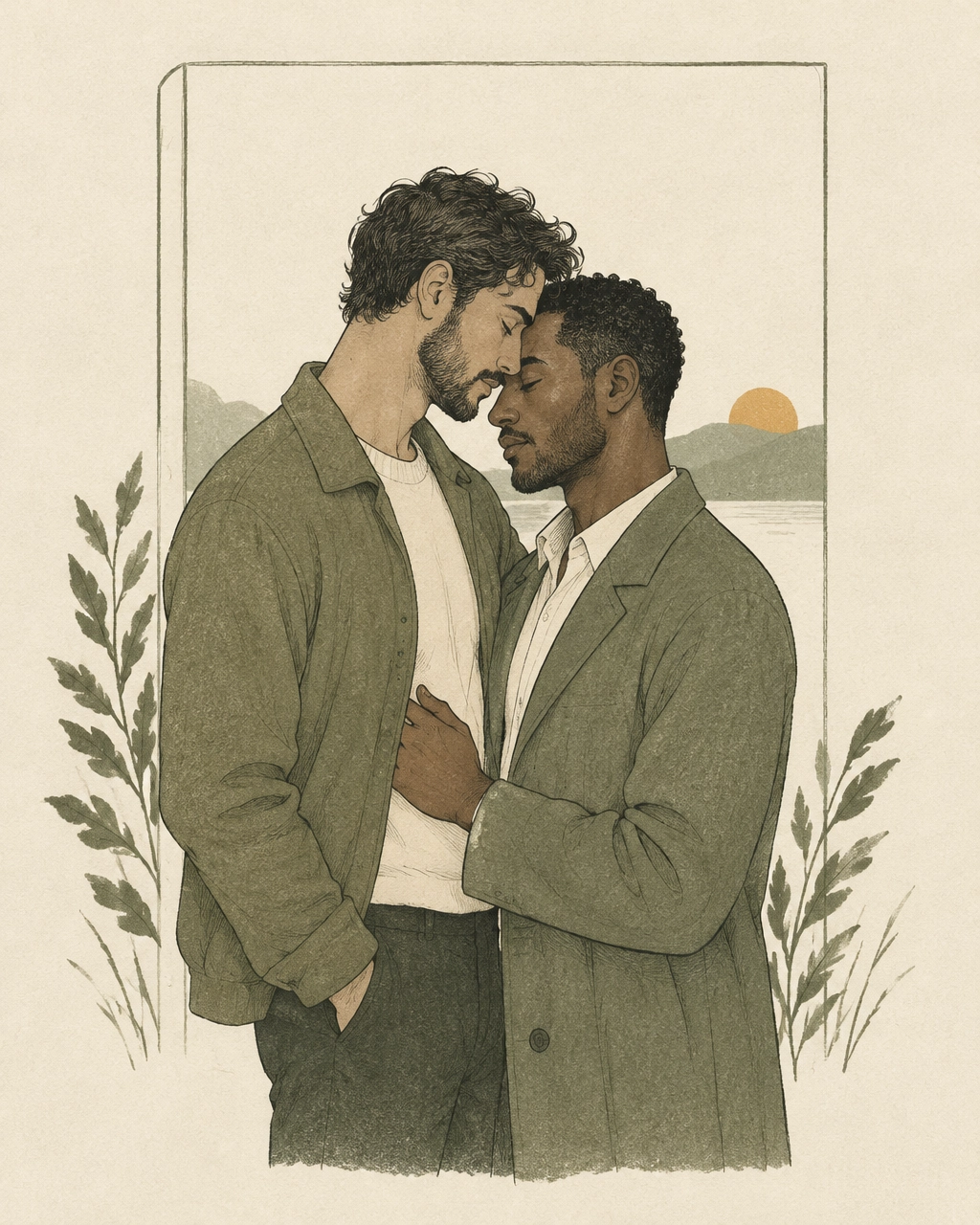
A reader scrolling through an ebook store may give a cover only a heartbeat. In that instant, they’re asking: Will this story make me feel what I want to feel? For MM romance, the cover is more than a genre label. It’s the first emotional promise a book makes.
That promise matters especially to readers looking for character-driven queer fiction. They may be searching for the ache of a second chance, the warmth of a hard-won home, or the tension between two men who can’t quite admit how much they need each other. A strong cover helps them recognise that feeling before they’ve read a single page.
Start with the feeling, not the image
Before choosing a photograph, illustration, colour palette or typeface, decide what you want the cover to feel like. Is the heart of the story longing? Tension? Warmth? An ache that lingers after the final chapter?
Write down a few words that capture the emotional centre of your book. Then use those words as a filter. If your story is a tender gay love story about learning to trust again, a cover that looks like a high-octane thriller may set the wrong expectation, even if it features two handsome men. If the novel is full of conflict and slow-burn attraction, a soft, cosy design might not signal its intensity.
Readers looking for emotional gay romance are often choosing by mood as much as by trope. Your cover should offer a truthful first impression: not the whole plot, and certainly not a spoiler, but a clear sense of the journey waiting inside.
Make the cover work at thumbnail size
A cover that looks beautiful full-screen may become a blur on a phone. Shrink your design until it’s about the size readers will see on an ebook storefront. Can you still read the title? Is the focal point clear? Does the image remain recognisable?
For a useful thumbnail test:
- Give the title strong contrast against its background.
- Keep the design focused on one main image, symbol or moment.
- Avoid tiny decorative details that disappear at small sizes.
- Check that the author name is visible without competing with the title.
This doesn’t mean every cover needs enormous lettering or a busy image. It means a reader should be able to understand its visual invitation quickly. Clear, uncluttered design gives your book a better chance to catch the eye among other gay books and LGBTQ+ ebooks.
Signal the right kind of romance
Readers browse by category and expectation. A cover should help them identify the kind of story they’ve found, whether that’s contemporary MM romance, a high-angst love story, or the next instalment in an MM romance series.
Think about the visual language of your subcategory, then make it your own. A contemporary romance might draw on a recognisable modern setting or the intimacy of an everyday moment. A story centred on longing could use distance, a half-turn, or two men drawn together by the composition. The goal isn’t to reveal the plot; it’s to make a clear promise about tone.
An emotionally close image of two men can signal romance, but intimacy doesn’t have to mean a kiss or a dramatic embrace. Sometimes a glance, a shared silence or the smallest touch tells the reader more. Choose a moment that reflects the book’s emotional temperature, and make sure it represents the relationship on the page.
Choose images with care
Stock photography can be useful, but a mismatch between the people on the cover and the characters in the story can pull a reader out of the experience before it begins. Consider details that matter to your characters, such as age, style, setting and the way they carry themselves. If your cover features a couple, their appearance and body language should feel plausible for the story you’ve written.
Be especially careful with real people’s faces. Don’t take images from social media, search results or another author’s cover and assume they’re free to use. A recognisable face may belong to someone who has not agreed to represent your characters; the image may also be protected by copyright or limited by its licence.
A more respectful approach is to commission a cover designer, collaborate with an artist, or use images with licensing terms that clearly allow the intended use. A designer can help you turn a feeling into a visual concept while keeping the work original and properly credited. Fair payment and clear permissions are part of building a creative community where queer authors and artists can thrive.
Give a series a visual signature
When readers finish book one and come back for the next, recognition helps. A consistent design across an MM romance series lets them spot the next title quickly, especially when all your books sit together on an author storefront.
You don’t need to make every cover identical. Instead, choose a few visual elements to carry through the series:
- A consistent treatment for titles and author names.
- A related palette, or colours that evolve in a deliberate way.
- The same placement for your author name.
- A shared visual motif, frame or layout.
Then vary the details to suit each book. One cover might lean into warmth, another into tension, while both still look like members of the same family. When book three appears on a reader’s screen, that familiar design language can make your whole series feel considered and inviting.
Test, learn and let the cover evolve
A cover isn’t a decision you can never revisit. Readers’ responses, a new series instalment or a seasonal refresh may give you a reason to refine the design. Sometimes you’ll spot a practical issue only after seeing the cover on a real storefront: the title is too small, the colours blend into the page, or the image promises a different kind of story.
On readwithpride.com, authors can use the free one-year publishing portal to update and re-upload covers without paying a fee for each upload. That makes it easier to test a thoughtful revision or refresh a series look in minutes, rather than treating every change as a new expense. The portal has no upfront cost; transaction fees apply when a sale is made. Authors retain control of their creative choices, without gatekeeper approval standing between them and a cover revision.
An author storefront brings your books together in one place. When the covers work as a coherent set, they quietly help readers understand what you write and where to start. Explore Dick Ferguson’s author storefront to see how a range of gay romance and queer fiction titles can sit together under one author name.
If you’re a gay author, queer author or LGBTQ+ writer ready to share your work, visit Read with Pride and claim your free one-year publishing portal. Bring the cover you have, the idea you’re still developing, or a series you’d like to make more cohesive. Your books deserve a storefront where readers can discover them, and a cover that says, at a glance, this is the feeling you came for.
Follow us on social media
Follow Instagram, X, and Facebook, and visit Read with Pride to discover more LGBTQ+ fiction.
#WriteWithPride #LGBTQAuthors #GayRomance #MMRomance #QueerFiction #SelfPublishing #IndieAuthor #BookCovers
Image suggestions


Leave a Reply
You must be logged in to post a comment.