

Category: Rare Experiences | Morning Edition
A place built for stillness
By late October, the cold had settled into the metal.
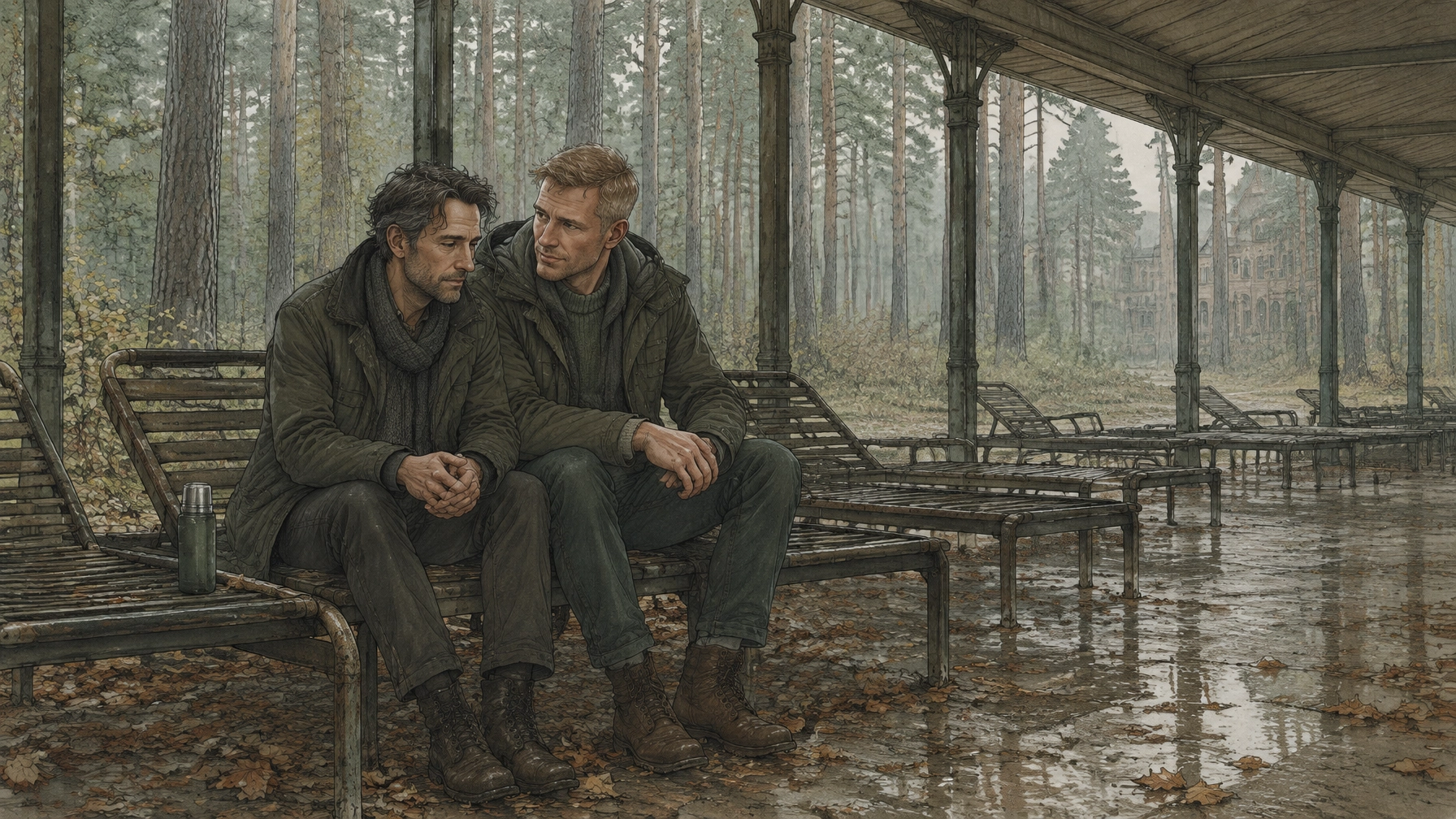
Reuben rested one hand on the rail of an old reclining frame and felt the chill travel through his fingers. Beyond the open side of the lying hall, pine trunks stood dark with rain. Wet leaves shone underfoot. Somewhere above the thin roof, a drop of water found its way through and tapped, then tapped again.
He was here with permission to document the Liegehallen for a preservation report. Mattis, his partner, had come to record their acoustics: wind passing through the open bays, rain on old roofing, jackdaws calling from the trees, the soft disturbance of footsteps. He held a microphone in one hand and a thermos in the other, as if both were tools for keeping the day manageable.
The halls had been made for a particular kind of rest. At Beelitz-Heilstätten, a vast sanatorium complex built in the pine forest from 1898 onward, patients followed the Liegekur, an open-air rest cure. They lay motionless and wrapped for hours in all kinds of weather, in rows of reclining frames or hammocks beneath roofs that offered shelter without shutting out the air. The complex was arranged in separate pavilions, oriented south to catch light and air. Patients were divided by gender and by infection status.
Reuben knew these facts. He had written them carefully in his notes. Still, standing among the frames, he felt the past pressing close in a way a report could not contain.
The care that feels like being watched
“Drink something,” Mattis said, lifting the thermos.
“I’m fine.”
“You’ve been saying that since the car.”
Reuben looked down at his notebook. He had left a sentence unfinished, not because the words were difficult but because his breath had caught halfway through them. Mattis had noticed. Mattis noticed everything: the pauses, the slight set of Reuben’s shoulders, the careful way he measured a walk across uneven ground.
“Do you want to sit for a minute?” Mattis asked.
“I am standing in a hall full of beds. I think I understand the options.”
Mattis lowered the thermos. The hurt in his face came and went quickly, but Reuben saw it. That was the trouble with loving someone closely: there was nowhere to put the things you saw.
Mattis had not come here to make Reuben feel ill. He was trying to help. He timed pauses because he cared; offered water because he remembered; asked questions because silence sometimes made him worry. None of that made the questions land gently.
In his twenties, Reuben had spent the better part of two years moving in and out of hospital with a long lung illness. He was well now. He knew that. But the fear had never quite left. He still hated being watched while he recovered from anything, hated the moment a person’s concern seemed to turn him into a condition to be managed.
“Stop checking on me,” he said.
Mattis’s hand tightened around the thermos. “I’m not checking a chart.”
“It feels like you are.”
For a moment, only the rain answered them.
An MM romance in an unexpected place
The Beelitz halls make an unusual setting for MM romance: not because the architecture offers easy drama, but because it asks what care means when stillness has been imposed rather than chosen. The most affecting gay love story is not always built around grand declarations. Sometimes its emotional journey begins with two men who love each other and cannot agree on what help should look like.
Mattis set the thermos down. “You’d rather collapse than be looked after.”
“That isn’t fair.”
“No,” he said. “It isn’t. But loving a man who won’t be seen is a lonely job.”
The words struck harder because they were not entirely wrong. Reuben’s first instinct was to answer with a list of reasons: the cold, the work, the walk back to the entrance. Practicalities made useful shields. But Mattis was not asking him to defend his stamina. He was telling him what it cost to stand beside someone who kept turning away.
Reuben glanced along the rows. The empty frames seemed to wait without expectation, which was worse than if they had demanded something. He imagined the hundreds of people who had once been told to lie still here, wrapped against the cold, looked at by staff and measured against the hope of a cure. The cure might come, or it might not. The watching remained.
“That’s what this place was,” he said at last. “People lying still while other people looked at them to see whether they were getting better. I know it was treatment. I know why it was done. But when I lie down, my body remembers being a problem everyone had to monitor.”
Mattis did not reach for him. He did not tell him to breathe, or ask whether he was all right. He let the explanation sit between them without trying to turn it into a plan.
Ten minutes without instructions
Mattis took the recorder from his hand and put it away.
The change was so small Reuben might have missed it if he had been looking anywhere else. The microphone lowered. The red recording light disappeared. Mattis stopped naming what he heard and stopped measuring the silence for signs of trouble.
Then he sat on one of the old metal frames and lay back, fully clothed, facing the open bay.
Reuben stayed standing.
Mattis said nothing.
The cold air moved over them. Rain ticked against the thin roof. In the trees, a jackdaw called once and then went quiet. Reuben could hear Mattis breathing, but there was no question tucked inside the sound, no invitation to report how he felt.
After a while, Reuben lowered himself onto the neighbouring frame. The metal was cold through his coat. He lay on his back with his hands resting over his stomach, unsure what to do with the sudden absence of instruction.
Ten minutes passed without a word.
For readers drawn to character-driven queer fiction, this is the difficult tenderness at the centre of the scene: Mattis cannot erase the past, and Reuben cannot make his fear vanish by explaining it. Yet something changes in the space between them. The emotional MM romance here is literary in its attention to gesture, not grand in its promises. Mattis offers presence without management. Reuben accepts it, not because he is suddenly comfortable, but because he chooses to remain.
The silence they can share
When Reuben sat up, the forest beyond the hall looked blurred by fine rain. Through the pines, the treetop walk rose above the roofless Alpenhaus ruin, its wooden path threading through the canopy. The place held more than one kind of history: the orderly rows of the halls, the damage left by war, and the green growth that had taken hold among broken walls.
Mattis did not ask whether the rest had helped.
Reuben did not say that he was fine. He did not need to give the moment a name, or make it useful. His fear was still there, quiet but present, like a draught moving through the open bay. He had only let himself be looked at once without being managed.
That was not surrender. It was not a cure, or a promise that the next time would be easier. It was simply a small space where he did not have to explain himself, and Mattis let the silence hold.
For emotionally invested MM readers looking for a gay love story shaped by vulnerability rather than easy answers, this kind of moment can linger. Find more queer fiction and gay romance through Read with Pride’s e-book store.
A note on the real place
Beelitz-Heilstätten began as a tuberculosis sanatorium complex in 1898, built among the pines for open-air treatment. From 1945 to 1994, it served as the Soviet army’s largest hospital outside the USSR. The Alpenhaus burned in 1945, and the treetop walk, opened in 2015, now crosses above its roofless ruin. Reuben, Mattis, and the story of their survey are invented; the history and landscape that frame their moment are real.
Follow us
Follow us on social media: Instagram · X · Facebook · Read with Pride
#MMRomance #GayFiction #QueerFiction #LiteraryMMRomance #ReadWithPride #RareExperiences #BookTok #CharacterDrivenFiction #BeelitzHeilstätten #EmotionalRomance
Three more Morning Edition ideas
- The Underwater Post Office of Vanuatu (Rare Experiences): A letter delivered beneath the sea becomes an unexpected message about what two men are willing to risk saying.
- The Wave Organ, San Francisco (Unexpected Places): Along a waterfront instrument played by the tide, two men listen for the truth neither has managed to speak.
- The Blue Grotto, Malta (Rare Experiences): In a sea cave where light changes the water by the minute, an old misunderstanding returns with the morning boats.
Images


Leave a Reply
You must be logged in to post a comment.