

readwithpride.com
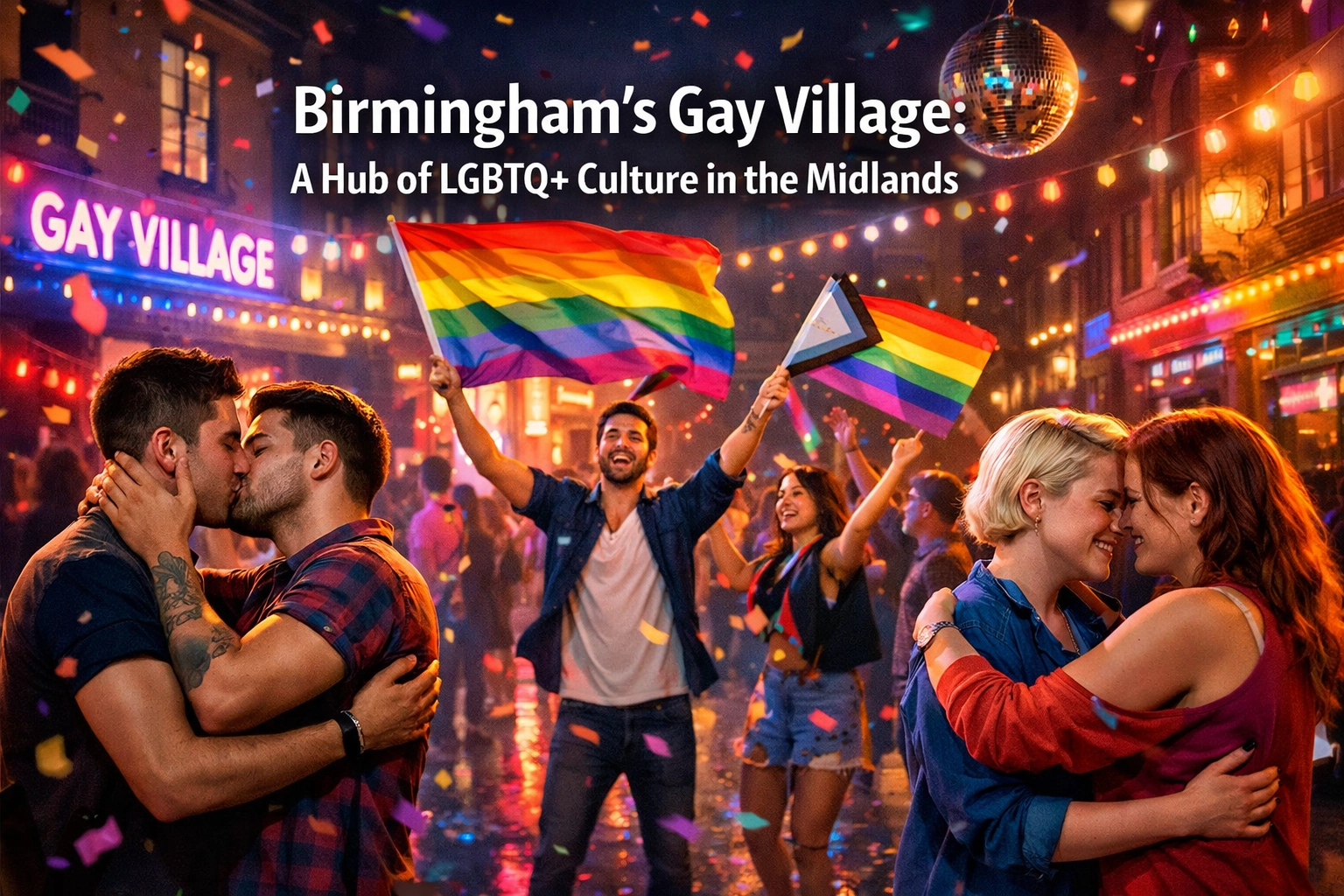
Birmingham doesn’t always get the credit it deserves for being a proper LGBTQ+ trailblazer. London gets the headlines, Manchester gets the montages, and Brighton gets… well, Brighton gets the beach. But if you’ve ever ended up on Hurst Street at 1am, glitter in your hair and a chip barm in hand, you already know: the Midlands has its own queer heartbeat, and it’s loud, proud, and historically significant.
Birmingham’s Gay Village isn’t just a cluster of bars. It’s a survival story. It’s community infrastructure. It’s protest energy. It’s dancefloor therapy. And these days, it’s also a setting that practically begs to be turned into gay romance novels, from slow-burn first dates to “we definitely weren’t supposed to fall for each other on a stag weekend” chaos.
This is the evolution of Hurst Street: then and now, with a side of culture, activism, and a little nod to the kinds of stories we love publishing and reading at Read with pride, especially MM romance books.
Where it all began: safety, secrecy, and the need to gather
To understand Birmingham’s Gay Village, you have to start with the vibe of the late 1960s: “technically legal” didn’t mean “socially safe.”
In 1967, the Sexual Offences Act decriminalised private sexual acts between men over 21 in England and Wales. That law shift cracked the door open, but it didn’t swing it wide. Police raids, harassment, job loss, and public shaming were still real risks. So queer spaces were often built like speakeasies: discreet, careful, and community-protected.
One of the earliest pillars was The Nightingale Club, which opened in 1967 as a members-only venue with strict door policies designed to keep people safe. That “members-only” approach wasn’t about exclusivity for the sake of it, it was about creating a controlled environment in a time when just being seen could cost you everything.
If you’re into queer history, this is the kind of detail that hits hard: the nightlife wasn’t just nightlife. It was refuge.
The 1970s: activism arrives (and Birmingham doesn’t do it quietly)
Birmingham’s queer community didn’t just build places to party, it built movements.
By 1972, the Birmingham Gay Liberation Front (GLF) had formed and quickly became one of the most active in the UK. That same year, Birmingham hosted an early Pride-style event including gatherings at Cannon Hill Park and a march up New Street ending with rallies in Victoria Square.
It’s worth pausing here because it’s easy to think of Pride as a modern brand-sponsored festival with wristbands and drink tokens. But early Pride marches were bold because they were risky. Showing up was a statement: I’m here, I’m not ashamed, and I’m not going away.
And that’s a core thread in Birmingham’s Gay Village story: it’s always been about visibility on your own terms.
The UK’s first LGBTQ+ community centre (yes, really)
Here’s a Birmingham fact more people should know: in 1976, the Birmingham Gay Community Centre opened, and it’s widely recognised as the first official LGBTQ+ community centre in the UK.
That matters because community centres aren’t just “nice-to-have.” They’re practical. They mean:
- support groups
- advice and advocacy
- social events that aren’t alcohol-centred
- safer spaces for people who aren’t ready (or able) to do nightlife
The centre helped set a model for similar spaces across the country in later decades. So while other cities were still figuring out what community infrastructure could look like, Birmingham was already building it.
If you’re writing queer fiction (or devouring it like the rest of us), this kind of detail gives you setting texture: the Gay Village wasn’t only hedonism, it was mutual care.
Hurst Street becomes “the Village”: the 80s–90s expansion
The Birmingham Gay Village as many people recognise it today truly came together in the 1980s and 1990s, when more venues opened around Hurst Street and nearby roads, close to Chinatown and the city centre.
This era also sits alongside major national shifts: Thatcher-era politics, the AIDS crisis, the rise of Section 28, and a growing need for queer spaces that felt both protective and defiant. Villages across the UK developed as clusters partly because strength was safer in numbers, venues near each other created a visible, walkable community.
There’s also a very Birmingham detail here: the proximity of Dorothy Towers (Clydesdale and Cleveland Towers), 1970s housing that became a kind of informal social gravity for late-night gathering and afterparty culture. It’s one of those pieces of urban folklore that tells you how queer communities build their own maps, sometimes in the spaces the city didn’t plan for us.
A symbol you can’t miss: the Gay Village Gateway (2012)
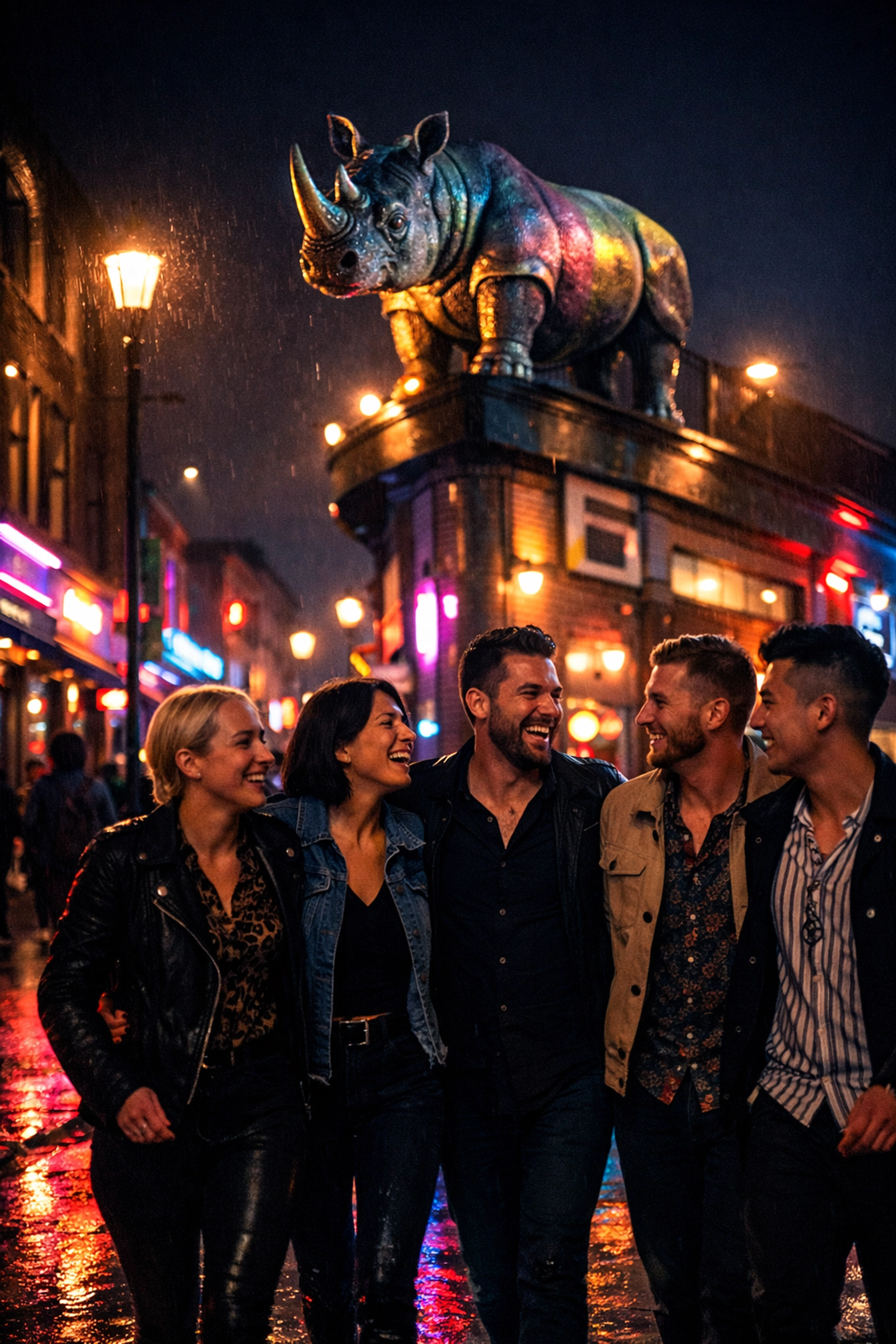
Fast-forward to 2012, and Birmingham installs one of the boldest “yes, we’re here” markers in the country: the Gay Village Gateway, a rhinoceros sculpture perched above Hurst Street, designed by artist Robbie Coleman.
It’s camp. It’s public. It’s unmissable. And it signals something important: the Village isn’t just tolerated behind closed doors: it’s acknowledged as part of the city’s cultural identity.
The Village now: nightlife, community, and a wider mix of identities
Today, Birmingham’s Gay Village is still a major LGBTQ+ hub: especially for people across the Midlands who want a place that feels like theirs. It’s a destination, but it’s also a local lifeline.
What’s changed?
1) Visibility is broader (and more complex)
You’ll see more open queerness in everyday life now, not just in nightlife. But with that comes the reality that safety still isn’t guaranteed for everyone: especially trans people and people facing intersectional discrimination. The Village remains important because it’s a space where being visibly LGBTQ+ is the norm, not a negotiation.
2) The community isn’t one-size-fits-all
The LGBTQ+ community includes different generations, cultures, and sub-communities: clubbers, drag lovers, leather folks, sober queers, students, couples on date night, people who’ve just moved to Brum and are trying to find their people. The best nights in the Village are the ones where the mix feels real.
3) Pride is bigger: but the roots still matter
Birmingham Pride has grown massively compared to those early 1970s marches. But the Village still holds the emotional core of it: the sense that you’re stepping into a shared story.
Why Hurst Street is basically a romance novel setting (and we mean that lovingly)
Let’s talk story: because if you’re here from Readwithpride.com, you already know we’re always scanning places for plot potential.
Hurst Street is perfect for MM romance books because it naturally creates classic tropes:
- Found family: bartenders, drag performers, regulars, chosen siblings you meet on a random Thursday
- Second chance romance: running into your ex outside the same club you swore you’d never return to
- Opposites attract: quiet guy from a small Midlands town + chaotic extrovert who knows every bouncer by name
- Forced proximity: a packed Pride weekend, one hotel room left, and a lot of feelings
- Enemies to lovers MM romance: two rival event organisers, one venue, and mutual respect that turns into something else
And because Birmingham has that grounded, no-nonsense humour, the romance hits differently. It’s not polished fantasy. It’s tender, funny, messy, and real.
Midlands queer life beyond the Village: not everyone lives on Hurst Street
Birmingham’s Gay Village is a beacon, but it also highlights a truth about regional queer life: many LGBTQ+ people in the Midlands live outside the city centre: Solihull, Wolverhampton, Dudley, Walsall, Coventry, Worcester: and they travel in for nights out, dates, and community events.
That “commuter queer” experience shapes stories too:
- the last train anxiety
- the “what if someone from work sees me” tension
- the relief of walking into a space where you don’t have to edit yourself
- the joy of meeting someone who gets it because they’ve lived it too
This is one reason queer fiction matters so much. Representation isn’t just about being out and proud in a capital city: it’s also about the in-between spaces, the regional realities, and the way community forms across distance.
Bookish detour: Hurst Street vibes in MM romance (gym, hockey, and a little spice)
Not every romance has to be set in Birmingham to feel like Birmingham. Sometimes it’s about energy: resilience, banter, and intimacy that’s earned.
If you’re in the mood for trope-y escapism that still feels emotionally grounded, here are two niche corners of gay romance novels that pair weirdly well with the Village’s vibe:
MM gym romance stories: sweat, support, and soft boys lifting heavy things
The gym trope works because it’s not just about bodies: it’s about routine, vulnerability, and trust. It’s “spot me” as a love language. It’s the slow burn that builds between reps.
Look for:
- slow burn and friends to lovers
- recovery arcs (injury, heartbreak, coming out late)
- protective tenderness under all that “alpha” posturing
MM hockey romance books with spice: intensity, teamwork, and feelings you can’t bench
Hockey romance brings peak pacing: fast, physical, and emotionally high-stakes. Add a bit of spice and you’ve got the perfect “one night turns into something real” setup: very Hurst Street-coded.
Look for:
- rivals to lovers
- secret relationship / “don’t get caught” tension
- heartfelt team dynamics (found family again: always a winner)
If you want to browse LGBTQ+ ebooks and queer fiction that leans into these tropes, start at readwithpride.com:
- Home: https://readwithpride.com
- Browse our wider catalogue via the site maps if you’re hunting a specific niche: https://readwithpride.com/sitemaps.xml
(Quick note for the technically minded: this post includes a single H1, so we’re good on that common SEO pitfall.)
Hurst Street’s legacy: more than a night out
It’s easy to reduce any gay village to nightlife. But Birmingham’s story is bigger than bar names and closing times.
Hurst Street represents:
- the shift from secrecy to visibility
- the power of organising (GLF, early Pride, community centres)
- the importance of dedicated queer space: especially outside London
- a Midlands-flavoured kind of pride: not flashy for the sake of it, just solid, stubborn, and deeply human
And honestly? That’s why it keeps inspiring stories: historical and contemporary, real and fictional. Because at its core, the Village is about people finding each other.
Follow Read with Pride (and keep your TBR thriving)
- Website: https://readwithpride.com
- Instagram: https://www.instagram.com/read.withpride/
- X: https://x.com/Read_With_Pride
- Facebook: https://www.facebook.com/profile.php?id=61586883027069
Hashtags
#BirminghamGayVillage #HurstStreet #MidlandsLGBTQ #UKQueerHistory #ReadWithPride #MMRomanceBooks #GayRomanceNovels #LGBTQEbooks #QueerFiction #EnemiesToLovers #ForcedProximity #SlowBurn #BestMMRomanceBooksOf2026

Leave a Reply
You must be logged in to post a comment.