

readwithpride.com
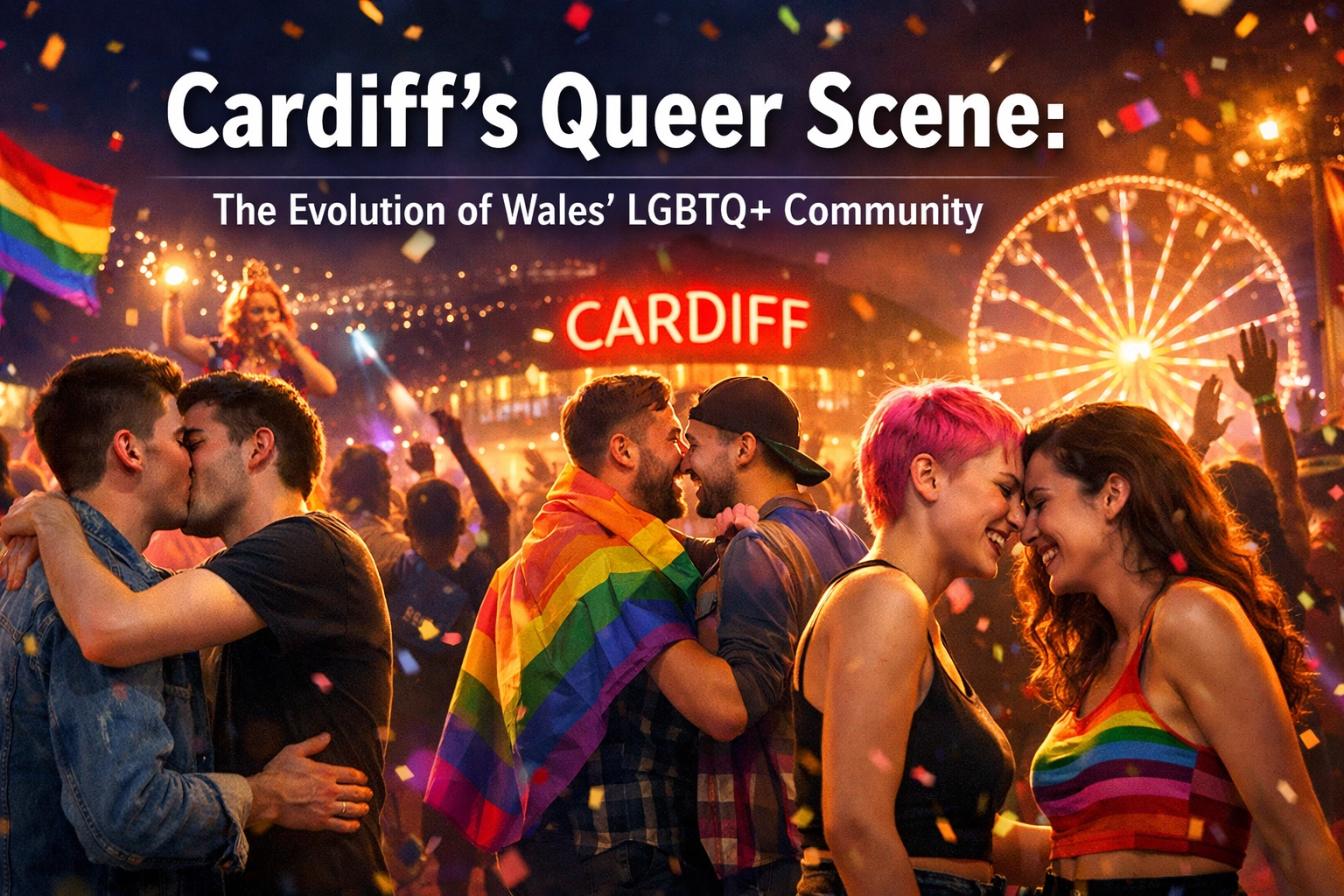
Cardiff’s queer scene didn’t just “appear” one day with rainbow bunting and a drag brunch menu. It grew in layers, through politics, protest, parties, heartbreak, found family, and the kind of stubborn Welsh pride that refuses to be erased. And while Cardiff often gets framed as “the Welsh capital (and that’s it),” the city has been a major engine for how Welsh queer identity has formed, fought back, and celebrated itself.
This is the story of how Cardiff went from coded conversations and clandestine meetups to Pride Cymru, film festivals, nightlife hubs, and a community that keeps reinventing itself, especially as LGBTQ+ life changes across the UK.
Before it was “a scene”: survival, secrecy, and small wins
For a long time, queer life in Wales, like the rest of Britain, was shaped by law and fear. When being yourself can get you arrested, the “scene” tends to be hidden in plain sight: certain pubs, certain parks, certain looks that last a second longer than they should.
A major turning point came with the partial decriminalisation of sex between men in England and Wales in 1967. The law didn’t magically make Wales safe (it didn’t), and it didn’t include everyone (it didn’t). But it did create space for more visibility, and it mattered that one of the key figures behind that shift was Cardiff-born MP Leo Abse, who helped steer the Sexual Offences Act through Parliament.
The important part here isn’t hero worship. It’s this: Cardiff wasn’t just catching up with history. Cardiff was making it.
The 1970s: Cardiff’s first gay venues and the rise of Welsh organising
By the 1970s, Cardiff started building the infrastructure that makes a queer community feel real: places to meet, groups to join, events to plan, and, crucially, spaces that feel like yours.
One of the best-known landmarks is The King’s Cross, which opened in 1972 on Caroline Street and became a central pillar of gay life in the city for decades (until 2011). For generations of people, it wasn’t “just a bar.” It was where you found your first chosen family, where you learned the local gossip, where you held someone’s hand without checking who might be watching.
At the same time, activism was getting organised. Cardiff and Newport formed a branch of the Campaign for Homosexual Equality (CHE) in 1972, with meetings at places like the Blue Anchor on St Mary’s Street. The Gay Liberation Front was also active, and Cardiff hosted Wales’ first gay rights march in the early 1970s.
The vibe of the era? Scrappy, brave, and community-led. Not polished. Not corporate. Just people refusing to disappear.
The 1980s: helplines, youth groups, and the shadow of Section 28
The 1980s brought both growth and pressure. This was the era when community support became more formal, because it had to.
Cardiff saw the development of LGBTQ+ street theatre, community groups, and targeted support, including Cardiff Lesbian Line (started in 1981). Spaces for connection mattered because loneliness is political too, especially when mainstream institutions are hostile or silent.
Then came Section 28 in 1988, the infamous clause that banned the “promotion” of homosexuality by local authorities and chilled LGBTQ+ visibility in schools and public life. Cardiff joined protests such as Wales Against Section 28, linking local resistance to national organising.
If you grew up anywhere in the UK under Section 28, you know the legacy: the missing conversations, the shame-by-default, the sense that your future was “not appropriate for discussion.” Cardiff’s queer community pushed back anyway, and those networks became the foundation for what came next.
The 1990s to early 2000s: the nightlife map starts to glow
By the late 1990s, Cardiff’s queer geography was becoming easier to point at on an actual map. Areas around Charles Street and Churchill Way became known as core nightlife zones. Venues with cabaret and drag, like Minskys, helped build a scene that wasn’t only about drinking, but about performance, humour, glamour, and shared cultural language.
Nightlife mattered (and still matters) because it often functions as a community centre you don’t have to explain yourself to. You don’t need a membership card to belong. You just need to show up.
And then Cardiff got a pop culture boost: the city gained broader visibility through shows like Torchwood (set in Cardiff), and queer storytelling became more mainstream, imperfectly, but noticeably.
Pride in Cardiff: from a small parade to a movement with choices
Cardiff’s first Pride event is often traced back to 1985, when a university-organised parade drew fewer than 100 people. That’s the kind of detail that’s easy to romanticise now, but at the time it was genuinely risky and deeply defiant.
In 1999, Cardiff hosted its first Mardi Gras, which became annual and later rebranded as Pride Cymru (2014). Over time, Pride Cymru grew into a major event, part protest, part party, part civic “yes, we exist” moment right in the capital.
And because queer communities are rarely just one thing, Cardiff also developed alternatives. The Big Queer Picnic, founded in 2012, became a free, grassroots Pride-adjacent gathering, more laid-back, more community-centred, and a reminder that you can celebrate without needing a wristband.
That’s the very Cardiff thing: the official event and the DIY version. The parade and the picnic. Room for different kinds of queerness.
Cardiff now: a bigger “community” than just bars (but yes, the bars still matter)
Today, Cardiff’s LGBTQ+ life is broader than nightlife, though nightlife remains a vital heartbeat. Modern venues like Pulse and Kings continue to act as gathering points, especially as dedicated queer venues have declined in many cities across Western Europe.
But Cardiff’s scene now includes film, mutual aid, identity-based groups, and activism that reflects what the community actually looks like in 2026: diverse, intersectional, and not interested in being put in a tidy box.
A major cultural institution is the Iris Prize (founded 2007), celebrating LGBTQ+ short film with an annual festival that pulls in audiences well beyond the “usual crowd.” If you want proof that queer culture in Wales is more than nightlife, Iris is a great place to start.
On the activism side, newer groups have emerged in response to current pressures, like Trans Aid Cymru, founded in 2020 following protests connected to Gender Recognition Act reforms. And community groups like Glitter Cymru support ethnic minority LGBTQ+ people, reflecting a more specific, more honest understanding of who needs what, and why “one community” still contains many different experiences.
The stats back up Cardiff’s significance too: the 2021 census found 5.33% of Cardiff residents (16+) identified as lesbian, gay, bisexual, or another non-heterosexual orientation, the largest LGBTQ+ population in Wales.
How Welsh queer identity shows up differently than “UK queer identity”
Here’s where Cardiff gets especially interesting: it’s not just “a queer scene in a city.” It’s a queer scene in Wales, shaped by language, local politics, regional culture, and that very particular blend of friendliness and side-eye that Welsh cities do so well.
Welsh queer identity often includes:
- A strong sense of place (Cardiff, the Valleys, the coast, the rural towns, each has its own vibe)
- Intergenerational community memory (because a lot of people stayed, built networks, and passed them on)
- A tension between visibility and privacy (especially for people connected to smaller communities)
- Pride that isn’t always loud, but is deeply rooted
Cardiff, as the capital, becomes the meeting point: where people from across Wales come to breathe a little easier, date a little more freely, and see possibilities that might feel out of reach back home.
Queer nightlife, then and now: what it gives people (beyond a dancefloor)
Nightlife is often dismissed as superficial. But in queer history, nightlife has been practical: a place to find safety, information, and connection. Cardiff’s venues, past and present, have offered:
- Visibility: seeing people like you, in the flesh, not just online
- Ritual: regular nights out that become traditions and anchors
- Community care: informal support networks (the “text me when you get home” culture didn’t come from nowhere)
- Culture: drag, cabaret, music, fashion, in-jokes, icons
- Romance: yes, including messy romance: because we’re human
And because we’re Read with Pride, we can’t ignore the way nightlife and storytelling feed each other. The same kinds of settings that shaped real lives: late-night takeaways, sticky dancefloors, smoky doorways, gym locker rooms, the walk home after you finally kissed him: are exactly what readers love to see in queer fiction.
Cardiff as inspiration for queer fiction (and yes, for MM romance)
Cardiff has everything a romance reader wants: a tight city centre, distinct neighbourhood energy, weather that forces forced proximity (you will share that umbrella, sorry), and a community that feels both familiar and surprising.
If you’re into MM romance books, Cardiff-coded stories practically write themselves:
- Enemies to lovers MM romance: two rivals in the same friend group, forced to co-chair a Pride fundraiser
- Forced proximity: flatmates during a housing crisis; one bed after a missed last train
- Slow burn: the friend of a friend you keep running into at the same bar, the same café, the same gym
- Second chances: a reunion at Pride Cymru years after a messy breakup
- Small-town-to-city glow-up: moving to Cardiff and realising you don’t have to shrink anymore
And if your niche is mm gym romance stories: Cardiff is an underrated setting. The gym is basically a romance laboratory: routine, proximity, tension, and the emotional support of a shared water fountain. It’s where a lot of queer men find confidence, community, and, occasionally, a crush that becomes a whole situation.
For readers hunting their next fix of gay romance novels, this is the kind of real-world texture that makes fictional love stories hit harder.
If you want more queer fiction recommendations and genre talk, start at readwithpride.com.
Reading the scene in 2026: what’s changing, what’s staying
Cardiff’s queer community is growing, but it’s also adapting to trends that are reshaping queer life across the UK and Ireland:
- Fewer dedicated venues, more mixed spaces: acceptance can be a win, but it also means fewer queer-only third places
- More community groups filling gaps: mutual aid, identity-specific support, sober events, hobby-based meetups
- More visibility: and more backlash: especially around trans rights, education, and public discourse
- More online connection, but renewed hunger for IRL: the pendulum is swinging back toward in-person community
All of this influences what people want to read, too. We’re seeing readers crave stories with big feelings and grounded settings: books that feel safe but not bland, romantic but not disconnected from real life.
Which brings us to the keyword moment we promised: most anticipated mm romance releases 2026. We can’t name-drop individual authors here, but we can say this: 2026 is shaping up to be a strong year for MM contemporary romance (especially trope-forward stories like slow burn, found family, and rivals-to-lovers). If you want to keep your TBR stacked with MM romance books and gay romance novels, keep an eye on new releases and curated lists on readwithpride.com.
A quick note for writers: Cardiff history is a goldmine (use it respectfully)
If you write queer fiction, Cardiff’s timeline gives you built-in stakes and authenticity:
- Post-1967: cautious visibility, coded spaces, legal shifts with social lag
- 1970s: first bars, organising, student energy, early marches
- 1980s: community helplines, youth work, Section 28 resistance
- 1990s–2000s: nightlife hubs, Mardi Gras/Pride growth, media visibility
- 2010s–2026: diversification of community spaces, trans-led organising, intersectional groups
The key is not to treat Wales as “England, but with dragons.” Cardiff has its own rhythm, humour, and cultural references. Let it be specific.
If you’re building characters for this kind of setting, you might also like this craft-focused post:
https://readwithpride.com/index.php/2026/01/20/7-mistakes-youre-making-with-lgbtq-character-development-and-how-to-fix-them
Find your next read (and keep up with us)
If Cardiff’s story makes you want to dive into more queer history, queer culture, and (let’s be honest) more gay romance novels, we’ve got plenty waiting for you at readwithpride.com. We focus on LGBTQ+ ebooks, queer fiction, and romance that actually feels like us: messy, funny, tender, and real.
Follow Read with Pride here:
- Website: https://readwithpride.com
- X: https://x.com/Read_With_Pride
- Instagram: https://www.instagram.com/read.withpride/
- Facebook: https://www.facebook.com/profile.php?id=61586883027069
Hashtags
#Cardiff #Wales #LGBTQWales #QueerHistory #PrideCymru #QueerCardiff #MMRomanceBooks #GayRomanceNovels #ReadWithPride #LGBTQBooks #QueerFiction #MostAnticipatedMMRomanceReleases2026 #MMGymRomanceStories #EnemiesToLovers #SlowBurn #ForcedProximity #LGBTQeBooks

Leave a Reply
You must be logged in to post a comment.