

readwithpride.com
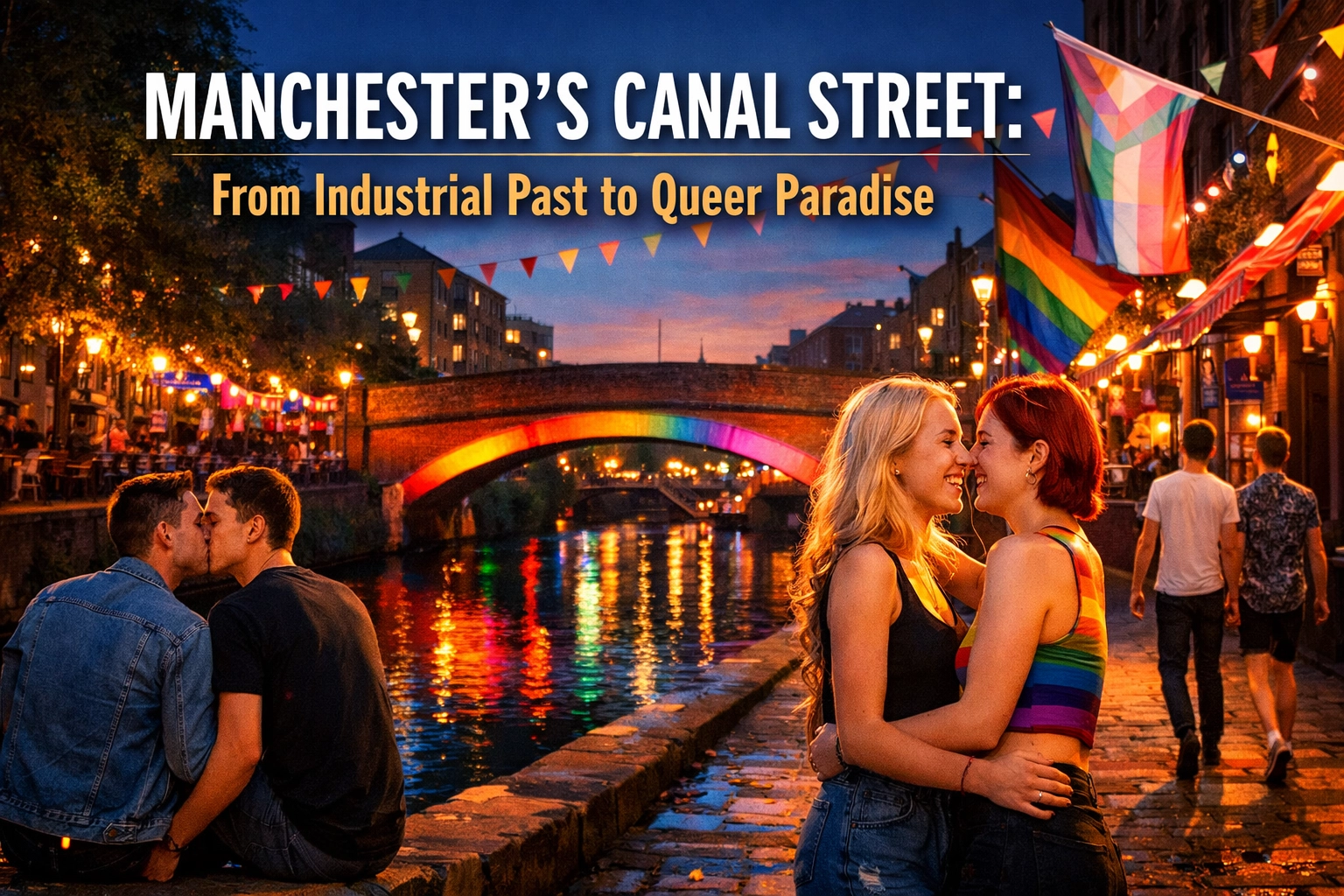
Canal Street is one of those places that’s managed to be a lot of things in one lifetime: a working artery of industrial Manchester, a shadowy “keep your head down” meeting point when being queer could get you arrested, and now, loudly, proudly, a world-famous strip of bars, clubs, and late-night kebab decisions that feels like a home base for a whole community.
If you’ve ever wandered down by the water and thought, this place has stories, you’re not wrong. Canal Street has always been about movement: goods, people, secrets, then eventually joy. And if you’re here because you love queer culture and you love queer stories, especially friends-to-lovers MM romance stories with a little spice, this street is basically a living moodboard.
The canal came first: an industrial street with a “canyon” vibe
Before Canal Street was neon signs and drag brunch, it was brick, iron, and graft.
The street grew up alongside the Rochdale Canal, built in 1804 as a trade route that fed Manchester’s industrial machine. Goods moved along the water, cotton, cloth, raw materials, headed to mills and factories that were, at the time, changing the entire world (and not always in cute ways). The buildings that still loom over the canal? Originally warehouses and workshops, designed for storage and work, not selfies and pre-drinks.
People often describe the old Canal Street architecture as “canyon-like,” and it fits: tall, tightly packed structures running along the water, built to maximize capacity and efficiency. That industrial legacy is still visible today, even if the contents have changed from bales of cloth to glitter, music, and chosen-family reunions.
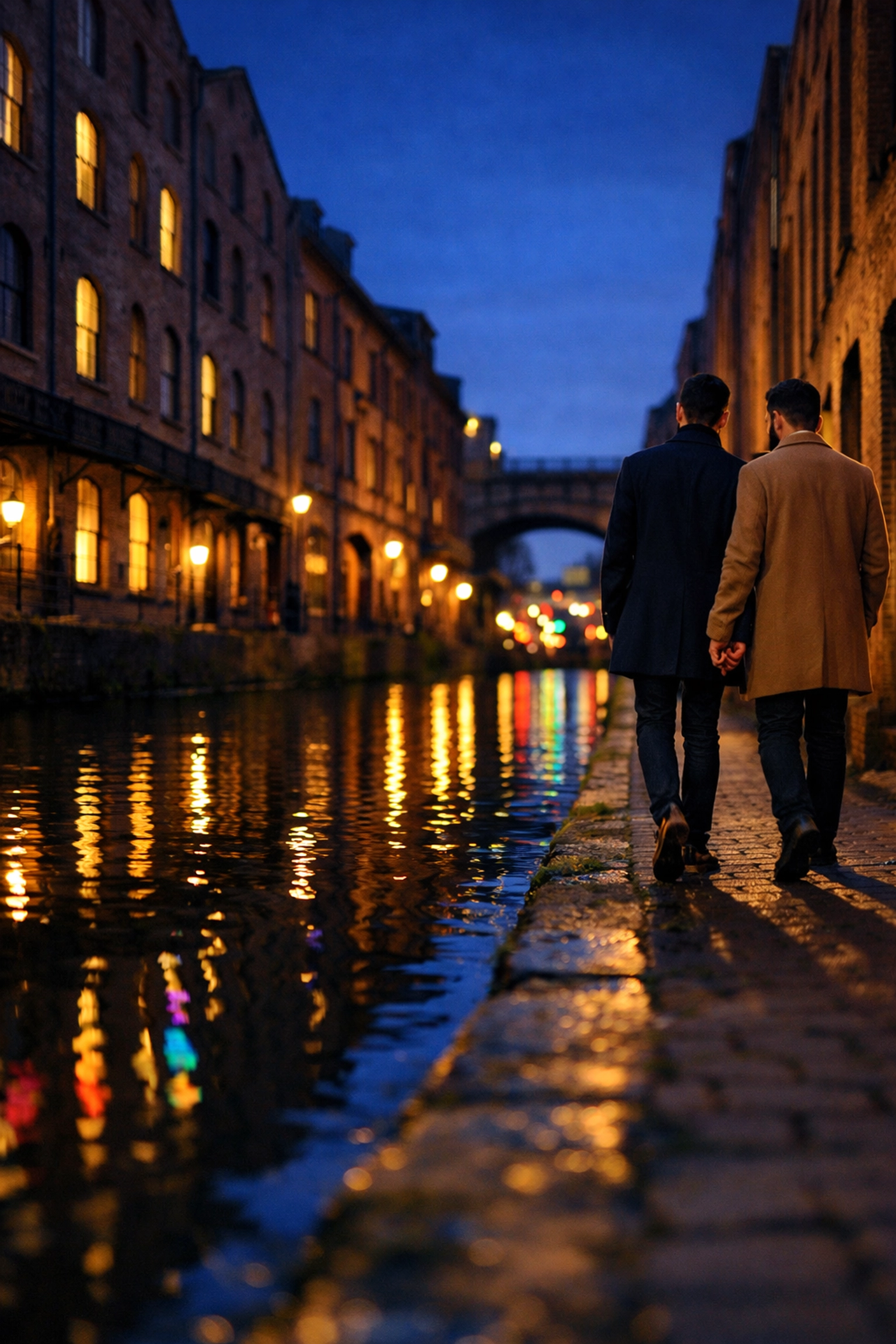
What’s kind of perfect about this: industrial spaces are built for volume, for holding, carrying, making. And decades later, they ended up holding something else that needed space: queer life.
When industry declined, queer community found room to breathe (and hide)
Manchester’s textile industry eventually declined, and as the city shifted, Canal Street shifted too. Emptying warehouses and less foot traffic created something cities often accidentally produce: pockets of anonymity.
And for queer people, especially before legal protections, anonymity wasn’t a vibe, it was survival.
Homosexual acts remained illegal in Britain until 1967, which meant that for a long time, queer men in particular lived with constant risk. Not just social judgement, actual prosecution, blackmail, job loss, violence. In that context, places like Canal Street became important because they offered what queer people were always building: informal networks and hidden meeting places.
This is where the street’s story gets complicated in a real way. The romance-novel version of history is “queer people found each other and danced under fairy lights.” The reality was often: queer people found each other carefully, through coded looks and quiet introductions, while doing mental maths about danger.
And yet, this is the part that matters, they still found each other.
The Gay Village era: from “clandestine” to community cornerstone
Over time, those repurposed industrial spaces became actual venues: bars, clubs, late-night hangouts that gradually formed what we now call Manchester’s Gay Village.
Canal Street didn’t just become “a place to party.” It became:
- a place to meet people without explaining yourself
- a place to celebrate (even when the rest of the world wasn’t clapping)
- a place to hear news, share warnings, swap names of safer taxis and kinder landlords
- a place to flirt, obviously, this is still Manchester
The Gay Village grew as social attitudes shifted, activism gained ground, and more people could live openly. By the time Canal Street was widely recognized as a queer district, it had already been doing the work for years, quietly, imperfectly, and persistently.
There’s also a bigger, universal queer-city pattern at play: marginalized communities often turn overlooked spaces into cultural landmarks. Canal Street is a classic example of that transformation.
What Canal Street feels like now (and why it still matters)
Modern Canal Street is visible in the way earlier generations could barely imagine: Pride celebrations, packed patios in summer, tourists, locals, birthday groups, first dates, messy breakups, found-family nights out that somehow end with someone crying in a takeaway queue.
But it’s not “finished” history. It’s a living space where a lot of different queer experiences overlap:
- People visiting from smaller towns for their first proper queer night out
- Trans folks finding community (and still pushing for better inclusion everywhere)
- Older LGBTQ+ people returning to a street that once felt dangerous, now familiar
- Queer couples just… existing, holding hands, having a normal night (which is still political sometimes)
The visibility matters because it creates safety through presence. But it also matters because queer spaces are not guaranteed. Rising rents, redevelopment, and shifting nightlife culture can hollow out even famous districts. The lesson from Canal Street’s past is that queer community adapts, but it shouldn’t always have to.
If you want to support queer culture year-round (not just when it’s sunny and there’s a parade), a good start is putting your time, money, and attention into queer-owned or queer-centred spaces, and reading queer stories from publishers who actually show up for the community. That’s literally what we do at readwithpride.com.
Canal Street as a romance trope generator (yes, really)
If you read MM romance books, you’ll know settings aren’t just backdrops, they’re catalysts. Canal Street works as a setting because it naturally creates what romance readers crave: tension, intimacy, momentum, and a sense of “only here, only now.”
Let’s talk tropes. Because Canal Street serves them on a tray.
Friends-to-lovers MM romance stories: the Gay Village edition
Canal Street is practically designed for that slow shift from mates to oh no, I’d die for him.
Picture it:
- Two best friends from school. One is out, one is “it’s complicated.”
- They come to Manchester for a weekend, “just to check it out.”
- One drink becomes three. One dance becomes “why are you holding my waist like that?”
- Then they end up outside by the canal, where everything finally gets said.
Friends-to-lovers works here because Canal Street has the mix of public energy and private corners, loud enough to hide in, quiet enough to confess in.
Long-tail keyword moment (because we’re helpful like that): friends to lovers MM romance stories set in Manchester is a niche that deserves more love.
Forced proximity, but make it rainy
Manchester weather is basically a co-author.
You can build forced proximity MM romance without even trying:
- the sudden downpour
- the tiny bridge underpass
- the crowded bar where there’s only one seat left
- the shared taxi when the trams are a nightmare
“Sorry, love, you’ll have to squeeze in.”
That’s not a line. That’s a plot device.
Second chance + small-world energy
The Gay Village has that “you’ll run into someone” effect. Perfect for:
- second chance MM romance
- exes to lovers
- “we dated ten years ago and now you’re standing in front of me in the same street where it all began”
Canal Street doesn’t let characters avoid their feelings for long. Which, honestly, same.
Spice level: where “just one kiss” turns into “get a room”
If you’re searching for MM romance books with spice, settings matter. A night out setting raises the stakes: chemistry, temptation, a sense of liberation. The best spicy scenes aren’t spicy because they’re explicit, they’re spicy because the emotional tension has been simmering all night.
Canal Street gives you:
- flirtation that escalates
- “are we actually doing this?” energy
- the feeling of being witnessed (or finally not judged)
- that post-club quiet where everything gets real
That’s romance pacing gold.
A quick, real timeline: how we got here
Canal Street history isn’t one neat line, but these beats help:
- 1804: Rochdale Canal opens, shaping the street’s industrial function
- 1800s–early 1900s: Warehouses and workshops dominate; the area is commercial, dense, hard-working
- Mid 1900s: Industrial decline creates quieter pockets; queer people begin using the area more discreetly
- 1967: Partial decriminalisation of homosexual acts in England and Wales (not the same as liberation, but a turning point)
- Late 1900s–2000s: Gay Village becomes mainstream-known; venues solidify the area as a queer hub
- Now: Canal Street is iconic, but still shaped by ongoing conversations about inclusion, safety, and protecting queer spaces
If you’re someone who loves gay romance novels and also cares about the real history behind the joy, this is the reminder: queer culture isn’t an aesthetic. It’s built from survival, creativity, and community care.
Visiting Canal Street: what to notice beyond the nightlife
Even if you’re not going out-out, Canal Street is worth walking with your eyes open.
- Look up at the buildings. Those were working structures. Their size and design tell you the street’s original purpose.
- Notice how the canal changes the energy. Water slows people down. It gives the street space to breathe.
- Watch the mix of people. Locals, visitors, first-timers, regulars. A queer district is a crossroads.
- Pay attention to the feeling. For some, it’s a party street. For others, it’s the first place they ever felt normal.
And if you’re the reading type (we respect that deeply), match the walk with a stack of queer fiction. If you’re hunting for gay romance novels or MM romance books that hit the sweet spot of heart + heat, start browsing at readwithpride.com.
Reading list vibes: what to search for in 2026 if Canal Street is your muse
If this post put you in the mood for a specific kind of story, here are trope-forward searches that tend to deliver (and they’re great for your 2026 TBR):
- Best MM romance books of 2026 friends to lovers
- MM contemporary romance Manchester nightlife
- Forced proximity MM romance rainy city
- Second chance gay romance novels set in the UK
- Steamy MM romance books with spice and emotional payoff
And if you want more queer culture + queer reading recommendations, our blog and updates live on:
- Website: https://readwithpride.com
- Instagram: https://www.instagram.com/read.withpride/
- X: https://x.com/Read_With_Pride
- Facebook: https://www.facebook.com/profile.php?id=61586883027069
Technical SEO check (quick but important)
- H1 present: Yes (single H1 at the top)
- Potential duplicate meta tags: Not assessable from markdown alone (check CMS settings before publishing)
- Image alt/metadata: Hero image is embedded; ensure the CMS includes descriptive alt text for accessibility
Hashtags
#Manchester #CanalStreet #GayVillage #LGBTQHistory #QueerUK #UKGayHistory #MMRomanceBooks #GayRomanceNovels #FriendsToLovers #ForcedProximity #ReadWithPride #Readwithpride #QueerFiction #LGBTQEbooks #GayBooks

Leave a Reply
You must be logged in to post a comment.