

readwithpride.com
Brighton has a talent for making people feel like they can finally exhale. It’s the sea air, sure. It’s the walkable streets where you can go from a scruffy little café to a drag brunch without needing to “explain yourself.” It’s the soft-focus romance of the coastline, windswept kisses on the promenade, hands tucked into coat pockets, that moment you realise you’re smiling for no reason other than you’re here.
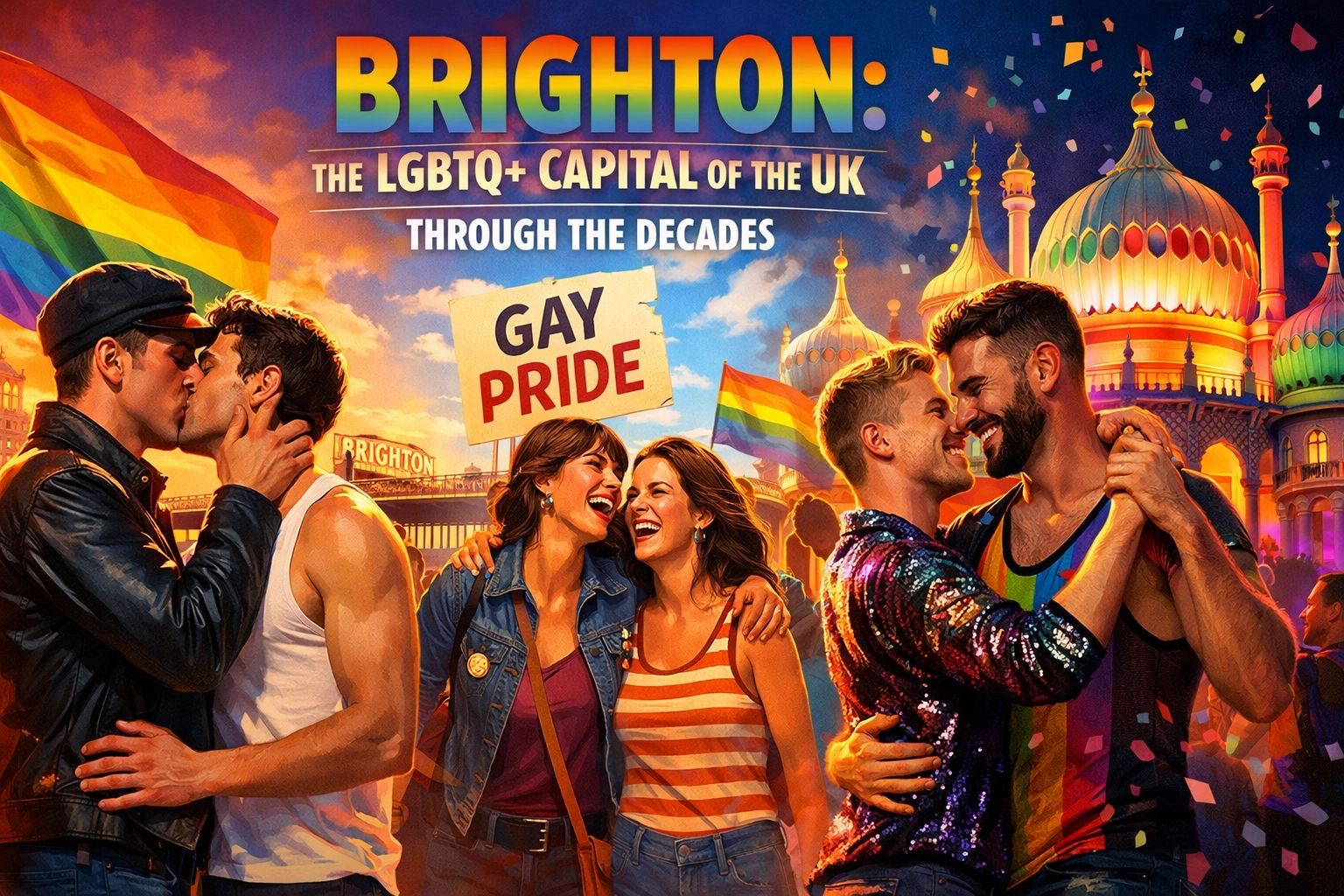
But Brighton’s reputation as the UK’s LGBTQ+ capital didn’t appear out of nowhere. It was built decade by decade: by people finding each other in the shadows, then choosing visibility, then fighting for safety, then turning celebration into culture. Here’s how it happened, and why it still matters now (especially if you love a good coastal romance vibe, and you’re always hunting for MM romance books to match it).
Why Brighton? The geography of queer escape (and return)
Brighton is close enough to London to be reachable on a whim, but far enough to feel like a different world. That combo has shaped its queer story for centuries.
- Easy access made it a practical “weekend refuge” long before anyone could say that out loud.
- A resort town atmosphere meant outsiders were expected, and privacy came with the territory.
- The seaside factor has always been part of the appeal: the pier lights, the late-night walks, the sense that rules blur a little near the water.
If you’ve ever read a gay love story where two people fall into something intense while “just visiting,” congrats, you already understand the Brighton blueprint.
Early 1800s–1930s: Discreet connections and early community roots
Brighton’s early queer history is a lot like early queer history everywhere: real, present, and mostly forced to be coded.
During the Napoleonic Wars, Brighton’s military presence created opportunities for discreet connections. When your world is uniforms, lodgings, and temporary postings, intimacy can spark fast, and vanish fast too. That pattern (brief romance, careful secrecy, intense feeling) shows up again and again in queer history, and honestly, it’s basically the emotional scaffolding of half the gay romance novels people devour today.
As the 19th century rolled on, improved transport links made Brighton an increasingly popular escape route for people who needed a break from scrutiny, especially anyone whose life in their home town required constant self-editing.
By the 1920s and 1930s, there were already gay and lesbian pubs and social venues emerging as early forms of infrastructure. Not “safe” in the modern sense, nothing was truly safe under criminalisation, but safer than isolation. These spaces mattered because they did two essential things:
- They helped people find each other.
- They made “a community” feel possible, not theoretical.
That’s the start of Brighton’s real power: not just being a place to visit, but a place where queer life could take shape.
1940s–1960s: Post-war shifts and the slow move toward visibility
World War II reshuffled everything. People moved, served, survived, lost, rebuilt. In the process, many encountered new communities and versions of themselves. Brighton’s queer reputation grew as service personnel passed through and carried stories back out into the world.
Then came the 1960s: a decade of pressure building under the surface. Laws and attitudes began shifting (slowly, unevenly), and organised community work started to appear in more structured ways.
One key moment: the Minorities Research Group, Britain’s first public lesbian organisation (founded in 1963), later established a South Coast branch in Brighton. For many lesbians, especially those who were isolated, this meant something life-changingly simple: counselling, social events, and the knowledge that you weren’t the only one.
This era is often misremembered as “quiet.” It wasn’t quiet. It was just coded. It was the prelude.
1970s: Liberation, student activism, and Brighton’s first Pride energy
The 1970s were Brighton’s “we’re done whispering” chapter.
In 1971, students at the University of Sussex formed the Sussex Gay Liberation Front (SGLF). And in 1972, they organised Brighton Gay Day, one of the city’s first gay rights demonstrations.
Then in July 1973, Brighton hosted its first Gay Pride Week, featuring what was, for its time, a radical public statement: a public gay wedding between two men. It wasn’t legally recognised, but that wasn’t the point. The point was visibility. Joy. Defiance. The refusal to be treated like a shameful secret.
This is the decade where Brighton’s identity shifts from “private refuge” to “public symbol.” The city starts to become what we’d now call a hub, where activism, nightlife, community care, and culture overlap.
And yes: this is also where the vibe starts looking suspiciously like an enemies to lovers MM romance setup. Pressure. Public conflict. Found family. Big feelings. A couple stepping into the light even when it’s risky. If you’re into mm enemies to lovers books 2026, Brighton history basically writes your backlist.
1980s–1990s: Resistance, Section 28, and Pride becoming a tradition
The 1980s hit hard across the UK: the AIDS crisis, moral panic, and policy attacks that tried to shove queer life back into the dark.
One of the most notorious was Section 28, which prohibited “promoting homosexuality” by local authorities and cast a long shadow over education and public life. Brighton didn’t take that lying down.
Activist organising against Section 28 in Brighton helped build momentum and community coordination, and marches from 1988 to 1991 evolved into what became the Brighton Pride Weekend in 1991. Pride here isn’t just a party (though it can be a great party). It’s also a receipt. Proof of effort. Proof of survival.
Around this era, Brighton’s nightlife and social scene solidified further, with dedicated LGBTQ+ venues becoming landmarks in their own right. The city’s “you can be yourself here” feeling started to get exported nationwide: Brighton as the place you went to come out, fall in love, or start over.
2000s–today: A city where queer life is everyday life (not a special event)
Modern Brighton is still a magnet, but now it’s also something more: a place where queer life is visible in ordinary ways.
Numbers back it up. Brighton has some of the highest LGBTQ+ demographics in the UK, including exceptionally high proportions of same-sex households. Some areas (like Kemptown) have especially strong LGBTQ+ community presence.
But it’s not only stats. It’s texture:
- Pride flags in windows year-round, not just in July.
- Queer book clubs and community groups that aren’t “niche”: they’re part of the cultural fabric.
- Intergenerational spaces where people can meet, date, argue, flirt, and build chosen family without needing to justify their existence.
Brighton also launched Brighton Trans Pride in 2013, which has since grown into one of the largest trans pride events outside the US: an important reminder that “LGBTQ+ capital” has to mean showing up for all of us, not just the most marketable letters.
The coastal romance factor: why Brighton feels like a love story
Let’s be honest: even if you don’t come for romance, Brighton kind of ambushes you with it.
There’s something about the sea that makes emotions louder. Maybe it’s the horizon. Maybe it’s the way the light changes every ten minutes. Maybe it’s because seaside towns have always been places where people behave a little differently than they do at home.
Brighton’s coastal romance vibe fits a bunch of beloved MM romance books tropes:
- Forced proximity: one hotel room left; one rainy weekend; one unexpected detour.
- Second chances: the ex you never forgot, spotted on the seafront like a ghost with better hair.
- Found family: dragged to a pub quiz by someone you just met, and suddenly you’ve got a crew.
- Slow burn: the kind that builds over coffees, long walks, and the stubborn refusal to admit you’re falling.
If your reading tastes lean spicy, Brighton is also very “we went for a walk on the beach and somehow ended up making out like we’re 19 again.” In other words: prime inspiration for anyone searching spicy mm romance recommendations that feel grounded, tender, and a little bit chaotic (the good kind).
Brighton today: how to experience it (and read it) like a local
You don’t need a checklist to “do Brighton right,” but if you’re visiting with queer history and romance on the brain, here are a few ways to make it feel more meaningful than a standard weekend away:
1) Walk the city like it’s an archive
Take the long route. Notice plaques, old pubs, side streets that feel like they’re holding stories. Brighton’s queer history spans over 200 years: some of it celebrated, some of it hidden in plain sight.
2) Go beyond the party version of Pride
Brighton Pride is iconic, but queer life here isn’t seasonal. If you can, seek out community events, queer markets, talks, and local creators throughout the year.
3) Pack a beach read that matches the mood
If you’re building your 2026 TBR and want romance that hits that Brighton energy: salt air, messy feelings, big declarations: lean into trope-led picks. Think enemies to lovers MM romance, slow burn, and forced proximity. (We see you, “accidentally booked the same cute sea-view room” crowd.)
For LGBTQ+ ebooks and trope-forward reading lists, start at readwithpride.com.
Reading the city: what Brighton adds to queer fiction (and why it’s not just “a backdrop”)
In queer fiction, setting isn’t wallpaper: it can be permission.
Brighton works so well in gay romance novels and broader LGBTQ+ fiction because it offers believable conditions for vulnerability and change. A character can arrive guarded and leave softer. They can show up closeted and leave with language for themselves. They can be lonely and leave with a phone full of new numbers (and one particular contact they keep rereading).
That’s why Brighton keeps showing up in gay novels and gay love stories: it’s a place where transformation doesn’t feel forced. It feels earned.
And from a community angle, its history matters because it shows the full arc: discreet refuge → visible activism → organised resistance → cultural centre. Not a fairytale. A real timeline built by real people.
If you’re here for bookish Brighton: quick trope map for your next read
Want your reading to mirror the city’s vibe? Pick your mood:
- Seaside second chance: soft, tender, emotionally satisfying
- Enemies to lovers with a queer nightlife backdrop: sparks, banter, heat (hello, mm enemies to lovers books 2026 searches)
- Found family + healing: comfort reads with heart
- Spicy coastal fling that turns serious: exactly what it sounds like (and yes, perfect for spicy mm romance recommendations)
If you’re curating a Kindle-friendly stack, focus on MM romance books and gay romance novels that proudly centre queer joy: because that’s the throughline Brighton keeps offering, decade after decade.
Browse LGBTQ+ ebooks and more at readwithpride.com.
Follow us for new releases + reading lists:
- Instagram: https://www.instagram.com/read.withpride/
- X: https://x.com/Read_With_Pride
- Facebook: https://www.facebook.com/profile.php?id=61586883027069
Hashtags
#Brighton #BrightonPride #LGBTQHistory #QueerHistory #UKLGBTQ #GayRomanceNovels #MMRomanceBooks #EnemiesToLovers #SpicyMMRomance #LGBTQEbooks #ReadWithPride #Readwithpride #GayFiction #QueerFiction #2026GayBooks

Leave a Reply
You must be logged in to post a comment.