

Four to a Table
Eleven months out of the city, I had learned the geography of other people’s houses without learning how to belong in them.
I knew which farmhouse floorboards complained outside the nursery. I knew the spaniel at the Miller place would bite if you reached for your tools too quickly, and that the church hall upright had a key that stuck in damp weather. I had tuned pianos in kitchens where families ate around me, speaking over my shoulder as if I were another appliance. At thirty-three, I was good at being present without becoming part of anything.
I still ate dinner alone.
The community hall quiz on Friday nights had teams of four. I arrived late enough to be placed at the end of a table with Walt and Denny, which made me the spare part. Walt was retired, seventy-something, and recorded every score in pencil on a beer mat. He did not let anything go. Denny, twenty-two, worked at the tyre place and answered every question as though the answer had personally offended him by not being obvious.
He was wrong about half of them.
The hall smelled of floor wax, percolated coffee and wet wool. Coats hung from chair backs, bringing the cold in with them. A child sat under the table beside us, colouring a horse purple while her parents argued quietly over the first round. Beyond the high windows, headlights swept across the glass and disappeared.
Hollis had put my name on the team sheet.
He had not asked me. He had only said, at the seed-and-feed store, that there was a space at Walt’s table if I wanted it. Then he’d looked down at the till, as if that settled everything.
I had thought about that sentence for hours. I still didn’t know whether it was an invitation or simply good administration.
The Man with the Microphone
Hollis was fifty and ran the seed-and-feed store. On Friday nights, he volunteered as quizmaster, wearing his reading glasses to read the questions and taking them off between rounds. His hands were wide, his forearms strong from lifting sacks and boxes. A pale burn scar crossed one of them.
In private, he was warm. He’d poured me tea in his kitchen when I rebuilt the organ action in October, leaning against the counter while I described a stubborn pin as though it had a personality. Once, he hummed a tune his mother used to play at the harvest dances, badly enough that he stopped halfway through and laughed at himself.
In public, he was formal. He thanked me for coming. He asked whether I wanted the chair beside the radiator. He did not touch my arm or hold my gaze any longer than was necessary.
For months, I’d read that restraint as distance. I had made a discipline of not looking at him across the room. The whole evening seemed to be built from it: his voice at the microphone, my attention fixed on the quiz sheet, the small, private fact of knowing exactly where he stood without turning my head.
The microphone popped on every hard consonant.
“Question one,” he said, and the sound cracked through the hall. “Which river runs through”
Nobody else seemed to hear the slight catch in his voice when he looked down at our table.
I did.
Rounds One Through Five
The first round was geography. Denny insisted the capital of Wales was Bristol. Walt corrected him without looking up from the beer mat.
“Cardiff.”
“Bristol’s practically Wales,” Denny said.
Walt’s biro made a sharp little line beside the score.
I knew the floor plan of the hall from tuning the piano there, but not the answer to a question about rivers. I tried not to think about Hollis, which is a thought that requires thinking about him constantly.
In round two, the child under the table asked her mother for another purple crayon. Her mother passed it down without interrupting her answer. The chair leg beside me squeaked against the lino every time I shifted my weight. I kept my hands flat on the table, as if they might otherwise confess something.
Denny got a question about old television right and looked delighted. Walt gave him a single nod. I liked the way the two of them settled into the evening, one certain, one exacting, neither having to earn his place again after every answer. I wanted that ease. I distrusted wanting it.
Between rounds, Hollis brought the microphone down and spoke to the table nearest the urn. He didn’t come over to us. He didn’t need to. I saw his scar when he lifted a stack of question sheets, and my mind supplied, without permission, the sight of his hand resting beside mine on his kitchen counter.
I could have stopped there.
I didn’t.
The questions moved on: music, local history, food. Walt corrected one of the dates by a year and looked pleased when Hollis accepted it. Denny guessed “tractor” for a question about a children’s book. He was wrong, but he defended the answer with such confidence that the woman behind us laughed into her tea.
We were not winning. We were not last. The jam and meat voucher seemed to belong to a different category of night, one where people knew where to put their elbows and how long to stay after the final answer.
When Hollis’s voice came through the speaker again, I knew when he was smiling. No one at our table did.
The Tiebreaker
The final round left two teams level. Hollis stepped back to the microphone, adjusted the paper in his hands and glanced at the score sheets.
“One tiebreaker,” he said. “Written by me.”
The hall went quieter. Even Denny stopped moving his pencil.
“Name the song the organist played at the end of every harvest dance in this hall for nineteen years.”
I knew.
I knew because I had rebuilt the organ’s action in October, taking it apart piece by careful piece while rain worried at the high windows. I knew because Hollis had told me about his mother one night in his kitchen, her hands on the keys, the hall full of people dancing. He’d hummed half a verse, badly, and stopped.
The Tennessee Waltz.
The answer sat in me like a match held between two fingers. I could give it to the room and let everyone hear the thing Hollis had given me alone. Or I could get it wrong on purpose. Keep it small. Keep it closed. The old city instinct was to make yourself hard to notice, then call that safety.
Walt tapped the end of his biro against the beer mat. Denny glanced at me. He seemed ready to say tractor.
I let out the breath I’d been holding.
“The Tennessee Waltz,” I said.
Hollis looked down at his paper. “Correct.”
Then there was a pause. Maybe half a second. It lasted long enough for me to hear the radiator ticking as it cooled, and the child’s purple crayon rolling beneath our table.
The room applauded. Denny slapped the table once, triumphant. Walt put a neat mark on the beer mat.
We had won the jam and the meat voucher.
What Walt Said
When the applause settled, Walt looked at me.
“You knew that.”
His voice was quiet. Still, the whole table turned to look. Their attention was ordinary, not sharp. Nobody had caught me in anything. Nobody was asking me to explain why I knew, or what it meant that Hollis had told me.
But I felt the familiar tightening in my chest, the small calculation of how much I could show without losing control of it.
Being looked at was not the same as being known.
I’d understood that much for years. I had confused being known with being watched because the two could feel alike at a distance: people noticing where you went, how long you stayed, who you stood beside. The difference, I realised, was that being known required more than eyes. It required letting someone remember what you had said in a kitchen, and letting that memory remain yours even when the room was full.
“Yeah,” I said. “Hollis told me about the organ.”
Walt nodded and went back to his score. Denny asked whether the song had been in a film. The child under the table held up her purple horse for me to see.
Across the hall, Hollis was stacking papers. He didn’t look over.
That was all right. For once, I didn’t need to turn his silence into an answer.
The Last Cup of Coffee
The hall emptied slowly. The child was carried out asleep, one purple crayon still clutched in her fist. Walt and Denny left with the voucher between them. Chairs folded and stacked; the urn was unplugged. I helped Hollis with the last of it, though there was nothing he couldn’t have done alone.
The radiator ticked in the cooling hush. Outside, a car passed and its headlights briefly lit the windows.
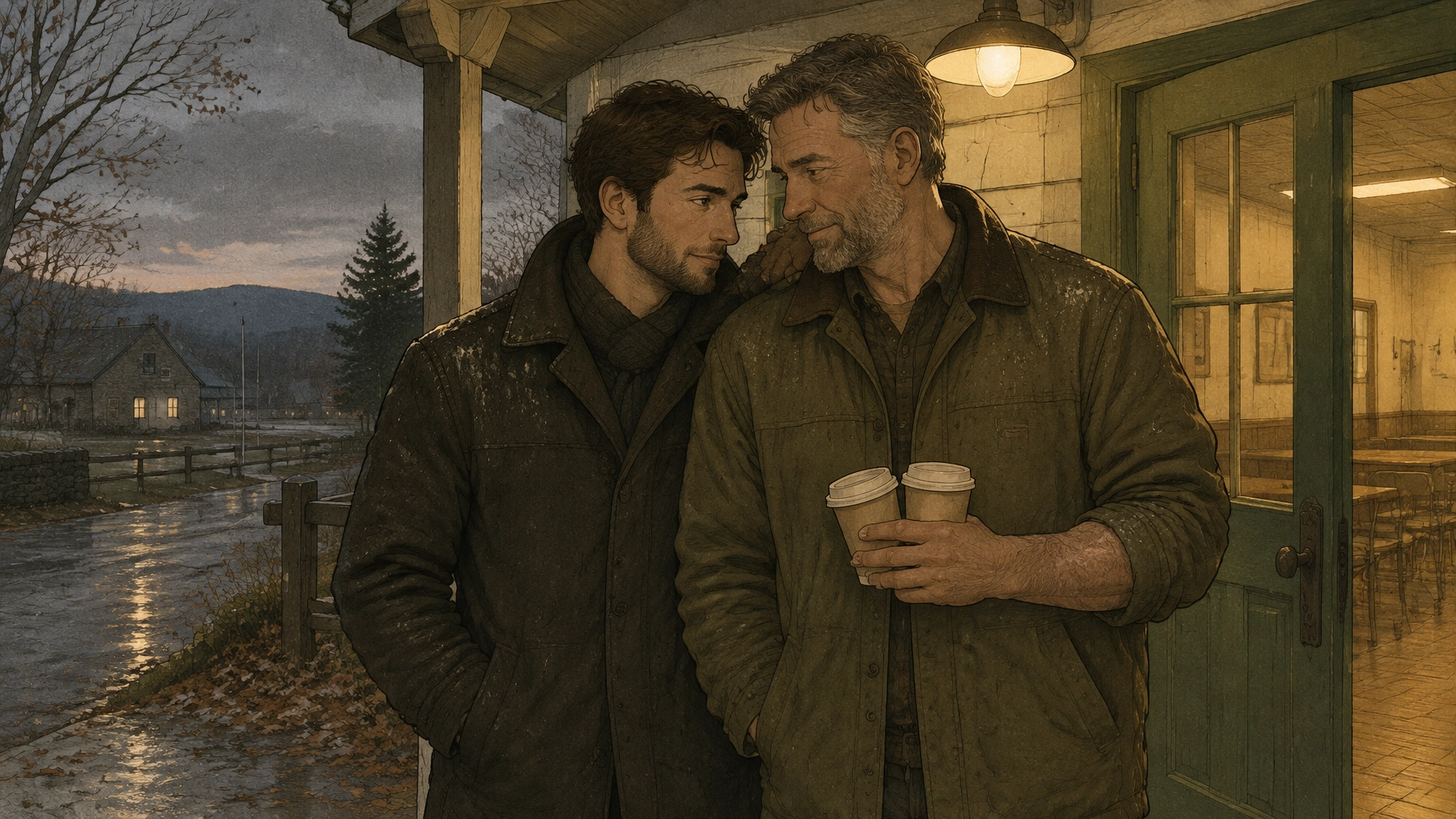
Hollis found me by the door with two cups of the last coffee. It was bitter, lukewarm and tasted faintly of the urn. I took one.
“Come back next Friday,” he said. “You can be regular.”
I had spent months trying to decide what he meant by every small kindness. I could have asked whether he meant at the quiz, or in his life, or somewhere between the two. Instead I said, “All right.”
His hand rested at the small of my back. A steady, brief warmth through my coat. The hall was empty. Nobody was watching.
I carried the coffee home. At my house, I switched on the kitchen light and set my keys down beside the piano tuner’s kit. The room looked the way it always had, but I no longer felt like I had only borrowed it.
For readers who want more character-driven queer fiction, more LGBTQ+ ebooks and MM romance can be found at Read with Pride. Dick Ferguson’s Read with Pride store is a place to find stories for emotionally invested MM readers, including emotional MM romance literary fiction and MM romance unexpected places.
Follow us on social media: Instagram · X · Facebook · Read with Pride
#MMRomance #GayLoveStory #QueerFiction #EmotionalMMRomance #ReadWithPride #CharacterDrivenFiction #SlowBurn #GayBooks #LGBTQBooks


Leave a Reply
You must be logged in to post a comment.