

Category: Queer Life and Identity
The lunch neither of them cancelled
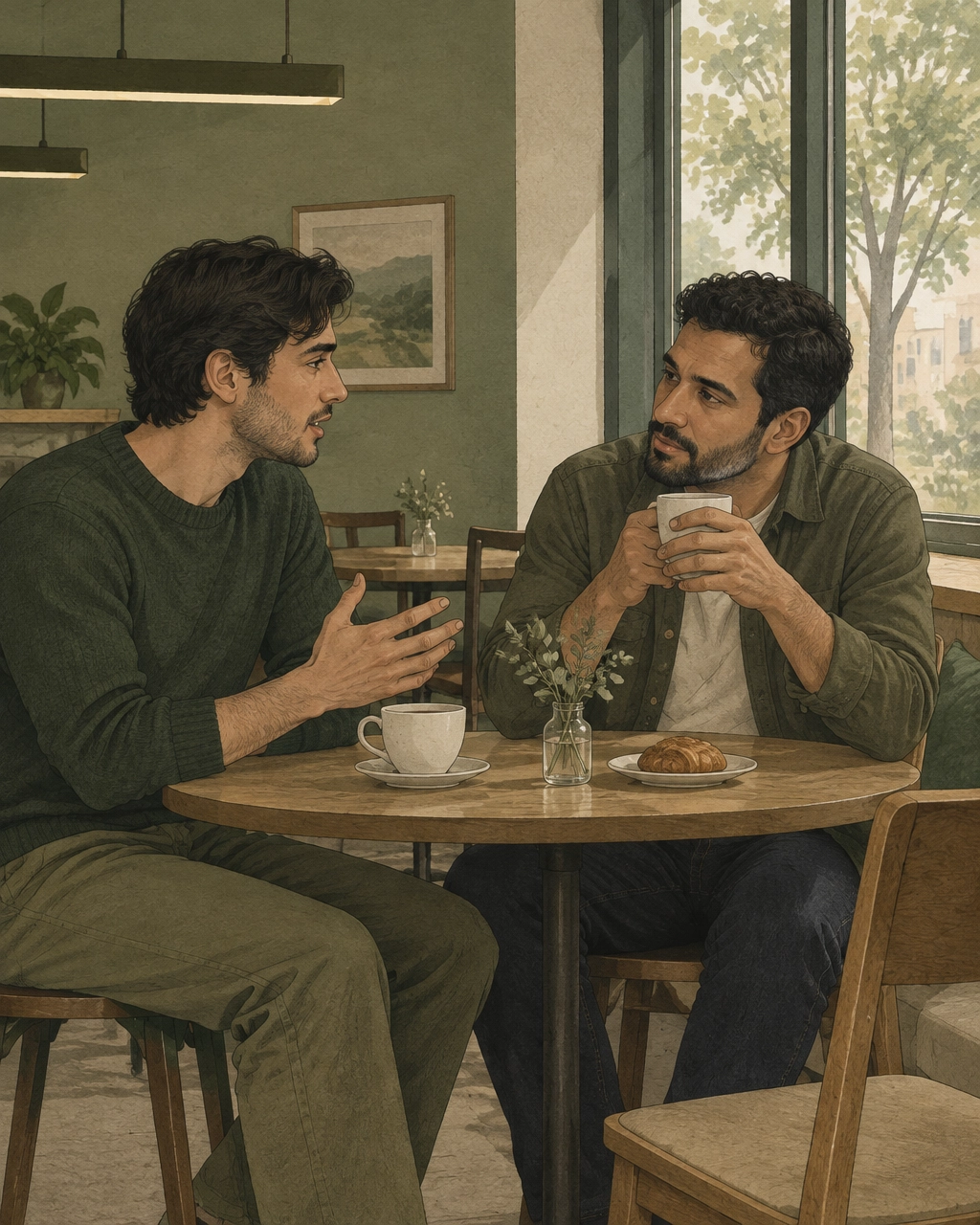
The café had bad strip lighting, a counter full of pastries nobody seemed to be buying, and one good table by the window. Jonah got there first and chose it. His younger brother arrived six minutes later, still wearing his coat.
Neither of them had cancelled. That counted for something, though neither knew what to do with the fact.
“Sorry,” his brother said.
“You’re six minutes late.”
“I know. I was trying to decide whether to come in.”
Jonah gave him a small smile. “And?”
“And here I am.”
They ordered sandwiches and coffee. The first few minutes went to work, the weather, the price of things. Small subjects, put down between them like cups that might spill if either moved too quickly.
Then his brother said the bookcase was built.
“Properly?”
“Mostly. There’s a screw left over.”
“Is it still standing?”
“Very proudly.”
His brother smiled at that. He was twenty-four, and looked pleased with himself in a way Jonah hadn’t seen before. It made him look younger, briefly. In the ordinary setting of a café lunch, their awkward reunion had the quiet intimacy of MM romance unexpected places: not a grand gesture, just two brothers staying at the table.
The flat with the bookcase in it
The new flat was small, his brother said, but the windows were decent and the rent wasn’t as bad as he’d expected. The bookcase stood against the living-room wall. He’d filled most of it, though he hadn’t worked out where a few things belonged.
“You can come and see it,” he said. “If you want.”
Jonah stirred his coffee. “I’d like that.”
His brother turned his cup by the handle, then let it go. “I’m having a small thing there in two weeks.”
“A party?”
“Not exactly. Eight or nine people. Mates from five-a-side. A couple from work. My flatmate’s brother.”
He listed them as if laying out the chairs in advance. Jonah listened, glad to have been included, even as he noticed how carefully the invitation was being assembled. His brother got almost to the end of it before he stopped.
“I thought it’d be good if you came.”
“Yeah. Thanks.”
“Only…” He looked at the table, then up again. “Can I ask you something?”
“Go on.”
The lunch had been for this, Jonah realised. Or not just for this. He didn’t pull away from the thought. He let his brother find the words in his own time.
What “go easy on the details” actually means
“Don’t take this the wrong way,” his brother said. “When you come, can you go easy on the details?”
Jonah held his coffee with both hands. “What details?”
“I don’t mean.” His brother exhaled. “I’m not asking you to hide it. Or pretend. I just mean, if someone asks, keep it light. Don’t make it a thing.”
“What would I be making a thing of?”
“I don’t know. Talking about being bi, or Elias. Just:” He shook his head. “I’m not asking you to lie.”
The request sat between them, clear enough now. Jonah had been invited into the room, then handed a script for how small to be in it.
There was a version of “go easy on the details” that meant a person wanted privacy for himself. A fair boundary: don’t tell my story at a table full of people. This felt different. It asked Jonah to manage everyone else’s ease before he’d even arrived. It asked him to pay, in silence, for the invitation.
The little discomfort of hearing it was not proof his brother was cruel. It was proof the request had landed where it was aimed.
Jonah almost gives the speech
Jonah had had the speech ready since the car park weeks ago: bisexuality wasn’t a phase. He didn’t owe anybody a briefing. His relationship wasn’t a topic on the agenda.
He could feel the sentences lining up behind his teeth. He could have delivered them cleanly, with the calm force of someone who had already practised them alone. But he stopped. The speech was true; that didn’t mean it was the only thing worth saying.
He watched his brother try to hold still. Watched his thumb rub at the paper sleeve around his coffee.
“What are you actually worried is going to happen?”
His brother didn’t answer at once.
Jonah let the silence stay. At first, he’d heard the request as a warning: be careful around my mates. Now he wondered whether the warning had been meant for his brother himself. He didn’t know yet. He could ask, and he had.
The question underneath the request
“I don’t actually know how long you’ve been out,” his brother said. “Not exactly.”
Jonah’s hands stayed around the cup.
“I was fifteen. Sixteen, maybe. You’d left home, and I was doing my own stuff. I told myself it wasn’t my business.”
He looked embarrassed, but didn’t look away.
“So if one of my mates asks, ‘How long has your brother been out?’ I’d have to say I don’t know. Then they’d know what that means about me.”
“What does it mean?”
“That I didn’t ask. I didn’t know enough to ask.”
He swallowed. “I’d rather you kept it small so nobody asks me anything.”
There it was: not a grand prejudice, not a neat excuse. Shame. A young man noticing the shape of his own neglect and wishing he could avoid being seen inside it. It didn’t make Jonah’s side of the request feel lighter. But it made the brother across from him more than the worst thing he’d said.
Jonah had once thought the lunch might be a test of whether his brother could accept him. Now it seemed there was another question in the room: whether his brother could stand to notice what he hadn’t known.
“Did you want to ask me something?” Jonah said.
His brother gave a brief, uncertain nod.
I’ll be there, at a normal volume
“I’ll come,” Jonah said. “If someone asks me something, I’ll answer like a person. Not like a press release.”
His brother nodded.
“I’m not going to lie for you. I’m also not going to give your mates a lecture. If you don’t know something, you can say you don’t know. Nobody hands you a certificate for this.”
His brother looked down. “I know.”
“You can ask me now, if you want. That’s what the lunch was for.”
For a moment, his brother seemed to be checking whether the offer was real. Then he asked, “If someone says you’re gay, should I correct them?”
“Yeah. I’m bisexual.”
“Right. Yeah.”
It was a small question. Still, Jonah felt the difference between being guessed at and being asked.
His brother shifted his cup. “And when I talk about Elias. What should I call him?”
“Elias,” Jonah said. “Mostly just Elias.”
“All right.”
They moved on to the sandwiches. The conversation wandered, paused, found its way back. Nobody apologised in a way that tied everything up. Nobody asked Jonah to say it was fine.
For emotionally invested MM readers, a scene like this can hold more than a dramatic declaration: a gay love story emotional journey may turn, quietly, on whether a brother can say his partner’s name without making it sound like a secret.
Elias at the door
Elias was walking Jonah home. At the end of lunch, he put his head round the café door, spotted Jonah, and lifted a hand.
“Here he is,” Jonah said.
His brother stood up too fast. The chair scraped. He reached across the little space between them and shook Elias’s hand a beat too hard.
“Nice to meet you, finally.”
The word stayed there after he’d said it.
“Good to meet you,” Elias said. “How’s the new flat?”
“Small, but decent. We’ve got a bookcase now.”
“That’s the important bit.”
“It’s holding up. There’s one screw left over, though.”
“Then it’s properly built,” Elias said. “That’s how you know.”
His brother laughed. It was a little too quick, but it was a laugh.
They stood near the door, the three of them, without deciding who should leave first. Then his brother glanced at Jonah.
“Bring him, if you want.”
“Yeah,” Jonah said. “I will.”
Elias waited until they were outside before asking how lunch had gone. Jonah told him. He didn’t tidy it up or turn it into a result. Elias listened, and they started towards home. It was an ordinary walk with an unfinished conversation inside it, the kind of small domestic turn that emotional MM romance literary writing handles best: no confession scene, no speech, just two men going home together.
The room he gets to walk into
The party hadn’t happened yet. Nobody had promised it would be easy. Jonah’s brother might still get nervous; Jonah might still feel the old instinct to measure every sentence against the room.
But he was going as himself, at a normal volume. And his brother had said the true thing out loud: he hadn’t asked, and he’d been afraid people would notice.
That was not everything. It was, however, something a person could begin from.
There’s a difference between a family that tolerates you and one that wants to know you. The first may make space on the sofa, then ask you not to mention who you love. The second can still stumble, but it tries to meet you without a script. Shame is often what makes people ask someone else to shrink, because shrinking seems easier than being seen not to know.
Jonah hadn’t given a speech, and he hadn’t shut the door. He’d answered the request without performing for his brother or pretending it had cost nothing. That, too, is part of character-driven queer fiction: not an instant transformation, but a person choosing what he can give and what he won’t edit away.
A relationship between men can be ordinary enough to speak about at lunch. In LGBTQ+ fiction, queer fiction and gay novels, that ordinariness can matter. It makes room for bisexual representation that isn’t a question waiting to be settled, and for gay fiction that understands acceptance as a practice, not a single declaration. The party was still ahead. So was the chance to learn each other in a room that belonged to neither of them alone.
A note from Read with Pride
If you’re looking for M/M books, gay romance books, MM novels or other LGBTQ+ ebooks, explore the Read with Pride collection here. Stories of queer life can make room for the quiet conversations as well as the turning points.
Follow us on social media
Instagram · X · Facebook · Read with Pride
#QueerLifeAndIdentity #MMRomance #GayRomance #BisexualRepresentation #QueerFiction #GayFiction #MMFiction #LGBTQBooks #EmotionalMMRomance #CharacterDrivenFiction #ReadWithPride #ReadingWithPride
Three stories we could tell next
1) The Flat Fills Up — Jonah Comes as Himself
At the gathering two weeks later, a casual question from one of his brother’s mates gives Jonah’s brother the chance to show whether he remembers what he said at lunch.
2) The Kindness Elias Has Been Doing — A Habit Comes Into View
Elias notices how often he softens other people’s discomfort before Jonah has a chance to answer, and wonders when care has started to look like taking the choice away.
3) Before I Knew You — Theo Asks Marcus About the Missing Years
Theo asks Marcus what his life was like before they met, and Marcus has to decide how honestly to talk about the years he spent keeping love at a distance.


Leave a Reply
You must be logged in to post a comment.