

A Tuesday that arrives at the wrong speed
It was their Tuesday standing evening, which meant Julian’s flat, two mugs, and the sort of conversation that could happen while pretending to pay close attention to the radiator.
Outside, November had gone dark early. Inside, the radiator knocked like it had a grievance and a solicitor. Elias sat at the kitchen table, physically present but somehow a beat behind himself. His jokes arrived late. He stirred his woodland-finish coffee long after it had stopped needing the help.
“Your coffee’s gone cold,” Julian said.
“It’s improving.”
“That’s not how coffee works.”
“Neither is this radiator, apparently.”
The radiator clanked, as if offended by the lack of recognition.
Elias gave it a distracted look, then turned his mug in a slow circle. “Would it be strange to make a cake for someone who isn’t here?”
Julian could have asked who. He didn’t.
“No,” he said. “I don’t think so.”
Elias’s shoulders eased. Just a little. There was relief in it, and something else, not quite disappointment, but close enough to make Julian notice. Elias had half wanted the question. He had half dreaded it.
Julian let the silence stay open.
The thing Elias has never said out loud
“Thursday would have been Theo’s birthday,” Elias said at last.
Julian put his mug down carefully. “All right.”
“I’ve never told anyone the date.” Elias rubbed a thumb over the handle of his cup. “If I say, ‘It’s his birthday,’ people get sad. Then they try to fix it. Then I end up comforting them about my grief, which is a frankly inefficient use of everyone’s evening.”
“I can see how that would get tiring.”
“For years I’ve done something small and private. Bought chips and eaten them out of the container. Watched one of his catastrophically bad films. Gone for a walk I don’t tell anyone about.” Elias took a breath. “I call it the least efficient grief in Europe.”
“That’s a strong title.”
“I’ve had years to workshop it.”
Julian watched him, trying not to turn carefulness into silence. “I’m not sure whether I’m allowed to be there.”
Elias looked up.
“I’m the new man on a day that belongs to the old one,” Julian said. “I don’t want to be the understudy.”
“You’re not the understudy. Nobody’s asking you to play his part.”
Julian swallowed. The answer helped, though it didn’t make the fear disappear.
Elias continued, quietly, “You’re not competing with a birthday. It’s a date, not a duel.”
“Good. I’d lose to a date. They’re very organised.”
Elias smiled, but it didn’t quite settle. “I don’t want to be alone this year.” He looked back at his mug. “Admitting that feels like betraying a habit, not a person.”
Julian reached across the table, then paused. Elias covered the last few inches by setting his hand near Julian’s, not touching yet, but close enough to count as an answer.
“You don’t have to decide everything tonight,” Julian said.
“Excellent. I’ve already made one large emotional decision by sitting down.”
“That was brave of you.”
“It was mostly the chair.”
Candles bought on spec
On Wednesday evening, Julian went to the corner shop without telling Elias.
He bought a multipack of birthday candles because he didn’t know whether buying them was allowed. The packet contained a worrying number of options: thin candles, short candles, candles that looked designed for a cake the size of a button, and a number seven shaped like a star.
Julian stood in the aisle long enough for a shopkeeper to ask if he needed help.
“I’m considering my options,” he said.
The shopkeeper looked at the candles. “It’s a birthday.”
“Apparently.”
Back at the flat, Julian found the Luigi’s Corner menu in the kitchen drawer. It had the fold in the corner he’d made deliberately, years ago, and left that way. The paper looked ordinary. That, he thought, was part of the difficulty. Ordinary things could hold an entire day without looking like they were carrying anything.
He ordered chips.
Not because chips could fix a birthday, or grief, or the uselessness of wanting to make a dead person laugh. They were simply part of the ritual. Julian wanted to get the ritual right, not replace it with something of his own.
The ugly duck mug, wearing its blue knitted hat, held Julian’s spare key on the shelf. He put the candles in the cupboard beside it, as if proximity might improve his understanding of them.
Thursday
Gerald, the creaky floorboard in the hall, announced Elias’s arrival with the usual structural complaint.
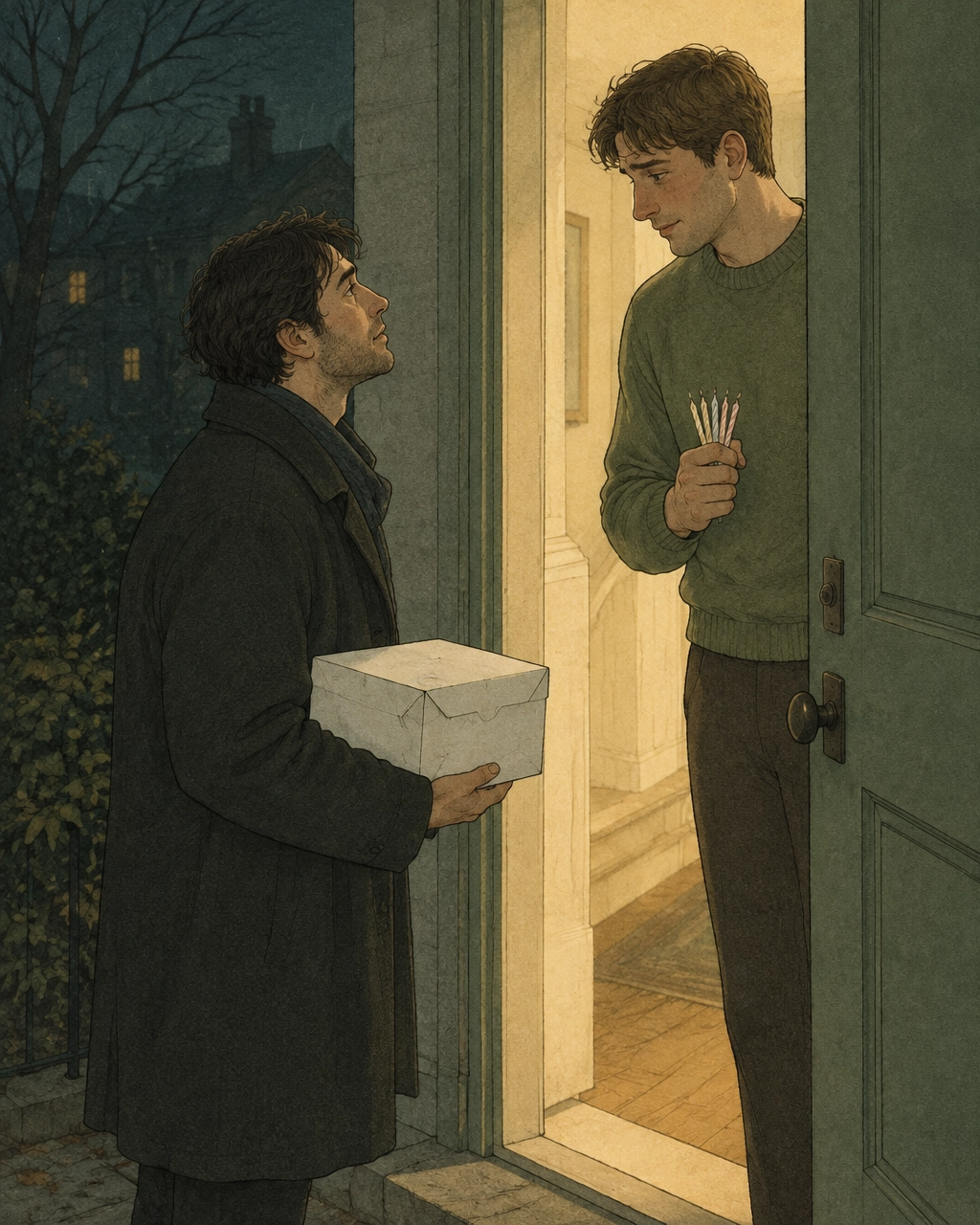
At the door, Here the stray cat sat at the threshold, looking as if the doormat were an appointment it intended to keep. It came no farther inside.
Elias held a cake box from the corner shop. One side had been crushed slightly.
“I’ve brought a cake,” he said.
“I can see that.”
“It survived the journey with more dignity than I did.”
“Did you get it home on foot?”
“I did. The cake had a difficult commute.”
He set the box down and opened it. The cake was lopsided, its icing bruised at one corner.
“At the checkout, the woman asked whose birthday it was,” Elias said. “I said, ‘A friend’s.’”
Julian waited.
“It’s true,” Elias added. “And it’s the first time I’ve said it out loud in years.”
“Then I’m glad you got to say it.”
They ate chips from a paper container and put on one of Theo’s films. The volcano was obviously fake. The plot collapsed somewhere in the second act, and the dialogue sounded as if everyone involved was being paid by the word.
Elias watched the screen with fond disbelief. “His film taste was a catastrophe.”
“You’ve said.”
“He knew it was bad. That was part of the pleasure. He’d defend it like the film had personally suffered an injustice.”
“What else should I know?”
Elias’s smile softened. “His laugh. You could hear it from another room. He stole chips as if it were a moral position. And he said my name like it was worth saying twice.”
He didn’t perform the memory. He simply set it down between them, where it could belong.
On the bookshelf, Maurice, the one-leaf plant, stood beside the framed photograph of Elias and Theo. Maurice seemed to thrive on household emotion, as if every difficult conversation counted as premium plant food. The photograph remained face up. It was there without being a challenge.
The candles
After the film, Julian brought out the candles.
Elias stared at the bunch. “Did you buy every option in the shop?”
“I wanted to be prepared.”
“For what? A candle emergency?”
“There was a number seven shaped like a star.”
“Why?”
“I don’t know. I think it’s meant to be festive.”
Elias laughed. Then he went quiet.
Julian set the candles on the table and let the laugh have its space. They didn’t sing. Singing would have turned the moment into a performance, and neither of them needed to prove anything to the cake.
Elias chose one candle and Julian lit it.
“Happy birthday, Theo,” Elias said.
The room did not go cold.
The radiator knocked once, then settled into its usual noisy existence. The film’s fake volcano waited on the paused screen. Outside, Here stayed on the doormat.
They didn’t make a wish. A wish would imply there was someone somewhere to be reached. Saying a name out loud was simpler. It was the truth of a person having existed, and having been loved.
Julian laid his hand over Elias’s on the table. “I’m here,” he said.
Elias turned his hand beneath Julian’s and held on.
They cut the cake badly and ate it with the same knife because the flat had one clean one. It was the worst cake either of them had had in a good way.
“Would Theo have liked it?” Julian asked.
“He’d have complained about it first.”
“And then?”
“Had another piece.”
Julian nodded. “Sounds reasonable.”
Afterwards, cake crumbs remained on the table. A single candle had burned down. The photograph stood on the shelf with Maurice beside it. On the sofa, two men sat close and didn’t say much. The day had been got through, not defeated.
For the Emotionally Invested Reader
Grief keeps a calendar. Some dates arrive carrying more than the day itself: a birthday, an old ritual, the memory of a voice that once filled another room. Love can still show up on that date, not to take anyone’s place, and not to make grief smaller, but to sit beside it without demanding a performance.
That is one of the quiet strengths of character-driven queer fiction: it can make room for a partner who isn’t asked to compete with a memory. In this gay love story emotional journey, Julian’s care is not measured by how much he says, but by whether he listens, asks what the ritual means, and stays.
Emotionally invested MM readers recognise the difference between being told a hard thing and being protected from it. Here, Elias is allowed to choose when the story comes out, and Julian is trusted with the truth once it does. That small exchange is the heart of emotional MM romance, and one of the places MM romance in unexpected places can feel most true: a kitchen table, chips in a paper container, one candle, two men making space.
For readers looking for queer fiction, MM books, MM romance books, and LGBTQ+ ebooks, Read with Pride offers stories where intimacy is built through moments like this: imperfect, tender, and honest about what love can and cannot mend.
Dick Ferguson collection on Read with Pride: https://readwithpride.com/e-book-store/dickfergusonwriter/
Follow us on social media: Instagram https://www.instagram.com/dickfergusonwriter, X https://www.x.com/DickFergus94902, Facebook https://www.facebook.com/profile.php?id=61572869844598, and Read with Pride https://www.readwithpride.com
#QueerExperiencesAndStories #MMRomance #QueerFiction #GayRomance #LGBTQFiction #CharacterDrivenRomance #ReadWithPride #EmotionalMMRomance
Possible next instalments
- Here Finally Comes In, When Two Men Learned That Trust Is Sometimes Just a Door Left Open
- Maurice Gets a Second Leaf, When Two Men Learned That Recovery Can Look Unimpressive and Still Count
- Julian's Own Photograph, When Two Men Learned That Being Asked About the Past Is Not the Same as Being Interrogated


Leave a Reply
You must be logged in to post a comment.