

Category: Rare Experiences | Morning Edition
The yellow light that stayed
On a cold Tuesday in November, with snow forecast in the Cascades, Ruben Vela and Theo Lindqvist went to the world’s last Blockbuster because Theo wanted one last thing that was not his phone.
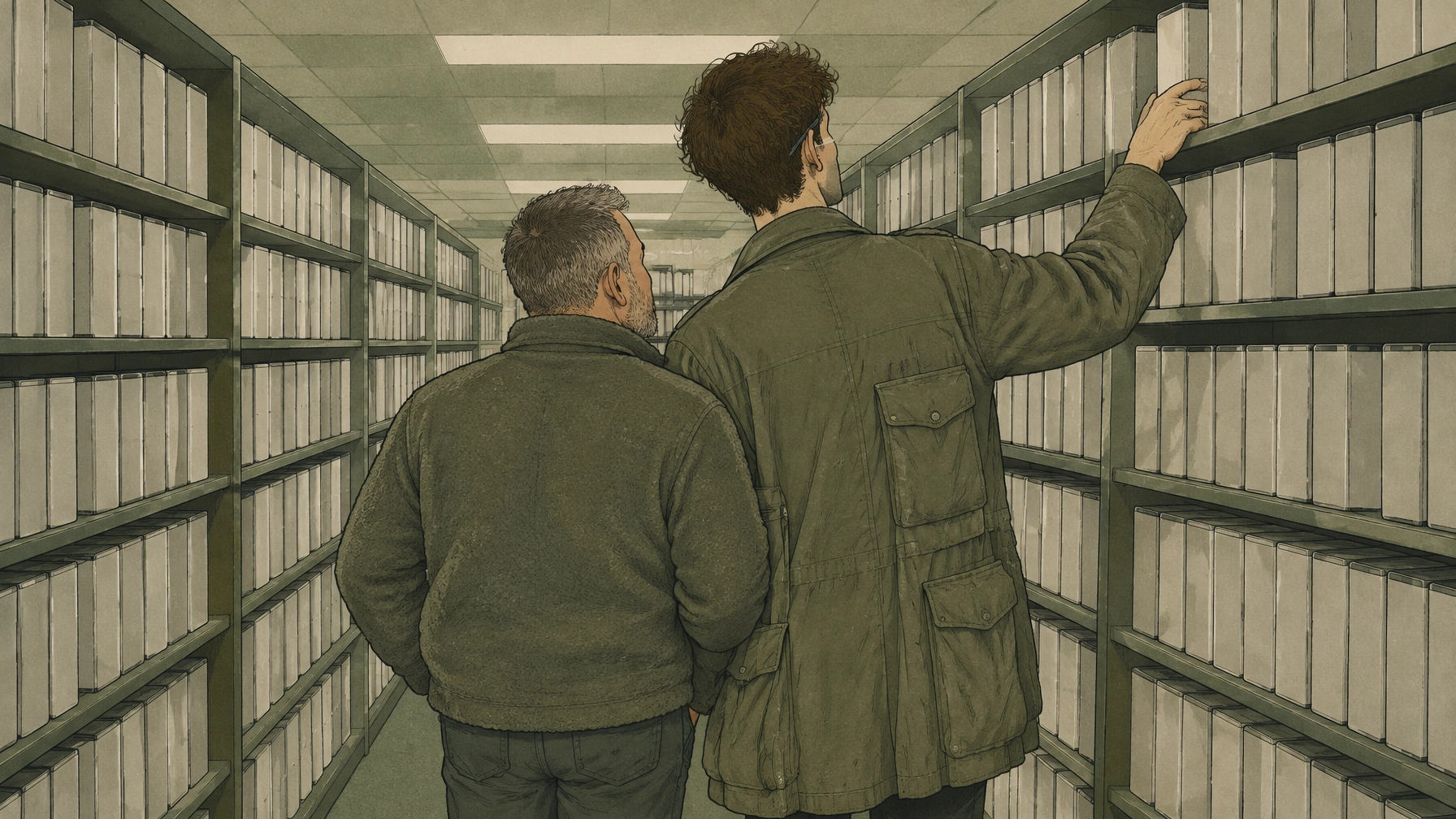
The store stood at 211 NE Revere Avenue, in an unassuming strip mall in Bend, Oregon. Outside, the high-desert evening was turning blue. Inside, yellow walls held the old light; fluorescents hummed over long aisles, and the popcorn machine worked steadily in the quiet. Blu-rays and DVDs lined the shelves. In the back, a 1990s living-room set waited as if somebody had just stepped out. Somewhere nearby, a shelf of employee picks faced the aisle.
Ruben was forty-one, short and broad, born in Bend and never gone for good. Grease lived in the creases of his hands, a grey-black stain that soap never quite persuaded to leave. A pale scar sat beneath his chin, souvenir of a pedal. He wore the same fleece until it was offensive, and when the weather turned cold, a soft brace appeared beneath his jeans at his left knee. He could true a bicycle wheel in eleven minutes. Asked how he felt, he tended to find something that needed fixing.
Theo, thirty-four, was tall and thin, with a pink line across the bridge of his nose where his headphones rested. A pen lived behind his ear, forgotten there. His coat had too many pockets, like a room with no plan for where things belonged. He had come to Bend for a six-week documentary shoot two years earlier and never quite left. He talked in film references when the truth got close.
They shared a rented house off Franklin Avenue, a wood stove Ruben maintained and a cat called Bishop who belonged to neither of them legally. They also shared a stack of films on the coffee table, rented by Theo “for us to watch before I go.” Neither man had touched them.
The store had opened in 1992 as Pacific Video, the second of three Central Oregon stores run by Ken and Debbie Tisher, who had moved to Bend in September 1990 and opened their first shop that December. In June 2000, the family converted the location to a Blockbuster franchise. The corporate chain filed for bankruptcy in 2010; Dish Network bought the brand out of bankruptcy in April 2011 for $320 million. After the final corporate-owned store closed in January 2014, the franchises remained. Bend became the last in the United States in 2018, then the last in the world in March 2019, when the Australian franchise closed.
The store had survived because the town kept renting. Roughly four thousand members kept the old ritual alive: choose, carry home, return. Even its most-rented title, The Goonies, filmed in Astoria about five hours away, seemed to hold the promise that a story could keep finding its way back.
The tape he kept renewing
Ruben went straight to the VHS section. The tapes still wore their “Be Kind, Rewind” stickers. He reached for the same one he pulled every November: Local Hero. He had rented it since he was a boy, first on his mother’s account. The man behind the counter knew him by name.
Ruben set the tape down for another renewal. The counter man looked at its worn sticker, then at the decades of dates on the card. He said nothing. The silence felt like recognition, not a question.
Theo stood beside Ruben, watching. “You’ve had this one for years.”
“Not the whole time,” Ruben said.
“Close enough.”
He did not say it at first. Theo had assumed the tape was sentimental, the kind of small relic a person keeps because the past is easier to hold than the present. But Ruben’s attachment was less comfortable than that.
“It’s about a man who goes somewhere to buy a place and ends up belonging to it, and then he has to go home,” Ruben said. His fingers closed around the tape. “I’ve never watched the end. Long as I don’t, it can go either way.”
The aisle seemed to draw in around them. A fluorescent tube buzzed overhead; the popcorn machine gave a soft mechanical stir. Theo had been speaking about “when I’m back,” and “next winter,” and how they would “do it properly then.” He had made the future sound like a room with the door left open.
“You’ve never once said a date,” Ruben said. “Not one. You say ‘soon’ like it’s a place you’re from.”
Theo’s face changed. Not dramatically. Just enough that Ruben could see how long he had been holding his breath.
The date he had swallowed
Theo had accepted nine months of work in Iceland three weeks earlier. He was going to record a documentary through the winter. He had not said it plainly. Instead, he had gathered films, one after another, as if choosing stories together might count as telling the truth.
“I leave on the 14th of January,” he said. “The ticket’s bought. I’ve known for three weeks.”
Ruben looked down at the tape between them. His hands, capable of straightening bent metal and coaxing a wheel back into balance, had no use for this.
“Because if I say the date out loud you’ll spend nine months waiting for it,” Theo said. “I’d rather you be angry at me than waiting.”
It was not a lie. That made it worse.
Ruben’s own silence rose to meet Theo’s. He had never told him he wanted him to stay. He had fixed the house instead: the wood stove, the hinge that dragged, the bathroom grout he had redone in October, carefully, like a man writing a letter with his hands and refusing to sign it.
“So the whole time you were stacking up films for us,” Ruben said, “you were packing.”
Theo did not reach for an excuse. He looked tired, and frightened, and like a man who had spent three weeks hoping the truth might somehow arrive without him.
“I was trying to make the leaving hurt less.”
“Did it?”
“No.”
Ruben’s laugh came suddenly, too loud for the aisle. It stopped almost as soon as it began. He looked at Theo then, not at the floor or the tape. “I want you to stay,” he said. “I should’ve said it before you had to ask me to understand.”
Theo’s mouth opened, then closed. He could not offer a promise that erased the ticket or the work. Neither could Ruben ask him to pretend the offer had never mattered. For a moment, the only honest thing between them was the space where a tidy answer would have gone.
A card with a return date
They moved to the counter. Theo asked for a laminated membership card in his own name and paid for it. Then he asked the man behind the counter for a pen.
On the back, he wrote: 12 October. The day he would land back in Redmond.
He handed the card to Ruben. “That’s not a leash. That’s a due date.”
Ruben read it once. “Nine months.”
“Nine months.”
Ruben took the card. His thumb rested over Theo’s handwriting, not hiding it, just keeping it close.
Readers who come here for MM romance unexpected places will find one in this aisle, because the turn in the story is not a grand declaration but a date written on the back of a card. A gay love story emotional journey can hold fear without mistaking it for a lack of love. That is the work of character-driven queer fiction, and it is what emotionally invested MM readers keep asking for: an ending that costs something. If your taste runs to emotional MM romance literary enough to sit with silence, Read with Pride keeps more LGBTQ+ fiction and MM romance on the shelf.
The ending left unwatched
They rented Local Hero and took it home. Ruben brought the renewed VHS, and Theo took a DVD copy for the old player. At home, the stack of other films remained untouched on the coffee table. Bishop curled up near the wood stove Ruben had kept working through the autumn.
They watched the film. In its last ten minutes, Theo fell asleep against Ruben’s shoulder. Ruben felt the weight of him settle there, his head warm through the fleece. He did not wake him. He did not watch the ending.
The departure still had a date. The work in Iceland still mattered. Love had not reached backward and cancelled either one. But, for once, the two men had spoken about what came next without asking the other to guess.
In the morning, Ruben rewound the tape, drove to the store and renewed it one more time. On the slip, in his own handwriting, he wrote 12 October. At home, he put the slip in the drawer with the tin of fuses and the warranty for the stove.
On the Friday they drove back together for popcorn and one more walk down the aisles. In the early dark, the yellow sign was lit above the strip mall. Snow had not yet begun. Two men crossed the lot to a truck, a tape carried between them, and neither of them said anything about the ending.
The store in Bend is real, and the details about its history and setting are accurate. Ruben, Theo, Bishop the cat and the November evening are invented; the VHS copy of Local Hero in the story is fiction.
Follow us on social media: Instagram | X | Facebook | Read with Pride
#MMRomance #QueerFiction #GayRomance #ReadWithPride #LGBTQBooks #BookLovers #LiteraryFiction #MorningEdition #LastBlockbuster #BendOregon #RareExperiences
Tomorrow’s Morning Edition could visit Mallows Bay Ghost Fleet in Maryland — a bay of deliberately scuttled First World War wooden ships turned into a reef of herons, kayaks and green water, where two men learn that a thing sunk on purpose is not the same as a thing lost.
Tomorrow’s Morning Edition could step inside the Mapparium in Boston — a walk-in stained-glass globe crossed by a glass bridge, where every voice comes back from the place it was spoken and two men hear their own words returned.
Tomorrow’s Morning Edition could travel to the Sunken Forest of Lake Kaindy in Kazakhstan — drowned spruce trunks standing upright in a mountain lake with their branches still underwater, where two men learn what a thing keeps when it goes under.
Images


Leave a Reply
You must be logged in to post a comment.