

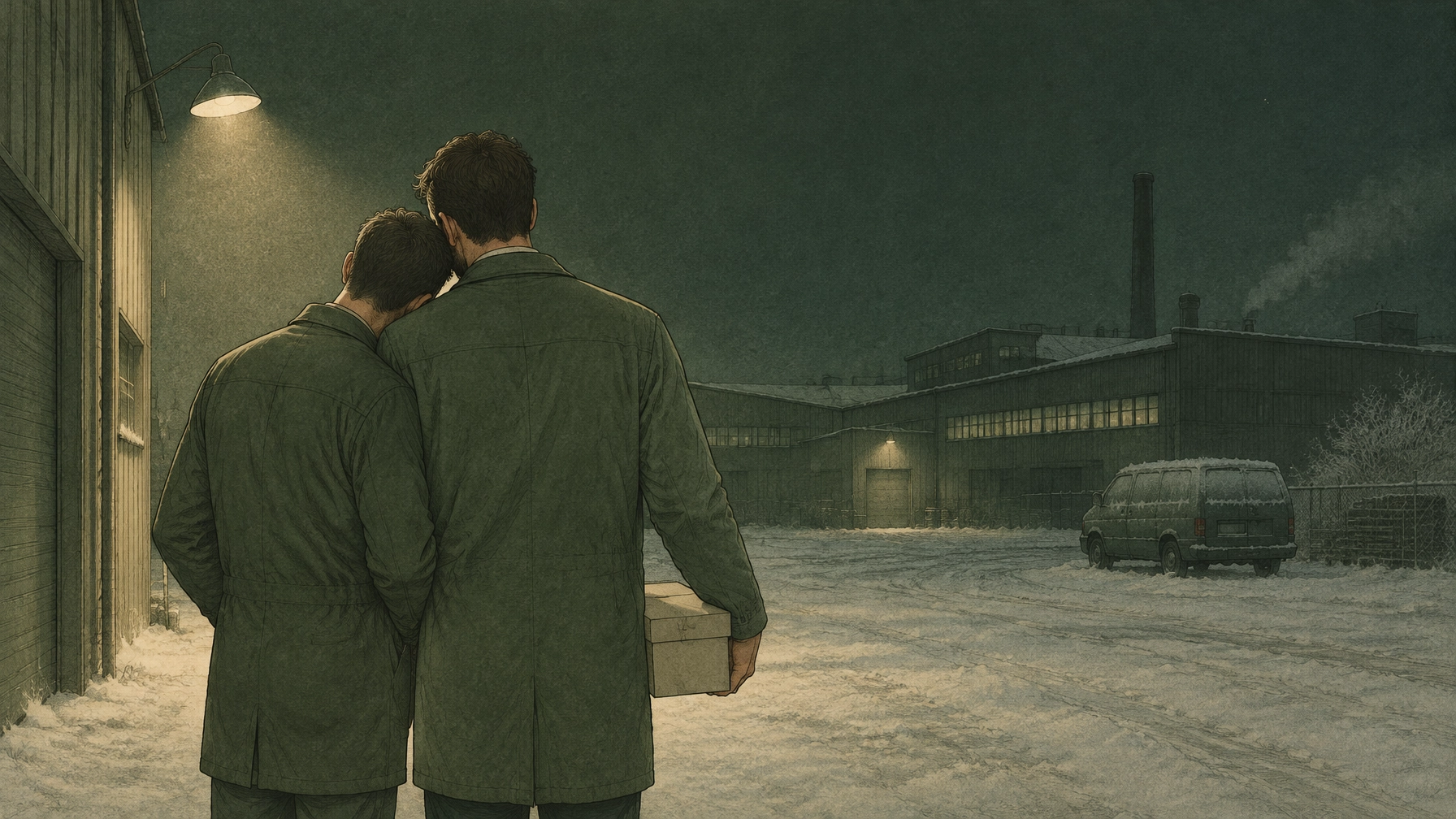
Frost on the Van
At four on Saturday afternoon, the paint shop was still working. The extractor fan hummed above us, drawing the smell of thinners through the roof. Hot metal held its heat under the lights. Beyond the open doors, frost had begun to gather in the corners of the yard and along the roof of the delivery van.
Nineteen of us worked in the paint shop. Eighty men worked on site altogether, though by then we had started counting people in other ways: who had been told, who had guessed, who might be useful somewhere else. Rennie & Sons made street furniture: litter bins, benches, bollards, lamp columns. I sprayed benches for towns I had never been to, giving their arms and legs an even coat before they went out into the weather.
The new fingerprint clock stood by the gate, pale and clean, with its little glass eye. It had been installed in November. The works was closing in January. Nobody said the joke out loud. It was too expensive to be funny.
A bench stood on trestles in front of me, its green paint still wet enough to catch the strip lights. I watched the shine settle. In the office, a list had been made. My place was at the bottom, last in. Gus’s was on it too, among the old hands. Twenty-nine years and a card in the rack the colour of weak tea.
Neither of us had mentioned it. Not to each other. Not to anyone.
The yard went white at the edges. A man from assembly passed with his collar turned up, carrying his gloves in one hand. The clock by the gate gave a soft electronic chirp as he pressed his thumb to it.
Then the fan swallowed the sound.
The Ironed Shirt
At Water Lane, I put my shirt on the kitchen table and ran the iron over its back. I had bought it in London for a different life. Its new-shirt smell had gone grey in the wardrobe, but the collar still held a crease. Outside the back bedroom window, the disused chapel yard sat under a thin coat of frost.
I had spent nineteen years in London doing paperwork. When the relationship ended, there had been a doorway and a suitcase. I came north, rented the terrace and learned to measure my days by the walk to the works and the weather over the chapel wall.
Gus was in my kitchen, ironing his own shirt with the television on. He never once looked at himself in the mirror while he did it. He was fifty-two, in the toolroom, and had been at Rennie’s for twenty-nine years. The oil in his knuckles had settled into the creases, a pencil-grey no soap shifted. On his left forearm, a comma-shaped burn scar marked where a press had caught him in 1998.
I knew the date because he had told me once, not as a story, but as the answer to a question about why he kept his sleeves rolled down.
He finished the cuff and set the iron upright. “The road’ll be icy.”
“I’ll walk.”
“You’ll be late.”
He was right about that. I folded the shirt over the back of a chair.
For eleven months I had been good with my hands and bad at being known. On site, every man could assume what he liked. I let “mate” do the work. At the function room, I could stay beside Gus as a colleague or stand beside him as a partner. I could not decide what either would look like at a buffet table beneath Christmas tinsel.
Gus took off his glasses and folded them, which was how I knew he was about to say something that mattered. “You’ve got time. It’s not a shift.”
It was the closest he came to asking.
Tinsel and Lager
The Red Lion’s function room was above the bar, up a narrow staircase with a brass rail worn smooth by hands. Inside, tinsel had been stapled along the picture rail. A karaoke machine stood near the fire door, one speaker working and the other silent. The chip fryer smell came up through the floorboards; floor polish sat sharp beneath it.
The room had a full coat of cold around its edges. Every time someone propped the fire door open, the weather pushed in from the landing and made the paper tablecloths lift. A row of glasses stood on trestle tables, each holding tepid lager. Damp rings spread beneath them. The raffle prizes were a bottle of something, a tin of biscuits and a pair of gloves still in their packaging.
A crisp packet opened under a table with a small, bright crackle. Someone laughed. Someone else called for the next song, and the karaoke screen held a line of words while the single speaker gave out a tune with a loose, tinny edge.
At the far end of the room, a collection tin went round for the apprentice’s motorbike. He had come off it in October and the front wheel had been bent into a shape no amount of optimism could fix. Men fed in coins and folded notes. The tin made a hollow little clink.
The room was warm where bodies pressed together, cold where the door opened, and full of things people had brought from the works: oil at the cuffs, paint dust on the backs of hands, a strip of reflective tape stuck to somebody’s heel. A coat steamed faintly on a chair. Ice melted from a pair of boots onto the carpet.
Gus sat beside me. Our shoulders touched once when a man squeezed past, then stayed close enough to touch again. We ate from paper plates balanced on our knees. The sausages had split in the heat; the chips were soft at the corners. Gus took the last fork from the packet and put it beside my plate without looking up.
Kevin, the foreman, came over to ask if we’d seen the raffle tickets. He was holding a microphone with a strip of black tape round its handle. I said no. Gus pointed to the packet on the table between us. Kevin took one and went back to the front.
The Numbered Years
Kevin waited until the room had settled, though the karaoke machine had not. A held note remained on its screen, unclaimed and bright.
He had numbers in his speech. He thanked the men with five years, ten years, twenty-five. He read out names and totals, and at the end he said Rennie & Sons had given the town six hundred and forty-two years of service.
A few glasses lifted. Most did not.
Then he said, “We remain committed to the consultation process.”
A man at the nearest table folded the edge of his paper tablecloth over and over, making a narrow white strip. A glass sat untouched beside his hand. The raffle tickets lay in a fan on the table. The held note stayed on the karaoke screen while the single speaker clicked softly.
Kevin thanked us and lowered the microphone. The fire door swung open. Cold air moved in past the coats and chairs, making the tinsel stir against the picture rail.
No one asked him what the sentence meant. We already knew.
One Plain Sentence
Kevin came over while I was standing near the drinks table. The cold had worked its way up from the landing; I could feel it through the thin soles of my shoes.
“How d’you know Gus?” he asked, easily, as if he were asking which shift I was on.
I had been afraid of being asked. I had not expected to be frightened by a question so small. Behind Kevin, men were laughing over a raffle ticket, and the karaoke microphone lay on the drinks table with its lead coiled like something put down in a hurry. Gus was at the table, folding his napkin into quarters.
“Gus is my partner.”
Kevin nodded once. “Right,” he said, and reached for the last bottle of lager.
The room continued. A man called out that he had won the biscuits. The karaoke machine changed songs. Someone at the door pulled it shut against the cold. Nothing ended; no one turned to look. The paper tablecloth gave a dry little crack beneath my thumb.
Gus came over. He took off his glasses and folded them. His hands were steady; the grey had settled into the knuckles.
“The council depot’s taking fitters in January,” he said. “I saw the notice outside the post office. We can go in on Monday.”
He put his glasses away. There was no hand on my shoulder, no promise dressed up as comfort. Just a date, a place, and a plan that included me.
I looked down at the table. The damp ring from my glass had spread into the paper and reached the edge of the raffle ticket.
The Shoebox
The old clocking-in machine had been replaced by the new one at the gate. Someone in the toolroom had been told to bin the cards. Instead, he brought them to the do in a shoebox.
The box was worn at the corners, its lid buckled where it had been pressed shut. He set it on a chair by the fire door and said the men could find their own. One by one, they queued to look through the cards, like a school photo arranged by number. Every card had a number, not a name. The oldest were furred at the edges, their punched holes softened by years of handling.
Outside, frost had returned to the landing window. Each time the fire door opened, the cold came in on the men’s coats. I found my card quickly. It was thin and pale, eleven months of punches in tidy rows. I put it in my inside pocket.
Gus found his and pushed it back into the box.
“Not keeping that?”
“No.”
He moved away to speak to Kevin. The card lay at the top of the pile, one corner worn nearly white. I took it and slipped it beside mine.
By the time we left, the music had stopped and the room had begun to empty. The fire door thumped shut behind us. Our breath showed on the pavement, then disappeared. We walked to Water Lane without speaking much. The cold kept finding the gaps in my coat.
Under the porch light, I took a biro from my pocket. On the back of my card, I wrote my name. On the back of Gus’s, I wrote his. Mine had eleven months of punches. His had twenty-nine years and a corner furred soft as felt.
The two cards lay side by side on the step, the same size and the same colour, and in the dark you could not have told which was which.
After the Last Shift
This story finds a love story in the ordinary places where men work, wait and make plans. MM romance unexpected places can hold a gay love story emotional journey, especially when character-driven queer fiction lets silence and small acts carry as much weight as a declaration.
Dick Ferguson’s fiction is written for emotionally invested MM readers drawn to difficult tenderness, layered characters and the slow work of being known. It offers emotional MM romance literary in its attention to place, memory and the physical details that stay with us.
Explore Dick Ferguson’s LGBTQ+ ebooks through Read with Pride, or visit the Read with Pride homepage to discover more queer fiction.
Follow us on social media: Instagram · X · Facebook · Read with Pride
#MMRomance #GayLoveStory #QueerFiction #EmotionalMMRomance #ReadWithPride #CharacterDrivenFiction #SlowBurn #GayBooks #LGBTQBooks


Leave a Reply
You must be logged in to post a comment.