

Category: Queer Life and Identity
The flat with too many shoes in the hall
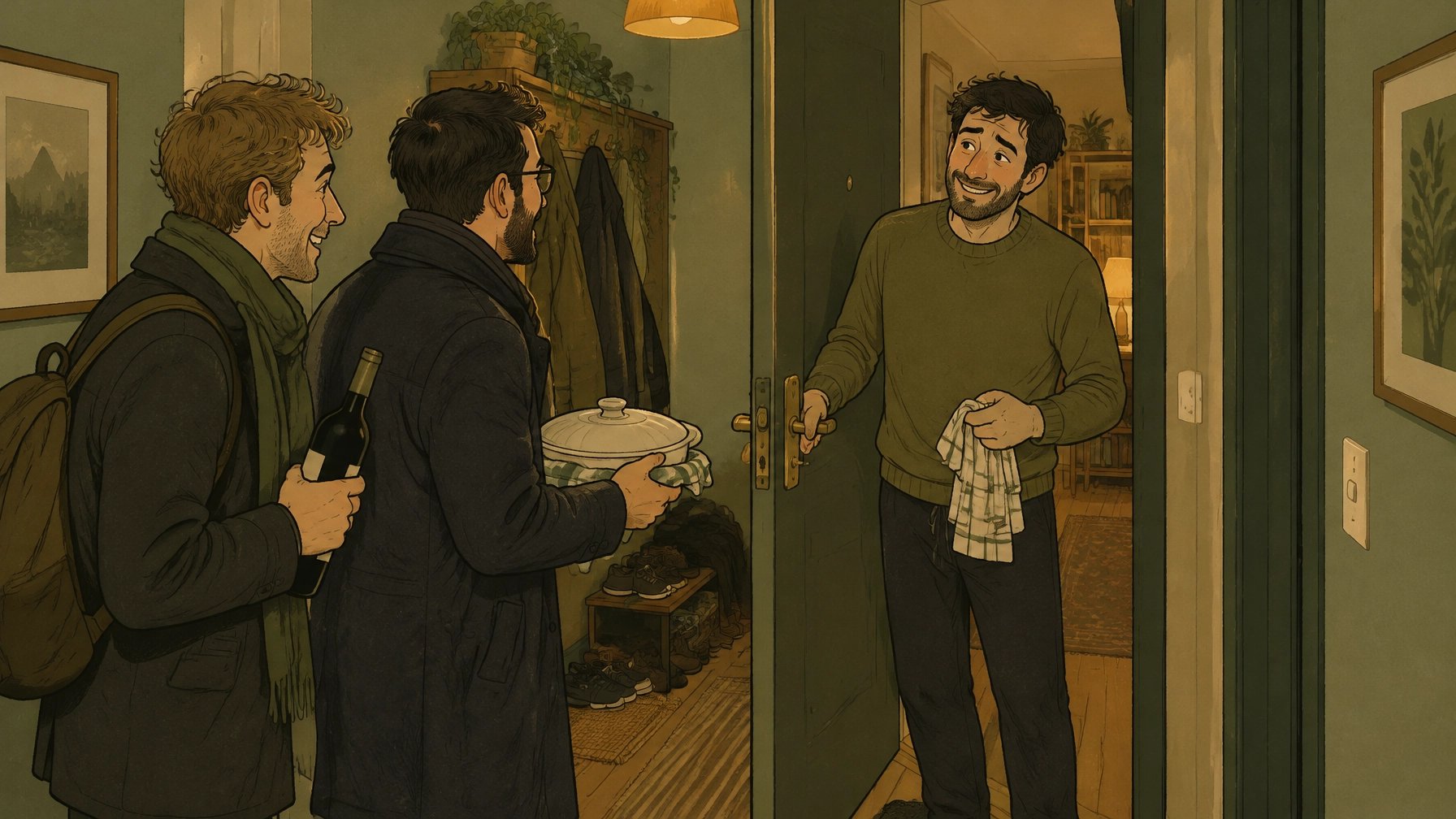
Two weeks after lunch, Jonah walked with Elias to his brother’s new flat, carrying a bottle in one hand and a plate of something Elias had made in the other. Jonah held the plate with the careful, slightly awkward balance of someone thinking about something else.
The hall was already full of shoes. They had been dropped in a heap beside a stack of unopened post on the floor. Before Jonah could knock, the door opened.
His brother had been listening for them. He was holding a tea towel and appeared to have no idea what to do with it.
“Hi,” he said.
“Hi,” Jonah replied.
His brother looked at the towel, then at the bottle. “I’ll take those.”
He took the bottle, reached for the plate, changed his mind, and tried to pass Jonah’s coat to Elias while Elias was still wearing his own. The coats ended up draped over the back of a chair in the hall, though the chair was already holding a bag.
“Good start,” Elias said.
“Very organised,” Jonah’s brother replied, with a dry little smile.
That was enough to let everyone move on. No grand welcome, no careful speech. Just a crowded hall, a tea towel without a purpose, and the first small laugh of the evening.
Jonah had spent years looking for stories that understood the weight ordinary rooms could carry. The best queer fiction does not need every doorway to become a declaration. Sometimes it is enough to arrive with a plate and be expected.
Nine people in a flat meant for three
The living room was warm enough that the window stood open, letting in a thin breath of cold air. There were nine people in the flat, which had apparently been designed for three. Men stood with drinks wherever there was room: near the sofa, beside the kitchen doorway, in a narrow strip between the table and the wall.
His brother introduced Elias by name. A little later, in another conversation, he introduced Jonah as his brother.
Not “my brother and his partner,” as if the sentence needed a frame around it. Just Elias, and Jonah, his brother. The words passed between people as easily as a bottle being handed across the room.
Jonah noticed that he was not being explained.
It might have been a small thing to anyone else. To him, it felt like walking into a room without first having to decide which version of himself would fit the space. His bisexuality was not a question he had to prepare to answer. His relationship with Elias did not need to be softened into a vague friendship or expanded into an announcement.
They were there. People made room, although not much. Someone shifted a chair with a foot. The flatmate asked whether anyone wanted more to drink. A man from work was already telling a story about a printer that had jammed at the worst possible moment.
Jonah caught Elias’s eye across the room. Elias looked perfectly at home, as if crowded flats and overheated rooms had never required him to put on a different self.
Jonah felt a little of that ease catch.
So how did you two meet?
The mate from five-a-side had a loud laugh and a cheerful way of asking questions that made it difficult to tell whether he expected an answer or was already on his way to another subject.
“So how did you two meet?” he asked, looking from Jonah to Elias. “Don’t tell me it was an app.”
Jonah smiled. “A bookshop.”
The mate looked surprised. “Really?”
“Elias was arguing with the man at the till about a mispriced book.”
“I was not arguing,” Elias said.
“You were making a case.”
“It was marked incorrectly.”
The mate laughed. “So he was like that from day one.”
“Pretty much,” Jonah said.
The mate nodded as if that settled the matter. Then he was back to the pub quiz he had been discussing before, trying to remember whether a particular round had been music or geography. The question died of natural causes. It did not become the evening’s subject, and no one turned Jonah and Elias into a story for the group to examine.
That was the win.
There was something reassuring in the way a meeting could be both personal and unremarkable. The best MM romance unexpected places are not grand collisions at all, but small scenes that turn out to matter: a book, an argument about its price, and a man who still had no intention of letting a badly labelled copy go.
Elias was not embarrassed by that first impression. He looked mildly pleased to have his principles recognised.
The mate moved on to the quiz. The room moved with him. Jonah took a sip from his drink and let himself stay where he was.
The version Jonah catches himself about to tell
Halfway through the evening, Jonah was talking with the flatmate’s brother and the man from work. They had got onto holidays, then onto the sort of places where you could spend a week without checking the time.
Jonah started to say something about Elias’s family. Before the sentence had properly arrived, he heard himself trimming it.
“His lot are local,” he said.
The words came out neat and small. They sat between them, tidy enough to go unnoticed.
Nobody had asked him to make it smaller. Nobody had even asked about Elias’s family. Jonah had done it automatically, the way he might fold a receipt into a pocket without thinking.
He stood with his drink in his hand and listened to the others talking. The conversation was easy. The flatmate’s brother had spent a holiday in a place where the rain apparently found its way through every window. The man from work said he had managed to get lost on a walk that was supposed to be simple.
Jonah felt the old script in his mouth. He had picked it up without being handed it.
He had been out for about eight years. He knew what his life was, and he knew what he wanted to say about it. Still, the habit of editing could arrive before a decision. It did not always announce itself as fear. Sometimes it dressed as politeness, or convenience, or the thought that nobody needed the extra detail.
For Jonah, bisexual representation meant more than being named correctly. It meant being allowed to speak about his life at its actual size, even when the room was ordinary and nobody had asked him to make a point.
He looked over at Elias, who was listening to the five-a-side mate explain a pub quiz dispute with complete seriousness. Jonah let the sentence he had swallowed sit there, not as a failure, just as something he had noticed.
Saying it at the size it actually is
Later, the conversation turned back to holidays, and Jonah found himself speaking with the flatmate and the man from work. He could have kept things general. It would have been easy to mention a place, an old trip, or the weather.
Instead, he said, “Elias and I went up there last year. His family live nearby, so we stayed a few days and had dinner with his lot. They’ve got a way of making every meal last twice as long as it needs to.”
He said Elias’s name in the middle of the sentence. He did not lower his voice or hurry to the end.
The flatmate asked whether the food had been any good. The man from work said he liked long dinners if there was enough bread. Someone called from the other side of the room to ask where the bottle opener had gone.
That was it. The room kept going.
Jonah waited for a reaction without meaning to. He found no raised eyebrow to interpret, no silence to fill, no sudden interest in the story of his relationship. There was no reaction to read, and the absence of one was its own kind of relief.
A gay love story emotional journey might sound, on paper, as though it ought to reach its turning point in a grand admission. For Jonah, the turning point was a full sentence about dinner, heard and received as a full sentence about dinner. The intimacy was not in the room congratulating him. It was in the room having no reason to.
He looked at Elias, who was offering the bottle opener to the flatmate. Elias met his eye for a moment, then went back to what he was doing. He had not rescued the moment or arranged it. He had simply been there, comfortable in himself, while Jonah caught up.
In the kitchen, the question from lunch
Jonah went to the kitchen to refill his drink. There was a bottle in his hand when he heard someone ask his brother a question through the doorway.
“How long has your brother been out, then?”
Jonah stopped in the hallway.
The question was ordinary in tone, almost casual. It was also the question his brother had been afraid someone might ask. The exact fear from lunch had arrived, dressed in a mate’s curious voice.
For a moment Jonah could see his brother as he had been in the café, trying to find a way to explain what he had not known and when. He could feel the reflex to step in, to make the answer easier, to say something that would take the pressure off.
But he was unseen, and he stayed still.
“About eight years, I think,” his brother said.
A pause. Not a dramatic one. Just the time it took to set something down.
“I didn’t know right away. I was a kid. I know now.”
He said it evenly, in the same voice he had used all evening. He did not turn towards the doorway to check Jonah’s face. He did not add a speech about how much he cared or how sorry he was. He did not make the moment belong to anyone except the conversation he was having.
The mate said something Jonah couldn’t quite hear.
“Did you get the car sorted?” his brother asked.
The conversation moved on.
Jonah stayed in the hallway for a few breaths, the bottle cool in his hand. Then he went into the kitchen and refilled his drink.
This was the kind of small truth that character-driven queer fiction could hold without dressing it up. His brother had not known everything at the right time. He knew more now. He could say so without pretending otherwise, and without asking Jonah to make him feel better for saying it.
Jonah returned to the living room. His brother was asking someone whether the window should stay open. The evening went on.
What a habit looks like from the doorway
The flatmate caught Jonah near the doorway to the living room.
“He’s been strange all week about tonight,” he said, nodding towards Jonah’s brother. “Tidying, then tidying again. Asked me whether the good table was too small.”
“I heard that,” Jonah’s brother called from across the room.
“It was a question.”
“It was a normal table.”
“It was a good table,” the flatmate insisted.
Jonah’s brother shook his head. “You’re both making this up.”
The flatmate’s face was bright with the pleasure of having something to report. Jonah could have joined in, made a joke, asked how many times his brother had moved the chairs. Instead he let him have the dignity of denying it.
He found he was quietly pleased. Not because the nerves had been necessary, but because they showed how much his brother wanted the evening to go well without knowing quite how to say it.
Emotionally invested MM readers know that affection often appears in small, imperfect acts before anyone gives it a name. A table checked twice. A door opened before the knock. A brother trying to make a crowded room feel ready.
Someone leaned against the bookcase. It gave a little rattle.
“Careful,” Jonah’s brother said. “There’s one screw left over.”
“Is it meant to do that?” the flatmate asked.
“It’s fine.”
The flatmate pressed a hand against the side. “It’s fine.”
“It’s been fine all week,” Jonah’s brother said.
“Then it’s a very reliable bookcase,” Elias observed.
The group accepted this as the final word on the matter. A bookcase with a spare screw, a crowded room, and no one in need of an explanation. Jonah looked at his brother, who had stopped pretending to be annoyed and was smiling into his drink.
The plates, the door, and the text the next morning
By the time the last guests left, the room had cooled and the small flat felt larger. Jonah and Elias stayed to stack plates and ask where things belonged. His brother pointed them towards a cupboard, then changed his mind and took two of the plates himself.
At the door, he watched as Jonah pulled on his coat.
“That was all right, wasn’t it?” he asked.
“It was a party,” Jonah said.
His brother looked pleased.
Jonah understood then that ordinary was what he had come for. Not a perfect evening, and not proof that nothing would ever feel awkward. Just a gathering in a small flat, where his brother had introduced him as his brother and answered a question without turning it into a test.
The walk home was quiet for a while. Elias carried the plate, now covered in foil. Jonah’s hands were free.
“Your brother’s bookcase held up,” Elias said.
“Against a person leaning on it.”
“A demanding structural test.”
“It passed.”
The night did not need a summary. Its meaning was in what had happened without anyone asking it to mean more.
There is a particular pleasure in emotional MM romance literary stories when the feeling is not announced but allowed to settle. Jonah had arrived wondering how the night might ask him to shrink. He left with the memory of a sentence spoken at full size, and a brother who had found his own words.
The next morning, his phone buzzed.
His brother had texted: “A mate asked which of us built the bookcase. Told him I did it myself. He was impressed. Fair enough, really.”
Jonah read it twice, then replied, “Don’t let the screw hear you.”
A note from Read with Pride
For readers looking for LGBTQ+ ebooks, gay fiction, gay romance books, M/M books, MM novels and queer fiction with room for complicated feelings, you can explore the Read with Pride collection.
Follow us on social media
Instagram · X · Facebook · Read with Pride
#QueerLifeAndIdentity #MMRomance #GayRomance #BisexualRepresentation #QueerFiction #GayFiction #MMFiction #LGBTQBooks #EmotionalMMRomance #CharacterDrivenFiction #ReadWithPride #ReadingWithPride
Three stories we could tell next
1) The Kindness Elias Has Been Doing — A Habit Comes Into View
Elias notices how often he softens other people’s discomfort on Jonah’s behalf, and wonders when care started to look like taking the choice away.
2) Before I Knew You — Theo Asks Marcus About the Missing Years
Theo asks what Marcus’s life was like before they met, and Marcus has to decide how honestly to talk about the years he kept love at a distance.
3) The Mate Who Asks Again — A Second Invitation, and What It Costs to Say Yes
The five-a-side mate invites Jonah and Elias to a thing of his own, and Jonah has to decide whether being ordinary in one room makes him brave enough to be ordinary in another.


Leave a Reply
You must be logged in to post a comment.