

Category: Rare Experiences | Morning Edition
The bay at low water
At low tide, Mallows Bay seemed to Corbin Meek less like a place where ships had sunk than a place where they were still deciding what to be.
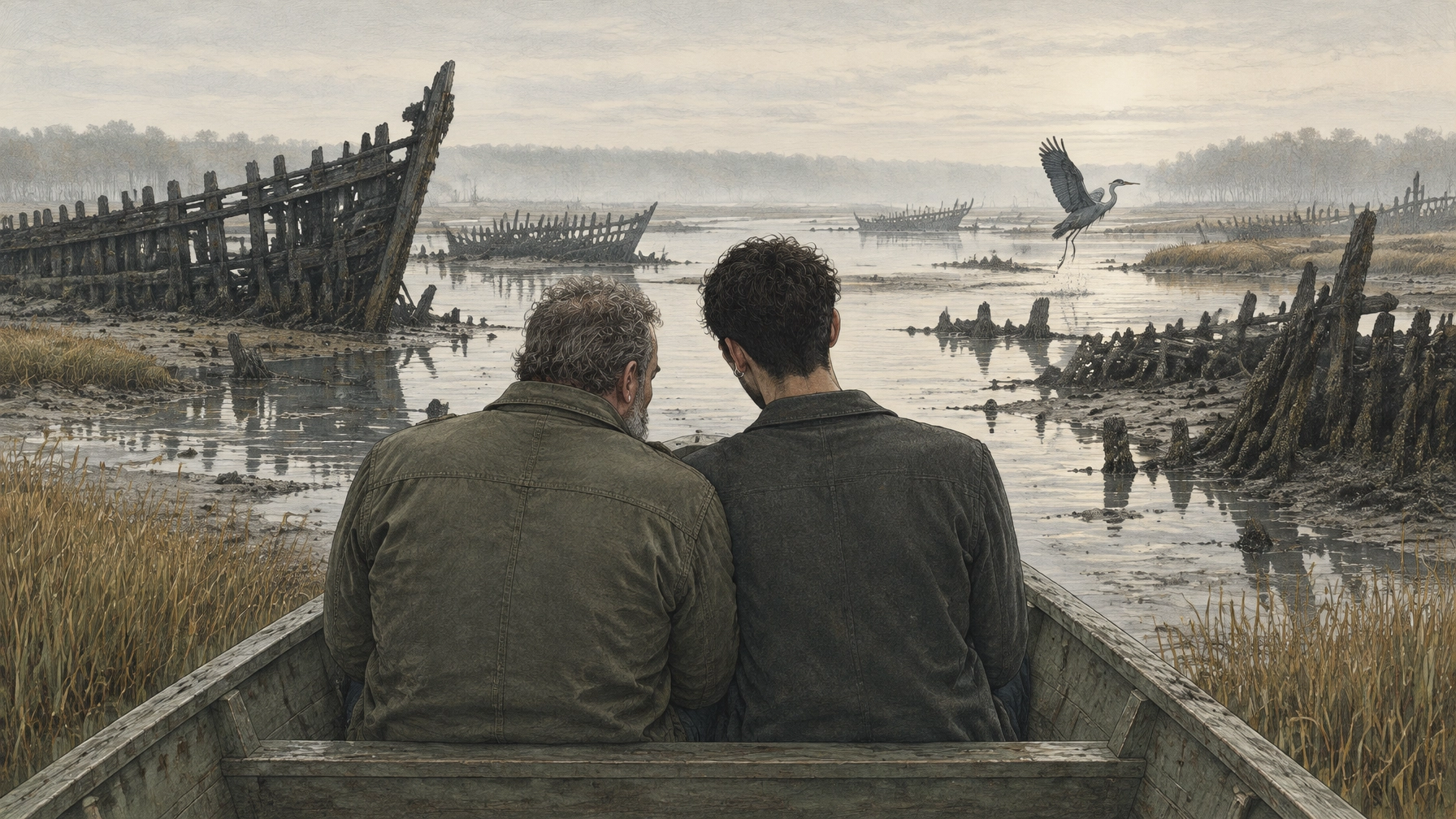
He took Jonah Whitlock out in his flat-bottomed skiff, the two of them sitting low among the water’s small, cold movements. Corbin knew the channels by the feel of the river under the hull. Jonah, tall and narrow-shouldered, narrated what he saw into the wind as if the bay were a colleague who needed briefing. He described the ridges of timber, a seam of mud, the heron standing perfectly still.
Corbin listened. He had spent most of his life learning how things sounded.
Mallows Bay is a shallow cove on the Maryland shore of the Potomac, in Charles County, about thirty miles downriver from Washington, D.C. The sanctuary covers eighteen square miles and contains 141 known shipwrecks. It is the largest wooden ship graveyard in the Western Hemisphere. From the water, those numbers seemed too clean for what lay ahead: charred ribs, rust-dark fittings, green growth, and a silence that held more life than either man expected.
Jonah was there on a season’s contract, recording the hulls for a community survey. Corbin needed the money and had local knowledge, so they had agreed on a simple arrangement: Corbin would take him out; Jonah would pay him for his time. Neither had included the possibility of wanting the other man to stay.
That was the trouble with MM romance unexpected places. Sometimes the place did not offer an escape from ordinary life. It made ordinary life impossible to avoid.
What the fire left
The wrecks had been built for a future that arrived too late.
Between 1917 and 1919, nearly 300 wooden steamships were built in at least 189 shipyards across 26 states for the U.S. Emergency Fleet. The government had promised a thousand ships in eighteen months. The war ended before the fleet was finished; none of the wooden ships reached the theatre of war, though some later carried cargo to Hawaii. Each hull had been meant to cost about $300,000. Each one came in at roughly $750,000.
In 1917, Senator Jacob H. Gallinger of New Hampshire warned, “when the war closes, whether it be within one year or five years, we shall have a lot of worthless ships on our hands that will have cost this country an enormous amount of money.”
After the Armistice, on 11 November 1918, the government sold ships at a heavy loss. The largest group — 233 vessels, 218 of them wooden — went to a San Francisco attorney for a fraction of their construction cost. The Western Marine and Salvage Company, based in Alexandria, Virginia, was given the work of stripping them. Their engines, boilers, propellers and steel fittings held value; the hulls did not. Local watermen protested when the fleet came up the Potomac, among the river’s most productive fishing waters. Some ships broke loose and drifted, hazards to navigation. The company was ordered to secure them.
Its answer was fire. On 7 November 1925, the first 31 ships were lashed together with steel cables and set alight at dawn. The flames burned for hours and could be seen for miles. The largest single destruction of ships at one time in U.S. history. The charred remains were floated into Mallows Bay. The company eventually went bankrupt in the Depression, leaving more than a hundred burned hulls behind. A later salvage effort during the Second World War ended with the war; residents petitioned for the hulks’ removal again in 1964.
Corbin had known the history since he was a boy. His great-grandfather Amos Meek had worked on the burning crews in 1924 and 1925. Corbin had never told anyone. Behind his boatbuilding shed, fifteen minutes from the bay, a back room held three generations of kept things. He had not opened its door since his uncle died in March.
Among those things, wrapped in a horse blanket, was a charred oak name board. BAYOU was all that remained of the word. The ship was almost certainly the Bayou Teche. Corbin had neither hung the board nor thrown it away.
The name in the ledger
Jonah found Amos’s name in a 1925 company payroll page at the county historical society. He brought the discovery to Corbin with the open delight of a man who had found a human thread running through a difficult story.
“It’s a connection,” he said. “Not just the salvage company. Someone who was there.”
Corbin felt the word there settle between them. He imagined Amos reduced to a line in a report, labelled, dated, and filed away. He imagined Jonah carrying the name somewhere Corbin could not follow, then leaving with it when the contract ended.
“You’ll put his name in a report and that’s all he’ll ever be.”
Jonah’s reading glasses were pushed into his hair. He reached for them, forgot they were there, and lowered his hand again. “You’d rather he be nothing than be a man who did a thing.”
It was honest. It also cut.
Corbin turned away. He was thick through the shoulders and thick-handed, with a grey-shot beard he trimmed with the same scissors he used on fibreglass cloth. Sawdust gathered in the creases of his neck. On his right wrist, a burn scar curved like a comma. He laughed once, sometimes, and then couldn’t stop; this time nothing came out.
Their gay love story emotional journey had not begun with the right words. It had begun with two men discovering how expertly each could miss the thing the other was trying to say.
Out on the water, Jonah kept narrating. At the Three Sisters site, he named the Moosabee, the Dertona and the wreck locals called the Heron Wreck. He was superb at describing what he saw. He had spent ten years recording wrecks in places he flew into and flew out of. His contract ended in three weeks, and he still had not said whether he was going.
Corbin knew the habit. He had been left before by men who found him too slow, too attached to a shed and a life that had to be built one careful piece at a time. Jonah never said goodbye until he was already gone. Neither of them was cruel. Each was simply brave in every direction except the one that mattered.
The survey was best done at low tide, when the water exposed more of the old structure. Corbin tapped one of the hulls twice with two knuckles. The sound came back hollow. A still-boat sound, he thought, not whole, but not nothing.
“It didn’t go down,” he said. “They put it down. There’s a difference.”
The wrecks had not been lost at sea. They had been towed, stripped, lashed together and burned on purpose. And in time, the remains became habitat. Ospreys nested on the wrecks; the steel-hulled Accomac carried nests at bow and stern. Blue herons, bald eagles, beavers, longnose gar and warmouth found a place among them. The estuary became spawning ground for striped bass. What had been made useless for one purpose was alive in another way.
A 1970 congressional report described trees rooted inside the hulls and birds making homes there. It called the strange islands “not unattractive.”
Jonah looked at Corbin, then at the hull. He didn’t turn the moment into a note.
A shelf in the light
That evening, Corbin opened the back-room door.
He did not sort the room in one evening, and he did not decide what the past was worth, or whether Amos had done wrong. Corbin had come out at thirty-one. It had cost him his father’s approval, and then his father died before either of them finished the argument. A debt with no counterparty: no one left to pay it, no one left to forgive him for having waited so long.
He carried the horse blanket into the front of the shed and unwrapped the board. BAYOU, blackened at the edges, looked no more resolved in the light than it had in the dark. Corbin hung it above the workbench.
Jonah stood beside him. “My contract ends in three weeks,” he said. “I’ve been offered a second season. One year. I haven’t answered.”
“Are you going?”
“I want to stay.”
It was not a promise of forever. It was a year said out loud instead of swallowed, and a choice made in the present tense.
Jonah signed for the second season. He put his survey cards in the drawer of Corbin’s bench, where they would be safe from sawdust and damp. Corbin showed him how to tap a hull and listen, not as a lesson in history, but as a way of asking what remained.
Character-driven queer fiction often turns on such small acts: a door opened, a name allowed into the light, a man who has always left quietly choosing to say when he might come back. For emotionally invested MM readers, the hope is rarely that the past will disappear. It is that the living can find a place beside it, which is what makes emotional MM romance literary in the end: not the elegance of the sentences, but how much honesty they are asked to carry.
They sorted one shelf in the back room. Not the room. One shelf.
The dead were still dead. The board still had a burned edge. Neither man pretended that making a place for something meant understanding it completely. But, for the first time, Corbin did not feel that keeping the past required him to hide it.
Two evenings later, they walked up the soft launch at Mallows Bay Park with the empty trailer. An osprey sat on a piling. The tide was coming back over the ribs, covering them without erasing their shape. Neither man said anything about how much it had cost to get there.
If you want more evenings in company like this, the novels are gathered in one place: https://readwithpride.com/e-book-store/dickfergusonwriter/.
Corbin Meek, Jonah Whitlock and their story are fictional. Mallows Bay, its shipwrecks and the history described here are real.
Follow us on social media
Instagram: https://www.instagram.com/dickfergusonwriter
X: https://www.x.com/DickFergus94902
Facebook: https://www.facebook.com/profile.php?id=61572869844598
Read with Pride: https://readwithpride.com
#MMRomance #QueerFiction #GayRomance #ReadWithPride #LGBTQBooks #BookLovers #LiteraryFiction #MorningEdition #MallowsBay #GhostFleet #PotomacRiver #RareExperiences
The Mapparium in Boston — a walk-in stained-glass globe crossed by a glass bridge, where every voice comes back from the place it was spoken, and two men hear their own words returned.
The Sunken Forest of Lake Kaindy, Kazakhstan — drowned spruce trunks standing upright in a mountain lake, their branches still underwater, and two men learning what a thing keeps when it goes under.
One Square Inch of Silence in the Hoh Rain Forest, Washington — the quietest place in the United States, where overflights have worn the silence thin, and two men find out whether quiet is a place you can keep or only borrow.
Images
Alt text: Two men share a quiet moment in a small skiff among Mallows Bay’s ghost fleet, a literary MM romance scene with skeletal shipwrecks, low-tide mudflats and a heron.

Alt text: Broad weathered hands and a slimmer hand with a silver ring rest together on a charred Mallows Bay shipwreck rib, an intimate detail from an emotional MM romance.

Alt text: Two men stand shoulder to shoulder in a wooden boat shed beside a charred plank, surrounded by tools and shavings in a quiet character-driven queer fiction scene.

Alt text: Two men walk together up the Mallows Bay launch ramp at dusk, passing a skiff, an osprey and mist over the Potomac in a hopeful literary MM romance closing scene.

Leave a Reply
You must be logged in to post a comment.