

Category: Unexpected Places | Morning Edition
The room that kept 1935
The cold had settled into Theo Marsh’s coat before he reached the Christian Science Plaza. He kept one hand in its crowded pocket, touching the folded pages there: twelve drafts of an apology, each more accurate than the last and less true. The other hand held a list he had already checked twice.
The Mary Baker Eddy Library and Christian Science Publishing House stood at 210 Massachusetts Avenue in Back Bay. The exhibits had been closed for the Thanksgiving recess; this was the morning the doors opened again. Theo had come because the Mapparium was on his list. Jonah Pell had come because Theo had asked him, and because Jonah still said yes to invitations that sounded like requests for company.
They had been seeing each other for four months. Jonah had kissed him outside his Somerville workshop; Theo had never asked what the workshop was called. He knew Jonah painted signs in gold leaf and glass gilding, and that a smear of gold size often lingered on his red-brown thumb. He knew Jonah’s hair was greying at the temples. He did not know why the door above the workshop remained blank.
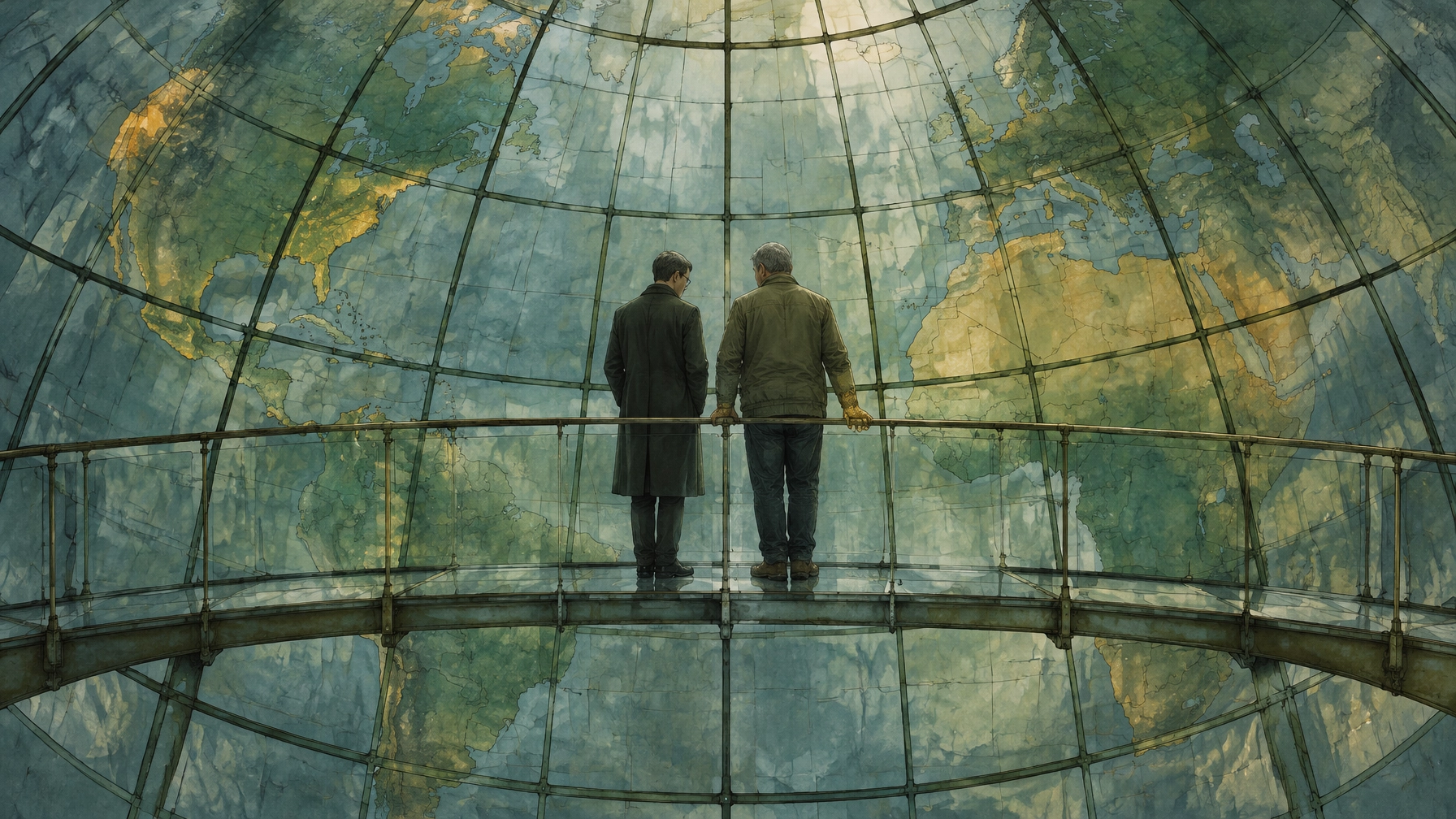
Inside, the building smelled faintly of paper and polish. The guide’s practised voice led their small group toward the globe: thirty feet across, three storeys high, a hollow sphere of stained glass. A bronze frame held 608 curved panels, each a ten-degree division of latitude and longitude. Painted and baked over eight months, they formed the world as mapped in 1935.
The map had not changed in ninety-one years. Siam remained; French Indochina remained. Israel and Indonesia did not appear. The USSR spread across the northern hemisphere, while Africa showed as a solid block of European colonies. This is the thing MM romance unexpected places keeps circling back to. The place already knows how to hold a loss it cannot update, and two men walk into it carrying something of their own that has stopped keeping up.
Theo spotted the plaque’s date and checked it against his folded list. Then he noticed the map.
“Siam has been Thailand since 1939,” he told the guide.
Jonah glanced at him. “The room isn’t wrong. It’s honest. It’s a photograph. Everything that happened afterwards is the error.”
Theo felt the old reflex rise: correct the premise, specify the terms, make the sentence defensible. He looked at Jonah’s thumb, at the gold caught in its creases, and said, “You gild lies for a living. Every sign you finish is a promise somebody is going to break.”
Jonah’s face tightened, but his voice stayed quiet. “You’ve never put your own name on anything in your life, so don’t tell me what a sign is for. You want the room to say what it is. You’ve never once said what you are.”
Neither of them apologised. The group crossed the short entry passage and stepped onto the glass bridge.
The bridge across the middle of the earth
The bridge ran thirty feet along the globe’s equator. Through the glass under Theo’s shoes, the curve and colour of the sphere seemed to fall away. Around him, continents arched overhead and below, divided by the dark lines of their panels. The guide explained that visitors crossed through the centre of the earth, then gave the group time to look.
The old bulbs that once lit the globe (three hundred forty- and sixty-watt lamps, hot enough to be uncomfortable and constantly in need of replacement) were gone. LEDs now gave the glass its steady glow. Theo could hear their faint hum beneath the shifting sounds of visitors: a shoe scuff, a low murmur, someone clearing their throat.
Jonah stood a few paces behind him. The bridge was crowded enough for their shoulders to brush, but neither moved closer.
Theo pulled the folded pages from his coat. The top draft had a crease through the first line. Eight weeks earlier, at dinner, he had told his older brother Martin that Martin only called when he needed someone to agree with him. The words had been true. Theo had chosen them to hurt. Since then, he had written and rewritten his apology, correcting its balance as if the right sentence could make the hurt smaller.
He tucked the pages away again.
Jonah watched him. “You’ve been carrying that for weeks.”
“You don’t know what it is.”
“I know what it looks like when you’re trying to make a sentence safe.”
Theo turned. “And you know what it looks like when someone corrects you?”
“I know what it feels like to have someone treat what I make as if it’s a mistake.”
The words landed more carefully than Theo’s had. This was the difficult space character-driven queer fiction keeps returning to, the reason readers stay in the room when both men are right and neither is generous: Theo correcting the world because he cannot correct himself, Jonah hearing every correction as a small erasure.
Jonah painted names on shops, boats and doors for other people. He had learned the trade from a man who was not his father, a teacher who told him that a name was applied, not inherited. Jonah believed his work was honest because it was ornament, not description. No one had ever mistaken a gold letter for a fact.
Theo looked back through the curved panels. “I didn’t say your work was a mistake.”
“You didn’t have to.”
The guide’s voice carried from the other side of the group, then faded as the visitors moved toward the exit. “Photos and short videos are allowed once the light-and-sound presentation has finished,” the guide reminded them. “Please don’t record the presentation itself.” The group began to leave. Soon the guide had stepped outside, and the sphere held only Theo, Jonah and one held breath.
What came back from the other side
Theo walked to the exact centre of the bridge.
He heard the reflections before he understood them. His own voice, under his breath, seemed to return from the wrong side of his head. He swayed left; the sound shifted into his right ear. He swayed back. For a man who had spent most of his life checking other people’s sentences, it was unnerving to hear his own come back as if spoken by someone else.
The sphere was a whispering gallery, the guide had said. The hard glass reflected sound instead of absorbing it. Acousticians, including William Hartmann of Michigan State University, had measured the effects: points opposite one another across the centre behaved as a pair; in hot spots, a voice could arrive nearly ten decibels louder. Some sounds seemed to come from the wrong direction because reflected frequencies between roughly 1,500 and 3,500 hertz were focused at the other ear.
Jonah had reached the far end of the bridge. Thirty feet separated them.
“You’re not going to send it, are you?” he said in an ordinary voice.
Theo heard him as if Jonah’s mouth were at his ear. The low frequencies seemed to gather and travel straight through the space between them. Thirty feet of glass and air collapsed into the small, private distance of a breath.
“No,” Theo said. “Not the way I wrote it.”
He stood still at the centre. His hand found the folded pages, but he didn’t take them out. Instead, he spoke toward the glass, to nobody in particular.
“I told Martin he only calls when he needs someone to agree with him. It was true. I said it to make him feel small. I’m sorry. I miss him. I want to hear what he meant, even if I don’t like it.”
The sphere gave the words back. Not corrected, not polished. Just spoken, and heard.
Theo took the mechanical pencil from behind his ear and put it down on the bridge beside his shoes.
Then he walked to the far end. Jonah waited at the other point, symmetric across the sphere’s centre. Theo stopped before him.
“Would you hear it once?” he asked. “Plainly. Not as a draft.”
He said the apology again, looking at Jonah this time. Jonah listened without rescuing him from any part of it.
“That’s the first one that had no corrections in it,” he said.
It wasn’t forgiveness, and it wasn’t a promise. Theo felt the difference. He also felt the sentence’s weight in the room, where it could not be mistaken for an edit.
The names a person answers to
They left without taking a photograph. Outside, the cold found them again on Massachusetts Avenue. The globe stayed behind them, full of borders and names from a world that no longer existed.
Jonah turned his red-brown hand palm-up. A small smear of gold size caught the light on his thumb.
“Do you ever paint your own name?” Theo asked.
Jonah looked at him. “I suppose I’ll find out.”
Theo did not send a message to Martin that day. The twelve drafts stayed folded in his inside pocket. He had not fixed the thing he had broken; he had stopped pretending another revision would do it for him. A gay love story emotional journey rarely turns on the sentence that finally gets sent. It turns on the man who stops editing and stands in the cold with what he has instead.
They walked on toward the T, past the steamed windows of a coffee shop, and neither of them said what it had cost to be heard at that distance. Nothing was resolved between Theo and Martin. Something had begun between Theo and Jonah, and it had no polish on it at all.
That week, in his workshop in Somerville, Jonah painted PELL above his own door. Out of practice with the letters, he set one a little high. He noticed, reached for the mahl stick, then let his hand fall. The name stayed as it was: not inherited, not a fact about what he would become. Something placed there because he had chosen it.
That is the ending emotionally invested MM readers keep coming back for, and the quiet work of the literary in emotional MM romance at its best, where an apology is not a plot device but a sentence a man has to stand next to, in the cold, in front of somebody. If that is the journey you read for, the novels are gathered in one place: Read with Pride.
The Mapparium, its 608 panels, the 1935 map and the acoustics are real and documented; Theo and Jonah are invented.
Follow us on social media
Instagram: https://www.instagram.com/dickfergusonwriter
X: https://www.x.com/DickFergus94902
Facebook: https://www.facebook.com/profile.php?id=61572869844598
Read with Pride: https://readwithpride.com
#MMRomance #QueerFiction #GayRomance #ReadWithPride #LGBTQBooks #BookLovers #LiteraryFiction #MorningEdition #Mapparium #Boston #UnexpectedPlaces
At Tyneham in Dorset — a village requisitioned in 1943 and left exactly as it was, with a notice still on the church door promising the owners will return.
Near Klevan in Ukraine, the Tunnel of Love — a working railway line where the trees close overhead, kept open by the trains themselves.
The Dwarfie Stane on Hoy in Orkney — a tomb cut from a single block of stone with no door, where you crawl in and lie in the dark.
Images


Leave a Reply
You must be logged in to post a comment.