


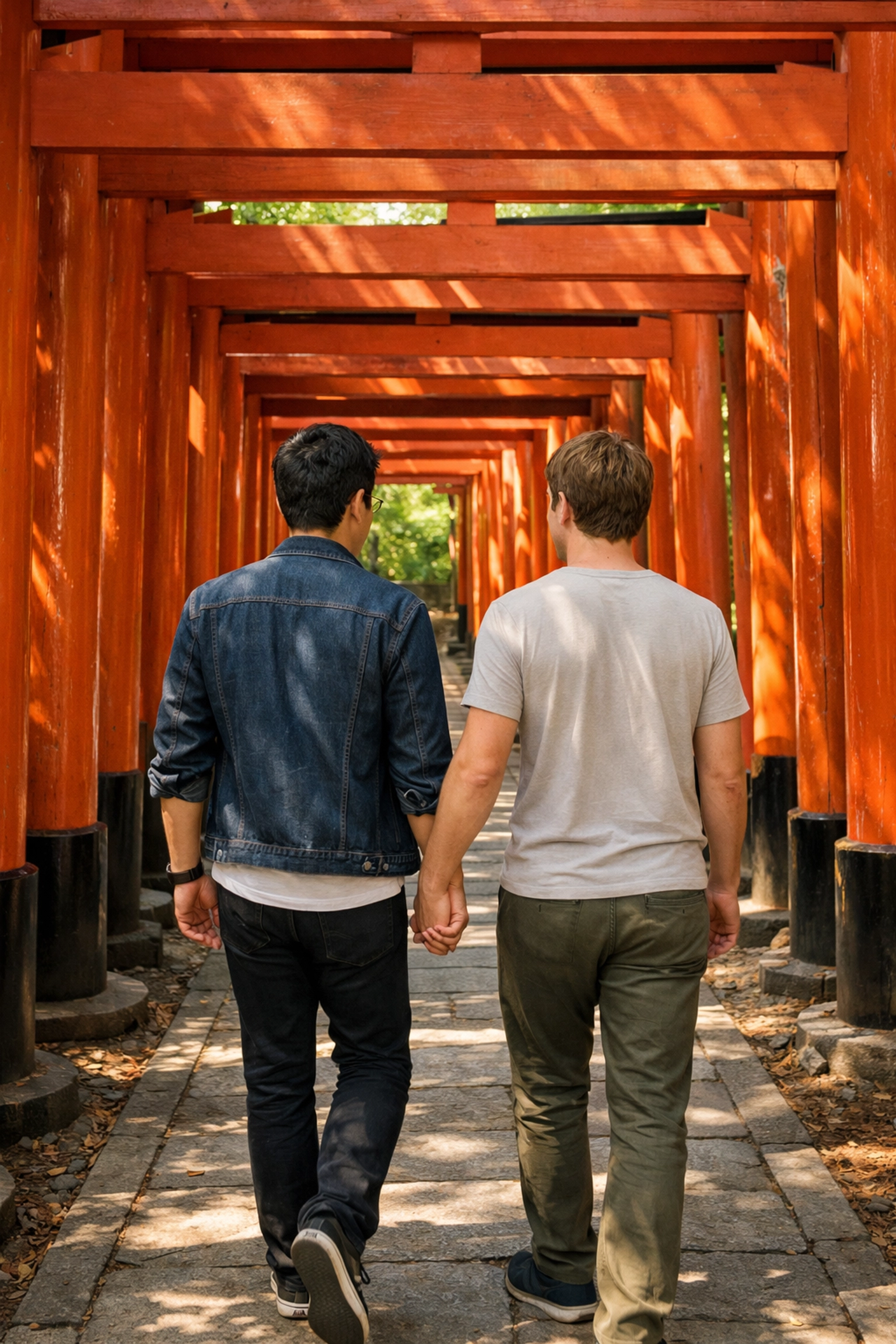
Kenji's hand found mine as we stepped through the towering torii gate at Nezu Shrine, and I felt something shift: not dramatically, but quietly, like taking off shoes you've worn too long. The red lacquered gate marked more than an entrance; it was a threshold between Tokyo's relentless pulse and something older, gentler. Something that didn't ask us to explain ourselves.
"This is the boundary," Kenji whispered, his thumb tracing circles on my palm. "Between the everyday world and the sacred."
I'd grown up Catholic in Brisbane, where sacred spaces came with rules I could never quite follow, where holding another man's hand would've earned sharp looks and sharper words. But here, in this peaceful corner of Tokyo, nobody looked twice at us. The kami: the spirits inhabiting this place: didn't care about the gender of who sought peace. They just… existed, in the trees, the stones, the still pond reflecting clouds.
The Quiet Revolution of Simply Existing
Three months into our relationship, Kenji had suggested this trip. "I want to show you where I find balance," he'd said over coffee in our shared apartment in Shibuya. He'd been visiting shrines since childhood, not out of rigid religious obligation, but as a practice of returning to himself. When Tokyo felt too loud, too demanding, too much, he'd slip away to Meiji Jingu or Hie Shrine, purify his hands and mouth at the temizuya, and just… breathe.
For someone like me: raised on guilt and confession booths: the Shinto approach felt revolutionary. There was no sin to atone for, no divine judgment weighing on who we loved. Just reverence for nature, respect for the spirits in all things, and the understanding that peace was something you could actively seek.
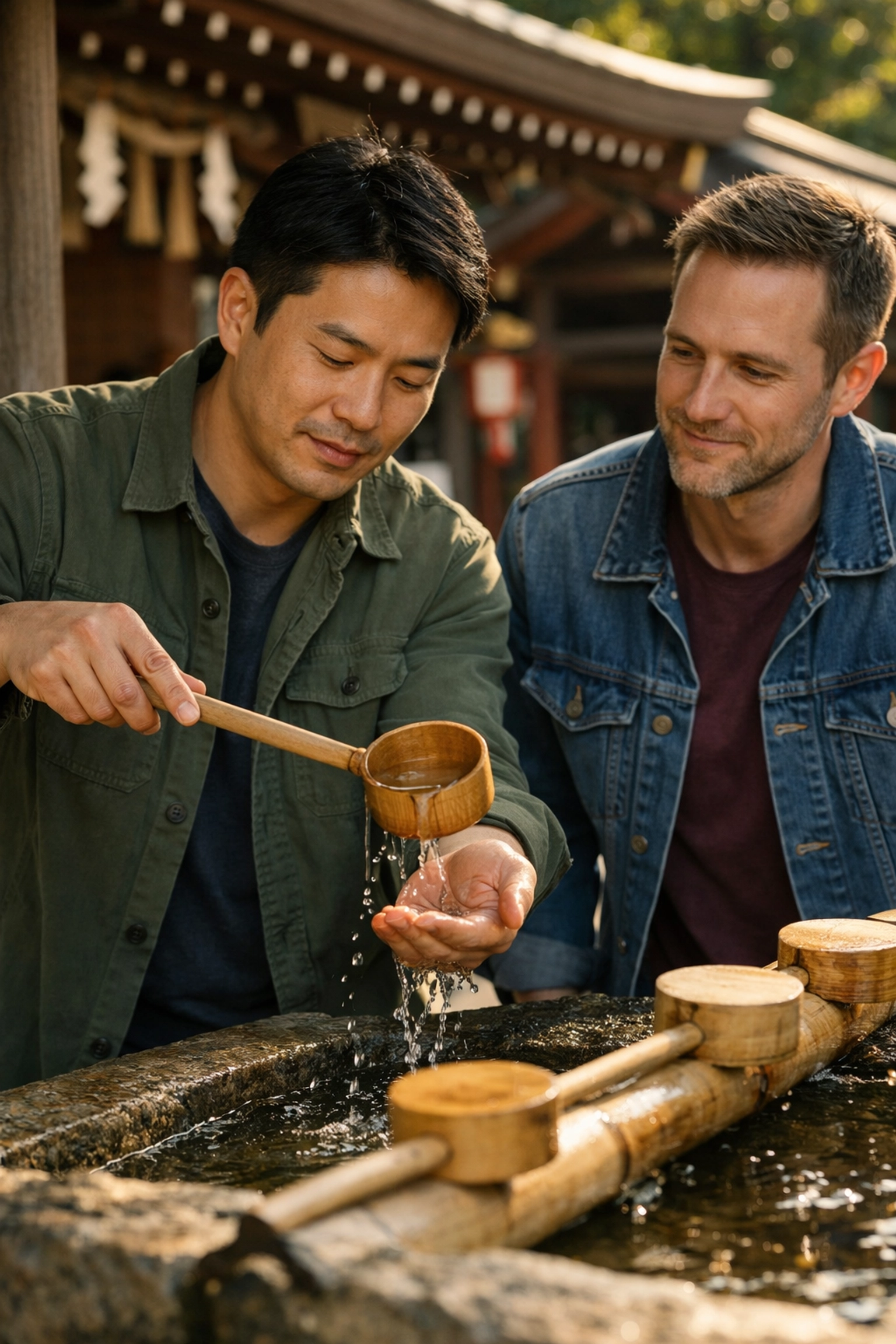
"Watch," Kenji said, guiding me to the purification fountain. He demonstrated the ritual: take the ladle in your right hand, pour water over your left. Switch hands, repeat. Pour water into your cupped left hand, rinse your mouth, spit discreetly. Finally, tilt the ladle vertically to cleanse the handle itself.
The water was cold and clean. I followed his movements, feeling self-conscious at first, then gradually easing into the rhythm of it. This wasn't about washing away shame. It was about entering a sacred space with intention, with respect. With cleanliness of spirit.
Finding Kinship in Centuries of Stillness
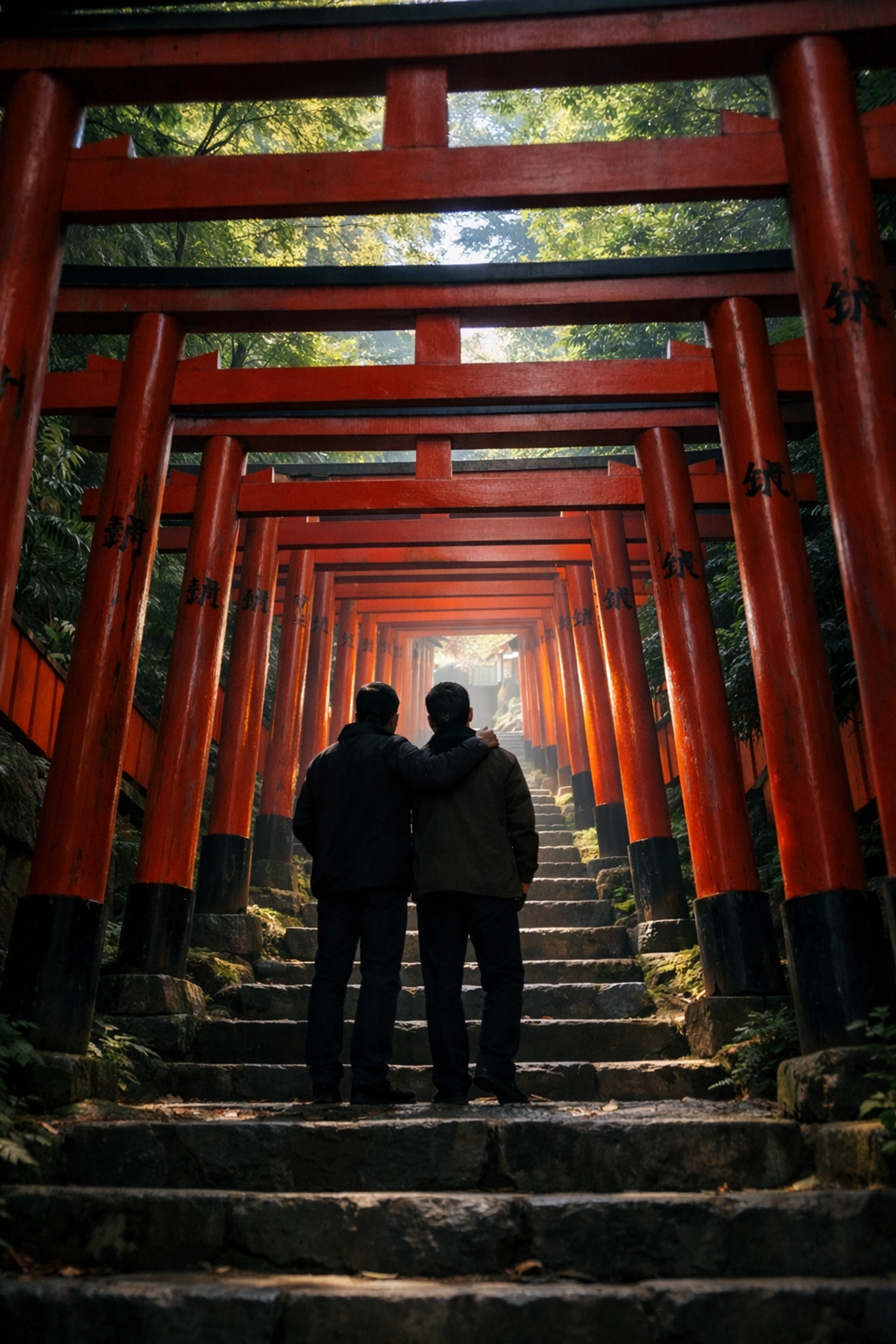
We walked the tunnel of vermillion torii gates that Nezu Shrine is famous for: each one donated by believers over centuries, creating a corridor of faith that curved upward into the hillside. Our footsteps echoed softly against the stone path.
"Do you feel it?" Kenji asked, stopping beneath the canopy of red gates.
I did. A stillness that wasn't empty but full: full of history, of prayers whispered and hopes carried, of countless people who'd walked this same path seeking connection to something larger than themselves. Samurai and commoners, artists and laborers, and yes, people like us. We weren't the first gay couple to seek peace here, and we wouldn't be the last.
In MM romance books, we often read about couples finding sanctuary in secret places, hidden corners where love can exist without judgment. But this wasn't hidden. Nezu Shrine sits in plain sight, near the charming Yanaka neighborhood, under-the-tourist-radar but not concealed. We could be ourselves here, openly, while still participating in something sacred.
That felt like its own kind of miracle.
The Language of Spirits and Silence
At the main shrine building, Kenji showed me how to pray. "Bow twice, clap twice, bow once more. But what you say: or don't say: in between is yours alone. The kami listen without judgment."
I watched him first: the deliberate bows, the sharp clap of hands that rang out in the quiet, the final bow held just a beat longer than necessary. His eyes were closed, his expression serene. Whatever conversation he was having with the spirits was private, personal, and utterly his own.
When my turn came, I felt nervous in a different way than I'd ever felt in church. Not the fear of getting it wrong and being punished, but the vulnerability of approaching something with genuine openness. I bowed, clapped, bowed. In the silence between, I didn't recite memorized prayers. I just thought: Thank you for this place. Thank you for this peace. Thank you for him.
Simple. True.
The kami, if they were listening, didn't respond with thunderbolts or divine pronouncements. They responded with birdsong and the rustle of leaves, with the dappled sunlight through the camphor trees, with Kenji's soft smile when I opened my eyes.
Sacred Spaces for Modern Love
After Nezu, we visited Meiji Jingu, nestled in its lush forest in Yoyogi. The walk from the entrance to the shrine proper takes about ten minutes through towering trees, and it felt like stepping into another world entirely: one where Tokyo's neon and noise couldn't reach us.
"They say there are power spots here," Kenji explained as we walked. "Places where the spiritual energy is particularly strong. Kiyomasa's Well is one: people believe it brings positive energy, good fortune."
We found the well tucked away in a grove, its water crystal clear and startlingly cold when I dipped my fingers in. The peace here was different from Nezu's intimate stillness: this was vast, ancient, the kind of calm that comes from trees that have stood for decades and will stand for decades more.
"Do you believe in it?" I asked. "The energy, the fortune?"
Kenji considered, his arm settling comfortably around my waist. A small gesture, but one that still made my heart jump: the casual intimacy of being with someone in public without fear. "I believe that when we come to places like this with open hearts, we find what we need. Whether that's the kami working their magic or just… giving ourselves permission to receive peace, I don't know. Does it matter?"
It didn't. Not really.
What We Carry Home
Our last shrine visit was to Hie Shrine, perched between the Imperial Palace and Roppongi, with its own tunnel of bright red torii gates ascending like a stairway to something holy. By then, I'd learned the rituals by heart: purify, approach, bow-clap-bow, accept the peace offered without questioning whether I deserved it.

That evening, back in our apartment with its view of the endless Tokyo skyline, Kenji made tea while I sat at the window, watching lights flicker on across the city. I felt different: not dramatically changed, but subtly shifted, like I'd set down something heavy I hadn't realized I'd been carrying.
"What are you thinking?" Kenji asked, handing me a cup of sencha.
"That I've spent so long thinking sacred spaces weren't for people like us," I said. "That we had to hide or compromise or apologize for existing. But the shrines… they just let us be."
Kenji nodded, settling beside me. "Shinto doesn't have the same concept of sin that Western religions do. It's about ritual impurity that can be cleansed, not moral failing that damns you. And love: " he took my hand again, ": love between any people isn't considered impure. It just is. Like water, like trees, like the kami themselves."
I leaned into him, breathing in his familiar scent mixed with the green tea steam. Outside, Tokyo glittered and roared. But inside, in this moment, we'd brought some of that shrine stillness home with us.
Finding Your Own Sacred Space
If you're exploring gay romance stories that center cultural authenticity and spiritual seeking, Read with Pride offers a growing collection of LGBTQ+ fiction that honors diverse experiences of faith, spirituality, and belonging. Because sometimes the most radical act is simply existing peacefully in spaces that welcome you as you are.
The kami taught me that. Kenji taught me that. And now, walking hand-in-hand through Tokyo's ancient and modern landscapes alike, I carry that lesson in my bones: peace isn't something you earn through suffering. It's something you allow yourself to receive, in sacred spaces built by centuries and in quiet moments built by two.
This story is part of our "Sacred Hearts" series, exploring LGBTQ+ experiences with faith and spirituality across different cultures and traditions worldwide. For more stories that celebrate authentic queer fiction and MM romance, follow us on Instagram, Facebook, and Twitter.
#ReadWithPride #MMRomance #GayRomance #LGBTQFiction #QueerFiction #GayLoveStories #JapaneseCulture #ShintoShrine #TokyoLove #SacredHearts #MLMRomance #GayBooks #QueersReading #LoveIsLove #LGBTQBooks #GayRomanceBooks #MMContemporary #CulturalRomance #SpiritualJourney #AuthenticLove

Leave a Reply
You must be logged in to post a comment.