

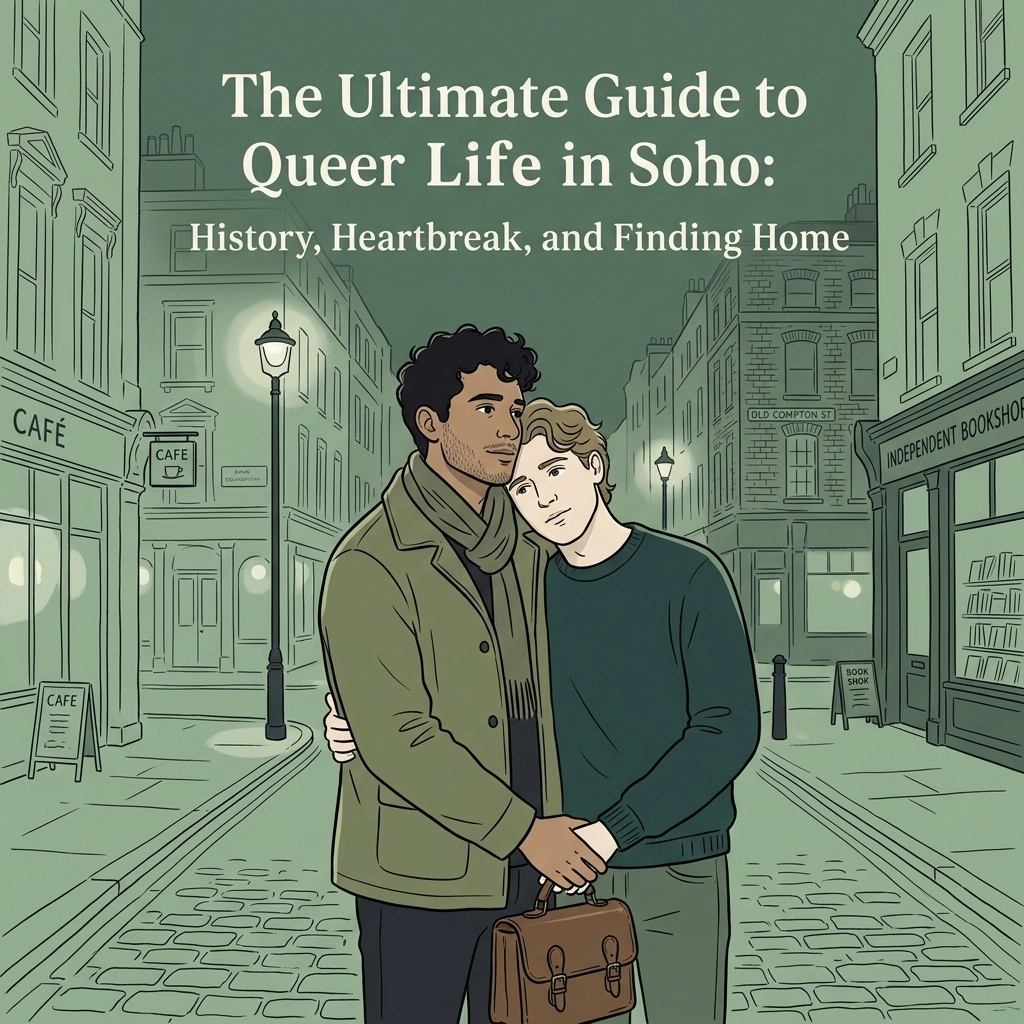
The Beauty of Being Non-Binary: Living Beyond the Binary Gaze
Before we dive into the neon-lit streets of Old Compton Street, we need to talk about the internal landscape of queer identity. There is an exquisite, quiet power in The Beauty of Being Non-Binary: Living Beyond the Binary Gaze. For many in our community, the journey to Soho wasn't just about finding a bar; it was about finding a space where the rigid lines of "man" and "woman" blurred into something more authentic.
Living beyond the binary gaze means reclaiming your narrative from a world that demands you fit into a box. It’s about the freedom to exist as a spectrum. In the context of our favorite MM romance and queer fiction, we’re seeing more characters who challenge these norms, showing that love isn’t about gender roles, but about the soul-to-soul connection. When we walk through Soho, we aren't just men or women; we are a vibrant tapestry of identities that refuse to be simplified. This philosophy of fluid existence is the very heartbeat of Soho’s history.

A Century of Secrets: Soho’s Early Queer History
Soho hasn’t just been "the gay village" for a few years; it has over 130 years of uninterrupted queer history. Long before the rainbow flags were draped over every balcony, Soho was a place of shadows and secrets. In the late 1800s, the area was already gaining a reputation. While the rest of London looked away, men were finding ways to meet other men in the narrow alleys and dimly lit basements.
The legendary Oscar Wilde was a frequent visitor to the area in the 1890s. He famously frequented Kettner’s restaurant, a spot that still stands today as a testament to those early, dangerous days of queer visibility. For Wilde and his contemporaries, Soho offered a reprieve from the stifling morality of Victorian London, even if that reprieve often came with the threat of prison.
By 1913, Soho saw the opening of the Cave of the Golden Calf. This wasn’t just a club; it was arguably the first "gay bar" in the modern sense. It was avant-garde, wild, and intentionally "different." It provided a sanctuary where a kiss didn't immediately lead to a jail cell: at least, not every night. The Trocadero Long Bar, which opened near Piccadilly Circus in 1896, also became a notorious hub for homosexual liaisons, proving that the roots of our community in this soil go deeper than many realize.
The Underground Years and the Shift to Earl’s Court
Post-World War II, the atmosphere in Soho shifted. The 1950s were a time of intense police surveillance. While places like the City of Quebec (one of the oldest gay pubs still running) offered a place to hide in plain sight, much of the community began to look elsewhere.
During this era, many queer people moved toward West London, specifically Earl’s Court, because the rents were cheaper and the heat from the authorities felt slightly less oppressive. But Soho never truly lost its pull. It remained the "seedy" heart of the city: a place where the rules of polite society didn't quite apply. This grit is what allowed the 1980s renaissance to happen.
The 1980s Renaissance: From Heaven to Comptons
If you ask any elder in the community about the "golden age" of Soho, they’ll likely point to the 1980s. This was the decade Soho truly reclaimed its crown. In 1979, Heaven opened its doors under Charing Cross station, changing the face of queer nightlife forever.
But the real shift in Soho itself happened in 1986. A traditional pub called the Swiss Tavern was transformed into Comptons of Soho. It was a revolution. For the first time, a pub was explicitly, unapologetically queer. It wasn’t hidden behind a blacked-out window or a secret knock; it was right there on Old Compton Street. Soon, others followed: The Village, Halfway II Heaven, and The Yard. Soho had become an LGBTQ+ wonderland.

Heartbreak and Resilience: The Admiral Duncan
You cannot talk about the history of Soho without talking about the heartbreak. On April 30, 1999, a neo-Nazi nail bomb exploded inside the Admiral Duncan pub. It was a targeted attack meant to tear the heart out of our community. Three people lost their lives, and dozens were injured.
However, the attack did the opposite of what was intended. Instead of scattering in fear, the community galvanized. Thousands gathered in Soho Square for a vigil that cemented Soho’s status not just as a nightlife destination, but as a home. The resilience shown in the face of such hatred is a cornerstone of why we read with pride today. We tell our stories because they were almost silenced.
Finding Home in Literature: MM Romance and Beyond
For many of us who couldn't get to Soho, we found our "Soho" in the pages of gay novels and MM romance. At eBooks by Dick Ferguson, we believe that literature is a vital part of queer geography.
When you read a book like The King of Spades and Broken Roses, you are engaging in that same search for home and identity that defined the patrons of the Cave of the Golden Calf a century ago. Whether it's gay historical romance that captures the tension of the Victorian era or gay contemporary romance that explores the complexities of modern dating in a gentrified city, these stories provide the emotional map of our lives.
If you’re looking for your next obsession, check out the latest LGBTQ+ ebooks at our store: Read with Pride Store. These stories are more than just entertainment; they are a continuation of the legacy started by Wilde and maintained by every person who has ever stood their ground on Old Compton Street.
The Modern Soho: Gentrification and the Future
Today, Soho faces a new kind of threat: gentrification. The "clean-up" of London, accelerated by projects like the Elizabeth Line, has led to the demolition of historic queer spaces. We’ve lost legendary spots like The Astoria, Ghetto, and the beloved queer café First Out.
As corporate chains move in and rents skyrocket, there is a legitimate fear that the "soul" of Soho is being priced out. However, if history has taught us anything, it’s that the queer community is nothing if not adaptable. We are seeing a rise in more inclusive, non-binary, and trans-focused spaces that are pushing back against the "cis-heteronormative" shift of the area.
Soho is still our home. It’s where we go to celebrate Pride, to mourn our losses, and to find a family that understands us without explanation.

Why We Must Continue to Read and Write with Pride
The history of Soho is a cycle of finding space, losing it, and reclaiming it again. This is exactly why queer fiction and gay literature are so important. They preserve the "ghosts" of the venues we've lost. They keep the spirit of the 1980s renaissance alive and provide a blueprint for the future.
Whether you are looking for steamy MM romance, heartfelt gay fiction, or gay thriller novels that keep you up all night, the act of reading is an act of preservation. By supporting queer authors and engaging with LGBTQ+ fiction, you are ensuring that our history: and our future: remains written in stone (and ink).
Explore our latest releases and find your next favorite read here: https://readwithpride.com/e-book-store/dickfergusonwriter/
Follow us on social media for more queer history and book recs!
- Instagram: https://www.instagram.com/dickfergusonwriter
- X (Twitter): https://www.x.com/DickFergus94902
- Facebook: https://www.facebook.com/profile.php?id=61572869844598
- Website: www.readwithpride.com
#MMRomance #LGBTQFiction #SohoHistory #GayBooks #QueerLiterature #ReadWithPride #NonBinary #GayRomance #LondonQueerLife #GayFiction2026
Proactive Blog Post Options for Dick:
- The Evolution of the 'Bodyguard Romance' Trope in Gay Fiction: A deep dive into why we love the "protective hero" and how it’s evolving in 2026.
- Beyond the HEA: Why High-Angst MM Romance Hits Harder: Exploring the "Emotionally Invested Reader" profile and why we crave the tears before the triumph.
- Hidden Gems: 5 Queer Authors You Should Be Reading This Spring: A curated list of rising stars in the LGBTQ+ publishing world.

Leave a Reply
You must be logged in to post a comment.