

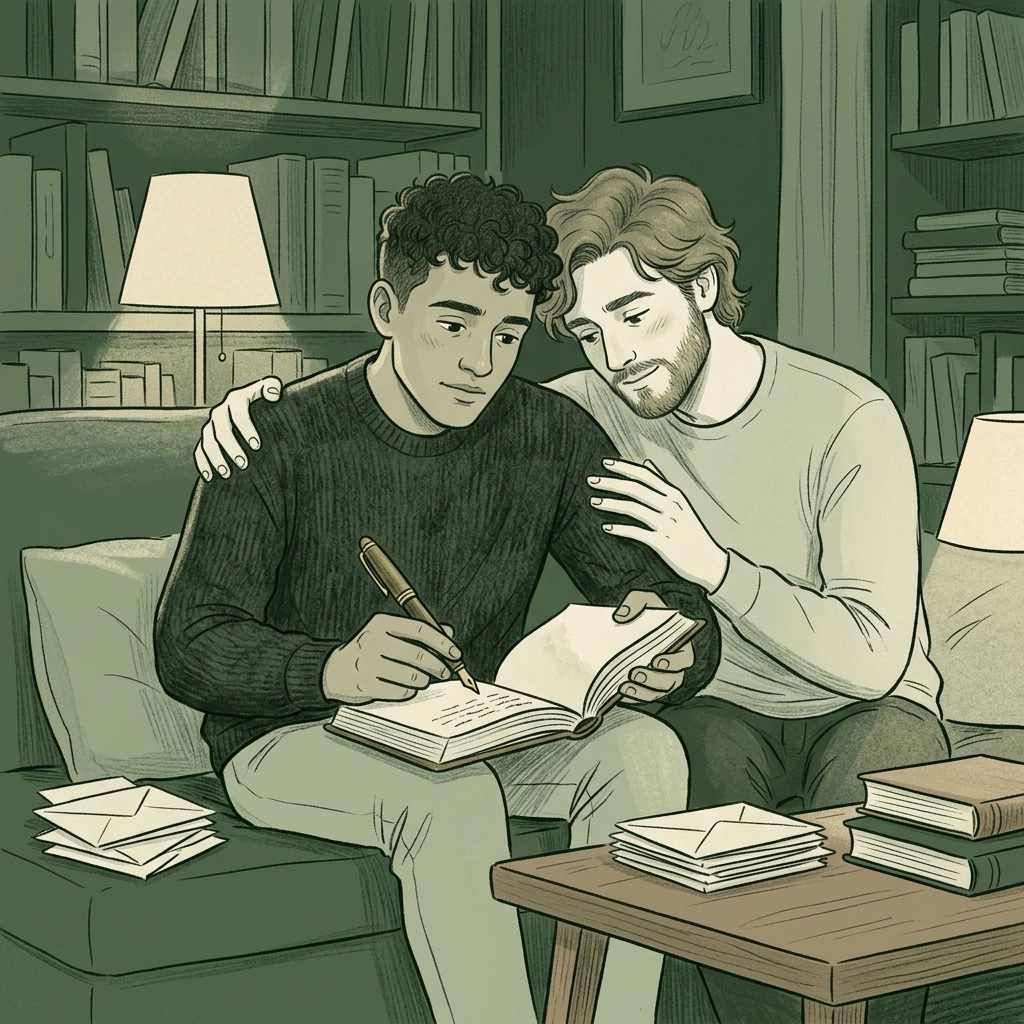
There is a specific kind of silence that only exists in the space between two people who have everything to say and no way to say it. We live in an age of instant gratification, where a "u up?" text arrives with the clinical buzz of a notification, devoid of soul, stripped of the tactile ache that used to define human connection. But I find myself wondering, as I sit in my study surrounded by the ghosts of characters past: are love letters truly dead? Or have we simply buried them in the unexpected places of our digital lives, letting the weight of unsent words crush us from the inside out?
The act of writing a letter is a rare experience now. It requires a deliberate surrender to time. You have to feel the grain of the paper, the scratch of the nib, and the slow, deliberate bleed of ink, a physical manifestation of your own blood and bone onto a page. In the world of MM romance, where longing is often a survival tactic, the letter has always been more than just communication. It is a sanctuary.
The Ghost in the Drawer: The Weight of the Unsent
We’ve all been there. You’ve written the message. You’ve poured every ounce of your internal struggle into a paragraph that burns with the heat of a thousand suns. And then, you delete it. Or, in the older, more visceral tradition, you fold the paper until the creases are white and brittle, and you tuck it into the back of a drawer where you hope the shadows will keep it safe.
These unsent words don't just disappear. They accumulate. They have mass. For the Emotionally Invested Reader, the tragedy of an unsent letter is often more poignant than the joy of a delivered one. It represents the "what if," the moment where fear outweighed the need for catharsis. In my writing, I often explore these jagged edges of the human heart, the moments where a man looks at the man he loves and finds his voice trapped behind a wall of history and hurt.

In my book Dust and Bone, the weight of the past is literal. It’s in the dirt, the grit, and the unspoken debts we owe to those who came before us. Sometimes, the most powerful love letter is the one written to a ghost, or the one written by a man who knows he may never see the dawn. It’s about the sensory details: the smell of rain on hot asphalt, the tremor in a hand that’s held a gun but doesn’t know how to hold a pen. This is the heart of M/M books, the raw, unfiltered exploration of masculinity meeting its match in the form of vulnerability.
Unexpected Places and Rare Experiences
I once found a letter tucked into the lining of an old leather jacket I bought at a vintage shop in London. It wasn't addressed to me, obviously. It was dated 1994, written from one man to another, speaking of a night spent watching the stars from a rooftop in Brixton. It was never mailed. There was no stamp, no postmark. Just the lingering scent of old tobacco and a desperation that felt as fresh as if it had been written yesterday.
That is a rare experience. To hold someone else’s unrequited soul in your hands. It reminded me that while the medium might change, the ache remains the same. Whether it’s a draft in a Gmail folder or a crumpled sheet of yellowing parchment, the "unsent" is a universal language of gay love stories. We are a people built on coded language, on the subtle press of a hand or the way a gaze lingers just a second too long. For decades, love letters were the only place where a man could truly be himself, hidden away from a world that demanded he be someone else.
The Anatomy of Longing
When I wrote The King of Spades and Broken Roses, I wanted to dive into the most personal parts of the MM romance experience. Longing isn't just a feeling; it’s a physical state. It’s the hollow in the chest, the dry throat, the way the light catches the edge of a glass.
A love letter, sent or unsent, is a map of that longing. It traces the topography of a relationship, marking the peaks of passion and the deep, dark valleys of doubt. In queer fiction, we often see characters grappling with the internal struggle of being seen. To write a letter is to demand to be seen, even if the only audience is the paper itself.

Why We Still Need the Written Word
Some might say that in 2026, the handwritten note is an anachronism. But I argue it is a necessity. In a world that feels increasingly fragmented, the permanence of ink offers a tether. It’s why readers gravitate toward heartfelt gay fiction and emotional MM books. They aren’t looking for a quick fix; they’re looking for a deep dive into the human condition.
Think about the sensory experience of receiving a letter. The way you handle the envelope, wondering who it’s from. The way you take it to a private place, maybe a park bench or a quiet corner of your room, to savor every word. It’s a journey, much like the one I describe in Blossoms and Reflections: A Journey Through Japan's Springtime Beauty. There is a beauty in the ephemeral, in the way a moment can be captured and held, even if it eventually fades.
The Unsent Word as a Literary Tool
As a writer of gay novels, I use the "unsent letter" trope to build tension and reveal character. What a man says to his lover's face is often very different from what he writes when he thinks no one is looking. It allows for a level of honesty that dialogue sometimes obscures. It’s where the steamy MM romance meets the psychological thriller of the soul.
If you’re looking for stories that don’t shy away from these depths, I invite you to explore the Read with Pride eBook Store. These aren't just stories; they are experiences crafted for those who feel the world in high definition. From gay historical romance to contemporary MM, each book is a letter of sorts, a communication from my heart to yours.

Conclusion: Write the Letter
So, are love letters dead? Not as long as there is a man who stays up until 3:00 AM wondering if he should have said "I love you" before the door closed. Not as long as we continue to find pieces of ourselves in the stories we read. The weight of unsent words is heavy, yes, but it is also a reminder that we are alive, that we feel, and that we have the capacity for a love that demands to be documented.
Don’t let your words rot in the dark. Write them down. Even if you never send them. Even if you burn them afterward and let the ashes scatter in the wind. The act of expression is a victory in itself.
In the world of Read with Pride, we celebrate these voices. We celebrate the men who love fiercely, the men who struggle, and the men who find their way through the darkness by the light of a single, flickering candle and a pen.
#gayromance #MMromance #LGBTQbooks #ReadWithPride #DickFerguson #GayLiterature #UnsentWords #BookLover #QueerFiction
Follow us on social media:
- Instagram: dickfergusonwriter
- X (Twitter): @DickFergus94902
- Facebook: Dick Ferguson Writer
- Website: www.readwithpride.com
Daily Proactive Suggestions for Dick Ferguson:
Option 1: The Scars We Carry: A Deep Dive into Bodyguard MM Romance
Focus: This post would explore the "Bodyguard/Protected" trope, focusing on the intense emotional bond formed through shared danger and the physical/emotional scars characters carry. It would target the "Emotionally Invested Reader" looking for high-angst and protective dynamics.
Option 2: Coded Language: How History Defined Gay Historical Romance
Focus: A look at how queer men communicated in eras where their love was illegal. It would delve into the historical accuracy and emotional resonance of "secret" languages, perfect for fans of gay historical romance.
Option 3: The Slow Burn: Why the Wait is Always Worth the Heat
Focus: An analysis of the "Slow Burn" trope in contemporary MM fiction. It would focus on character development, the building of tension, and why the emotional payoff is more satisfying when the characters have to earn their happily ever after.

Leave a Reply
You must be logged in to post a comment.