

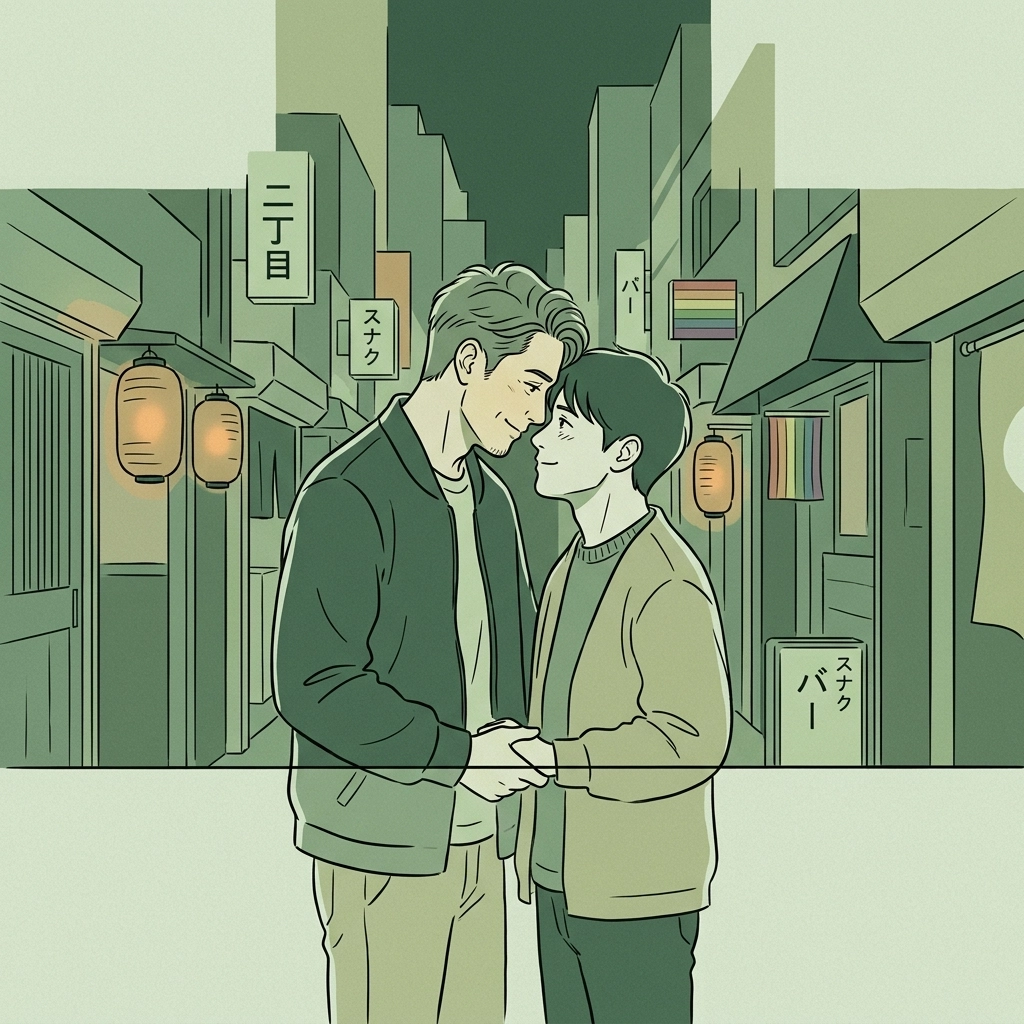
There is a specific kind of silence that exists only in the heart of the world’s busiest city. You find it just past the towering monoliths of Shinjuku Station, where the roar of the Yamanote line fades into a rhythmic hum and the neon glow shifts from corporate gold to a bruised, beautiful purple. This is Shinjuku Ni-chōme. To the uninitiated, it is a grid of three hundred bars packed into a few square blocks. To those of us who have wandered its narrow alleys with a heart full of unspoken questions, it is a sanctuary where the air tastes of charcoal, rain, and the electric possibility of a shared glance.
Finding connection here isn't like finding it in London or New York. It isn’t loud. It doesn't demand your attention with a shout. In Ni-chōme, connection is a whisper, a subtle shift in the atmosphere of a ten-seat bar where the master knows your drink before you’ve even found your stool. It is a place of profound empathy, where the struggle to be seen is met with the quiet dignity of a community that has survived by mastering the art of the unspoken.
The Neon Pulse: Navigating the Labyrinth
Entering Ni-chōme for the first time feels like stepping into a living, breathing MM romance novel. The streets are narrow, the buildings lean in as if sharing secrets, and the signage is a kaleidoscopic array of kanji and rainbow motifs. If you are the Emotionally Invested Reader, you aren't just looking for a drink; you’re looking for a narrative. You’re looking for that moment where the urban chaos gives way to a singular, human heartbeat.
Start your journey on Nakadori, the main artery of the district. In the late spring air of mid-May, the heat of the day has surrendered to a cool breeze that carries the scent of the nearby Shinjuku Gyoen National Garden. It’s a transition point: a bridge between the rigid expectations of salaryman life and the fluid, liberated reality of the "second block."

The Ritual of Visibility: AiiRO CAFE and the Rainbow Torii
Every journey needs a starting point, a place to ground yourself before disappearing into the vertical labyrinths of the bar buildings. For many gay men finding their footing in Tokyo, that place is AiiRO CAFE. Sitting on a corner with its iconic rainbow torii gate, it serves as a beacon.
There is something profoundly moving about a torii gate: traditionally a symbol of the transition from the profane to the sacred: rendered in the colors of our pride. Standing there with a drink in hand, watching the mosaic of identities drift past, you realize that Ni-chōme is a niche event that happens every single night. It is a milestone of the soul to stand in a place where you are the majority, where the internal struggle of "fitting in" finally takes a backseat to the simple act of being.
In my writing, I often explore the "unspoken heart": those feelings that sit heavy in the chest but struggle to find words. At AiiRO, the connection is visual. It’s in the way a stranger holds the door, or the way the bartender catches your eye and offers a small, knowing nod. It’s the first chapter of a story you didn’t know you were writing.
The Architecture of Intimacy: The "Small Bar" Culture
In the West, we are used to sprawling clubs where the bass vibrates in your teeth and you can lose your friends in a sea of bodies. Ni-chōme is the opposite. It is an architecture of intimacy. Most bars here: the "snack bars": are no larger than a walk-in closet. They seat six, maybe eight men.
This physical closeness forces a different kind of connection. You cannot be anonymous when your shoulder is brushing against a stranger’s. You cannot be distant when the "Mama-san" or "Master" (the bar owner) is curating the conversation like a conductor leading an orchestra.
This is where the true depth of the community lies. These tiny rooms are where the gay novels of real life are penned. You’ll find men who have been coming to the same stool for thirty years, their faces etched with the history of a changing Japan. You’ll find the young traveler, wide-eyed and searching, hoping to find a fragment of himself in this neon forest. The internal struggle here is often one of language: not just Japanese vs. English, but the language of the heart. How do you say I am lonely or I am finally home without saying a word?

Sensory Details: A Night in the Life
If I were to write this scene for one of my MM romance books, I would tell you about the condensation on a glass of highball, the way the ice clinks like wind chimes. I would describe the smell of yakitori drifting from a nearby alley, mingling with the expensive, woody scent of a stranger's cologne.
I would tell you about the "Smallness." Everything in Ni-chōme is scaled down to the human level. It’s a contrast to the "Urban/Rural" divide of Tokyo: the city is a giant, but Ni-chōme is a village. You go to a place like Advocates and stand on the street, the boundary between "inside" and "outside" blurred by the laughter of men who have found their tribe.
The connection here is often found in the shared experience of the "after-hours." After 2:00 a.m., when the last trains have long since departed and the "standard" world is asleep, Ni-chōme truly wakes up. The masks come off. The professional hierarchies of Tokyo dissolve. In the dim light of a basement bar, two men can share a story about their families, their fears, and their dreams, knowing that what is said in the "second block" stays in the "second block."
Finding the "One" (Or Finding Yourself)
Many come to Ni-chōme looking for a whirlwind gay love story, a cinematic moment under the cherry blossoms. And while those moments happen, the more profound connection is often with the community itself.
There is a specific resilience in the gay men of Tokyo. To live authentically in a culture that prizes harmony and conformity is an act of quiet revolution. When you sit in a bar in Ni-chōme, you are participating in that revolution. You are part of a gay fiction narrative that is being written in real-time.
For the reader who thrives on high-angst and emotional depth, Ni-chōme offers a masterclass in the "slow burn." It is about the lingering look over a glass of shochu. It is about the courage it takes to ask for a Line ID (the preferred messaging app in Japan) before the sun comes up. It is about the realization that even in a city of 14 million people, you are not alone.

Beyond the Night: The Morning-After Reflection
As the sun begins to bleed over the horizon, painting the skyscrapers of Shinjuku in shades of pale rose and gold, the district changes. The neon flickers out. The streets are cleaned with a meticulousness that is uniquely Japanese.
Walking toward Shinjuku Gyoen National Garden as it opens at 9:00 a.m. provides the perfect "Urban/Rural" contrast. After the cramped, electric intimacy of the bars, the wide-open lawns and ancient trees offer a place to breathe. It’s here that you process the night. You think about the man you spoke to: the one who works in finance but spends his weekends painting: and you realize that every person you met is a volume in a library of LGBTQ+ fiction.
Bringing the Heart Home
Whether you are navigating the streets of Tokyo or the pages of a book, the search for connection remains the same. We are all looking for that "Unspoken Heart": the place where we don't have to explain who we are because the environment already knows.
At eBooks by Dick Ferguson, we believe in those stories. We believe in the power of the MM romance to bridge the gap between our internal struggles and the world around us. If you’ve ever felt like a stranger in a neon city, or if you’re looking for a love story that feels as real and vivid as a rainy night in Shinjuku, I invite you to explore our collection.
You can find my latest works, filled with the same sensory detail and emotional weight I’ve described today, at our store: https://readwithpride.com/e-book-store/dickfergusonwriter/
Ni-chōme is more than a destination; it’s a state of being. It’s a reminder that no matter how niche our lives may feel, there is always a place where the lights are kept on for us.
Three New Blog Post Options for Tomorrow:
- The Ghost of Us: Exploring the "Right Person, Wrong Time" Trope in MM Romance (Deep dive into emotional angst and timing).
- From Cobblestones to Penthouses: How Setting Dictates the Tension in Queer Fiction (A look at urban vs. rural settings in storytelling).
- The Art of the Slow Burn: Why the Best Gay Love Stories Take Their Time (Analyzing pacing and character depth in modern novels).
Follow us on social media:
- Instagram: https://www.instagram.com/dickfergusonwriter
- X (Twitter): https://www.x.com/DickFergus94902
- Facebook: https://www.facebook.com/profile.php?id=61572869844598
- Website: www.readwithpride.com
#ReadWithPride #LGBTQBooks #MMRomance #GayFiction #ShinjukuNichome #QueerTravel #GayNovels #TokyoNightlife #DickFerguson #ReadingWithPride #GayLoveStories #MMFiction #QueerLiterature #GayLiterature #GayMan #GayPride2026

Leave a Reply
You must be logged in to post a comment.