

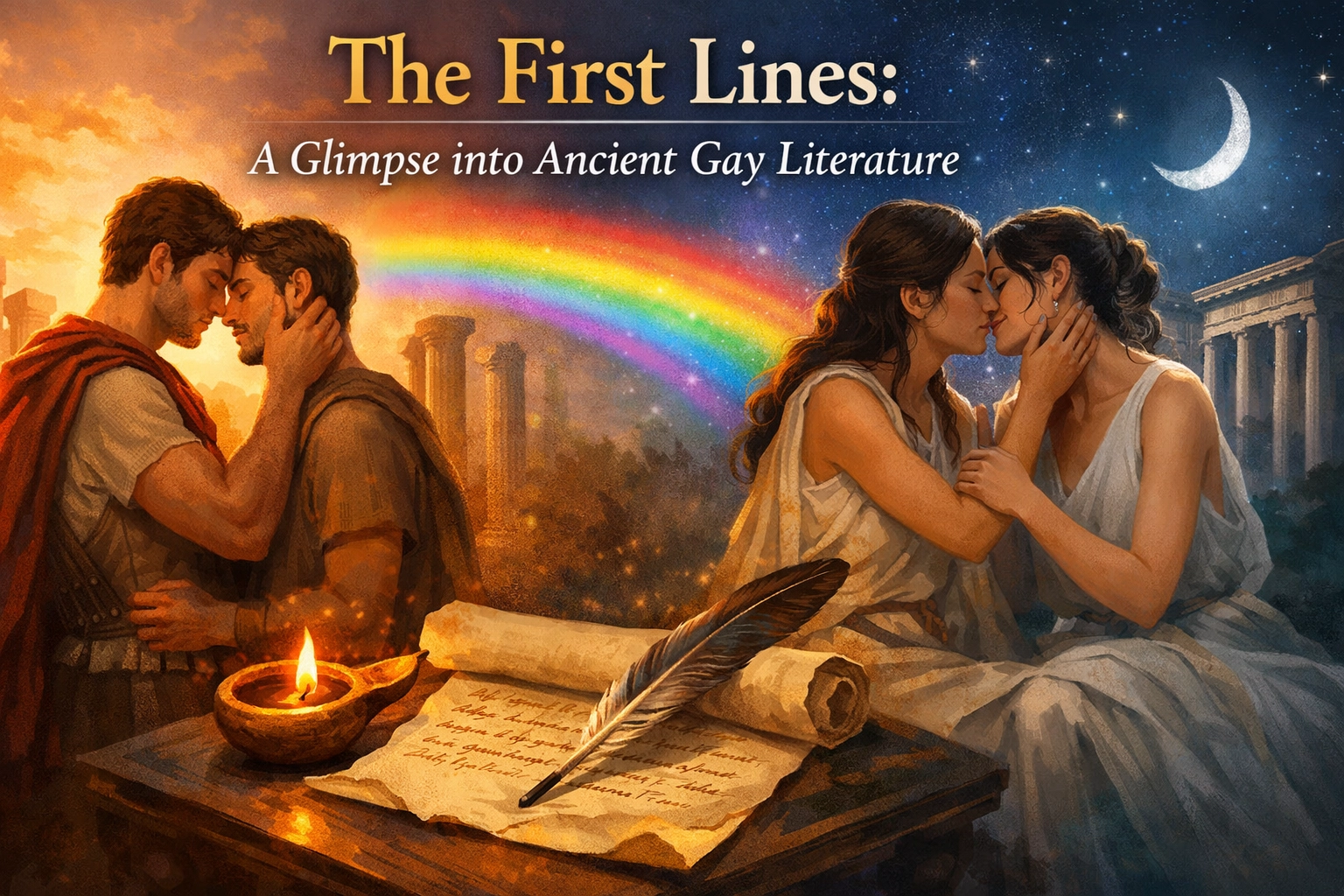
Here's something wild to think about: queer love stories aren't some modern invention. They're not even a Renaissance thing. Nope, gay literature has roots that stretch back thousands of years, all the way to the marble columns and sun-drenched symposiums of ancient Greece and Rome.
Long before we had pride flags, coming-out stories, or MM romance books filling our Kindles, ancient writers were crafting tales of same-sex desire, philosophical debates about love between men, and poetry so steamy it would make your grandma blush. This is where it all began, the very first lines of LGBTQ+ literature.
When Philosophy Met Passion: Plato's Symposium
Let's start with the big one: Plato's Symposium, written around 385–370 BC. If you've never cracked open this ancient text, here's the gist: it's basically a dinner party where a bunch of intellectuals get tipsy on wine and debate the nature of love. And spoiler alert, most of them are talking about love between men.
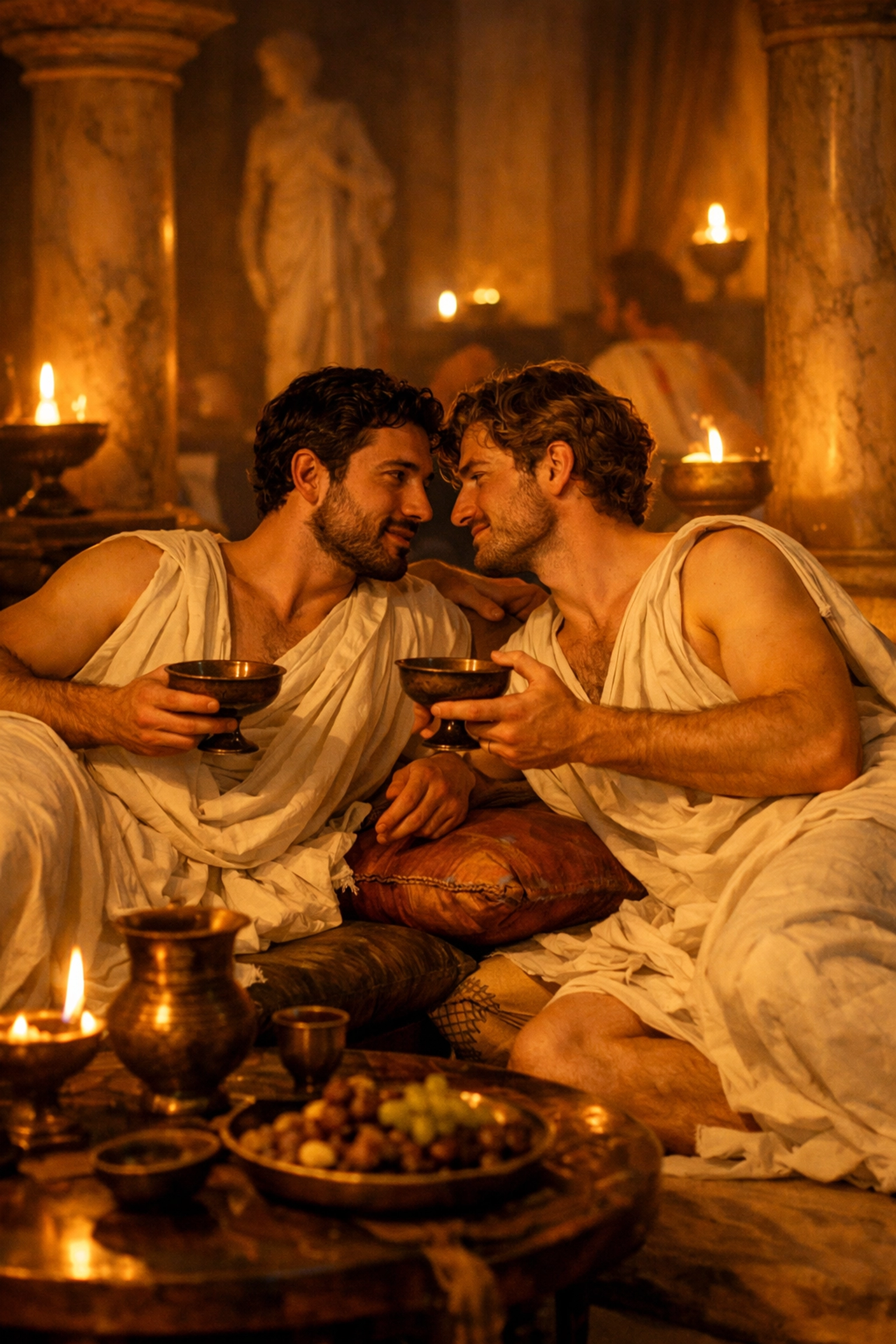
The Symposium isn't just some dusty philosophical text. It's one of the earliest works to celebrate same-sex love as something profound and beautiful. One of the speakers, Phaedrus, even uses the legendary relationship between Achilles and Patroclus as the ultimate example of devotion. In earlier works like Aeschylus's 5th-century BC tragedy The Myrmidons, these two warriors weren't just battle buddies, they were lovers. A surviving fragment has Achilles mourning "our frequent kisses" and their "devout union of the thighs." Yeah, ancient Greek literature didn't do subtlety.
What's revolutionary about the Symposium is how it frames these relationships. It's not scandalous or shameful, it's presented as the highest form of connection, where physical attraction blends with intellectual and spiritual bonds. Sound familiar? That's basically the foundation of modern gay romance novels and MM fiction, the idea that queer love is just as deep, just as meaningful, and just as worth celebrating as any other kind.
Sappho: The Original Queer Icon
You can't talk about ancient gay literature without mentioning Sappho of Lesbos (yes, that's where the word "lesbian" comes from). Writing around 630–570 BC, Sappho crafted poetry so beautiful and so explicitly homoerotic that scholars spent centuries trying to straight-wash her legacy.
For real: historians would bend over backwards to claim she was writing about "friendship" or "mentorship." But come on. When someone writes lines dripping with desire about other women, describing racing heartbeats and trembling hands, that's not friendship. That's love. That's longing. That's the kind of emotional intensity we now celebrate in queer fiction.
Much of Sappho's work has been lost to time (sometimes literally destroyed by people who found it too scandalous), but what remains is powerful. She proved that women loving women deserved poetry, art, and celebration just as much as any heterosexual romance.
Roman Writers: Unapologetically Queer
Ancient Rome took Greek traditions and ran with them. Virgil's Eclogues (1st century BC) features a male shepherd openly proclaiming his love for a younger man: no subtext, no metaphors, just straight-up (or should we say gay-up?) romantic declaration.
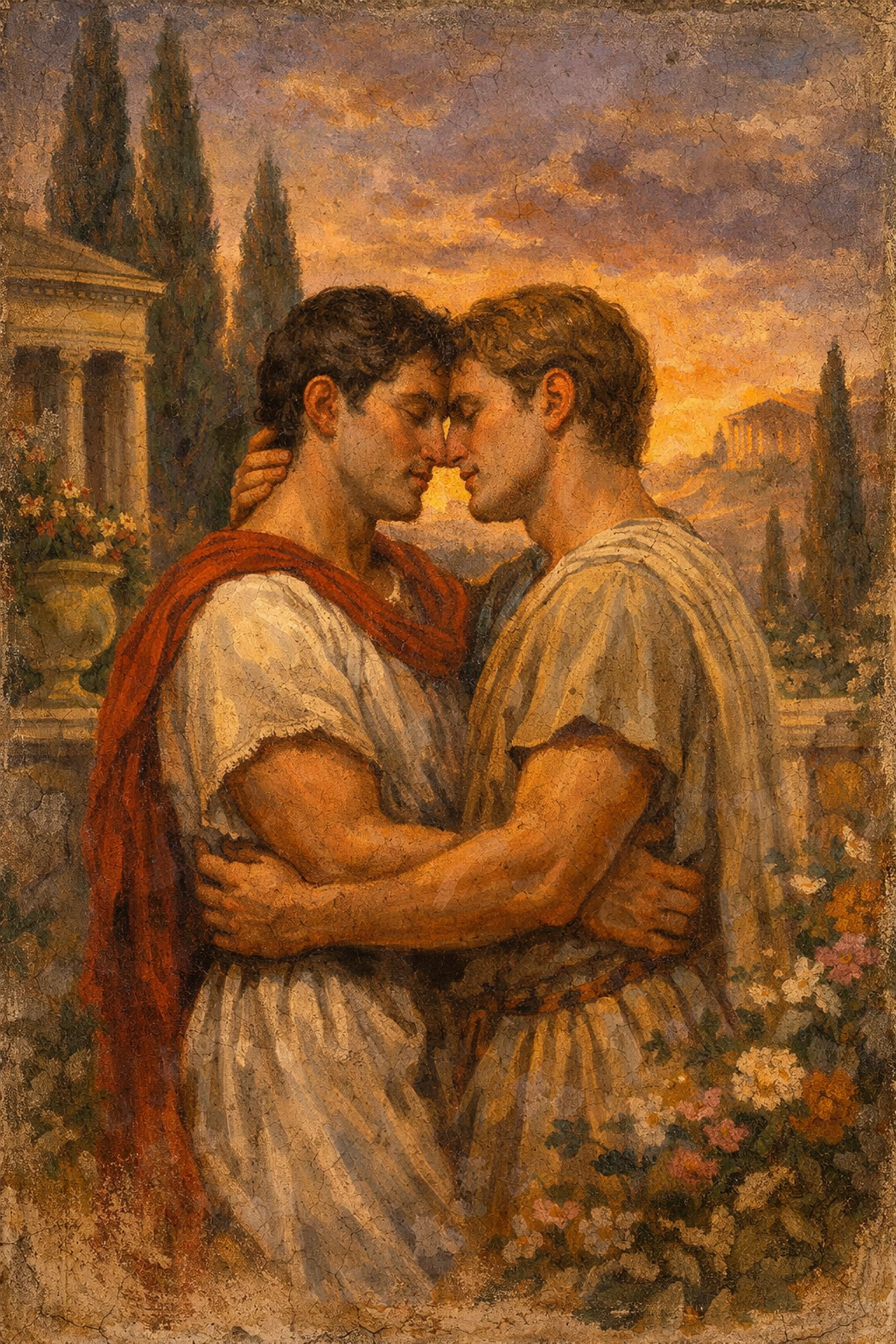
Then there's Petronius's The Satyricon (1st century AD), often considered the earliest known text depicting homosexuality in narrative form. The story follows Encolpius and his young lover Giton through a series of misadventures that are equal parts comedy and drama. Think of it as an ancient road-trip romance: except with more togas and fewer rest stops.
And we can't forget Catullus, whose poetry contains some of the most explicit references to sexual acts between men in classical literature. He wrote with raw honesty about desire, jealousy, and heartbreak: themes that still dominate MM romance books today on ReadWithPride.com.
Beyond the Mediterranean: Global Queer Narratives
While Greece and Rome often dominate discussions of ancient gay fiction, other cultures were telling queer stories too. In Japan's Heian period, Lady Murasaki Shikibu wrote The Tale of Genji (early 11th century), considered by many to be the world's first novel. In it, the protagonist Genji: after being rejected by a woman: sleeps with a young man. It's treated as just another facet of human desire, no big deal.
This casual acceptance of same-sex relationships in ancient Japanese literature shows that queer narratives weren't confined to one corner of the world. Love between men (and sometimes between women, though these stories were documented less frequently) appeared across cultures, each adding their own perspective to the growing tapestry of LGBTQ+ literature.
The Renaissance and Beyond
Fast-forward to the 17th century, and we get Antonio Rocco's Alcibiades the Schoolboy, published anonymously. Some scholars consider it the first homosexual novel, framed as a philosophical dialogue defending same-sex relationships. Rocco used the format of classical Greek philosophy to argue for the legitimacy of male-male love, basically creating gay historical romance centuries before the genre had a name.
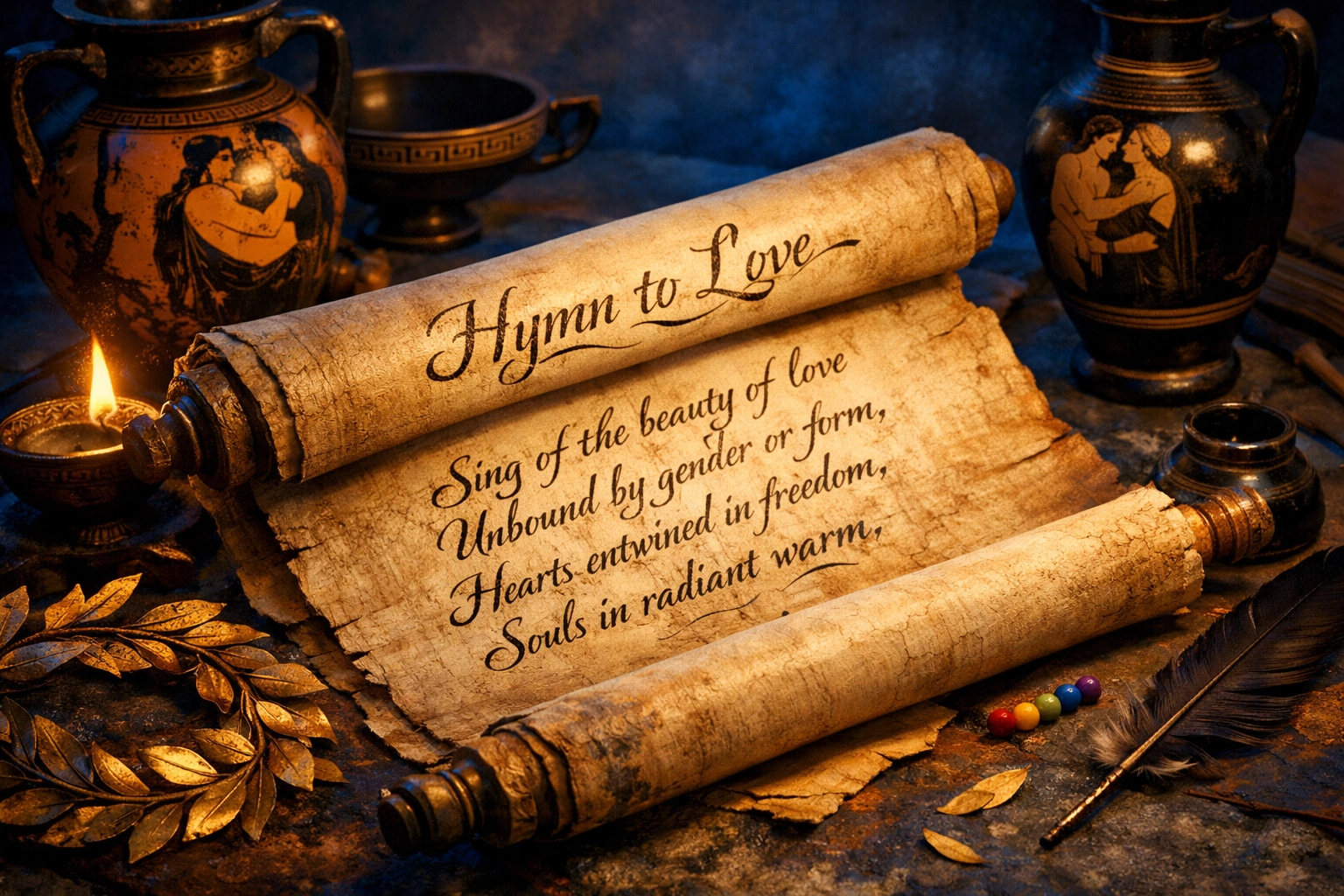
These works laid the groundwork for everything that came after. Every MM contemporary romance, every gay fantasy epic, every tear-jerking gay love story: they all owe a debt to these ancient texts that dared to say, "This love is real. This love is worthy. This love deserves to be written down and remembered."
Why Ancient Literature Still Matters
So why should modern readers care about texts written thousands of years ago? Because they prove something crucial: queer love isn't a trend. It's not a phase. It's not some modern construct invented by Gen Z on TikTok (no shade: we love Gen Z).
Queer love has always existed. It's been celebrated in poetry, debated in philosophy, woven into mythology, and preserved in literature for millennia. When someone tries to claim that LGBTQ+ identities are "new" or "unnatural," you can literally point to texts from 2,500 years ago and say, "Actually…"
For those of us who grew up without representation, discovering these ancient texts can be revolutionary. They connect us to a lineage of queer storytelling that stretches back through the ages. We're not starting from scratch: we're continuing a conversation that began in ancient symposiums and continues today in LGBTQ+ ebooks, book clubs, and online communities.
The Legacy Lives On
Today's thriving world of MM romance, gay romance books, and queer fiction didn't appear out of nowhere. It's the latest chapter in a story that began with Sappho's poetry, Plato's dialogues, and the bold Roman writers who refused to hide their desires.
Modern authors stand on the shoulders of these ancient giants, creating stories that honor the past while pushing into new territory: gay thriller novels, gay psychological thrillers, gay adventure romance, slow burn relationships, enemies to lovers dynamics, and every trope in between.
The best part? We're living in a golden age where anyone can access this literary heritage. Whether you're diving into historical MM romance novels that recreate ancient settings or enjoying contemporary stories that echo those timeless themes of connection and desire, you're part of this unbroken tradition.
Join the Conversation
Want to explore more LGBTQ+ fiction and discover books that celebrate queer love across every genre and time period? Check out ReadWithPride.com for curated collections, new gay releases, and award-winning gay fiction.
Follow us on Facebook, Instagram, and X for daily recommendations, gay book club discussions, and celebrations of both classic and contemporary queer literature.
Because at the end of the day, whether it was written in 370 BC or 2026, great gay literature does the same thing: it tells us we're not alone, we've always existed, and our stories matter.
#ReadWithPride #GayLiterature #MMRomance #LGBTQBooks #QueerFiction #GayRomance #AncientHistory #GayBooks #MMBooks #QueerReads #LGBTQLiterature #GayRomanceBooks #PrideLiterature #BookLovers #LGBTQReading #2026Reads #GayBookClub #MMRomanceBooks #GayNovels

Leave a Reply
You must be logged in to post a comment.