

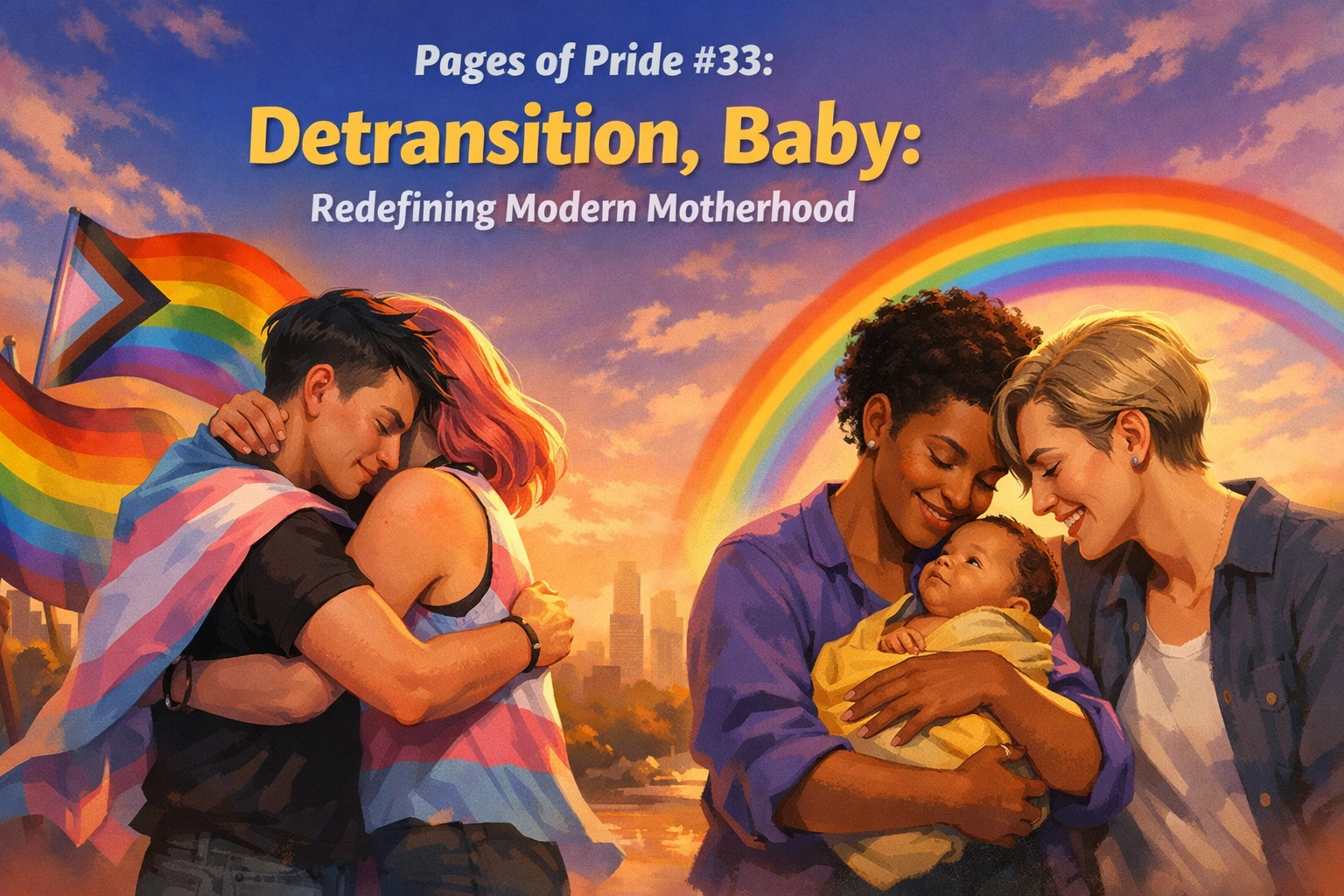
What does it mean to become a mother? For some, it's a biological inevitability. For others, it's a choice, a dream, or an impossibility wrapped in longing. But what happens when motherhood becomes the unexpected connective tissue between three people navigating gender, desire, and the wreckage of past relationships?
Torrey Peters' groundbreaking 2021 novel Detransition, Baby doesn't just ask these questions, it blows them wide open, creating one of the most honest and complex portrayals of trans womanhood and modern family formation in contemporary queer fiction. This is not your grandmother's novel about motherhood. Hell, it's probably not even your cool aunt's version. This is something entirely new.
A Love Triangle With Higher Stakes
At the heart of Detransition, Baby are three unforgettable characters whose lives become unexpectedly intertwined through an unplanned pregnancy. There's Reese, a trans woman who has spent years yearning for motherhood as a path to the legitimacy she feels society denies her. There's Ames, who used to be Amy: Reese's ex-girlfriend who detransitioned back to living as a man and is now entangled in both guilt and privilege. And then there's Katrina, Ames's boss and lover, a pragmatic Chinese-American woman who finds herself pregnant and facing an impossible decision.

When Ames learns Katrina is pregnant, he doesn't do what conventional narratives would suggest. Instead of simply stepping up as the father or walking away, he proposes something radical: What if all three of them: Reese, Ames, and Katrina: raised the baby together? What follows is a deeply human exploration of what family could mean when you throw the heteronormative playbook out the window.
Motherhood as Survival and Identity
Peters doesn't romanticize Reese's desire for motherhood. Instead, she presents it with brutal honesty. For Reese, becoming a mother isn't just about nurturing a child: it's about claiming a piece of womanhood that society tells her she can't have. It's about finding family when you've been cast out of your birth family. It's about survival in a world that often refuses to see trans women as complete.
This complexity is what makes Detransition, Baby essential trans literature. Peters refuses to simplify trans experiences into neat narratives. Reese is flawed, messy, sometimes selfish, and completely relatable. She wants motherhood for all the "wrong" reasons and all the right ones simultaneously. She wants it because she's lonely. She wants it because she thinks it will make her more woman. She wants it because she genuinely believes she could love and care for a child.
The novel asks: Are any of our motivations for parenthood ever pure? And does it matter if the love is real?
Queering the Nuclear Family
What makes this novel particularly revolutionary in the landscape of LGBTQ+ fiction is its refusal to slot characters into recognizable roles. Ames doesn't want to be the "father" in any traditional sense. His detransition complicates everything: he has access to male privilege now, but he also carries the lived experience of being a trans woman. He understands Reese's pain intimately because he lived it, and that shared history creates both connection and resentment.

Katrina, meanwhile, becomes the pivot point. She's not queer, she's not trans, and she's initially bewildered by the proposal. But Peters gives her the space to grapple with what this unconventional family might offer: not just to Reese and Ames, but to her. The novel explores how all three characters might benefit from refusing heteronormative scripts, even if the path forward is terrifying and uncertain.
This is MM romance and queer fiction at its most daring: not because of explicit content or dramatic plot twists, but because it imagines new ways of building family that center queer and trans needs rather than forcing queer people into cishet templates.
The Trans Woman's Perspective We've Been Missing
Let's be real: mainstream literature has not been kind to trans women. When trans characters appear at all, they're often tragic figures, victims, or sidekicks in someone else's story. Detransition, Baby centers trans women: their desires, their community, their complexity: in a way that feels both revolutionary and long overdue.
Peters writes about the specific isolation that white trans women face, the ways that transition can sever family ties, and how that severance creates a desperate hunger for chosen family. She writes about the "trans girl bullshit" that her characters wade through daily: the casual transmisogyny, the dating difficulties, the constant negotiation of space and safety. But she also writes about friendship, humor, resilience, and the messy, beautiful ways that trans women take care of each other.

This is the kind of gay literature and LGBTQ+ fiction we need more of: stories that treat queer and trans experiences as the default rather than the exception, stories that assume the reader understands or is willing to learn the vocabulary of trans life without hand-holding.
Why This Book Matters in 2026
Published in 2021 and longlisted for the Women's Prize, Detransition, Baby arrived at a cultural moment when trans rights were under increasing attack. Five years later, in 2026, that attack has only intensified in many places. Reading this novel now feels both urgent and necessary.
Peters offers no easy answers. The novel doesn't end with a neat resolution where everyone gets what they want. Instead, it honors the difficulty of these choices, the ways that desire and pragmatism clash, and the reality that love doesn't always fix everything. But it also insists that trans women deserve the full complexity of literary representation: the right to be difficult, ambitious, flawed, and fully human on the page.
For readers exploring modern queer fiction and contemporary gay romance, Detransition, Baby represents a significant evolution. It proves that LGBTQ+ books can tackle weighty themes without sacrificing entertainment value, that they can challenge readers while still being deeply readable. Peters' prose is sharp, witty, and occasionally devastating. Her characters live and breathe.
The Ripple Effect
Since its publication, Detransition, Baby has influenced how we talk about trans literature and representation. It's sparked conversations in gay book clubs and queer reading groups about family formation, gender identity, and what we owe each other. It's become required reading for anyone wanting to understand contemporary trans experiences beyond simplified narratives.
The novel also highlights why supporting publishers like Read with Pride matters. We need spaces dedicated to amplifying LGBTQ+ voices, to publishing the gay novels and MM fiction that challenge, comfort, and expand what's possible in queer storytelling. Every purchase of LGBTQ+ ebooks and gay romance books supports an ecosystem that makes room for groundbreaking works like Detransition, Baby.
Reading as Resistance
In an era when trans rights are constantly under threat, when trans books are being banned from libraries, and when trans people are fighting for basic recognition and dignity, reading and celebrating trans literature is an act of resistance. Detransition, Baby doesn't just tell a story: it insists that trans women's stories matter, that their desires for family and motherhood are legitimate, and that their lives deserve the full complexity of great fiction.
Whether you're deep into gay fiction or just beginning to explore queer authors and LGBTQ+ romance, this novel deserves a spot on your reading list. It's not always comfortable, but the best literature rarely is. It pushes, it questions, and it refuses to let readers off easy. And in doing so, it creates space for all of us to imagine what family, love, and parenthood could look like when we dare to dream beyond the default.
Ready to explore more groundbreaking LGBTQ+ literature? Check out our full collection of gay books and MM romance at readwithpride.com.
Connect with our community:
📘 Facebook
🐦 Twitter/X
📸 Instagram
#ReadWithPride #TransLiterature #DetransitionBaby #QueerFiction #LGBTQBooks #ModernQueerFiction #TransRights #GayLiterature #MMRomance #QueerReading #TransVisibility #LGBTQRomance #GayBooks #QueerAuthors #TransStories #PagesOfPride #2026Reading #BookRecommendations #DiverseBooks #GayFiction

Leave a Reply
You must be logged in to post a comment.