

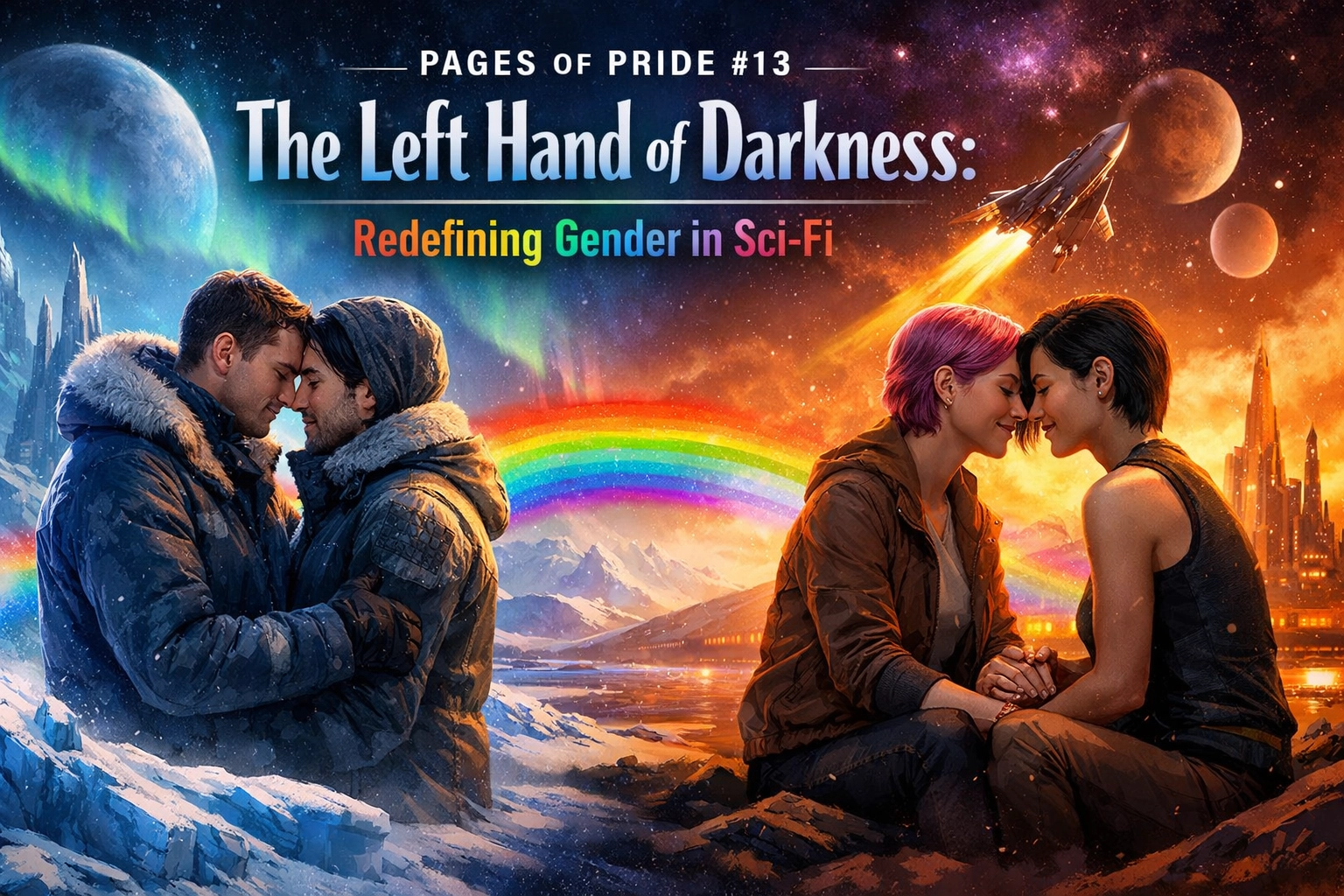
Picture this: It's 1969, and while Stonewall is erupting and changing the world forever, a science fiction novel drops that essentially says, "What if gender… just wasn't a thing?" Before most of us were even thinking about pronouns, Ursula K. Le Guin created an entire civilization where gender fluidity isn't just accepted, it's the biological norm.
Welcome to The Left Hand of Darkness, a book that's been messing with people's minds (in the best way) for over five decades.
The Planet Where Everyone is "They"
Let's talk about Gethen, also called Winter, a frozen planet where the inhabitants are ambisexual beings with no fixed gender. We're not talking about a society that's just progressive or open-minded. We're talking about people who literally have no permanent sex. The Gethenians spend most of their time in a state called "somer," where they're essentially gender-neutral. Then, once a month during "kemmer," they enter a mating phase where they can become either male or female, depending on hormonal and social cues.
Mind. Blown. 🤯
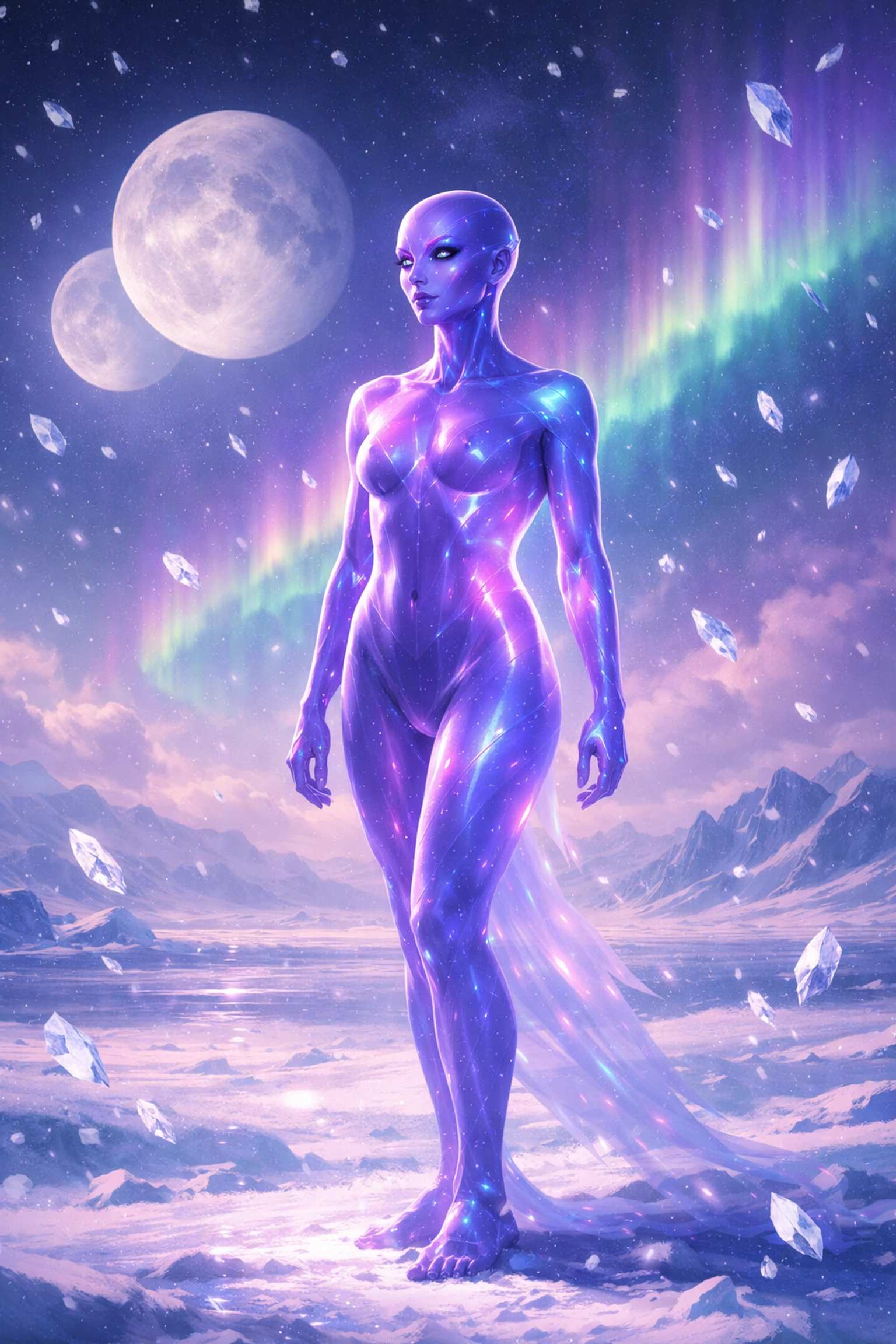
This wasn't Le Guin using gender as a gimmick or a plot twist. This was a serious thought experiment: What happens to society when you remove fixed gender from the equation? What's left of humanity when you strip away the binary?
Spoiler alert: A lot. And also, everything changes.
A Revolutionary Act of World-Building
What makes The Left Hand of Darkness essential queer fiction isn't just that it imagines gender-fluid beings. It's that Le Guin actually thought through the implications. On Gethen, there's no concept of the "weaker sex." There's no rape (because everyone has equal physical strength). There's no enforced gender roles, no "boys will be boys," no glass ceilings. War exists, politics exist, betrayal exists, but they're not tied to testosterone-fueled aggression or feminine manipulation.
The protagonist, Genly Ai, is a human envoy from Earth who arrives on Gethen with all his binary gender baggage intact. He struggles, really struggles, to see the Gethenians as fully human because he can't put them in his mental boxes of "man" or "woman." Watching him fumble through his prejudices is like holding up a mirror to our own world.
Le Guin was basically calling out all of us, decades before it became a mainstream conversation.

When the Author Has a Gender Awakening Too
Here's where it gets really interesting. Le Guin herself had to evolve in understanding what she'd written. In 1976, she wrote an essay called "Is Gender Necessary?" where she sort of downplayed gender's role in the novel, suggesting it was secondary to themes of loyalty and betrayal.
Then, in 1988, she came back and basically said, "Yeah, no, I was wrong. Gender is absolutely central to this story."
She admitted that her original defensiveness came from the criticism she'd received about using masculine pronouns (he/him) for the Gethenians. It was a choice that bothered a lot of readers, and honestly, it bothers many queer readers today. If you're creating a gender-neutral society, why default to masculine language?
But Le Guin acknowledged this limitation and her own biases. That kind of self-reflection and growth? That's what makes her a legend in gay literature and LGBTQ+ fiction. She didn't get it perfect the first time, but she kept thinking, kept questioning, kept pushing boundaries.
Why This Book Matters to Queer Readers
The Left Hand of Darkness arrived at a time when most science fiction was written by men, for men, about men doing manly things in space. Le Guin said "not today" and gave us something completely different: a story about connection, understanding, and the difficulty of loving someone when you can't categorize them.

The central relationship between Genly and Estraven, a Gethenian politician, is one of the most beautiful and complex love stories in science fiction. Is it romantic? Platonic? Something else entirely? Le Guin refuses to give us easy answers. What we get instead is a meditation on what it means to truly see another person when gender isn't there to do the sorting for you.
For anyone who's ever felt like they don't fit the binary, or who's loved someone outside traditional categories, this book gets it. It understands that removing the labels doesn't simplify human relationships: it actually makes them richer, more nuanced, more real.
The Structure That Broke the Mold
Le Guin didn't just revolutionize the content of science fiction: she messed with the form too. The Left Hand of Darkness doesn't follow the typical linear, action-packed structure of most sci-fi from that era. Instead, it weaves together:
- Genly's journal entries
- Official reports
- Gethenian myths and legends
- Historical tales
This post-modern approach prioritizes emotional depth and cultural understanding over space battles and plot mechanics. It's science fiction as anthropology, as philosophy, as poetry. Le Guin was more interested in exploring "improved modes of human relationships based on integration and integrity" than in showing us cool technology.
And you know what? That's exactly what queer sci-fi should do: imagine not just different bodies or identities, but entirely different ways of being human.
The Legacy Lives On
More than fifty years later, The Left Hand of Darkness remains a touchstone for gender-fluid literature and a must-read for anyone interested in how science fiction can challenge our most basic assumptions. It paved the way for authors like Octavia Butler, N.K. Jemisin, and Becky Chambers, who continue to use speculative fiction to explore identity, power, and belonging.

Is the book perfect? No. Le Guin herself would tell you that. The pronoun choices are clunky. Some of the cultural elements feel dated. But it's still essential reading because it dared to ask questions that most people in 1969 weren't even considering.
What is gender, really? How much of what we think is "natural" about men and women is actually cultural? Can you love someone without gendering them? What would society look like if we built it without the binary?
These aren't just academic questions for many of us in the LGBTQ+ community: they're deeply personal. And The Left Hand of Darkness gives us a framework to explore them through the safety of science fiction.
Why You Need This on Your Shelf
If you're building your collection of LGBTQ+ books and gay novels that actually changed the conversation, The Left Hand of Darkness deserves a place of honor. It's not just a good story (though it absolutely is). It's a book that challenges you, frustrates you, and ultimately expands how you think about gender, love, and what it means to be human.
For readers who love MM romance and queer fiction, this book offers something different but equally valuable: a vision of a world where the gender of your partner literally doesn't matter because everyone is potentially every gender. It's a radical act of imagination that still feels fresh today.
So if you haven't read it yet, what are you waiting for? And if you read it years ago, maybe it's time for a revisit. You might be surprised by what you find: both in the book and in yourself.
Discover more groundbreaking LGBTQ+ fiction and celebrate the stories that changed everything at ReadwithPride.com. Because every great love story starts with representation.
Follow us for more literary love:
- Facebook: Read with Pride
- Instagram: @read.withpride
- X: @Read_With_Pride
#ReadWithPride #LeftHandOfDarkness #UrsulaKLeGuin #QueerSciFi #GenderFluidLiterature #LGBTQBooks #QueerFiction #GayLiterature #TransLit #NonBinaryRep #SciFiClassics #LGBTQReads #QueerBookClub #GenderQueer #PagesOfPride #SpeculativeFiction #ClassicSciFi #GayBooks #LGBTQLiterature #QueerCanon

Leave a Reply
You must be logged in to post a comment.