
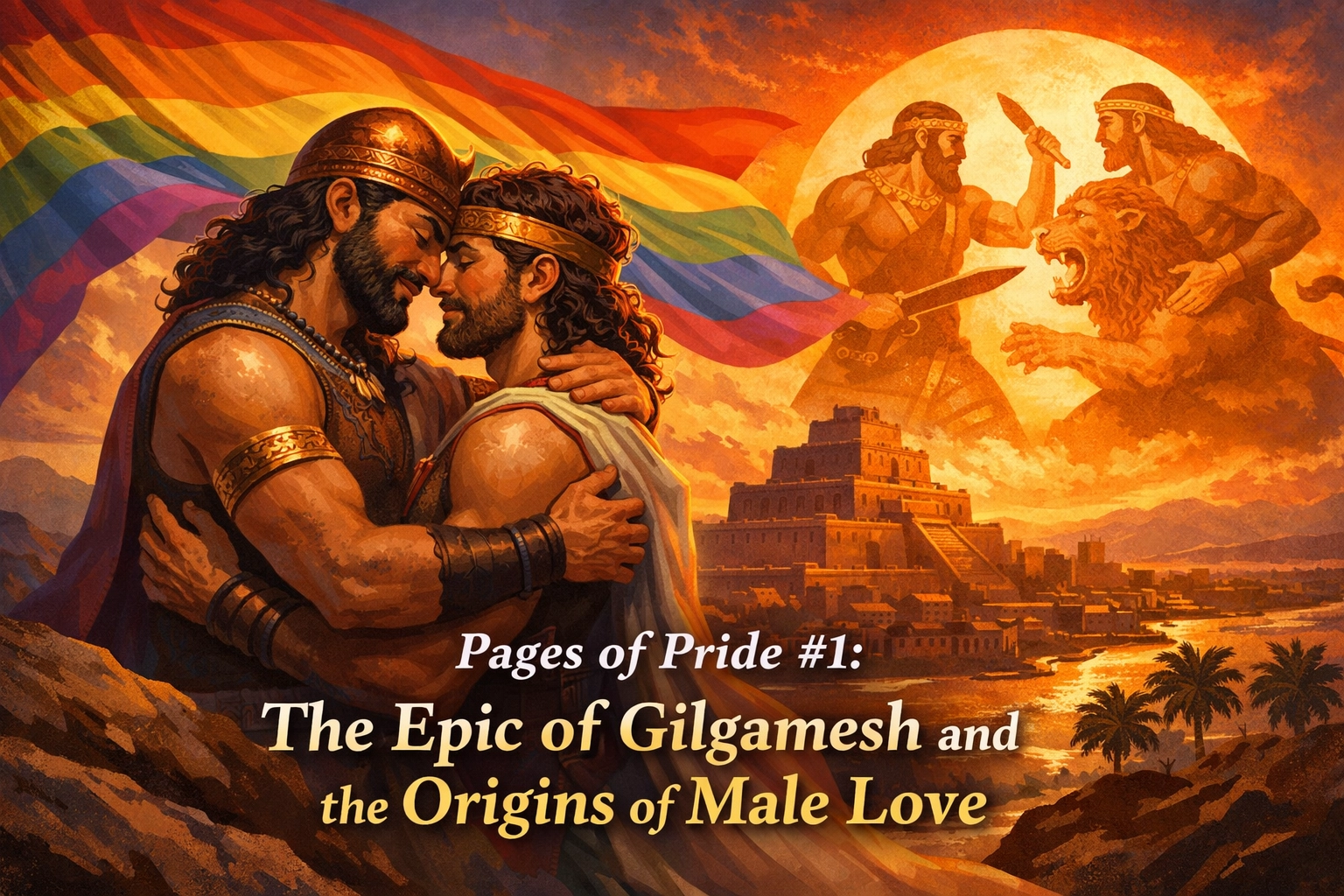
Welcome to Pages of Pride, where we're diving deep into 50 of the most important LGBTQ+ books in history, from ancient epics to contemporary masterpieces. And where better to start than at the very beginning? We're talking about a story written around 2100 BCE, carved into clay tablets in cuneiform script, featuring one of literature's most passionate male bonds. Yeah, the queers have been here since day one.
When Ancient Mesopotamia Gave Us the Original MM Romance
Before there was fanfiction, before AO3, before anyone even invented the printing press, there was The Epic of Gilgamesh. This Sumerian masterpiece isn't just the world's oldest surviving work of literature, it's also one of the earliest explorations of intense male love and devotion in written history.
Sure, scholars love to slap the word "friendship" on it and call it a day. But anyone who's read MM romance knows that when two men meet, fight, become inseparable, complete each other's souls, and one literally grieves himself into a wilderness journey when the other dies… well, that's giving soulmates energy. That's giving "you're the only one who understands me." That's giving historical MM romance novels before romance novels even existed.
The Ultimate Enemies-to-Lovers Arc
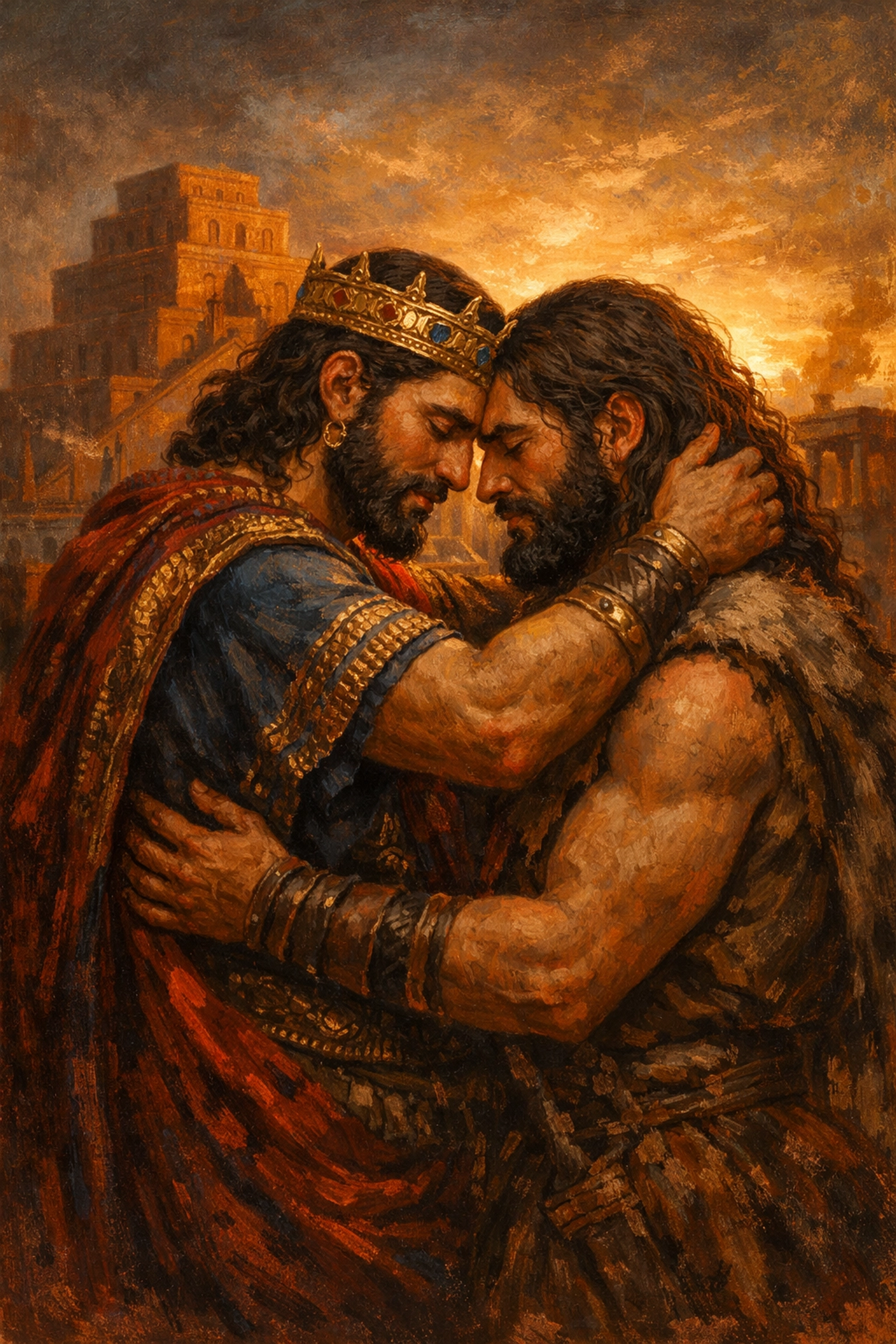
Let's set the scene: Gilgamesh is the king of Uruk, two-thirds god and one-third human (the math doesn't math, but go with it). He's powerful, arrogant, and honestly kind of a tyrant. He's taking whatever he wants, including the brides of his subjects on their wedding nights. The people are suffering, so they pray to the gods for help.
Enter Enkidu, a wild man created by the gods, living with animals, completely untouched by civilization. He's Gilgamesh's equal in strength but his opposite in every other way. When they first meet, they fight in an epic battle that shakes the city walls. And then? They embrace. They become brothers. They become everything to each other.
If that's not the blueprint for every enemies-to-lovers trope in gay romance books, I don't know what is.
"You Are My Other Half"
The text itself is pretty explicit about the depth of their bond. When Enkidu first appears in Gilgamesh's dreams (yes, he's literally dreaming about this man before they even meet), he embraces him "like a wife." Gilgamesh's mother interprets the dream by saying Enkidu will be "a companion who will never forsake you."
Once they meet and become close, they're inseparable. They go on adventures together: fighting the demon Humbaba, slaying the Bull of Heaven. They complement each other perfectly: Gilgamesh's ambition tempered by Enkidu's wisdom, Enkidu's wildness refined by Gilgamesh's civilization. They make each other better, which is exactly what the best MM romance does: two characters who are incomplete until they find each other.
The epic explicitly states that their relationship transforms Gilgamesh from a tyrant into someone capable of empathy and growth. That's the power of love, folks.
A Love That Transcends Death
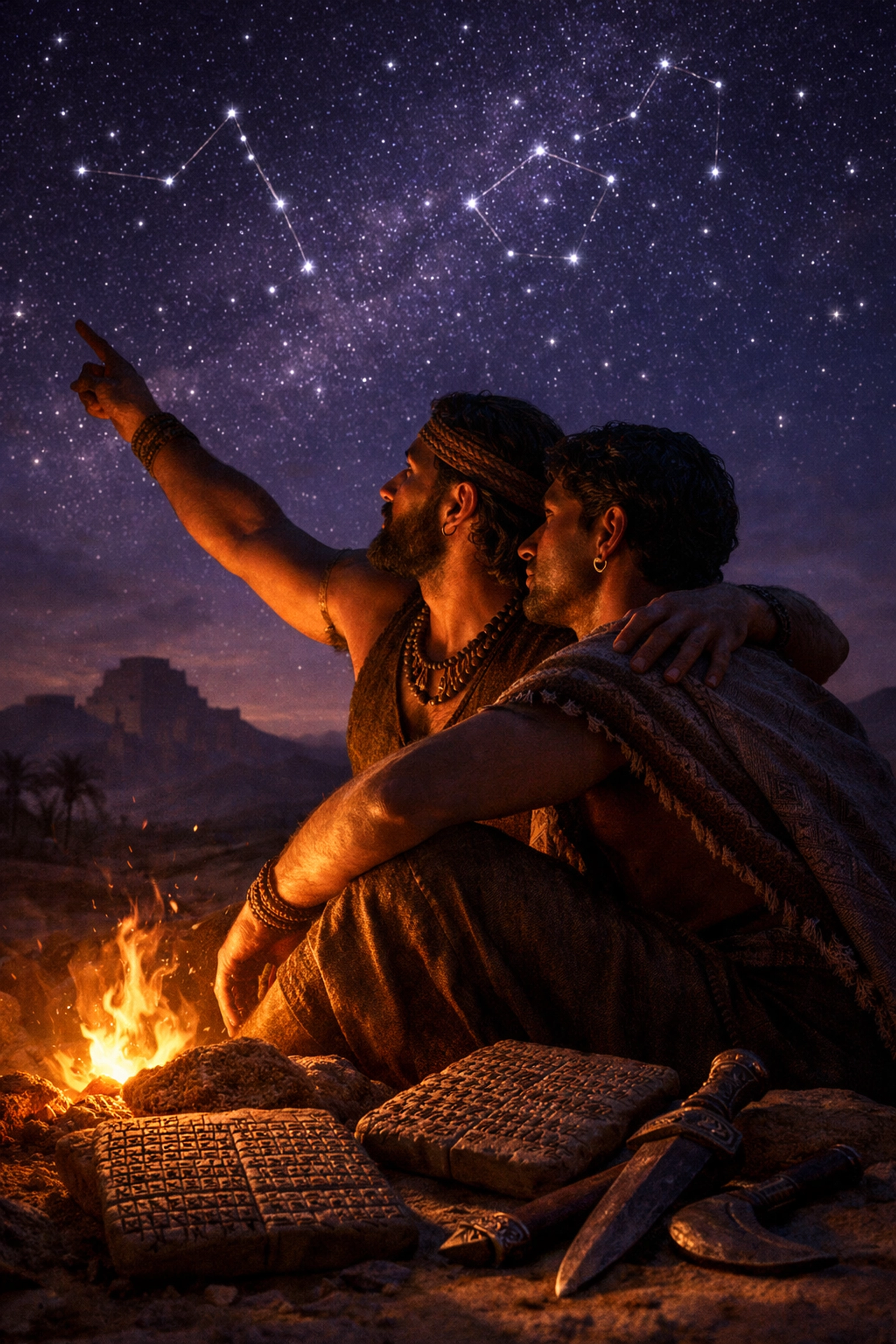
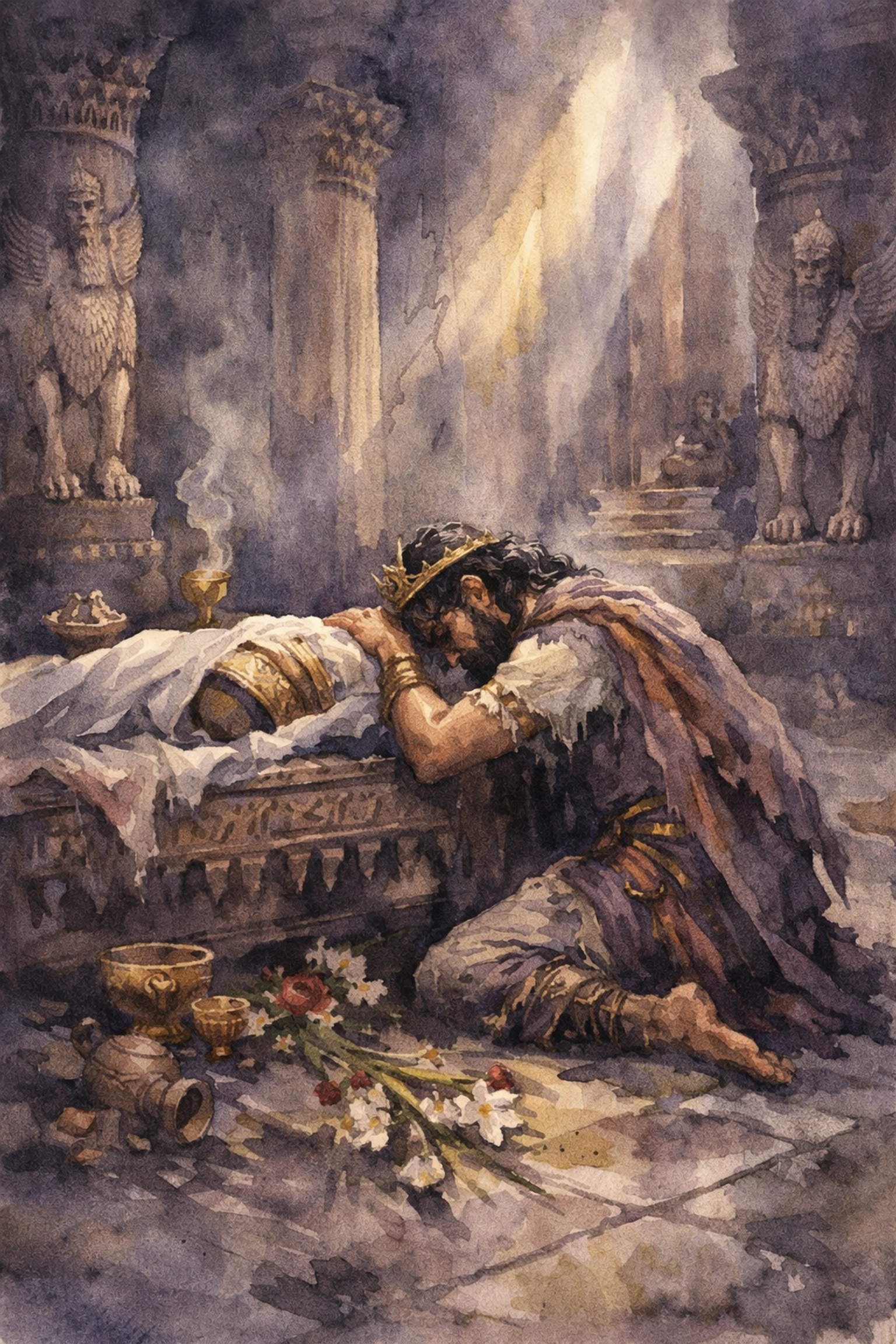
Here's where it gets really heartbreaking. When Enkidu dies (punished by the gods for their hubris), Gilgamesh absolutely falls apart. His grief is so overwhelming, so all-consuming, that he abandons his throne and wanders the wilderness, refusing to accept Enkidu's death.
The text describes Gilgamesh weeping over Enkidu's body for seven days and nights, refusing to bury him until maggots appear. He tears his clothes, tears his hair, and roams like a wild animal. His lament is pure poetry:
"For Enkidu, my friend, I weep like a wailing woman… My friend, whom I loved so dear, who accompanied me through every hardship."
This grief launches Gilgamesh on an existential quest for immortality: not for himself, but because he cannot bear the reality of Enkidu's mortality. If that doesn't sound like the emotional core of every angsty gay love story ever written, I don't know what does.
Friendship or Something More?
Look, ancient Mesopotamia didn't have our modern labels and categories. They didn't have "gay" or "straight" as identities. But what they did have was poetry about male love so intense, so central to the narrative, that it has resonated for over 4,000 years.
Some scholars insist it's "just friendship," pointing to the lack of explicit sexual content. But here's the thing: the ancient world understood that deep emotional and spiritual bonds between men could be just as significant: if not more so: than romantic or sexual relationships with women. The epic itself makes this point when Gilgamesh rejects the goddess Ishtar's advances, having found something more meaningful with Enkidu.
Whether you read their relationship as romantic, erotic, or the deepest of friendships, one thing is undeniable: The Epic of Gilgamesh places male-male love at the absolute center of human experience and transformation.
Why This Matters for LGBTQ+ Literature Today
When we talk about gay literature history, we often start with Oscar Wilde or maybe Greek philosophy. But the roots go so much deeper. The Epic of Gilgamesh shows us that stories about profound male love have been central to human storytelling since the very beginning of literature itself.
For readers seeking LGBTQ+ fiction that connects to our shared human past, for those who love MM historical romance and want to understand its ancient precedents, Gilgamesh and Enkidu are your literary ancestors. Every contemporary MM romance book that explores themes of transformation through love, grief and loss, soulmate connections, and two people becoming better together owes something to this ancient epic.
The fact that this story: this explicitly queer-coded narrative: is considered one of humanity's foundational texts should tell us something important: queer stories are not new, they're not modern inventions, and they've always been essential to human culture.
Reading Gilgamesh Today
Multiple translations exist, though most scholars recommend either the Andrew George or Stephen Mitchell versions for contemporary readers. Fair warning: it's not going to read like your favorite gay romance novels. It's poetry, it's fragmented (we're missing chunks of the tablets), and it's deeply rooted in ancient Mesopotamian cosmology.
But if you can push through the archaic language and cultural differences, you'll find a story that still resonates. The ache of losing someone you love. The fear of mortality. The transformative power of connection. The idea that we are incomplete until we find our other half.
Sound familiar? That's because every MM novel, every gay love story, every piece of queer fiction is telling some version of this ancient truth.
Join Us for 49 More Stories
This is just the beginning of our Pages of Pride series, where we're exploring 50 essential LGBTQ+ books from throughout history. From ancient epics to cutting-edge contemporary fiction, we're celebrating the texts that shaped queer literature and continue to inspire gay authors and readers today.
Next week, we'll be diving into Classical Greece and the poetry of Sappho: because if we're starting with male love, we need to balance it out with the OG lesbian icon.
Want more queer literary deep dives and MM romance recommendations? Follow us on Instagram, Facebook, and Twitter/X, and explore our collection of contemporary gay romance books and LGBTQ+ ebooks at ReadWithPride.com.
Because whether it was written 4,000 years ago or published in 2026, great MM fiction tells us the same truth: love between men has always existed, has always mattered, and has always been worth celebrating.
#ReadWithPride #MMRomance #LGBTQBooks #GayLiterature #EpicOfGilgamesh #QueerHistory #GayRomanceBooks #HistoricalMMRomance #LGBTQFiction #QueerLiterature #GayBooks #MMBooks #LGBTQReading #GayLoveStories #PagesOfPride #AncientQueerHistory

Leave a Reply
You must be logged in to post a comment.