

readwithpride.com
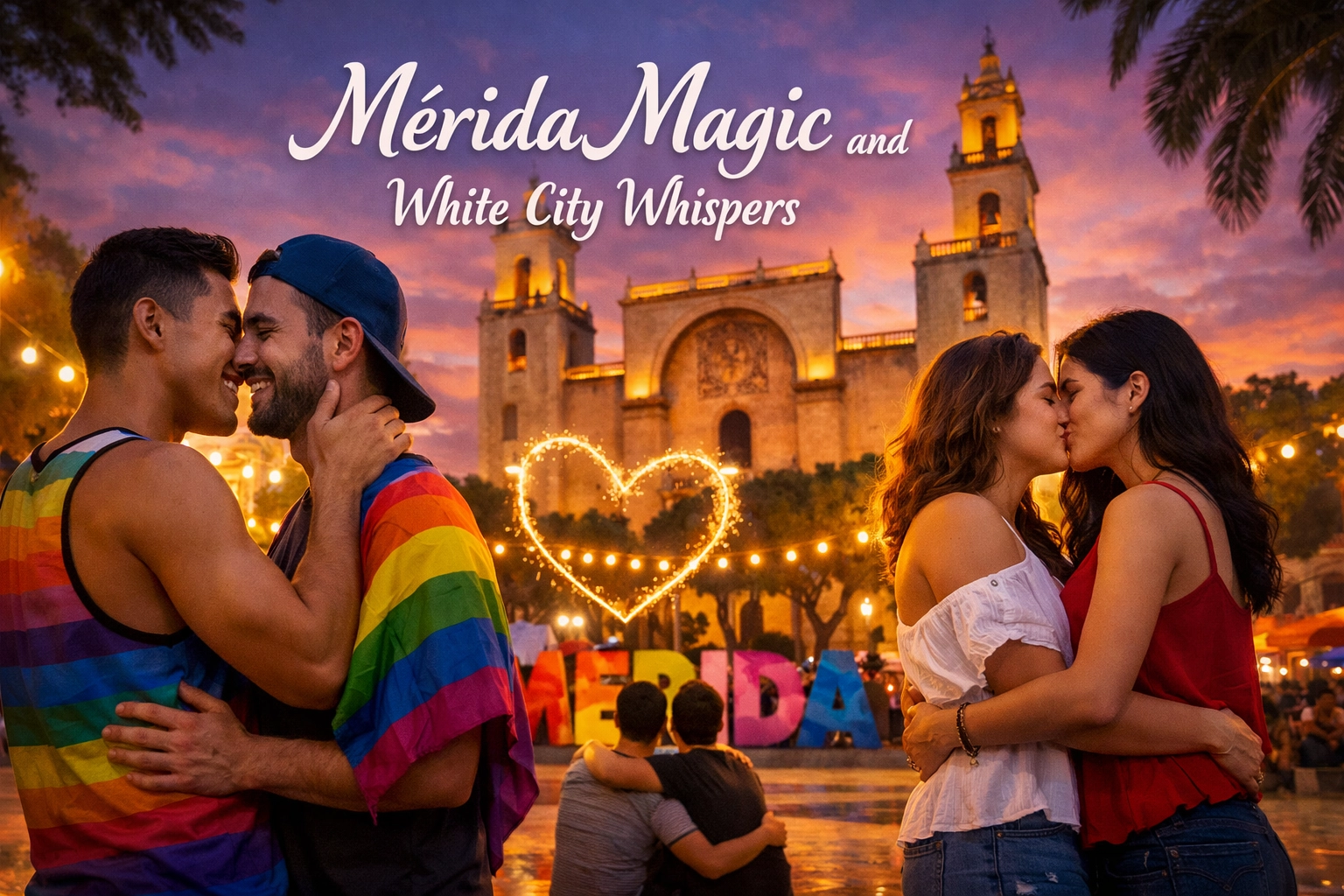
The Yucatán sun had a different quality to it: softer somehow, like it understood the art of taking its time. That's what drew Marcus to Mérida in the first place. After two years of bouncing between Mexico City's frenetic energy and Guadalajara's sprawling chaos, he needed somewhere that breathed at a human pace. The "White City" promised colonial charm, Mayan heritage, and reliable wifi. What it didn't advertise in the digital nomad forums was Diego.
Finding Connection in Plaza Grande
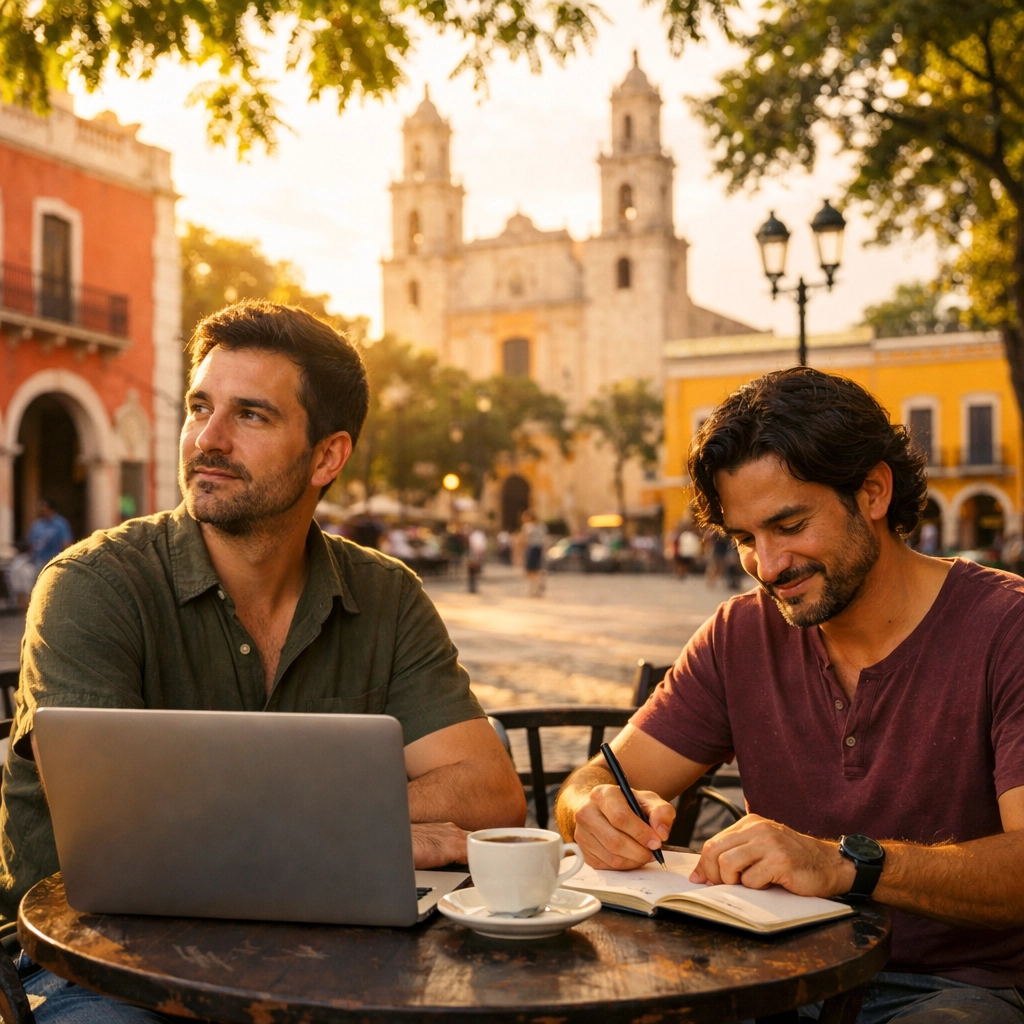
Marcus first spotted him on a Tuesday evening at Plaza Grande, the city's beating heart where locals and travelers converge under the shade of laurel trees. Diego was sketching something in a weathered notebook, completely absorbed, his dark hair falling across his forehead. Around them, the square pulsed with its usual rhythm: street vendors calling out, families strolling, the 16th-century Cathedral de Mérida standing sentinel with its honey-colored stones that once belonged to an ancient Mayan city.
"You're drawing the cathedral," Marcus said, immediately regretting how obvious it sounded.
Diego looked up, and his smile carried no judgment. "Actually, I'm drawing the shadow it casts. The way it changes throughout the day: it's like watching time move."
That simple observation cracked something open. They talked until the Friday night light show began, the cathedral's facade illuminating in vibrant colors while a narrator recounted centuries of history. But Marcus was barely listening to the presentation. He was listening to Diego explain how Mérida had always been a place of layers: Mayan foundations beneath Spanish conquest, tradition wrapped in progress, and yes, a growing queer community finding its voice in Mexico's most traditional corners.
The Artist's Mérida
Diego wasn't just a local artist: he was a curator of Mérida's LGBTQ+ story, the one that didn't make it into tourist brochures. Over café de olla at a corner spot near Parque Santa Lucia, he explained how the city had changed in the last decade. Gay couples could walk down Paseo de Montejo holding hands without the hostility that lingered in smaller Yucatecan towns. Pride celebrations had grown from whispered gatherings to legitimate events. Certain venues along Calle 60 had become known as safe spaces, though you still had to know which ones.
"It's not perfect," Diego admitted, stirring his coffee. "But Mérida is kinder than people expect. Maybe it's the heat: too exhausting to maintain that much hatred."
Marcus appreciated the honesty. After visiting gay scenes in New York, Toronto, and Mexico City for this series he was documenting, he'd grown tired of cities that presented themselves as queer utopias while hiding their complications. Mérida didn't pretend. It was a place still figuring itself out, which made it strangely authentic.
The friendship: if that's what they were calling it: developed in the spaces between tourist attractions. They explored the Gran Museo Del Mundo Maya together, where over a thousand artifacts told stories of a civilization that understood gender and sexuality differently than the conquistadors who tried to erase it. They wandered through the historic arches: Arco de San Juan, Arco de Dragones, Arco del Puente: each one marking old boundaries that no longer held meaning.
Cenote Confessions
Their real conversation happened at Cenote X'batun, about forty minutes outside the city. The sacred Mayan sinkhole opened like a turquoise eye in the limestone, its water so clear you could see ancient rock formations thirty feet down. They'd taken Diego's beat-up sedan, windows down, regional música blasting, and for the first time in months, Marcus wasn't checking his phone every five minutes.
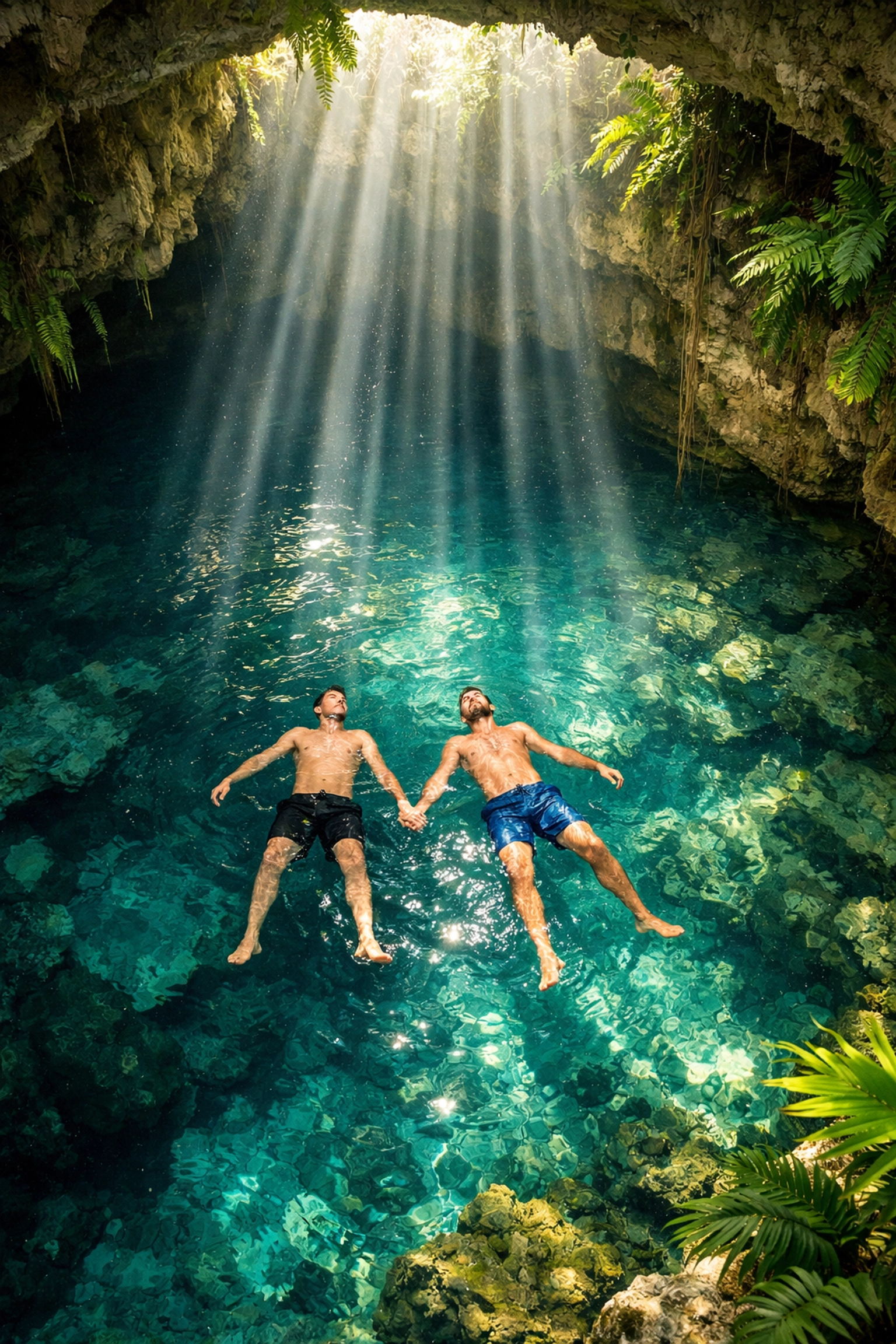
Floating in that impossibly blue water, Diego finally asked what Marcus was really doing in Mérida.
"I'm a writer," Marcus said. "Documenting gay life across major North American cities. Started as a blog series, but it's becoming something bigger. A book, maybe. Or just proof that we exist everywhere, not just in the expected places."
"And what are you finding here?"
Marcus thought about it, treading water, watching light dance across Diego's shoulders. "Something quieter. Less performative. In New York, there's this pressure to be loud about everything, to claim space aggressively because it can be taken away. But here… I don't know. It feels different."
Diego swam closer. "We're loud in our own ways. We just do it at a different volume."
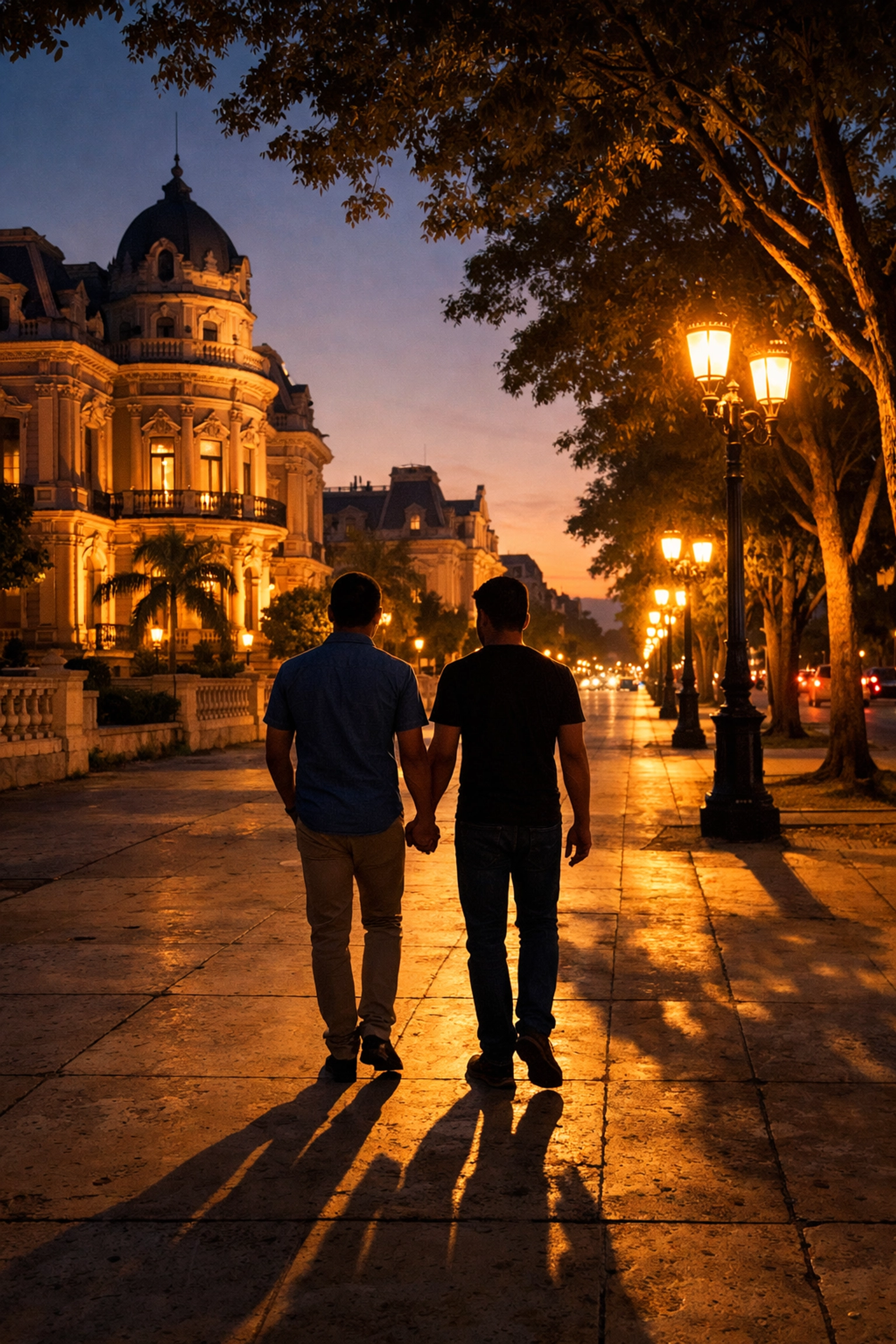
That night, walking back through Mérida's centro histórico, they held hands. Just briefly, crossing the street near the Monumento a La Patria: that impressive sculpture with over three hundred hand-carved figures depicting Mexican history. Nobody stared. Nobody cared. It was the kind of quiet radical act that would've been front-page news in Diego's childhood but now barely registered.
Paseo de Montejo Evenings
The thing about falling for someone in a temporary situation is that it makes everything sharper. Marcus had three weeks left in Mérida before his next destination (Miami, then Ottawa, completing the series). Diego had a gallery showing coming up, featuring his "Shadows of Mérida" collection: the work Marcus had interrupted that first day in Plaza Grande.
They made the most of borrowed time. Evening strolls down Paseo de Montejo became ritual, that tree-lined boulevard where French-inspired mansions told stories of old wealth and new museums. Diego pointed out which buildings had belonged to henequén barons: the "green gold" that made Mérida rich: and which ones now housed art collectives where queer artists could actually show their work.
"That one," Diego gestured to a particularly grand mansion, "used to be owned by a man who had a male 'secretary' living with him for thirty years. Everyone knew. Nobody said anything. That was the deal back then: don't make noise, don't exist too loudly, and we'll pretend we don't see you."
"And now?"
"Now we make noise. We exist. We're still figuring out how much space we're allowed to take up, but at least we're trying."
The Gallery Opening
Diego's opening fell on Marcus's second-to-last night in Mérida. The gallery was a converted colonial home off Calle 60, its thick walls keeping the interior cool while outside the street had closed to vehicle traffic, transforming into a pedestrian wonderland of restaurants and shops.
The "Shadows of Mérida" collection was stunning: each piece capturing how light and darkness interacted with the city's architecture throughout the day. But there was one piece Marcus hadn't seen before: a digital print titled "El Nómada," showing a solitary figure at a café, laptop open, but his gaze fixed on something beyond the frame.
"That's not very subtle," Marcus said when he found Diego accepting congratulations from a small crowd.
"I'm an artist, not a spy." Diego's smile was nervous. "Did I capture you accurately?"
Marcus studied the piece again. The figure looked contemplative, a little lonely, but also present in a way Marcus recognized. "Yeah. Maybe too accurately."
They stayed at the gallery until closing, then walked to a late-night taqueria where the owner knew Diego by name and didn't blink at two men sitting closer than friendship required. Over tacos al pastor and Coca-Cola in glass bottles, they finally addressed the elephant that had been following them around for three weeks.
"I don't know how to do this," Marcus admitted. "The long-distance thing, the uncertainty. I've got fifteen more cities to visit. You've got your life here, your work."
Diego wiped salsa from his mouth. "I'm not asking you to stay. I'm not even asking for promises. But I am asking you to remember that Mérida isn't just a chapter in your book. It's my home. And for a few weeks, you were part of it."
White City Wisdom
Marcus's last morning in Mérida, Diego took him to see the sunrise from the rooftop of his studio apartment. The whole city spread out below them, white buildings glowing pink in the early light, church bells beginning their morning chorus.
"You know why they call it the White City?" Diego asked.
"The limestone buildings."
"That's the tourist answer. But some of us like to think it's because Mérida is a blank canvas. You can write your own story here: queer, straight, local, foreign. The city doesn't judge as harshly as other places. It just asks that you show up honestly."
Marcus left that afternoon with a suitcase full of photographs, pages of notes for his series, and Diego's email address carefully saved in three different places. They didn't make dramatic promises. They didn't pretend the goodbye was anything other than what it was: two people whose paths had crossed beautifully and might not cross again.
But six months later, when Marcus finally compiled his North American series into a manuscript, the Mérida chapter remained his favorite. Not because of the cenotes or the museums or even the vibrant LGBTQ+ scene he'd discovered in unexpected corners. But because Diego had been right: Mérida was a place that let you show up honestly, and in doing so, taught you something about who you actually were.
The White City kept its secrets, but it also knew when to let light in.
Exploring gay romance and LGBTQ+ fiction through authentic stories matters now more than ever. At Read with Pride, we're committed to sharing diverse queer narratives from around the world. Whether you're into MM romance books, heartfelt gay love stories, or contemporary queer fiction, there's a story waiting for you.
Follow us on Facebook, Instagram, and X for more LGBTQ+ content and book recommendations.
#ReadWithPride #MMRomance #GayRomance #LGBTQFiction #QueerTravel #MeridaMexico #GayMexico #MMRomanceBooks #GayLoveStories #QueerFiction #LGBTQTravel #GayLifestyle #PrideStories #AuthenticQueerVoices #MMContemporary #GayBooks2026

Leave a Reply
You must be logged in to post a comment.