

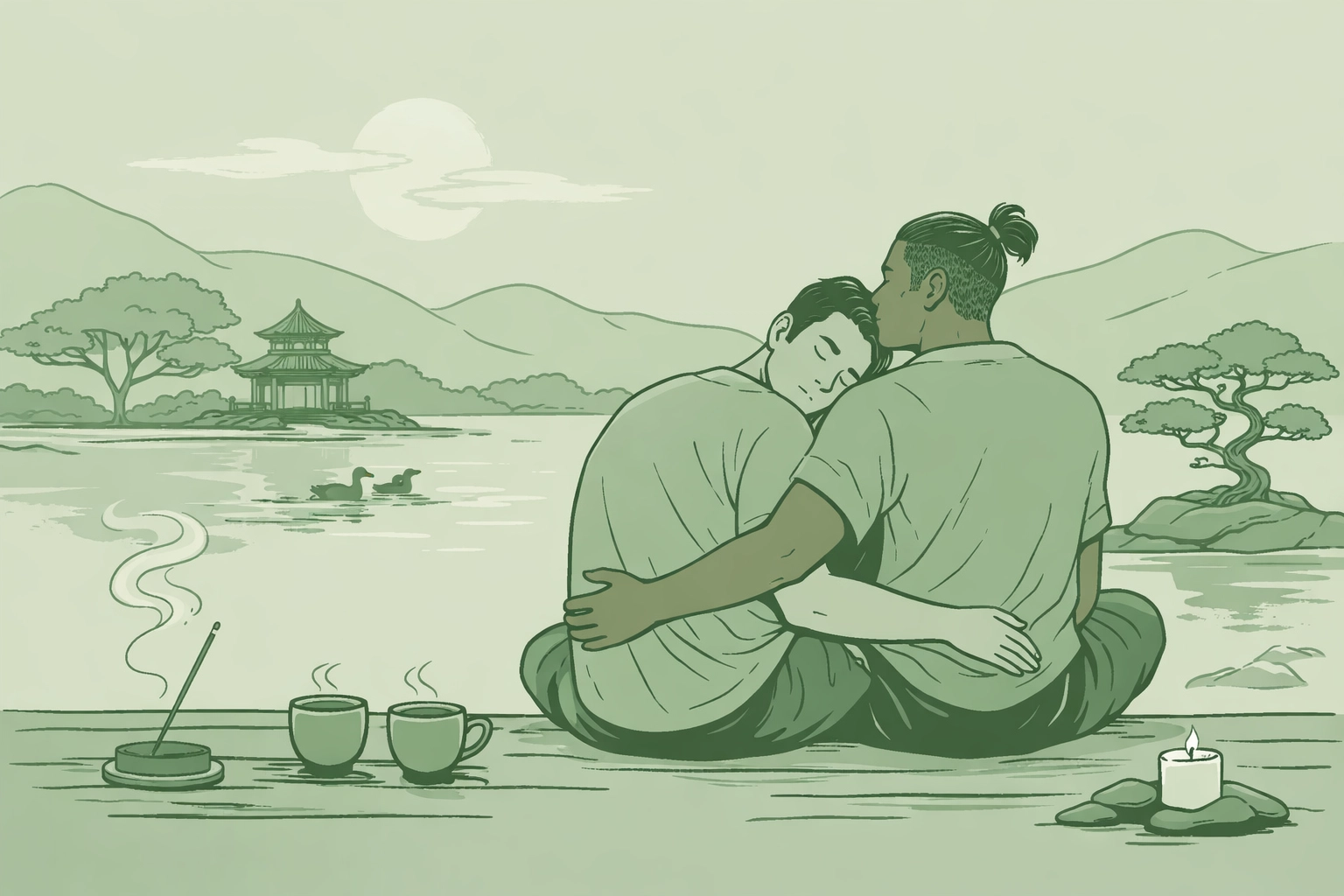
There's something profoundly queer about the practice of waiting. Not the passive, resigned waiting of a closet door never opened, but the active, deliberate patience of zazen: of sitting with what is, breathing into the space between what you feel and what you dare to speak.
In rural Japan, where tradition moves like mountain mist: slowly, pervasively, quietly: two men might live entire lifetimes in the charged silence between friendship and something deeper. Their story unfolds not in dramatic declarations or stolen kisses behind festival stalls, but in the incremental opening of hearts that have been taught, cell by cell, to remain closed.
This is the art of the slow burn. This is Zen made flesh.
The Middle Way Between Desire and Denial
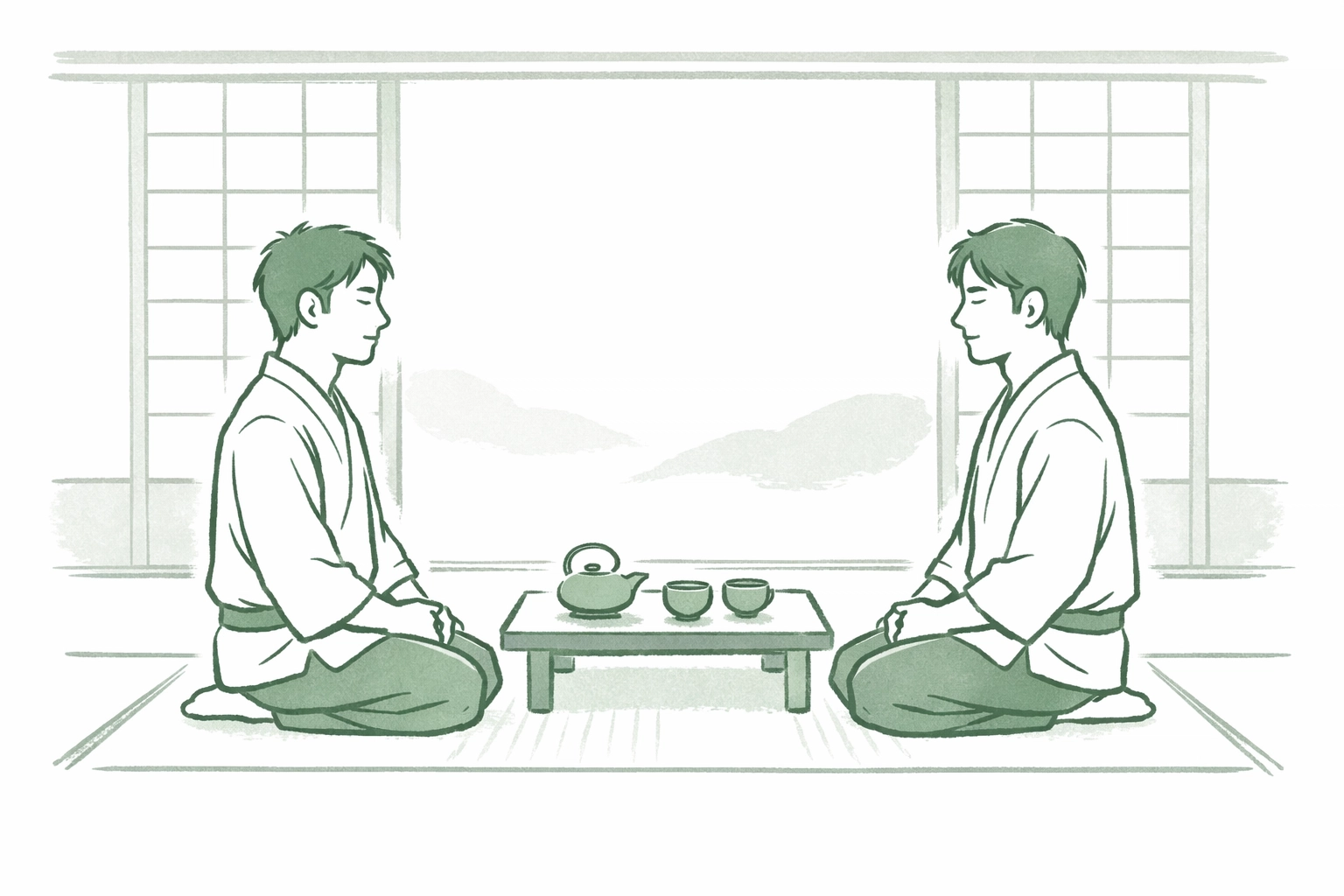
Zen Buddhism teaches the Middle Way: neither grasping desperately toward enlightenment nor avoiding the work entirely. For Kenji and Takeshi, childhood friends in a village where everyone knows everyone's business, this middle path manifests differently. It's the space between pretending their feelings don't exist and burning down their entire lives to pursue them.
Kenji tends his family's tea fields with the same meticulous attention he brings to zazen. Each morning at 4 AM, he sits in the small shrine room his grandfather built, breathing into the knot of longing that has lived in his chest since he was seventeen and realized he'd never look at women the way other men did. He breathes into it. Doesn't push it away. Doesn't act on it recklessly.
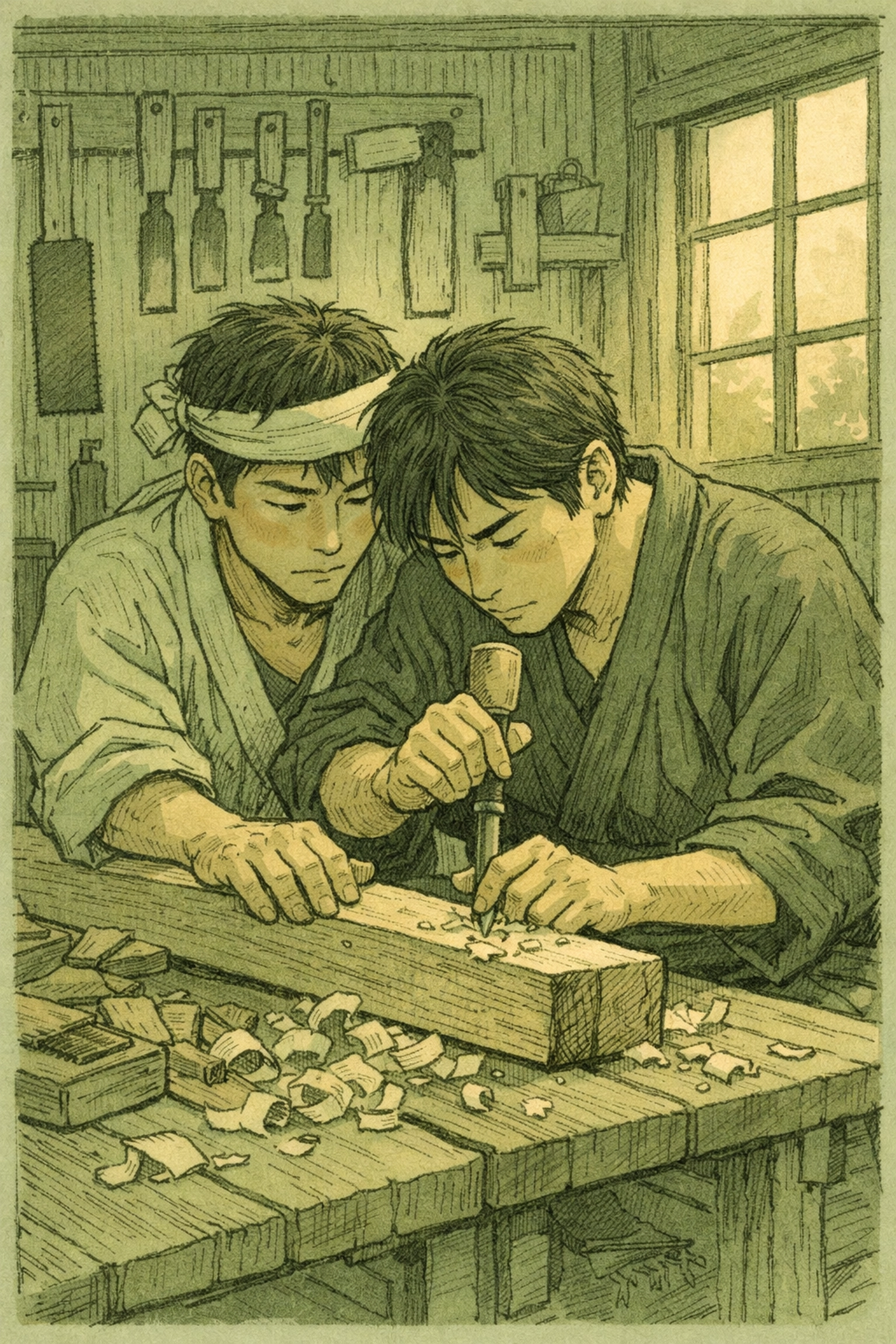
Takeshi, who returned to the village after a failed life in Osaka: failed marriage, failed salary job, failed attempts to be someone he wasn't: practices his own form of meditation in the carpentry shop. The smell of hinoki wood. The precise angle of chisel against grain. The slow transformation of raw material into something beautiful and functional.
They drink tea together every Sunday. They have for fifteen years.
Neither has ever said the word "love" aloud.
This patience isn't passivity: it's profound respect for the complexity of their situation. In MM romance and gay fiction, we often celebrate the explosive coming out, the defiant kiss, the running away together. But for many gay men, especially in traditional communities, the reality is subtler. The love is no less real for being quiet.
Tanden Energy and the Body's Wisdom
In Zen practice, tanden: the energy center located in the lower belly: is considered the source of physical and spiritual power. Opening this energy takes years of patient breathwork and meditation. You cannot force it. You can only create conditions for it to unfold naturally.
The same is true for Kenji and Takeshi's relationship.
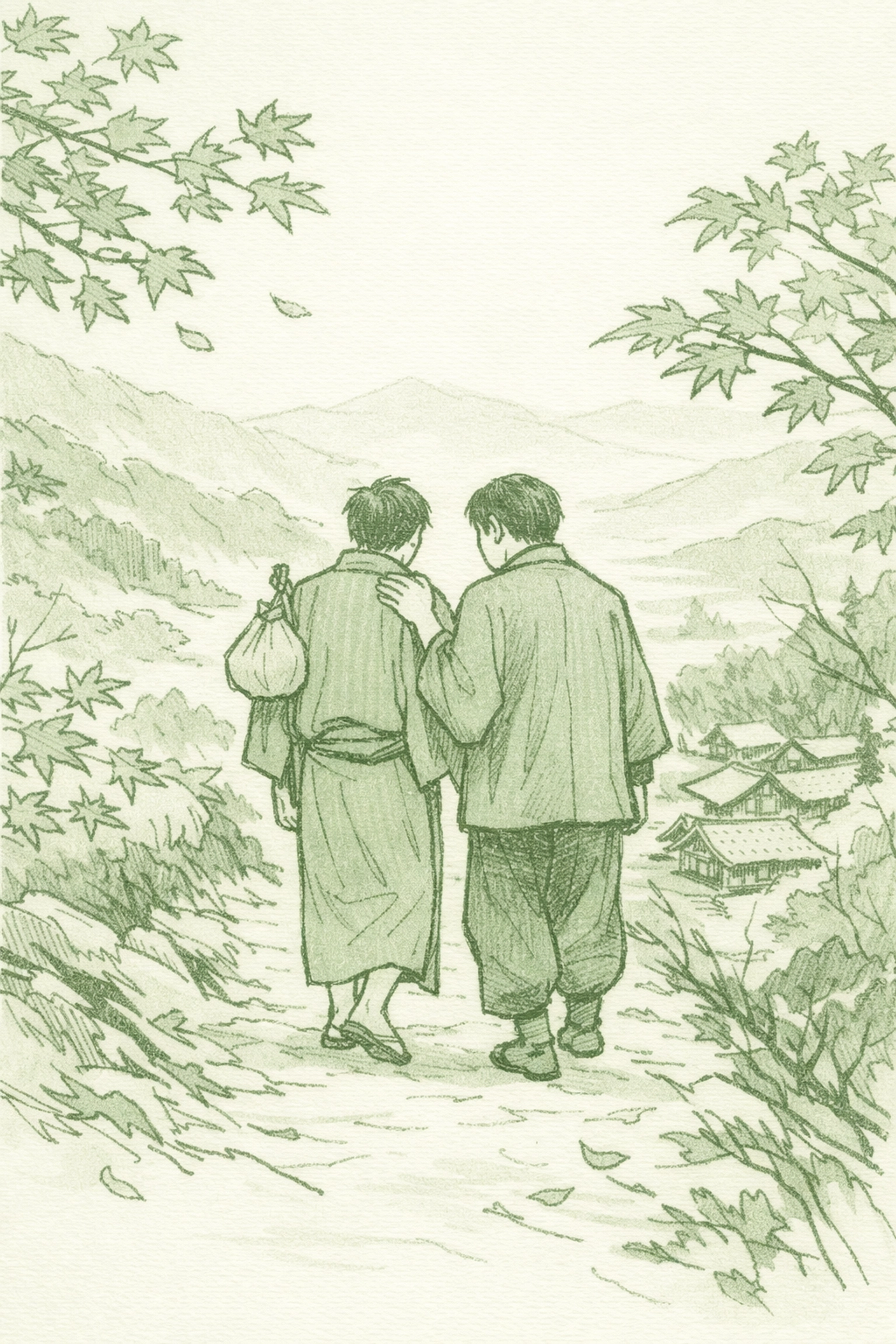
There are moments when the energy between them becomes almost unbearable. Takeshi's hand steadying Kenji's shoulder as they navigate a steep path during mushroom season. The way their knees touch under the kotatsu in winter, neither moving away. The night of the summer matsuri when, drunk on sake and proximity, Takeshi's fingers brushed Kenji's wrist and stayed there for three full seconds.
Three seconds. An eternity.
In gay romance books and queer fiction, these micro-moments often get overlooked in favor of grand gestures. But for men like Kenji and Takeshi: for many gay men navigating traditional cultures: these small openings are everything. They're the cell-by-cell transformation Zen describes. The body learning to hold more truth than the mind believes is safe.
Their love story doesn't unfold through dramatic plot devices. It unfolds through the gradual lowering of defenses. Through Takeshi finally mentioning, casually, why his marriage failed ("I couldn't make myself want her"). Through Kenji, one autumn evening, describing the loneliness he's carried since adolescence. Through the slow realization that they're describing the same loneliness to each other.
This is honne: true feelings: emerging after decades of tatemae: public facade.
Process Over Results: The Zen of Simply Being
Zen masters teach that enlightenment isn't a destination but a practice. You don't sit zazen to achieve something; you sit because sitting itself is the point. The process is the outcome.
What if we applied this wisdom to love? Particularly to gay love in contexts where happily-ever-after might never look like mainstream romance promises?
Kenji and Takeshi may never marry. They may never even explicitly acknowledge what they are to each other. Their families expect both to carry on lineages neither can authentically continue. The village has no framework for understanding two middle-aged men who are clearly more than friends but don't fit any recognizable category.
And yet.
They have Sunday tea. They have Takeshi's silent presence at family gatherings when Kenji's parents pressure him about marriage. They have the carpentry shop where Kenji now spends evenings "helping" with projects, their shoulders touching as they work. They have New Year's Eve at the shrine, standing close enough that their breath mingles in the cold air, and the certainty that this: whatever this is: matters more than words.
In MM fiction and LGBTQ+ romance, we hunger for representation that includes celebration and visibility. That hunger is valid and necessary. But there's also power in representing love that exists in the margins, love that sustains itself through glances and proximity and the revolutionary act of showing up, consistently, for decades.
This is the slow burn at its most profound. Not will-they-won't-they tension manufactured for plot, but the real question: can love sustain itself without validation, without names, without the structures society typically provides?
For Kenji and Takeshi, the answer reveals itself gradually, like morning light on Mount Fuji. Not all at once. Not dramatically. But absolutely, undeniably real.
The Opening That Cannot Be Rushed
Twenty years after those first Sunday teas, Takeshi's father dies. At the funeral, Kenji stands beside Takeshi for three hours, their shoulders touching. No one comments. Perhaps by now, no one notices: or if they notice, they've learned not to see.
That night, Takeshi appears at Kenji's door. They don't discuss it. Kenji makes tea. They sit in the small room overlooking the tea fields, illuminated only by moonlight and the distant glow of the village below.
"I've been practicing patience my whole life," Takeshi says finally. "Waiting to be someone I wasn't. Then waiting to recover from trying. Then waiting to… I don't know. Permission, maybe."
Kenji's hand finds Takeshi's in the darkness between them.
"Zen teaches that the waiting is the practice," Kenji says. "Maybe there's nothing to wait for anymore."
This is the moment. Not a kiss: not yet. But the acknowledgment. The opening of energy that has been building, cell by cell, year by year, Sunday by Sunday, for two decades.
For readers seeking MM romance with emotional depth and authentic gay love stories, this is the territory that literary queer fiction can explore. Not every romance needs to be loud. Some of the most powerful love stories are meditations in restraint: not because the love is smaller, but because the context requires a different kind of courage.
Your Slow Burn Reading Journey
If this exploration of patience, internal growth, and gay romance within traditional contexts resonates with you, explore more MM fiction and LGBTQ+ books at Read with Pride. Our collection features gay novels and queer fiction that honor the complexity of male/male relationships across cultures and circumstances: from historical romance to contemporary love stories that refuse to simplify what it means to be gay in a complicated world.
Discover gay romance books that treat love as both destination and practice, where the journey toward authenticity matters as much as the arrival.
Follow us on social media:
- Instagram: @dickfergusonwriter
- X/Twitter: @DickFergus94902
- Facebook: Dick Ferguson Writer
Visit readwithpride.com for more LGBTQ+ ebooks and gay fiction celebrating authentic queer stories.
#MMRomance #GayFiction #LGBTQBooks #SlowBurnRomance #QueerFiction #GayRomanceBooks #JapaneseCulture #LiteraryRomance #MMFiction #GayLoveStories #ReadWithPride #AuthenticRepresentation #GayNovels #LGBTQLiterature #QueerAuthors #GayContemporaryRomance #2026GayBooks #ReadingWithPride #HeartfeltGayFiction #EmotionalMMBooks

Leave a Reply
You must be logged in to post a comment.