

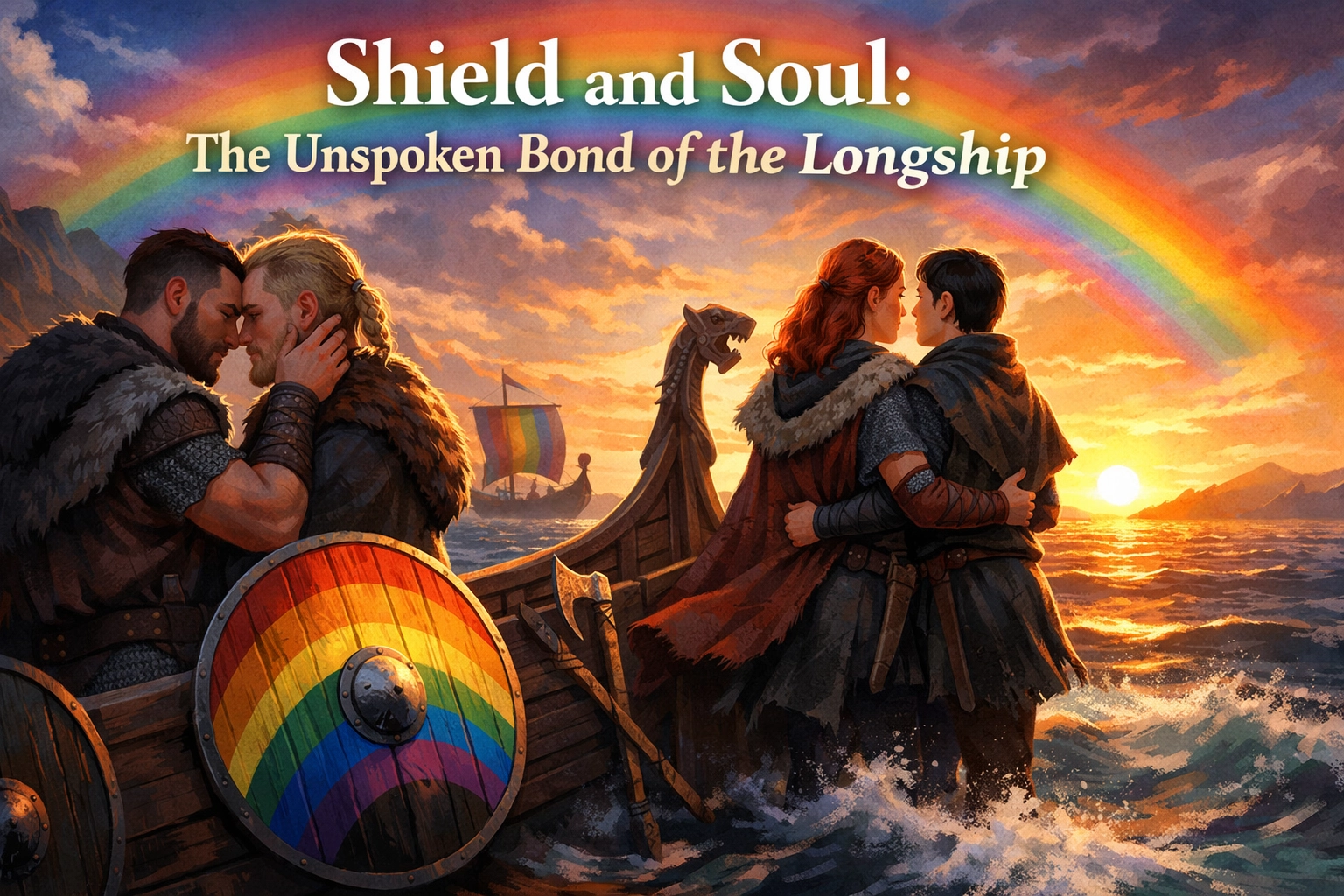
readwithpride.com
The North Sea doesn't forgive weakness. Neither does it judge who you love.
Out there on the longships, with salt spray stinging your face and the horizon stretching endlessly in every direction, the rules of the village held no power. The petty concerns of jarls and their politics, the whispers of wives at the well, the expectations of bloodline and legacy, all of it dissolved into the foam of the wake behind you.
What mattered was the man standing next to you when the storm hit. The one who handed you his last dried fish when your rations ran out. The shield-brother who pulled you back from the edge when a rogue wave tried to claim you for the sea gods.
The Sacred Bond of Shield-Brothers
Vikings had a word for everything that mattered, and vígi was one of the most sacred. Your shield-brother wasn't just a battle companion or a crew mate, he was the other half of your soul in combat. You trained together, fought together, and quite literally trusted him to protect your life with his shield while you protected his.
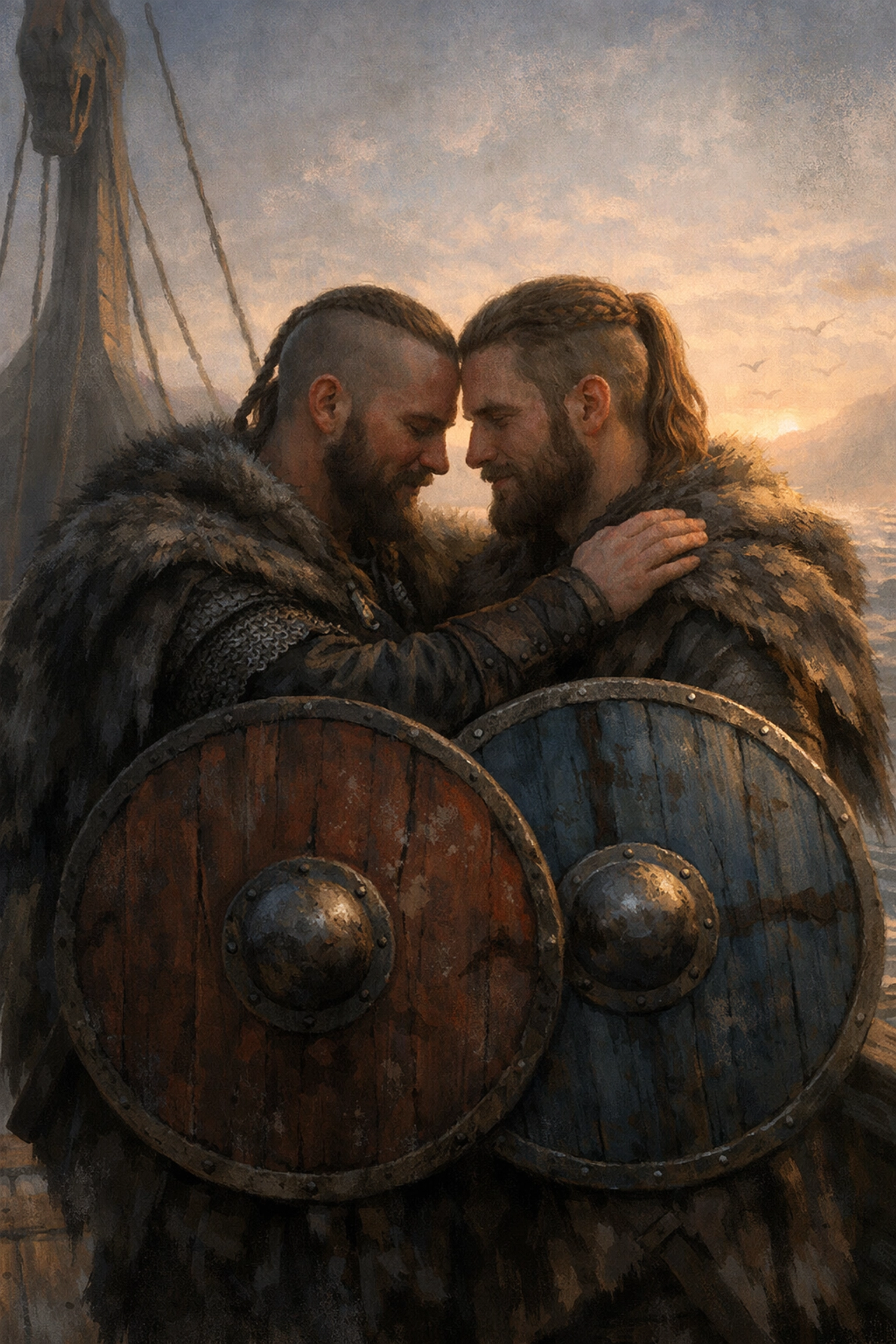
The sagas speak endlessly of these bonds. Óláfr and Tryggvi. Egill and Arinbjörn. Gunnar and Njáll. Names that echo through history not because they conquered kingdoms, but because their loyalty to each other became the stuff of legend. The skalds sang of their deeds, yes, but also of their devotion, a devotion that often ran deeper than blood, deeper than marriage, deeper than anything the Christian missionaries who came later could quite understand or approve of.
On a longship, you lived in closer quarters than most married couples. Seventy feet of oak and pine, maybe thirty warriors packed shoulder to shoulder, sharing body heat on freezing nights, sharing fears when the fog rolled in thick enough to lose the stars. There were no private chambers, no walls to hide behind. You saw every side of a man out there, his courage and his terror, his generosity and his desperation.
And sometimes, in the middle of all that brutal honesty, something else emerged.
When the Northern Lights Dance Overhead
Picture this: It's the third week at sea. The raid on the Frankish coast went better than expected, enough silver to make everyone rich, few enough casualties to call it a victory. The crew is in high spirits, passing around mead horns and boasting about their exploits. The sky above puts on a show, green curtains of light rippling across the darkness like the gods themselves are celebrating.
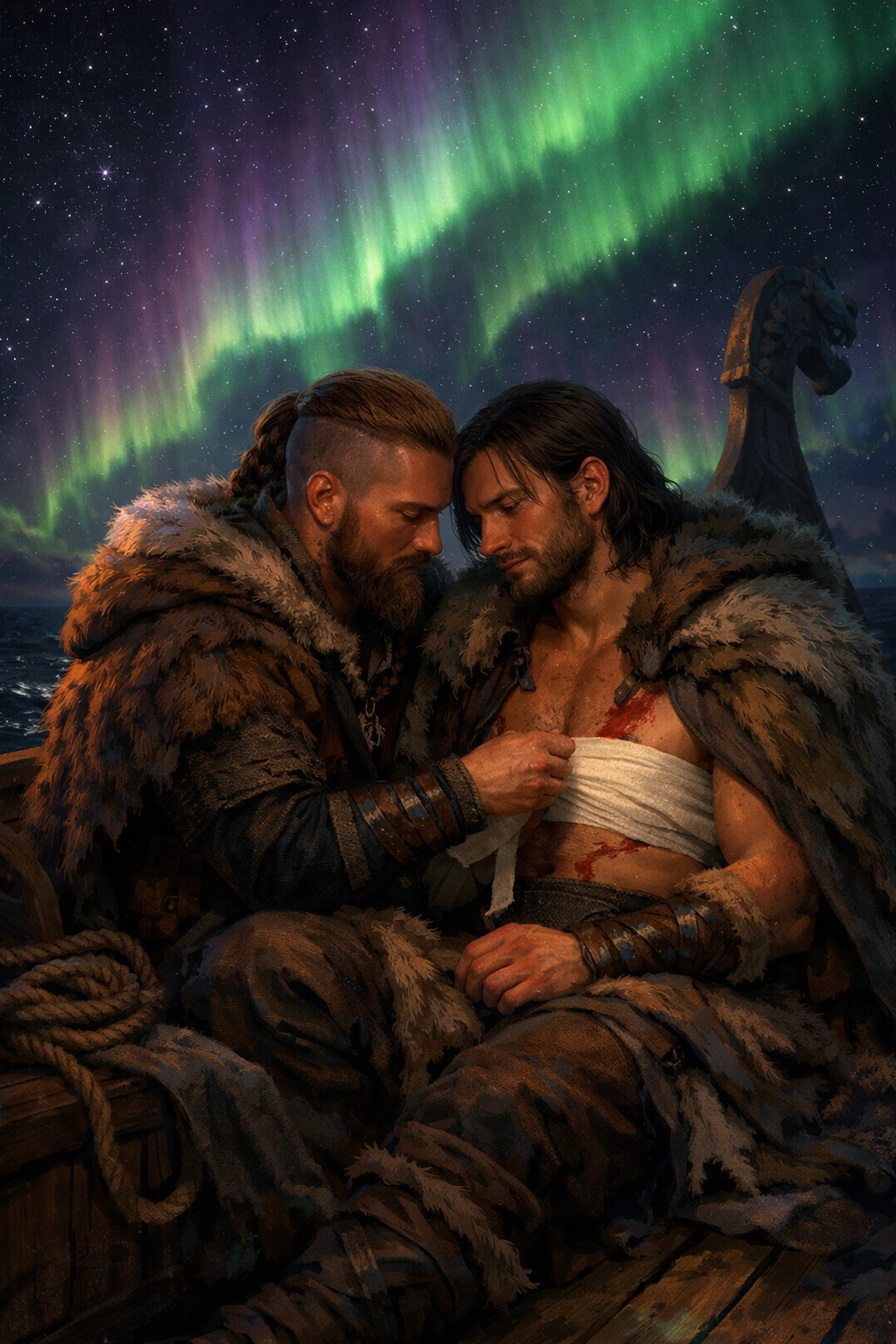
Two warriors sit near the stern, away from the loudest revelry. They've been shield-brothers for five years now. They know each other's fighting style better than they know their own. One has a fresh wound across his ribs where an axe nearly found its mark, would have, if the other hadn't been there to intercept the blow.
The wounded one shivers despite the furs wrapped around his shoulders. Without a word, his shield-brother moves closer, adding his warmth. It's practical. It's necessary. It's also something more, though neither would ever speak it aloud in the light of day.
This is where the gay historical romance hidden in plain sight exists, not in grand declarations or obvious displays, but in the quiet moments between heartbeats. In the hand that lingers on a shoulder. In the willingness to die for someone not because duty demands it, but because a life without them isn't worth living.
The Historical Evidence We Don't Talk About
Here's what the history books gloss over: Viking culture was complicated about same-sex relationships, but not in the way you might think. The concept of ergi (unmanliness) existed, yes, but it had more to do with perceived passivity and failure to fulfill warrior duties than it did with who you loved. A man who showed weakness in battle could be accused of ergi. A man who refused to avenge an insult to his family could be called ergi.
But two warriors who fought side by side, who upheld their honor and showed courage? That was different. The sagas are full of intense male friendships that modern readers recognize immediately for what they probably were. The excessive grief when one dies. The refusal to marry even when pressured by family. The choosing to be buried together rather than with their wives.
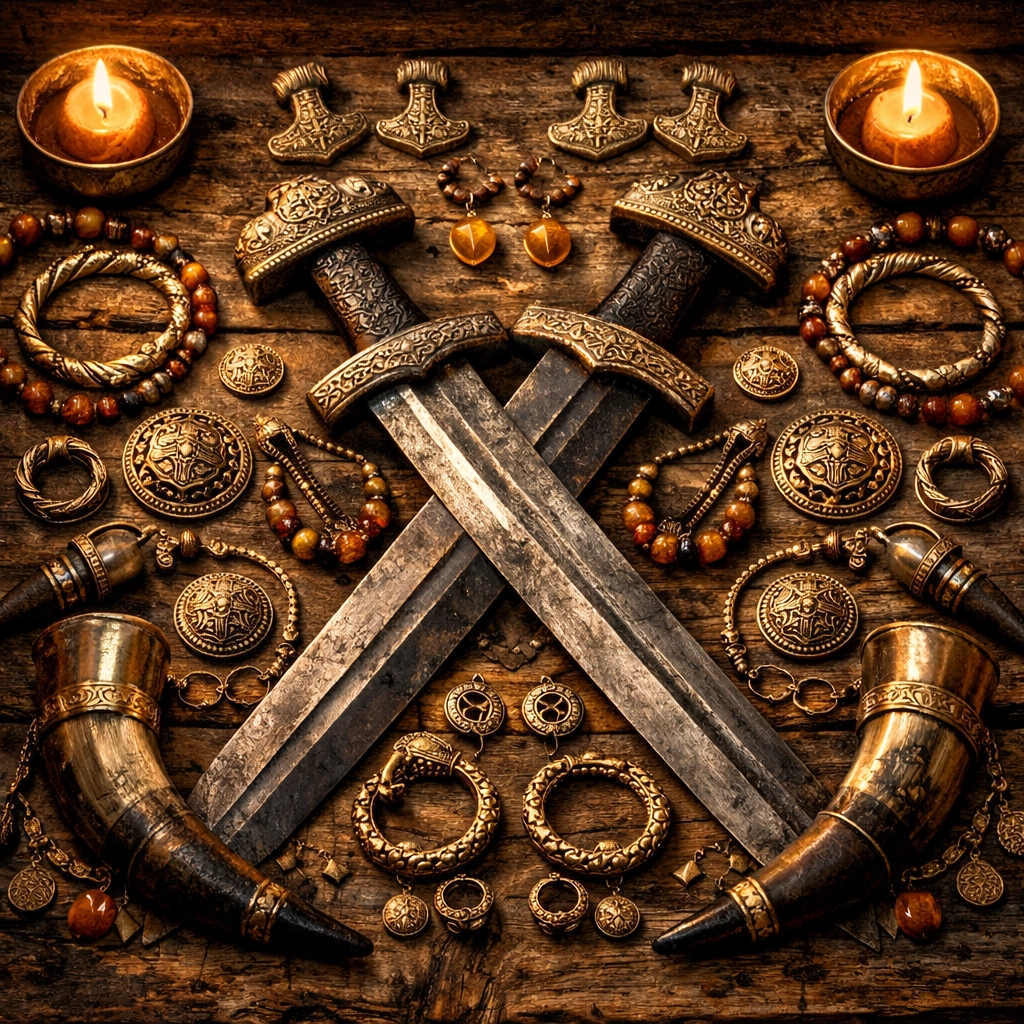
Archaeological evidence backs this up. We've found Viking graves with two male warriors buried together, arms positioned as if embracing, accompanied by matching weapons and jewelry that suggest equal status and deep connection. The archaeologists call them "companion burials" and carefully avoid drawing conclusions, but the LGBTQ+ community knows what we're looking at.
Life Between the Oar Strokes
The thing about being on a longship for weeks or months at a time is that you can't maintain pretense. The masks we wear on land get washed away by the first big wave. You become fundamentally, sometimes uncomfortably, honest about who you are.
Maybe you realize you fight harder when you're protecting him. Maybe you notice how your heart lifts when you see his face after a dangerous raid, alive and grinning with blood in his beard. Maybe the cold night you reach for each other isn't about warmth at all anymore, and maybe neither of you cares to pretend otherwise when you're this far from anyone who would judge.
The longship becomes its own world with its own rules. What happens at sea stays at sea. The crew knows, of course, you can't hide anything from twenty-nine other men living in your lap, but they don't speak of it. Why would they? Half of them have their own unspoken arrangements. The other half don't care as long as you pull your weight when it's time to raid or row.
The Return Home and the Choice
Here's where it gets complicated. The ship always has to return to shore eventually. Back to the village where expectations wait like traps in tall grass. Back to the wives and families and roles everyone expects you to play.
Some shield-brothers go back to their separate lives and pretend the ship was just a ship, the bond just a bond of battle. They marry the women their families chose. They father children. They live honorable lives by Viking standards, and maybe they're even happy in their way.
Others make a different choice. They claim a piece of land far from their birth villages and build a hall together. They tell anyone who asks that they're shield-brothers, which is true, and let people draw whatever conclusions they want. Some even bring their families into it, creating complex households that modern people would struggle to categorize.
And some? Some die young in battle, and maybe that's not entirely an accident. Maybe fighting to the death is easier than going home and living half a life. The sagas present these deaths as glorious, and they are, but they're also tragic in ways the skalds didn't have words for.
Why These Stories Matter Now
We're living in 2026, and you might wonder why we should care about two Viking warriors who may or may not have loved each other a thousand years ago. Here's why: because queer history isn't just rainbow flags and Stonewall. It's not just modern pride parades and legalized marriage.
It's knowing that men have loved men since humans first figured out what love was. It's understanding that our existence isn't some modern aberration or "lifestyle choice", we've always been here, even when we had to be creative about how we expressed it.
The MM romance we write today, the gay love stories we celebrate, they're not creating something new. They're reclaiming something ancient. They're saying the same thing those Viking shield-brothers said without words every time they chose to stand beside each other in battle: You are worth fighting for. You are worth living for. You are worth the risk.
So yeah, maybe two warriors on a longship found comfort in each other's arms during cold northern nights. Maybe they called it friendship and brotherhood because those were the only words they had. Maybe if they'd had access to our modern vocabulary, they would have called it something else.
Or maybe the words don't matter as much as the truth underneath: that love has always found a way, even on a narrow strip of oak surrounded by an unforgiving sea, under the dancing lights of the aurora borealis, with salt spray in your hair and your shield-brother's warmth against your side.
That's the story that deserves to be told. That's the history worth remembering.
Discover more untold LGBTQ+ stories from history at Read with Pride.
Follow us for more queer historical content:
#ReadWithPride #MMRomance #GayHistoricalRomance #LGBTQHistory #VikingRomance #QueerHistory #GayRomanceBooks #HistoricalMMRomance #ShieldBrothers #LGBTQFiction #GayLoveStories #QueerFiction #MMHistoricalRomance #GayBooks #LGBTQBooks #PrideReading #GayNovels #NorseHistory #VikingLove #AncientLGBTQ

Leave a Reply
You must be logged in to post a comment.