

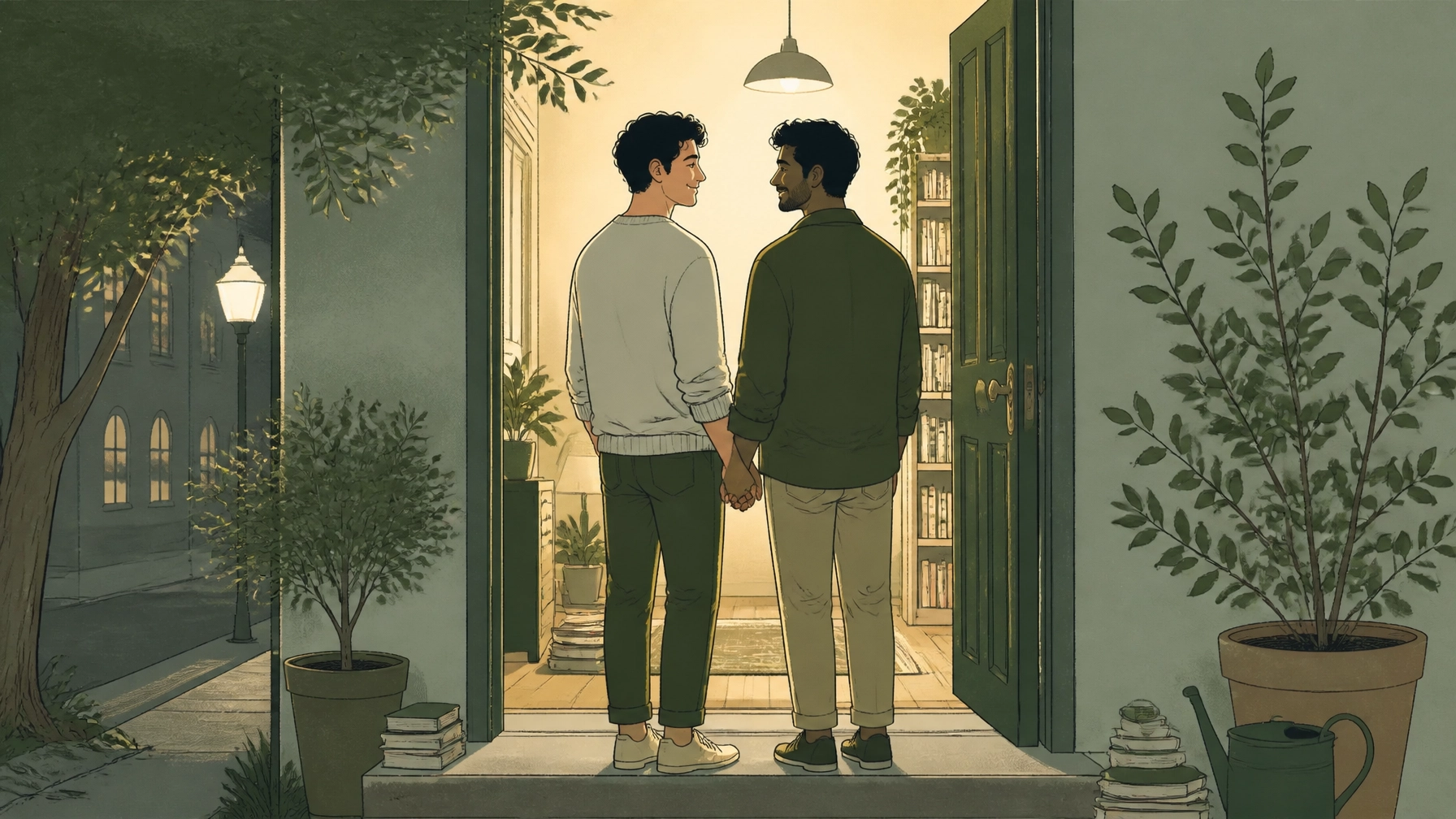
Home is more than an address.
It is the mug you always reach for first. The blanket that belongs to both of you. The key left in the bowl by the door. The quiet understanding that, here, you do not have to explain every part of yourself before you are allowed to rest.
For queer men, home can carry an especially powerful meaning. It may be the first place where a man feels free to speak honestly, invite someone in, display a photograph, or fall asleep beside the person he loves without performing a version of himself for the outside world.
In this next instalment of the Queer Life and Identity series, following The Long Game of Love, we are looking at the homes we make: the rooms, rituals, relationships, and emotional spaces that help us understand belonging.
Home is not always where we started
Many stories about identity begin with leaving.
A man leaves a family home after coming out. He moves to a new city. He rents a room where nobody knows his history. He walks into a queer bar, community centre, or shared flat and discovers that the world is larger than the one he was given.
Leaving can be necessary. It can be frightening, exciting, lonely, and liberating all at once.
But the deeper journey often begins after the door closes behind him.
What happens when he has to decide what kind of life he wants to build? What does safety look like when it is no longer something he is waiting for someone else to provide? How does he create a home that does not simply protect him from the past, but makes room for the future?
These questions sit at the heart of many powerful gay novels and LGBTQ+ fiction. The emotional journey is not only about finding love. It is about finding somewhere that love can live.
Domestic queerness is found in the everyday
“Domestic queerness” may sound like a theoretical phrase, but its meaning is wonderfully ordinary.
It is two men arguing gently about where to put the bookshelves. It is one partner learning how the other takes his tea. It is cooking together after a difficult day. It is deciding which family traditions to keep, which to change, and which to leave behind completely.
Queer domestic life does not have to look dramatic from the outside. In fact, its power often comes from its simplicity.
For generations, mainstream ideas of home and family have been built around narrow expectations: a particular kind of couple, a particular division of labour, a particular path through adulthood. Queer people have always created other ways of living, loving, and caring.
Two men may share a home without reproducing the roles they saw growing up. They may divide chores according to time, ability, preference, or sheer practicality. One may be better at organising bills while the other is the person who remembers birthdays, waters the plants, and notices when something feels wrong.
There is no single correct model. That is part of the freedom.
The home becomes a place where identity is not an argument to be won. It is something lived, adjusted, and understood through daily acts of care.
The sanctuary has to feel real
It is tempting to imagine a queer home as a perfect refuge: soft lighting, open doors, shared laughter, and no fear.
Those spaces matter. But emotionally honest stories understand that sanctuary is rarely perfect.
A home can be safe and still contain tension. It can be loving and still hold old wounds. A man who has spent years hiding may not immediately know how to relax when he is finally accepted. A partner may offer reassurance, but reassurance does not erase every learned fear.
Sometimes the outside world still enters through a phone call, a family visit, a workplace conversation, or the silence that follows an unexpected question.
That is why the most convincing MM romance and gay fiction do not treat home as a magical solution. Instead, they show couples building safety together.
Safety might mean asking before making a decision that affects both partners. It might mean respecting a boundary. It might mean saying, “You do not have to talk about this tonight,” and meaning it.
It might also mean having the difficult conversation instead of allowing resentment to settle into the walls.
A sanctuary is not a place where nothing painful happens. It is a place where pain can be met with honesty, patience, and care.
Chosen family can begin at the kitchen table
For some queer men, biological family is a source of warmth and acceptance. For others, family relationships may be complicated, distant, or unsafe. Many find support through friendships, community networks, neighbours, colleagues, and other LGBTQ+ people who understand the emotional geography of becoming yourself.
This is where chosen family becomes so important.
Chosen family is not simply a group of friends who spend time together. It can become a living network of practical and emotional support. It is the person who drives across town when your car breaks down. The friend who remembers the anniversary of a loss. The couple who make space at their table without asking you to justify your presence.
In fiction, chosen family creates opportunities to show belonging through action. A character may not be ready to say, “These people are my family,” but he can show up every Sunday. He can leave his spare key with them. He can trust them with the parts of his history he has kept hidden.
The emotional shift is often quiet. It happens when a man realises he is no longer waiting to be invited into someone else’s life. He has helped create a life of his own.
Shared space reveals the truth about love
Romance often focuses on the moments that change everything: the first kiss, the confession, the reunion, the grand declaration.
Domestic life asks a different question:
What happens afterwards?
What happens when one man is exhausted and the other is worried? What happens when money is tight, routines clash, or one partner’s past makes the present difficult? What happens when love has to become less about intensity and more about consistency?
This is where a relationship’s emotional architecture becomes visible.
A couple can be deeply passionate and still need to learn how to communicate. They can love each other while disagreeing about privacy, family, work, or the future. They can carry different ideas of what home should mean.
A character-driven gay love story does not need to pretend these differences are easy. It can explore jealousy, fear, possessiveness, grief, and the longing to be chosen without reducing either man to a problem that needs fixing.
The strongest relationships are not built because the characters become flawless. They are built because the characters become more honest.
Making a home can mean reclaiming the past
Not every queer home begins with a blank canvas.
Sometimes a man carries old objects from a life he has outgrown. A photograph he cannot throw away. A chair inherited from someone who never understood him. A recipe connected to family, even when family itself is complicated.
Turning a place into a sanctuary may involve deciding what to keep.
Queer identity is not always a clean break between “before” and “after.” A man can reject shame without rejecting every memory. He can build a loving relationship with another man while still grieving what he did not receive earlier in life.
That complexity gives domestic stories their emotional weight.
A room can hold contradiction. A home can contain both mourning and joy. A relationship can make space for the past without allowing it to control the future.
The act of decorating, repairing, cooking, or simply staying can become a form of self-definition. The characters are saying: this is what we value; this is how we care for each other; this is the life we are choosing.
Belonging is something we practise
Belonging is often described as a feeling, but it is also a practice.
We practise belonging by making room. By listening. By learning the shape of another person’s silence. By letting ourselves be known in small, unguarded ways.
For queer men, that practice can be especially meaningful after years of self-protection. A man may know how to survive long before he learns how to receive love. He may understand secrecy better than openness. He may mistake independence for safety because relying on anyone once felt dangerous.
A home built with another man can challenge those habits gently.
Not every day will be a breakthrough. Sometimes belonging is simply coming back to the same place and finding that the welcome is still there.
That is the quiet promise at the centre of domestic queerness: we are allowed to make lives that fit us. We are allowed to create relationships that do not follow inherited rules. We are allowed to find sanctuary not because the world has become completely safe, but because we have built something truthful within it.
Read stories about men building lives, not just romances
Readers drawn to emotionally immersive MM romance books, heartfelt gay fiction, queer fiction, and character-driven gay love stories often want to know what happens beyond the first declaration of love.
They want the difficult mornings, the shared keys, the changed plans, the repaired trust, and the ordinary moments that make a relationship feel lived-in.
Dick Ferguson’s stories explore men facing identity, vulnerability, desire, fear, and connection with emotional intensity and empathy. If you enjoy emotional MM books, gay romantic fiction, and LGBTQ+ stories that look closely at how people change through love, you can explore the collection at the Dick Ferguson author store on Read with Pride.
Read with pride. Love without limits. And wherever life takes you, may you find: or help create: a place where you can finally be fully yourself.
Follow us on social media
Follow Dick Ferguson and Read with Pride for new gay book recommendations, LGBTQ+ ebooks, MM romance updates, queer fiction, and more stories about reading with pride:
#QueerLifeAndIdentity #ReadWithPride #MMRomance #GayBooks #GayRomance #QueerFiction #GayFiction #LGBTQBooks #MMNovels #GayLoveStories #LGBTQReading #GayAuthors #QueerAuthors #EmotionalMMBooks #ReadingWithPride
Three possible next blog posts in the series
- Queer Life and Identity: The Language We Choose : Names, Pronouns, and the Courage to Be Known
- Queer Life and Identity: When Family Changes Shape : Love, Distance, Reconciliation, and Chosen Kin
- Queer Life and Identity: The Parts We Protect : Privacy, Visibility, and Letting Someone In


Leave a Reply
You must be logged in to post a comment.