

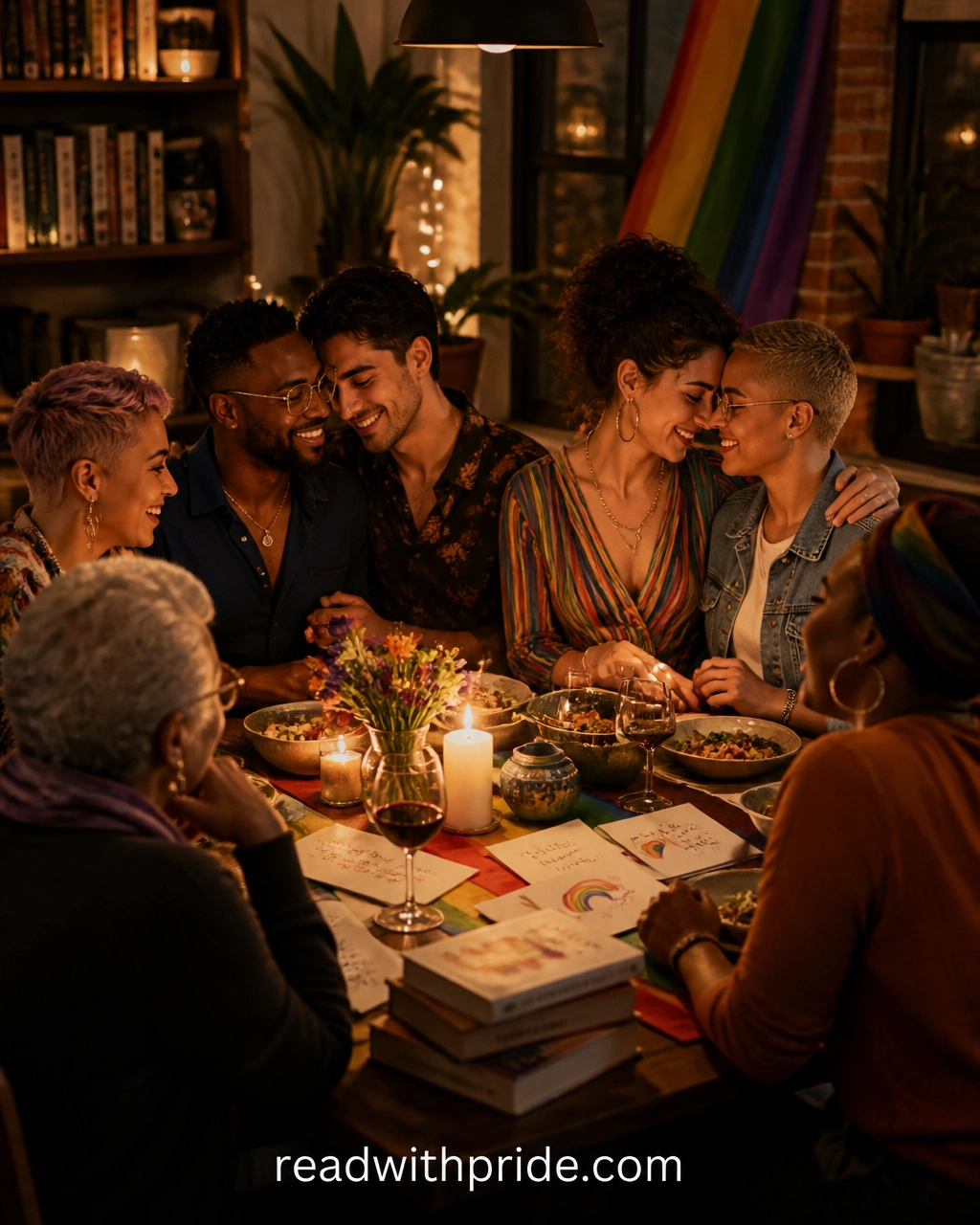
readwithpride.com
There is no single queer timeline: and honestly, that is part of the beauty.
Some people know who they are as teenagers. Others find the language for themselves in their thirties, sixties, or somewhere in between. Some build a life around one devoted partner. Others create expansive networks of lovers, friends, co-parents, and community. Some celebrate weddings, while others mark commitment with a shared home, a chosen-family holiday, or the simple promise to keep showing up.
When we talk about LGBTQ+ relationships and life milestones, it is tempting to reach for a familiar checklist: come out, meet someone, move in together, get married, raise children, live happily ever after. But queer life rarely follows a neat sequence: and it does not need to.
Our milestones can be delayed, repeated, reimagined, or completely invented from scratch. That is not falling behind. That is building a life that actually fits.
Coming out is a process, not a deadline
Coming out is often treated like one dramatic announcement. Cue the deep breath, the emotional family dinner, and the cinematic swell of music.
In real life, it is usually much less tidy.
Coming out may begin privately, with the first moment you recognise an attraction, a feeling, or a part of yourself that does not fit the expectations handed to you. It might involve questioning, experimenting with labels, finding community online, telling one trusted friend, or deciding that a particular person does not need to know yet.
You can come out to yourself before anyone else. You can come out more than once. You can use different words in different spaces. You can also choose not to come out in a situation where doing so could affect your safety, housing, employment, or wellbeing.
There is no prize for doing it quickly.
For many LGBTQ+ people, coming out is less about one grand reveal and more about gradually bringing your life into alignment with your truth. That might mean introducing a partner by their correct name and pronouns, wearing something that feels affirming, joining a queer group, or finally allowing yourself to imagine a future that includes love.
Research on sexual minority identity development supports this idea of coming out as a lifelong and evolving process rather than a single event. The National Library of Medicine’s overview of LGBTQ+ identity development explores how identity milestones can unfold in different sequences and at different ages.

Chosen family is a milestone in its own right
For many queer people, family is not only defined by biology. It is defined by consistency, care, history, and the people who make room for your whole self.
Chosen family might include your best friend who knows every version of your coming-out story, your ex-partner who remains a trusted part of your life, the neighbour who checks in after a difficult week, or the friends who become your holiday table when the traditional one is no longer safe or welcoming.
Forming a chosen family can be one of the most powerful life milestones a queer person experiences. It may happen slowly: a regular Sunday dinner here, an emergency key exchange there, a group chat that never sleeps, and suddenly you realise you have built a support system with its own rituals and language.
These relationships can be especially important during transitions. Moving to a new city, recovering from family rejection, becoming a parent, navigating illness, or ending a long-term partnership can all reveal the strength of the people around us.
Chosen family is not a consolation prize. It is family.
At Read with Pride, our collection includes LGBTQ+ fiction and nonfiction that explores alternative family structures, resilience, parenting, and queer belonging. You can also explore Raising Rainbow Kids: Love, Challenges, and Joy in LGBTQ+ Families Across the Globe, a collection of true stories about LGBTQ+ families around the world.
Queer relationships do not have to follow a borrowed script
Heteronormative culture has a very specific idea of what a successful relationship should look like. Meet, date, move in, marry, buy a house, have children, and never discuss the emotional labour required to make any of it work.
Queer relationships often make the negotiations more visible.
Partners may need to discuss whether they are out at work, how to handle family gatherings, what language feels affirming, and how public affection feels in different environments. They may need to navigate gender expectations, community visibility, religious backgrounds, distance, disability, or the impact of previous relationships.
These conversations are not signs that a relationship is failing. They are signs that two people are paying attention.
For couples, major milestones might include:
- Telling friends or family about the relationship
- Spending your first Pride together
- Creating a shared home
- Meeting one another’s chosen family
- Making decisions about finances and care
- Becoming co-parents or legal parents
- Establishing boundaries around privacy and visibility
- Celebrating an anniversary that feels meaningful to both partners
There is no requirement for every couple to want every milestone. A relationship can be deeply committed without marriage. A shared life can be meaningful without children. A partnership can be real even when it does not photograph well for social media.
Monogamy and polyamory: commitment has more than one shape
Queer communities have long made space for many forms of intimacy, including monogamy, open relationships, relationship anarchy, and polyamory.
A monogamous relationship is not automatically more serious. A polyamorous relationship is not automatically more adventurous or less committed. The important questions are whether everyone involved has informed consent, honest communication, meaningful choice, and room to express their needs.
For some couples, monogamy offers comfort, focus, and a sense of shared devotion. For others, consensual non-monogamy allows them to build relationships that are more expansive. Some people move between relationship structures over time. Others know exactly what works for them and have no interest in changing it.
The milestone is not choosing the “right” structure according to someone else’s rules. The milestone is having the conversation.
That conversation might include:
- What does exclusivity mean to us?
- Are emotional and sexual boundaries different?
- What information do we share with one another?
- How do we handle safer sex and testing?
- What happens when someone’s needs change?
- How do we make sure every partner has genuine agency?
- How do we repair trust after conflict?
The Read with Pride article on polyamory in queer relationships explores love, boundaries, and relationship agreements through an MM romance lens. It is a useful reminder that queer love stories do not need to squeeze every relationship into a single mould.

What MM romance themes can teach us about milestones
One reason MM romance themes resonate so strongly with readers is that they often make emotional milestones impossible to ignore.
In an enemies-to-lovers story, the milestone may be the first moment hostility gives way to curiosity. In a slow burn, it might be the first honest confession after weeks or months of almosts. In a forced-proximity romance, sharing a physical space can push characters into conversations they have avoided for years.
The best MM romance books understand that the kiss is not always the biggest turning point.
Sometimes the real milestone is:
- Saying “I want this” without apologising
- Letting a partner see the fear beneath the confidence
- Introducing someone as your boyfriend, husband, or partner
- Asking for reassurance instead of pretending not to need it
- Returning after conflict with a willingness to repair
- Making room for a partner’s community instead of demanding they choose
- Believing that tenderness can be part of desire
These themes also appear across lesbian romance, bisexual romance, trans romance, and wider queer fiction. The details may differ, but the emotional truth remains familiar: intimacy is built through repeated acts of trust.
Queer romance can offer readers a mirror, a map, or simply two fictional people making spectacularly complicated decisions while looking very good doing it.
Browse Read with Pride’s LGBTQ+ ebooks for gay romance books, MM fiction, lesbian romance, queer fiction, and heartfelt stories about relationships that refuse to be reduced to one formula.
Your timeline is allowed to be gloriously unfinished
You do not have to have everything figured out.
Maybe you are still choosing a label. Maybe you are newly dating after years of hiding. Maybe you are building a chosen family from the ground up. Maybe your partnership is changing shape. Maybe you are single and deeply content. Maybe you are grieving a relationship that mattered, even though it ended.
All of these can be part of a queer life.
Milestones are not proof that you are progressing correctly. They are moments that help you recognise where you have been, what you have survived, and what you are choosing next. Some are loud and public. Others are private enough to fit inside a text message, a held hand, or the first morning you wake up and feel at home in your own life.
So celebrate the milestones that matter to you. Your first queer friendship. Your first safe date. Your first Pride. Your first chosen-family gathering. Your first honest conversation about monogamy or polyamory. Your first quiet, ordinary Tuesday when love feels less like a battle and more like belonging.
That is the promise at the heart of queer relationships: not perfection, not a universal script, but the freedom to create something true.
For more LGBTQ+ reading, relationship reflections, and MM romance books, visit Read with Pride, follow Read with Pride on Instagram, and connect with us on Facebook.
#ReadWithPride #Readwithpride #QueerRelationships #LGBTQRelationships #LifeMilestones #ChosenFamily #MMRomance #QueerFiction #LGBTQFiction #LesbianRomance #LGBTQReading #GayRomanceBooks #Polyamory #QueerJoy

Leave a Reply
You must be logged in to post a comment.