

Good morning, and welcome to another story from the Unexpected Places collection.
There are cities that seem determined to keep growing upward. Concrete rises into glass. Roads knot themselves between towers. Trains pass beneath pavements, carrying thousands of people towards work, obligation, and the next appointment. From street level, the city can feel endless, loud, hurried, and indifferent to the private weather moving through each person who crosses it.
But sometimes, above all that noise, something begins to grow.
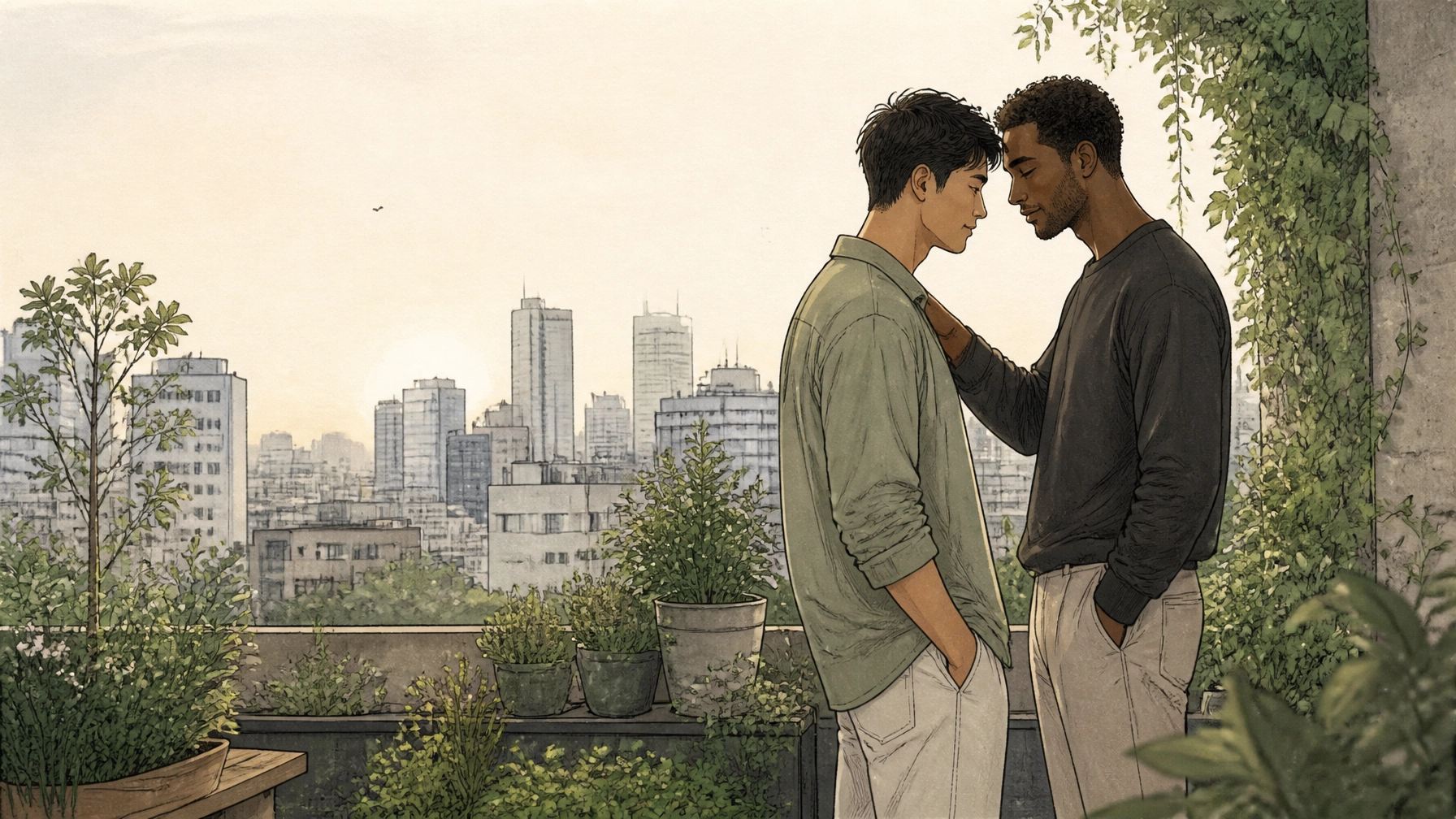
A hidden rooftop garden can be easy to miss. It may sit behind an unmarked metal door, above an office block or an old hotel, its existence known only to a caretaker, a handful of tenants, or the person who first decided that an empty roof deserved a second life. Up there, among rosemary, climbing jasmine, weathered benches, and wind-bent grasses, the city changes.
The traffic becomes a distant current. The towers lose their authority. The sky opens.
And in an emotional MM romance, that kind of place can become far more than a beautiful setting. It can become a refuge. A testing ground. A place where two men discover that being seen is sometimes more frightening: and more necessary: than being loved.
The hidden rooftop garden as an urban sanctuary
The first thing that makes a rooftop garden powerful is its contradiction.
It is green, but surrounded by steel. It is quiet, but suspended above millions of lives. It offers privacy without taking the characters entirely out of the world. The city is still there, visible beyond the railings and between the leaves. Its demands have not vanished. They have simply been held at a distance for a little while.
That tension gives the setting emotional weight.
For one man, the garden might be a place to escape the pressure of his public life. Perhaps he spends his days making decisions that affect other people, presenting confidence when he feels hollow, and moving through meetings with the polished exhaustion of someone who has forgotten how to rest. He comes to the roof early in the morning because it is the only place where nobody asks anything of him.
For the other, the garden might represent a different kind of solitude. He may be carrying a private uncertainty, an old hurt, or the fear that honesty will cost him more than silence ever did. He does not necessarily come looking for romance. He comes because the plants need watering, because the air is cleaner above the traffic, or because he has learned that tending something living can make his own thoughts less severe.
Neither man expects to find the other.
That is part of the magic.
When the first meeting is quiet
A dramatic first encounter has its pleasures, but not every love story needs a collision.
Sometimes, two men meet through a small act of attention.
One notices that the other has left a pair of gardening gloves on the bench. One holds the rooftop door open without asking for thanks. One knows which planter has begun to dry out in the heat. The first conversation might be about basil, a broken tap, or the stubborn tomato plant refusing to take root.
The emotional charge arrives in the spaces between the words.
A glance held a second too long.
A smile that seems to surprise the person wearing it.
The strange relief of discovering that silence does not have to be filled.
In a character-driven MM romance, attraction is often most compelling when it grows alongside recognition. These men do not simply find each other attractive. They begin to understand the shape of each other’s loneliness. They notice the habits built around old fears: the way one apologises before asking for anything, the way the other makes jokes whenever a conversation becomes too honest.
The garden gives them time to notice.
Below them, the city rewards speed. Above it, the plants insist on patience.
A place where vulnerability can take root
The hidden garden becomes important because it allows the men to speak without performing.
Away from colleagues, family expectations, crowded bars, and the unspoken rules of public life, they can begin to ask more difficult questions.
What are you afraid of?
What did you once believe you had to hide?
When did you become so certain that love was meant for other people?
These questions do not need to be answered immediately. In fact, the strongest emotional MM stories understand that trust is not created by one grand confession. It is built through repetition.
A hand resting on the back of a chair.
A message sent after a difficult day.
A remembered detail: no sugar in the coffee, the preference for the shaded side of the roof, the need for a few minutes of quiet before speaking.
The garden becomes an archive of these small choices. Every visit adds another layer to the relationship. A new pot appears beside the bench. A damaged vine is tied gently to a trellis. Two cups are left on the ledge instead of one.
Love is not announced. It is cultivated.
The city below still matters
A sanctuary should not become a complete escape from reality.
The city remains essential to the story because it carries the pressures the men are trying to understand. The rooftop is peaceful partly because the streets below are not. Their private tenderness gains meaning when set against the wider world they must eventually re-enter.
Perhaps one man is afraid of being recognised beside another man. Perhaps the other has spent years being open in theory but guarded in practice, always calculating the emotional cost of being known. Their relationship may be tender, but tenderness does not erase fear. It gives fear something to argue with.
That is where the deeper conflict of an MM romance often lives: not in whether the men feel something, but in whether they believe they are allowed to build a life around it.
The rooftop garden cannot make that decision for them.
It can only give them a place to imagine what choosing each other might look like.
Why unexpected places make memorable love stories
Readers who seek out queer fiction, gay love stories, and emotionally immersive MM romance books often remember the setting as vividly as the characters. A memorable place can become part of the emotional vocabulary of the novel.
The frozen lake remembers a goodbye.
The train platform holds a promise.
The abandoned chapel preserves a moment of shelter.
The rooftop garden becomes a symbol of possibility: proof that life can appear in places designed for something else.
That symbolism matters because queer love has often been forced to create its own spaces. A hidden garden above the city reflects that history without reducing the relationship to struggle. It offers both difficulty and joy. The men are not merely surviving. They are learning how to tend a future.
This is what makes the setting especially resonant for the Emotionally Invested Reader. The appeal is not just the fantasy of meeting someone in a beautiful place. It is the emotional truth beneath the fantasy: sometimes we need somewhere quiet enough to hear what we have been denying ourselves.
When the garden becomes a promise
By the time the men understand what they mean to each other, the garden has changed.
The leaves have thickened. The morning light has shifted with the season. The city may look different from the same height: not because it has become kinder, but because the men no longer face it as they did before.
The garden has taught them that belonging is not always something we find ready-made. Sometimes it is something we build through care.
A space becomes home when we return to it.
A relationship becomes real when we keep choosing it.
And love becomes courageous not when fear disappears, but when two people decide that fear will no longer be the only voice guiding them.
For readers drawn to emotional MM romance in unexpected places, a hidden rooftop garden offers the perfect setting for that journey. It holds secrecy and openness, distance and intimacy, the hard lines of the city and the soft persistence of living things.
Most of all, it reminds us that love does not always arrive where we have been told to look.
Sometimes it waits above the traffic, behind a plain door, beneath a wide morning sky.
Sometimes two men climb the stairs seeking only silence: and find, among the green leaves, the first place where they can finally be heard.
If you enjoy heartfelt gay fiction, lyrical MM contemporary romance, and stories about men confronting fear, identity, and the possibility of connection, you can explore Dick Ferguson’s LGBTQ+ ebooks on Read with Pride. You can also browse Read with Pride’s LGBTQ+ reading community for more queer fiction, gay novels, MM authors, and emotionally rich love stories.
For another reflection on unexpected shelter and intimate queer storytelling, read The Morning We Found Shelter in the Abandoned Chapel. You may also enjoy Healing Out Loud: Imagining a Queer Future Worth Living For.
Three Morning Edition ideas for tomorrow
- The Last Train Before Dawn: How Two Men Turned a Missed Connection into a Second Chance
- The Bookshop Beneath the Station: A Slow-Burn MM Romance About Stories, Silence, and Starting Again
- The Lighthouse Keeper’s Room: When Two Men Found a Future at the Edge of the Sea
Follow us on social media
Follow Dick Ferguson and Read with Pride for new gay book recommendations, queer fiction, emotional MM books, LGBTQ+ reading, and new releases:
#ReadWithPride #ReadingWithPride #MMRomance #GayRomance #QueerFiction #GayFiction #MMNovels #LGBTQPlusFiction #GayLoveStories #EmotionalMMBooks #HeartfeltGayFiction #GayRomanceBooks #MMContemporary #UnexpectedPlaces #QueerAuthors #GayAuthors


Leave a Reply
You must be logged in to post a comment.