

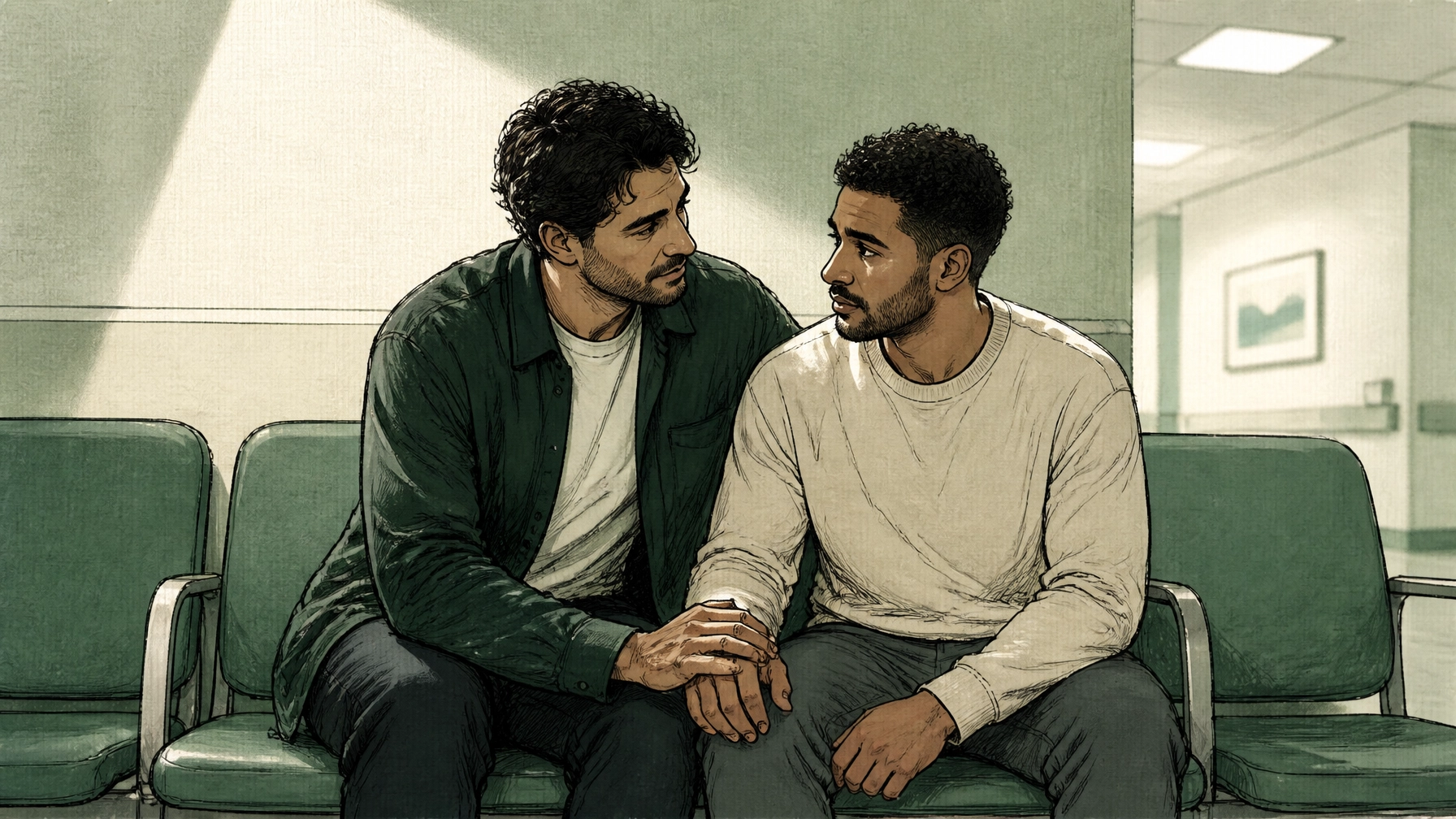
There are places where nobody goes looking for love.
A hospital waiting room is one of them.
People arrive carrying plastic bags, folded coats, unanswered questions, and the particular silence of those trying not to imagine the worst. The lights are too bright. The chairs are designed to discourage comfort. Somewhere beyond the closed doors, machines measure what the people outside cannot control.
And yet, sometimes, in the middle of fear, two strangers look up.
Sometimes one man notices that another has been staring at the same untouched cup of coffee for nearly an hour. Sometimes a borrowed phone charger becomes an introduction. Sometimes the first act of tenderness is as simple as moving a coat so someone can sit down.
This is where a gay love story emotional journey can begin: not with certainty, grand declarations, or the easy confidence of people who believe life will make room for them. It can begin with two men who are frightened, exhausted, and honest enough to stop pretending they are fine.
The hospital waiting room as an unexpected place for intimacy
A waiting room is a threshold. Nobody is quite where they were when they walked in, but nobody knows what comes next.
That uncertainty makes it a powerful setting for character-driven queer fiction. The usual distractions fall away. There is no carefully constructed social identity, no polished first impression, no convenient opportunity to perform confidence. A man may still be wearing his work clothes, but the day has already lost its shape. A relationship may be hidden from family or colleagues, but fear has a way of making secrets feel heavier.
For two men meeting under those conditions, connection is not instant perfection. It is recognition.
One might be waiting for news about his older brother. The other may be keeping vigil beside a father who has never fully understood his son. They may have very different lives, beliefs, and ways of coping. One talks when he is afraid. The other becomes almost silent. One makes jokes because silence reminds him of funerals. The other studies every passing nurse because details are easier to manage than emotion.
Their attraction does not need to erase those differences.
In an emotional MM romance literary story, attraction can exist alongside discomfort, restraint, and doubt. The question is not simply, Will these men fall in love? It is also: What will they have to admit before love becomes possible?
Vulnerability is more than confession
Emotional depth does not come from making characters suffer beautifully. It comes from allowing them to respond in ways that reveal who they are.
In the waiting room, vulnerability may look like a man admitting he has not eaten since morning. It may be the quiet shame of not knowing what to say to a frightened parent. It may be the sudden panic that arrives when a phone rings, even if the caller is only a friend.
For queer characters, vulnerability can carry another layer. A man may wonder whether the stranger beside him will understand the name he uses for his partner. He may hesitate before saying “my boyfriend” or “the man I love.” He may have spent years translating his life into language other people find acceptable.
The emotional movement begins when he decides not to translate.
That moment does not need to be theatrical. He may say it while looking at the floor. He may correct himself halfway through a sentence. He may wait for rejection that never comes.
The other man might simply nod and ask, “How long have you been together?”
That question can become an act of care.
It says: I heard you. I am not making your love strange. You do not have to defend it here.
For emotionally invested MM readers, these small exchanges often carry more weight than a dramatic speech. They make the relationship feel lived-in before it is even established. They show that intimacy is built through attention, not just desire.
Quiet devotion begins with noticing
A hospital waiting room offers very little privacy, which means tenderness has to become almost invisible.
Two men cannot always hold each other. They may not even know whether touch would be welcome. Instead, devotion appears in small adjustments.
One man notices the other is cold and offers his scarf. He remembers which vending-machine drink the other chose. He stands when the other receives bad news, not because he knows how to fix it, but because standing makes it clear he will not leave.
This is the emotional architecture of quiet devotion: not rescue, but presence.
A character-driven relationship understands that care is not the same as control. One man cannot promise that everything will be all right. He cannot take away the diagnosis, rewrite the past, or guarantee that the family waiting behind the hospital doors will respond with grace.
What he can do is stay.
That choice matters because fear often makes people retreat into old habits. A guarded man may decide he is safer alone. A man who has been abandoned may test the other’s patience without meaning to. A man accustomed to being the strong one may resent his own need for comfort.
Love becomes credible when the characters do not overcome these patterns in a single scene. They notice them. They fail. They apologise. They try again.
That is where the gay love story emotional journey gains its emotional truth.
Hope does not have to be loud
In many romances, hope arrives as a turning point: a kiss in the rain, a declaration, a door opened at exactly the right moment.
In a hospital waiting room, hope may be quieter.
It may be the first laugh after several hours of silence. It may be one man sleeping with his head against the other’s shoulder. It may be a message sent the next morning: Did you get home safely?
Hope can be unexpected because it does not depend on good news. The medical outcome may remain uncertain. The family conflict may not be resolved. The men may still carry grief, fear, or complicated histories.
Hope is not the promise that nothing painful will happen.
It is the discovery that pain does not have to be faced alone.
This is one reason emotionally immersive queer fiction can speak so powerfully to readers. It allows love to be affirming without becoming simplistic. It recognises that queer lives contain joy, anger, desire, shame, resilience, and ordinary tenderness at the same time.
A hopeful ending does not need to pretend the world is safe. It can show two men choosing honesty within an unsafe or uncertain world. It can show them making room for one another without demanding that either person become less complicated.
Writing an authentic MM love story in a liminal space
For writers exploring an unexpected-place romance, the setting should do more than provide atmosphere. It should challenge the characters.
The hospital waiting room can strip away routine, but the relationship still needs a life beyond its walls. What happens when the lights are no longer fluorescent? What does each man do with the connection once the immediate crisis has passed? Does he reach out, or convince himself the intimacy belonged only to that night?
These questions create a stronger emotional MM romance literary arc than a simple “they met during a difficult moment” premise.
The setting can also shape the language of the story. Hospital sounds: rubber soles, distant announcements, the hum of machines: can become part of the emotional rhythm. Details such as cold coffee, a cracked phone screen, and the smell of disinfectant can ground the reader in the body of the scene.
But the most important detail is often what remains unsaid.
A man looking at the exit but not leaving.
A hand placed palm-up on the chair between them.
A question asked twice because the first answer was clearly a lie.
These moments invite the reader to participate. They create the charged silence in which trust begins.
For readers who seek the best MM romance with emotional depth, this is the appeal of intimacy built under pressure. The romance is not only about who wants whom. It is about who can bear to be seen, who will remain present, and whether two men can create a place of safety inside a world that offers very little of it.
When hope becomes a place
By morning, the waiting room has changed.
The same chairs are still uncomfortable. The same pale light falls across the floor. The same doors open and close with quiet mechanical certainty.
But the men are different.
Perhaps one has finally slept. Perhaps the other has learned a truth he was afraid to ask. Perhaps they exchange numbers with the awkwardness of people who understand that a phone number is not a promise, but it can be an invitation.
Outside, the day begins without asking whether they are ready.
They step into it together.
That is the heart of an authentic gay love story: not the fantasy that love removes fear, but the possibility that love teaches fear where it can rest. In the most memorable queer fiction, hope is not a distant reward waiting at the end of suffering.
Hope is a place two people make.
Sometimes it is a kitchen. Sometimes it is a train platform. Sometimes it is a hospital waiting room at three in the morning, where two men sit beneath unforgiving lights and discover that being witnessed can feel like the first form of healing.
For more emotionally immersive stories, explore Read with Pride, and discover Dick Ferguson’s MM romance and LGBTQ+ fiction for readers drawn to lyrical prose, complex relationships, and unforgettable emotional journeys.
Three possible next Morning Edition stories
-
The Last Train Home : Where Two Men Turned a Missed Connection into a Second Chance
A character-driven gay love story about grief, timing, and the courage to remain when leaving would be easier. -
The Community Garden : Where Two Men Learned That Care Can Grow Slowly
An emotional MM romance literary exploration of guarded hearts, shared work, and tenderness built through ordinary rituals. -
The Night Ferry : Where Two Men Carried Their Old Lives Across Dark Water
A queer fiction story about reinvention, fear, and the fragile hope of beginning again somewhere neither man expected to belong.
Follow us on social media
Follow Dick Ferguson and Read with Pride for LGBTQ+ ebooks, gay books, MM romance, queer fiction, heartfelt gay fiction, emotional MM books, and new gay releases:
#MMRomance #GayRomance #QueerFiction #GayFiction #LGBTQBooks #MMBooks #GayLoveStory #EmotionalMMRomance #CharacterDrivenFiction #LGBTQRomance #GayLiterature #ReadingWithPride #ReadWithPride #EmotionallyInvestedReaders #EmotionalJourney #LiteraryRomance


Leave a Reply
You must be logged in to post a comment.